Operation
Tires and wheels
Traction
The traction grades, from highest to lowest, are AA, A, B, and C. Those grades represent the tire’s ability to stop on wet pavement as measured under controlled conditions on specified government test surfaces of asphalt and concrete. A tire marked C may have poor traction performance.
Warning!
The traction grade assigned to this tire is based on straight-ahead braking traction tests, and does not include acceleration, cornering, hydroplaning, or peak traction characteristics.
Temperature
The temperature grades are A (the highest), B, and C, representing the tire’s resistance to the generation of heat and its ability to dissipate heat when tested under controlled conditions on a specified indoor laboratory test wheel. Sustained high temperature can cause the material of the tire to degenerate and reduce tire life, and excessive temperature can lead to sudden tire failure. The grade C corresponds to a level of performance which all passenger car tires must meet under the Federal Motor Vehicle Safety Standard No. 109. Grades B and A represent higher levels of performance on the laboratory test wheel than the minimum required by law.
Warning!
The temperature grade for this tire is established for a tire that is properly inflated and not overloaded. Excessive speed, underinflation, or excessive loading, either separately or in combination, can cause excessive heat build-up and possible tire failure.
326
Operation
Tires and wheels
Tire ply material
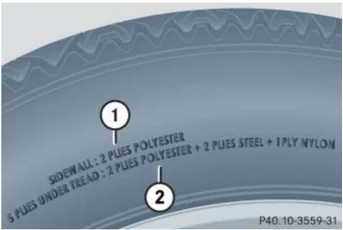
① Plies in sidewall ② Plies under tread
i For illustration purposes only. Actual data on tires is specific to each vehicle and may vary from data shown in above illustration.
This marking tells you about the type of cord and number of plies in the sidewall and under the tread.
Tire and loading terminology
Accessory weight
The combined weight (in excess of those standard items which may be replaced) of automatic transmission, power steering, power brakes, power windows, power seats, radio, and heater, to the extent that these items are available as factory-installed equipment (whether installed or not).
Air pressure
The amount of air inside the tire pressing outward on each square inch of the tire. Air pressure is expressed in pounds per square inch (psi), or kilopascal (kPa) or bars.
Aspect ratio
Dimensional relationship between tire section height and section width expressed in percentage.
Bar
Another metric unit for air pressure. There are 14.5038 pounds per square inch (psi) to 1 bar; there are 100 kilopascals (kPa) to 1 bar.
Bead
The tire bead contains steel wires wrapped by steel cords that hold the tire onto the rim.
Cold tire inflation pressure
Tire inflation pressure when your vehicle has been sitting for at least three hours or driven no more than one mile (1.6 km).
327
Operation
Tires and wheels
Curb weight The weight of a motor vehicle with standard equipment including the maximum capacity of fuel, oil, and coolant, and, if so equipped, air conditioning and additional optional equipment, but without passengers and cargo.
DOT (Department of Transportation) A tire branding symbol which denotes the tire meets requirements of the U.S. Department of Transportation.
GAWR (Gross Axle Weight Rating) The GAWR is the maximum permissible axle weight. The gross vehicle weight on each axle must never exceed the GAWR for the front and rear axle indicated on the certification label located on the driver’s door B-pillar.
GVW (Gross Vehicle Weight) The GVW comprises the weight of the vehicle including fuel, tools, spare wheel, installed accessories, passengers and cargo and, if applicable, trailer tongue load. The GWV must never exceed the GWVR indicated on the certification label located on the driver’s door B-pillar.
GVWR (Gross Vehicle Weight Rating) This is the maximum permissible vehicle weight of the fully loaded vehicle (weight of the vehicle including all options, passengers, fuel, and cargo and, if applicable, trailer tongue load). It is indicated on certification label located on the driver’s door B-pillar.
Kilopascal (kPa) The metric unit for air pressure. There are 6.9 kPa to one psi; another metric unit for air pressure is bars. There are 100 kilopascals (kPa) to one bar.
Maximum load rating The maximum load in kilograms and pounds that can be carried by the tire.
Maximum loaded vehicle weight The sum of curb weight, accessory weight, vehicle capacity weight and production options weight.
Maximum tire inflation pressure This number is the greatest amount of air pressure that should ever be put in the tire under normal driving conditions.
328
Operation
Tires and wheels
Normal occupant weight The number of occupants the vehicle is designed to seat, multiplied by 68 kilograms (150 lbs).
Occupant distribution The distribution of occupants in a vehicle at their designated seating positions.
Production options weight The combined weight of those installed regular production options weighing over 5 lbs (2.3 kilograms) in excess of those standard items which they replace, not previously considered in curb weight or accessory weight, including heavy duty brakes, ride levelers, roof rack, heavy duty battery, and special trim.
PSI (Pounds per square inch) A standard unit of measure for air pressure -> bar, kilopascal (kPa).
Recommended tire inflation pressure Recommended tire inflation pressure listed on placard located on driver’s door B-pillar for normal driving conditions. Provides best handling, tread life and riding comfort.
Rim A metal support for a tire or a tire and tube assembly upon which the tire beads are seated.
Sidewall The portion of a tire between the tread and the bead.
TIN (Tire Identification Number) Unique identifier which facilitates efforts by tire manufacturers to notify purchasers in recall situations or other safety matters concerning tires and gives purchases the means to easily identify such tires. The TIN is comprised of “Manufacturer’s identification mark”, “Tire size”, “Tire type code” and “Date of manufacture”.
Tire load rating Numerical code associated with the maximum load a tire can support.
Tire ply composition and material used This indicates the number of plies or the number of layers of rubber-coated fabric in the tire tread and sidewall. Tire manufacturers also must indicate the ply materials in the tire and sidewall, which include steel, nylon, polyester, and others.
329
Operation
Tires and wheels
Tire speed rating Part of tire designation; indicates the speed range for which a tire is approved.
Traction Force exerted by the vehicle on the road via the tires. The amount of grip provided.
Tread The portion of a tire that comes into contact with the road.
Treadwear indicators Narrow bands, sometimes called “wear bars” that show across the tread of a tire when only 1/6 in (1.6 mm) of tread remains.
Uniform Tire Quality Grading Standards A tire information system that provides consumers with ratings for a tire’s traction, temperature and treadwear. Ratings are determined by tire manufacturers using government testing procedures. The ratings are molded into the sidewall of the tire.
Vehicle capacity weight Rated cargo and luggage load plus 68 kilograms (150 lbs) times the vehicle’s designated seating capacity.
Vehicle maximum load on the tire Load on an individual tire that is determined by distributing to each axle its share of the maximum loaded vehicle weight and dividing it by two.
330
Operation
Tires and wheels
Rotating tires
Warning!
Rotate front and rear wheels only if the tires are of the same dimension.
If your vehicle is equipped with mixed-size tires (different tire dimensions front vs. rear), tire rotation is not possible.
Tire rotation can be performed on vehicles with tires of the same dimension all around. If your vehicle is equipped with tires of the same dimension all around, tires can be rotated, observing a a front-to-rear rotation pattern that will maintain the intended rotation (spinning) direction of the tire (▷ page 307).
In some cases, such as when your vehicle is equipped with mixed-size tires (different tire dimension front vs. rear), tire rotation is not possible.
If applicable to your vehicle's tire configuration, tires can be rotated according to the tire manufacturer's recommended intervals in the tire manufacturer's warranty pamphlet located in your vehicle literature portfolio. If none is available, tires should be rotated every 3000 to 6000 miles (5000 to 10000 km), or sooner if necessary, according to the degree of tire wear. The same rotation (spinning) direction must be maintained (▷ page 307).
Rotate tires before the characteristic tire wear pattern becomes visible (shoulder wear on front tires and tread center wear on rear tires).
Thoroughly clean the mounting face of wheels and brake disks, i.e. the inner side of the wheels/tires, during each rotation. Check for and ensure proper tire inflation pressure.
Warning!
Have the tightening torque checked after changing a wheel. Wheels could become loose if not tightened with a torque of 80 lb-ft (110 Nm).
Only use genuine Mercedes-Benz wheel bolts specified for your vehicle's rims.
For information on wheel change, see the "Practical hints" section (▷ page 377) and (▷ page 399).
331
Operation
Winter driving
Before the onset of winter, have your vehicle winterized at an authorized Mercedes-Benz Center. This service includes:
- Check of anticorrosion and antifreeze concentration.
- Addition of cleaning concentrate to the water of the windshield and headlamp cleaning system. Add MB Concentrate "S" to a premixed windshield washer solvent/antifreeze which is formulated for below freezing temperatures (▷ page 439).
- Battery test. Battery capacity drops with decreasing ambient temperature. A well charged battery helps to make sure that the engine can be started, even at low ambient temperatures.
- Tire change. Mercedes-Benz recommends M+S rated radial-ply tires with a minimum tread depth of approximately $1/6$ in (4 mm) on all four wheels for the winter season.
Winter tires
Always use winter tires at temperatures below 45°F (7°C) and whenever wintry road conditions prevail. Use of winter tires is the only way to achieve the maximum effectiveness of the ABS, ESP, and 4MATIC in winter operation.
For safe handling, make sure that all mounted winter tires are of the same make and have the same tread design.
Warning!
Winter tires with a tread depth under $1/6$ in (4 mm) must be replaced. They are no longer suitable for winter operation.
Always observe the speed rating of the winter tires installed on your vehicle. If the maximum speed for which your tires are rated is below the speed rating of your vehicle, you must place a notice to this effect where it will be seen by the driver. Such notices are available from your tire dealer or from any authorized Mercedes-Benz Center.
Warning!
If you use your spare tire when winter tires are fitted on the other wheels, be aware that the difference in tire characteristics may very well impair turning stability and that overall driving stability may be reduced. Adapt your driving style accordingly.
Have the spare tire replaced with a winter tire at the nearest authorized Mercedes-Benz Center.
332
Operation
Winter driving
Block heater (Canada only)
The engine is equipped with a block heater.
The electrical cable may be installed at an authorized Mercedes-Benz Center.
Snow chains
Snow chains should only be driven on snow-covered roads at speeds not to exceed 30 mph (50 km/h). Remove chains as soon as possible when driving on roads without snow.
When driving with snow chains, you may wish to deactivate the ESP (> page 85) before setting the vehicle in motion. This will improve the vehicle’s traction.
Please observe the following guidelines when using snow chains:
- Use of snow chains is not permissible with all wheel/tire combinations.
- Snow chains should only be used on the rear wheels. Follow the manufacturer’s mounting instructions.
- Only use snow chains that are approved by Mercedes-Benz. Your authorized Mercedes-Benz Center will be glad to advise you on this subject.
- Use of snow chains may be prohibited depending on location. Always check local and state laws before installing snow chains.
! Even on vehicles with all-wheel-drive use snow chains on rear tires only.
Use of snow chains is not permissible with tire sizes:
- 245/40 R17 91W
- T 125/90 R16 98M
- T 125/80 R17 99M
333
Operation
Maintenance
We strongly recommend that you have your vehicle serviced by an authorized Mercedes-Benz Center, in accordance with the Maintenance Booklet at the times called for by the maintenance service indicator display.
Failure to have the vehicle maintained in accordance with the Maintenance Booklet and maintenance service indicator at the designated times/mileage will result in vehicle damage not covered by the Mercedes-Benz Limited Warranty.
The maintenance service indicator will notify you when your next maintenance service is due.
Starting approximately one month before your next maintenance service is due, one of the following messages will appear in the multifunction display while you are driving or when you switch on the ignition (example service A):
Service A in XX Days Service A in XX Miles (Km) A Service due now
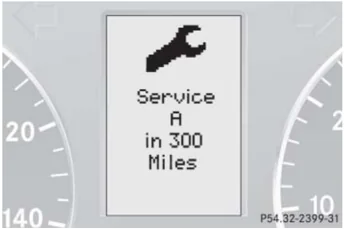
The type of maintenance service due is indicated in the multifunction display:
Basic service (A)
Extended service (B)
Vehicles equipped with FSS (Flexible Service System) only (Canada vehicles): The interval between maintenance services depends on your driving habits. A gentle driving style, moderate engine speeds and the avoidance of short-distance trips will lengthen the interval between services.
334
Operation
Maintenance
Clearing the maintenance service indicator
The maintenance service indicator is automatically cleared
- after ten seconds when you switch on the ignition or when reaching the main- tenance service threshold while driving
- after 30 seconds, once the suggested maintenance service term has passed
You can also clear it yourself.
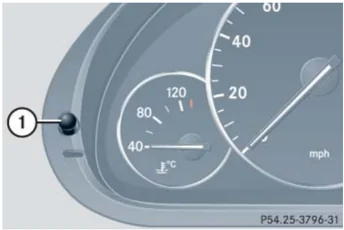
① Reset button
► Press reset button ① on the instrument cluster.
Maintenance service term exceeded
If you have exceeded the suggested maintenance service term, you will see the following message in the multifunction display:
Service A exceeded by XX Days Service A exceeded by XX Miles (Km)
In addition, a signal sounds when the message appears.
Any authorized Mercedes-Benz Center will reset the maintenance service indicator following a completed maintenance service.
Calling up the maintenance service indicator
► Switch on ignition (▷ page 33).
The standard display of the control system appears (▷ page 129).
► Press button [icon] or [icon] on the multifunction steering wheel until the maintenance service indicator with the service symbol [icon] or [icon] and the service deadline appears in the multifunction display.
If the battery is disconnected, the days of disconnection will not be included in the count shown by the maintenance service indicator. To arrive at the true maintenance service deadline, you will need to subtract these days from the days shown in the maintenance service indicator.
Do not confuse the maintenance service indicator with the engine oil level indicator [icon].
335
Operation
Maintenance
Resetting the maintenance service indicator
In the event that the maintenance service on your vehicle is not carried out by an authorized Mercedes-Benz Center, you can have the maintenance service indicator reset. The automotive maintenance facility carrying out the maintenance service will find the information for resetting the maintenance service indicator in the maintenance-relevant information for your vehicle. Such information is available from either your authorized Mercedes-Benz Center or directly from Mercedes-Benz.
i If the maintenance service indicator was inadvertently reset, have an authorized Mercedes-Benz Center correct it.
Only reset if the proper maintenance service has been performed. Resetting the system without performing the proper service as called for by the maintenance service indicator will result in engine damage and/or other vehicle damage not covered by the Mercedes-Benz Limited Warranty.
336
Operation
Vehicle care
▼ Vehicle care
Cleaning and care of the vehicle
Warning!
Many cleaning products can be hazardous. Some are poisonous, others are flammable. Always follow the instructions on the particular container. Always open your vehicle’s doors or windows when cleaning the inside.
Never use fluids or solvents that are not designed for cleaning your vehicle.
While in operation, even while parked, your vehicle is subjected to varying external influences which, if gone unchecked, can attack the paintwork as well as the underbody and cause lasting damage.
Such damage is caused not only by extreme and varying climatic conditions, but also by:
- Air pollution
- Road salt
- Tar
- Gravel and stone chipping
To avoid paint damage, you should immediately remove:
- Grease and oil
- Fuel
- Coolant
- Brake fluid
- Bird droppings
- Insects
- Tree resins, etc.
Frequent washing reduces and/or eliminates the aggressiveness and potency of the above adverse influences.
More frequent washings are necessary to deal with unfavorable conditions:
- near the ocean
- in industrial areas (smoke, exhaust emissions)
- during winter operation
You should check your vehicle from time to time for stone chipping or other damage. Any damage should be repaired as soon as possible to prevent corrosion.
In doing so, do not neglect the underbody of the vehicle. A prerequisite for a thorough check is a washing of the underbody followed by a thorough inspection. Damaged areas need to be re-undercoated.
Your vehicle has been treated at the factory with a wax-base rustproofing in the body cavities which will last for the lifetime of the vehicle. Post-production treatment is neither necessary nor recommended by Mercedes-Benz because of the possibility of incompatibility between materials used in the production process and others applied later.
337
Operation
Vehicle care
We have selected car-care products and compiled recommendations which are specially matched to our vehicles and which always reflect the latest technology. You can obtain Mercedes-Benz approved car-care products at an authorized Mercedes-Benz Center.
Scratches, corrosive deposits, corrosion or damage due to negligent or incorrect care cannot always be removed or repaired with the car-care products recommended here. In such cases it is best to seek aid at an authorized Mercedes-Benz Center.
The following topics deal with the cleaning and care of your vehicle and give important "how-to" information as well as references to Mercedes-Benz approved car-care products.
Power washer
When using a power washer for cleaning the vehicle, always observe the manufacturer's operating instructions.
! Never use a round nozzle to power-wash tires. The intense jet of water can result in damage to the tire.
Always replace a damaged tire.
Always keep the jet of water moving across the surface. Do not aim directly at electrical parts, electrical connectors, seals, or other rubber parts.
Tar stains
Quickly remove tar stains before they dry and become more difficult to remove. A tar remover is recommended.
Paintwork, painted body components
Mercedes-Benz approved Paint Care should be applied when water drops on the paint surface do not "bead up", normally every three to five months, depending on climate and washing detergent used.
Mercedes-Benz approved Paint Cleaner should be applied if the paint surface shows signs of embedded dirt (i.e. loss of gloss).
Do not apply any of these products or wax if your vehicle is parked in the sun or if the hood is still hot.
Use the appropriate MB-Touch-Up Stick for quick and provisional repairs of minor paint damage (i.e. chips from stones, vehicle doors, etc.).
338
Operation
Vehicle care
Engine cleaning
Prior to cleaning the engine compartment, make sure to protect electrical components and connectors from the intrusion of water and cleaning agents.
Corrosion protection, such as MB Anticorrosion Wax, should be applied to the engine compartment after every engine cleaning. Before applying, all control linkage bushings and joints should be lubricated. The poly-V-belt and all pulleys should be protected from any wax.
Vehicle washing
Do not use hot water or wash your vehicle in direct sunlight. Only use a mild car wash detergent, such as Mercedes-Benz approved Car Shampoo.
Thoroughly spray the vehicle with a diffused jet of water. Direct only a very weak spray towards the ventilation intake. Use plenty of water and rinse the sponge and chamois frequently.
Rinse with clear water and thoroughly dry with a chamois. Do not allow cleaning agents to dry on the finish.
Due to the width of the vehicle, fold in exterior rear view mirrors prior to running the vehicle through an automatic car wash to prevent damage to the mirrors.
In the winter, thoroughly remove all traces of road salt as soon as possible.
When washing the underbody, do not forget to clean the inner sides of the wheels.
Ornamental moldings
For regular cleaning and care of very dirty chrome-plated parts, use a chrome cleaner.
Headlamps, tail lamps, side markers, turn signal lenses
Use a mild car wash detergent, such as Mercedes-Benz approved Car Shampoo, with plenty of water.
To prevent scratches, never apply strong force and only use a soft, non-scratchy cloth when cleaning the lenses. Do not attempt to wipe dirty lenses with a dry cloth or sponge.
339
Operation
Vehicle care
Wiper blades
▶ Fold wiper arms forward.
Warning!
For safety reasons, switch off wipers and remove SmartKey from starter switch before cleaning the wiper blades. Otherwise, the wiper motor could suddenly turn on and cause injury.
▶ Clean the wiper blade inserts with a clean cloth and detergent solution.
! Fold the windshield wiper arms back onto the windshield before turning the SmartKey in the starter switch.
Hold on to the wiper when folding the wiper arm back. If released, the force of the impact from the tensioning spring could crack the windshield.
Window cleaning
▶ Fold wiper arms forward.
Warning!
For safety reasons, switch off wipers and remove SmartKey from starter switch before cleaning the windshield. Otherwise, the wiper motor could suddenly turn on and cause injury.
▶ Use a window cleaning solution on all glass surfaces.
An automotive glass cleaner is recommended.
! Fold the windshield wiper arms back onto the windshield before turning the SmartKey in the starter switch.
Hold on to the wiper when folding the wiper arm back. If released, the force of the impact from the tensioning spring could crack the windshield.
Light alloy wheels
Mercedes-Benz approved Wheel Care should be used for regular cleaning of the light alloy wheels.
If possible, clean wheels once a week with Mercedes-Benz approved Wheel Care, using a soft bristle brush and a strong spray of water.
Follow the instructions on container.
ℹ Only use acid-free cleaning materials. Acid may cause corrosion or damage the clear coat.
Instrument cluster
Use a gentle dishwashing detergent or mild detergent for delicate fabrics as a washing solution. Wipe with a cloth moistened in lukewarm solution. Do not use scouring agents.
340
Operation
Vehicle care
Steering wheel and gear selector lever Wipe with a damp cloth and dry thoroughly or clean with Mercedes-Benz approved Leather Care.
Cup holders Use a gentle dishwashing detergent or mild detergent for delicate fabrics as a washing solution. Wipe with a cloth moistened in lukewarm solution. Do not use scouring agents.
Hard plastic trim items Pour Mercedes-Benz approved Interior Care onto soft lint-free cloth and apply with light pressure.
Headliner and rear window shelf Clean with soft bristle brush, or use a dry-shampoo cleaner in case of excessive dirt.
Seat belts The webbing must not be treated with chemical cleaning agents. Only use clear, lukewarm water and soap. Do not dry the webbing at temperatures above 176°F (80°C) or in direct sunlight.
Warning! Do not bleach or dye seat belts as this may severely weaken them. In a crash they may not be able to provide adequate protection.
Upholstery Using aftermarket seat covers or wearing clothing that have the tendency to give off coloring (e.g. when wet, etc.) may cause the upholstery to become permanently discolored. By lining the seats with a proper intermediate cover, contact-discoloration will be prevented.
Leather upholstery Wipe leather upholstery with a damp cloth and dry thoroughly or clean with Mercedes-Benz approved Leather Care. Exercise particular care when cleaning perforated leather as its underside should not become wet.
341
Operation
Vehicle care
Cloth upholstery Clean with soft bristle brush, or use a dry-shampoo cleaner in case of excessive dirt.
MB Tex upholstery Pour Mercedes-Benz approved Interior Care onto soft lint-free cloth and apply with light pressure.
Plastic and rubber parts Do not use oil or wax on these parts.
Wood trims Dampen cloth using water and use damp cloth to clean wood trims in your vehicle. Do not use solvents like tar remover or wheel cleaner nor polishes or waxes as these may be abrasive.
342
Practical hints
What to do if ... Where will I find ...? Unlocking/locking in an emergency Opening/closing in an emergency Replacing SmartKey batteries Replacing bulbs Replacing wiper blades Flat tire Battery Jump starting Towing the vehicle Fuses
343