Technical data
Parts service Warranty coverage Identification labels Layout of poly-V-belt drive Engine Rims and Tires Electrical system Main dimensions Weights Fuels, coolants, lubricants, etc.
417
Technical data
Parts service
The “Technical data” section provides the necessary technical data for your vehicle.
All authorized Mercedes-Benz Centers maintain a stock of genuine Mercedes-Benz parts required for maintenance and repair work. In addition, strategically located parts distribution centers provide quick and reliable parts service.
More than 300000 different parts for Mercedes-Benz models are available.
Genuine Mercedes-Benz parts are subject to stringent quality inspections. Each part has been specifically developed, manufactured or selected for and adapted to Mercedes-Benz vehicles.
Therefore, genuine Mercedes-Benz parts should be installed.
! The use of non-genuine Mercedes-Benz parts and accessories not authorized by Mercedes-Benz could damage the vehicle, which is not covered by the Mercedes-Benz Limited Warranty, or could compromise the vehicle’s durability or safety.
418
Technical data
Warranty coverage
▼ Warranty coverage
Your vehicle is covered under the terms of the warranties printed in the Service and Warranty Information booklet. Your authorized Mercedes-Benz Center will exchange or repair any defective parts originally installed in the vehicle in accordance with the terms of the following warranties:
- New Vehicle Limited Warranty
- Emission System Warranty
- Emission Performance Warranty
- California, Maine, Massachusetts, and Vermont Emission Control Systems Warranty
Replacement parts and accessories are covered by the Mercedes-Benz Parts and Accessories warranties, copies of which are available at any Mercedes-Benz Center.
Loss of Service and Warranty Information Booklet
Should you lose your Service and Warranty Information booklet, have an authorized Mercedes-Benz Center arrange for a replacement. It will be mailed to you.
419
Technical data
Identification labels
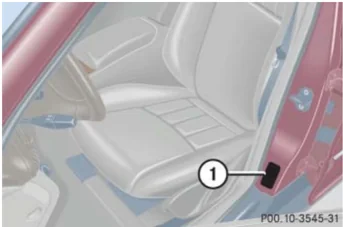
① Certification label (includes Paintwork code)
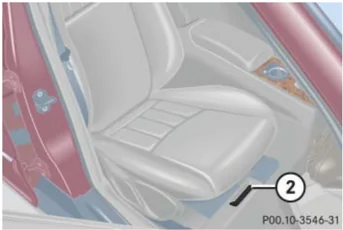
② Vehicle Identification Number (VIN)
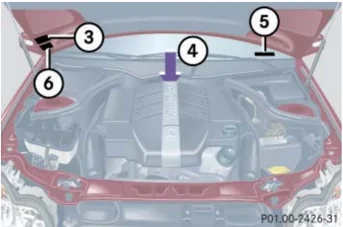
③ Emission control information label, includes both federal and California certification exhaust emission standards ④ Engine number (engraved on engine) ⑤ VIN, visible (lower edge of windshield) ⑥ Vacuum line routing diagram label
When ordering parts, please specify vehicle identification and engine numbers.
420
Technical data
Layout of poly-V-belt drive
▼ Layout of poly-V-belt drive
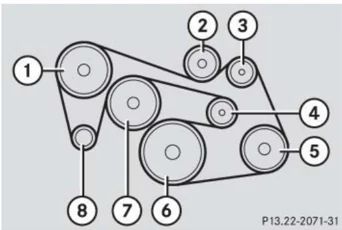
C 230 Kompressor (all models)
P13.22-2071-31
① Power steering pump ② Idler pulley ③ Supercharger ④ Automatic belt tensioner ⑤ Air conditioning compressor ⑥ Crankshaft ⑦ Coolant pump ⑧ Generator (alternator)
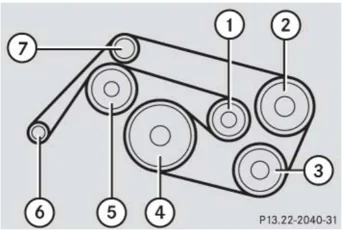
C 240 (all models)/C 320 (all models)
P13.22-2040-31
① Automatic belt tensioner ② Power steering pump ③ Air conditioning compressor ④ Crankshaft ⑤ Coolant pump ⑥ Generator (alternator) ⑦ Idler pulley
421
Technical data
Engine
| Model | C 230 Kompressor (203.040)¹ (Canada only) C 230 Kompressor Sport (203.040)¹ | C 240 (203.061)¹ C 240 4MATIC (203.081)¹ |
|---|---|---|
| Engine | 271 | 112 |
| Mode of operation | 4-stroke engine, gasoline injection | 4-stroke engine, gasoline injection |
| No. of cylinders | 4 | 6 |
| Bore | 3.23 in (82.00 mm) | 3.54 in (89.90 mm) |
| Stroke | 3.35 in (85.00 mm) | 2.68 in (68.20 mm) |
| Total piston displacement | 109.6 cu in (1796 cm³) | 158.5 cu in (2597 cm³) |
| Compression ratio | 8.5:1 | 10.5:1 |
| Output acc. to SAE J 1349 | 189 hp/5800 rpm² (141 kW/5800 rpm) | 168 hp/5500 rpm² (125 kW/5500 rpm) |
| Maximum torque acc. to SAE J 1349 | 192 lb-ft/3500 - 4000 rpm (260 Nm/3500 - 4000 rpm) | 177 lb-ft/4500 rpm (240 Nm/4500 rpm) |
| Maximum engine speed | 6000 rpm | 6200 rpm |
| Firing order | 1-3-4-2 | 1-4-3-6-2-5 |
| Poly-V-belt | 2420 mm | 2380 mm |
¹ The quoted data apply only to the standard vehicle. See an authorized Mercedes-Benz Center for the corresponding data of all special bodies and special equipment.
² Premium fuel required. Performance may vary with fuel octane rating.
422
Technical data
Engine
| Model | C 320 (203.064)¹ (USA only)C 320 Sport (203.064)¹C 320 4MATIC (203.084)¹ |
|---|---|
| Engine | 112 |
| Mode of operation | 4-stroke engine, gasoline injection |
| No. of cylinders | 6 |
| Bore | 3.54 in (89.90 mm) |
| Stroke | 3.31 in (84.00 mm) |
| Total piston displacement | 195.2 cu in (3 199 cm³) |
| Compression ratio | 10:1 |
| Output acc. to SAE J 1349 | 215 hp/5700 rpm²(160 kW/5700 rpm) |
| Maximum torque acc. to SAE J 1349 | 229 lb-ft/3000 - 4600 rpm(310 Nm/3000 - 4600 rpm) |
| Maximum engine speed | 6000 rpm |
| Firing order | 1-4-3-6-2-5 |
| Poly-V-belt | □□□□ mm |
¹ The quoted data apply only to the standard vehicle. See an authorized Mercedes-Benz Center for the corresponding data of all special bodies and special equipment.
² Premium fuel required. Performance may vary with fuel octane rating.
423
Technical data
Rims and Tires
Only use tires and rims which have been specifically developed for your vehicle and tested and approved by Mercedes-Benz. Other tires and rims can have detrimental effects, such as
- poor handling characteristics
- increased noise
- increased fuel consumption
! Moreover, tires and rims not approved by Mercedes-Benz may, under load, exhibit dimensional variations and different tire deformation characteristics that could cause them to come into contact with the vehicle body or axle parts. Damage to the tires or the vehicle may be the result.
i Further information on tires and rims is available at any authorized Mercedes-Benz Center. A placard with the recommended tire inflation pressures is located on the driver's door B-pillar. Some vehicles may have supplemental tire inflation pressure information for driving at high speeds (▷ page 314) or for vehicle loads less than the maximum loaded vehicle condition. If such information is provided, it can be found on the placard located on the inside of the fuel filler flap. The tire inflation pressure should be checked regularly and should only be adjusted on cold tires. Follow tire manufacturer's maintenance recommendation included with vehicle.
424
Technical data
Rims and Tires
Same size tires
425
Technical data
Rims and Tires
Mixed size tires
$^{1}$ Must not be used with snow chains.
426
Technical data
Rims and Tires
Minispare wheel
$^{1}$ Must not be used with snow chains.
427
Technical data
Electrical system
| Model | C 230 Kompressor (all models) | C 240 (all models) C 320 (all models) |
|---|---|---|
| Generator (alternator) | 14 V/120 A | 14 V/120 A |
| Starter motor | 12 V/1.1 kW | 12 V/1.7 kW |
| Battery | 12 V/100 Ah | 12 V/100 Ah |
| Spark plugs | Bosch F 6 MPP 332 | Bosch F 8 DPP 332 NGK PFR 5 R-11 |
| Electrode gap | 0.031 in (0.8 mm) | 0.039 in (1.0 mm) |
| Tightening torque | 18 – 22 lb-ft (25 – 30 Nm) | 15 – 22 lb-ft (20 – 30 Nm) |
428
Technical data
Main dimensions
Main dimensions
| Model | C 230 KompressorC 240C 240 4MATICC 320C 320 4MATIC | C 230 Kompressor SportC 320 Sport |
|---|---|---|
| Overall vehicle length | 178.4 in (4531 mm) | 178.4 in (4531 mm) |
| Overall vehicle width | 68.0 in (1728 mm) | 68.0 in (1728 mm) |
| Overall vehicle height | 56.3 in (1429 mm) | 55.6 in (1413 mm) |
| Wheelbase | 106.9 in (2715 mm) | 106.9 in (2715 mm) |
| Track, front | 59.3 in (1505 mm) | 59.3 in (1505 mm) |
| Track, rear | 58.1 in (1476 mm) | 58.1 in (1476 mm) |
429
Technical data
Weights
430
Technical data
Fuels, coolants, lubricants, etc.
Capacities
Vehicle components and their respective lubricants must match. Therefore only use products tested and approved by Mercedes-Benz.
Please refer to the Factory Approved Service Products pamphlet, or inquire at your Mercedes-Benz Center.
| Component | Model | Capacity | Fuels, coolants, lubricants, etc. |
|---|---|---|---|
| Engine with oil filter | C 230 Kompressor (all models) | 5.8 US qt (5.5 l) | Approved engine oils |
| C 240 | 7.9 US qt (7.5 l) | ||
| C 240 4MATIC | 7.4 US qt (7.0 l) | ||
| C 320 | 7.9 US qt (7.5 l) | ||
| C 320 4MATIC | 7.4 US qt (7.0 l) | ||
| C 320 Sport | 7.9 US qt (7.5 l) | ||
| Automatic transmission | C 230 Kompressor (all models) | 8.5 US qt (8.0 l) | MB Automatic Transmission Fluid |
| C 240 (all models) | 8.5 US qt (8.0 l) | ||
| C 320 (all models) | 8.5 US qt (8.0 l) | ||
| Manual transmission | 1.3 US qt (1.2 l) | MB Manual Transmission Oil | |
| Rear axle | C 230 Kompressor (all models) | 1.2 US qt (1.1 l) | Hypoid gear oil SAE 85 W 90 |
| C 240 (all models) | 1.2 US qt (1.1 l) | ||
| C 320 (all models) | 1.2 US qt (1.1 l) | ||
| Front axle | C 240 4MATIC | 0.5 US qt (0.46 l) | Hypoid gear oil SAE 85 W 90 |
| C 320 4MATIC | |||
| Transfer case | C 240 4MATIC | approx. 0.62 US qt | MB Transfer case fluid |
| C 320 4MATIC | (0.59 l) |
431
Technical data
Fuels, coolants, lubricants, etc.
| Model | Capacity | Fuels, coolants, lubricants, etc. | |
|---|---|---|---|
| Power steering | approx. 1.1 US qt (1.0 l) | MB Power Steering Fluid (Pentosin CHF 11S) | |
| Front wheel hubs | approx. 2.1 oz (60 g) each | High temperature roller bearing grease | |
| Brake system | 0.5 US qt (0.5 l) | MB Brake Fluid (DOT 4+) | |
| Cooling system | C 230 Kompressor (all models) | approx. 5.9 US qt (5.6 l) | MB 325.0 Anticorrosion/antifreeze agent |
| C 240 (all models) | approx. 6.8 US qt (6.4 l) | ||
| C 320 (all models) | approx. 6.8 US qt (6.4 l) | ||
| Fuel tank including a reserve of | 16.4 US gal (62.0 l) | Premium unleaded gasoline: Minimum Posted Octane 91 (Avg. of 96 RON/86 MON) | |
| 2.1 US gal (8.0 l) | Flexible Fuel Vehicle (identified by a label reading Premium gasoline or E85 only! on fuel filler flap): Alternative fuel: Ethanol fuel (E85) | ||
| Air conditioning system | R-134a refrigerant and special PAG lubricant oil (never R-12) | ||
| Windshield washer | 3.2 US qt (3.0 l) | MB Windshield Washer Concentrate¹ | |
| Windshield washer and headlamp cleaning system* | 6.4 US qt (6.0 l) |
¹ Use MB Windshield Washer Concentrate “S” and water for temperatures above freezing point or MB Windshield Washer Concentrate “S” and commercially available premixed windshield washer solvent/antifreeze for temperatures below freezing point. Follow suggested mixing ratios (▷ page 439).
432
Technical data
Fuels, coolants, lubricants, etc.
Engine oils
Engine oils are specifically tested for their suitability in our engines and durability for our service intervals. Therefore, only use approved engine oils and oil filters required for vehicles with Maintenance System (U.S. vehicles) or FSS (Canada vehicles). For a listing of approved engine oils and oil filters, refer to the Factory Approved Service Products pamphlet, or contact an authorized Mercedes-Benz Center.
Using engine oils and oil filters of specification other than those expressly required for the Maintenance System (U.S. vehicles) or FSS (Canada vehicles), or changing of oil and oil filter at change intervals longer than those called for by the Maintenance System (U.S. vehicles) or FSS (Canada Vehicles) will result in engine damage not covered by the Mercedes-Benz Limited Warranty.
Please follow Maintenance System (U.S. vehicles) or FSS (Canada vehicles) recommendations for scheduled oil changes. Failure to do so will result in engine damage not covered by the Mercedes-Benz Limited Warranty.
Engine oil additives
Do not blend oil additives with engine oil. They may damage the engine.
Damage or malfunctions resulting from blending oil additives are not covered by the Mercedes-Benz Limited Warranty.
Air conditioning refrigerant
R-134a (HFC) refrigerant and special PAG lubricating oil are used in the air conditioning system.
Never use R-12 (CFC) or mineral-based lubricating oil. Otherwise damage to the system will occur.
Brake fluid
During vehicle operation, the boiling point of the brake fluid is continuously reduced through the absorption of moisture from the atmosphere. Under extremely strenuous operating conditions, this moisture content can lead to the formation of bubbles in the system, thus reducing the system’s efficiency.
Therefore, the brake fluid must be replaced every two years, preferably in the spring.
Only brake fluid approved by Mercedes-Benz is recommended. Your authorized Mercedes-Benz Center will provide you with additional information.
433
Technical data
Fuels, coolants, lubricants, etc.
Premium unleaded gasoline
! To maintain the engine’s durability and performance, premium unleaded gasoline must be used. If premium unleaded is not available and low octane fuel is used, follow these precautions:
- Have the fuel tank only partially filled with unleaded regular and fill up with premium unleaded as soon as possible.
- Avoid full throttle driving and abrupt acceleration.
- Do not exceed an engine speed of 3000 rpm if the vehicle is loaded with a light load such as two persons and no luggage.
- Do not exceed 2/3 of maximum accelerator pedal position if the vehicle is fully loaded or operating in mountainous terrain.
Fuel requirements
i Flexible Fuel Vehicles (identified by a label reading Premium gasoline or E85 only! on fuel filler flap) are designed to operate on premium unleaded gasoline or ethanol fuel (E85) or any mixture of these two.
For more information, see “Flexible Fuel Vehicles” (\triangleright page 435).
Only use premium unleaded fuel:
- The octane number (posted at the pump) must be 91 min. It is an average of both the Research (R) octane number and the Motor (M) octane number: (R+M)/2. This is also known as the ANTI-KNOCK INDEX.
Unleaded gasoline containing oxygenates such as ethanol, IPA, IBA and TBA can be used provided the ratio of any one of these oxygenates to gasoline does not exceed 10%; MTBE must not exceed 15%.
The ratio of methanol to gasoline must not exceed 3% plus additional cosolvents.
Using mixtures of ethanol and methanol is not allowed. Gasohol, which contains 10% ethanol and 90% unleaded gasoline, can be used.
These blends must also meet all other fuel requirements, such as resistance to spark knock, boiling range, vapor pressure, etc.
434
Technical data
Fuels, coolants, lubricants, etc.
Gasoline additives
A major concern among engine manufacturers is carbon build-up caused by gasoline. Mercedes-Benz recommends only the use of quality gasoline containing additives that prevent the build-up of carbon deposits.
After an extended period of using fuels without such additives, carbon deposits can build up especially on the intake valves and in the combustion area, leading to engine performance problems such as:
- Warm-up hesitation
- Unstable idle
- Knocking/pinging
- Misfire
- Power loss
In areas where carbon deposits may be encountered due to lack of availability of gasolines which contain these additives, Mercedes-Benz recommends the use of additives approved by us for use on Mercedes-Benz vehicles. Refer to Factory Approved Service Products pamphlet for a listing of approved product(s). Follow directions on product label.
Do not blend any specific fuel additives with fuel. This only results in unnecessary cost and may be harmful to engine operation.
Damage or malfunction resulting from poor fuel quality or from blending additional fuel additives other than those tested and approved by us for use on Mercedes-Benz vehicles listed in the Factory Approved Service Products pamphlet are not covered by the Mercedes-Benz Limited Warranty.
Flexible Fuel Vehicles
Flexible Fuel Vehicles are identified by a label reading Premium gasoline or E85 only! on fuel filler flap.
These vehicles are designed to operate on premium unleaded gasoline or ethanol fuel (E85), or on any mixture of these two.
Ethanol fuel (E85) is a mixture of approximately 85% ethanol and 15% unleaded gasoline.
Warning!
Ethanol fuel (E85) and its fumes are highly flammable, poisonous and burn easily. Ethanol fuel can cause serious injuries if ignited or if you come into contact with it or inhale fumes of it. Avoid inhalation of ethanol fumes and skin contact with ethanol. Extinguish all open flames before fueling. Never smoke or create sparks close to ethanol.
435
Technical data
Fuels, coolants, lubricants, etc.
Switching fuels
For best performance and driveability it is recommended to use either one or the other fuel. A refueling pattern that alternates between the two different fuels should be avoided if possible.
When switching fuels, make sure:
- Fuel level is below half full.
- Fuel level is above reserve (fuel reserve warning lamp is not lit).
- Amount of added fuel is more than 5 gallons (20 liters).
- Ignition is off during refill.
- Immediately after refueling engine is started and operated for at least five minutes.
These precautions and recommendations are supposed to prevent any difficulties when starting and operating the engine which otherwise may be experienced before the engine has fully adapted to the different fuel.
If in spite of these recommendations the engine does not perform properly, adding more gasoline [at least 3 gallons (12 liters)] to the fuel may improve the engine behavior.
Cold weather performance
It is possible that starting times will significantly increase at temperatures below 32°F (0°C). At low temperatures the use of a block heater (Canada only) is recommended (see an authorized Mercedes-Benz Center for further information). Rough idling may also be experienced at such temperatures before the engine is fully warmed up.
! E85 fuel is unsuitable for use when ambient temperatures fall below 14°F (-10°C).
Hot weather performance
At ambient temperatures above 95°F (35°C) start times may increase and be accompanied by a rough idle following the start.
Cruising range
E85 fuel contains less energy per gallon than gasoline. To make sure that engine performance with ethanol fuel is similar to that when using gasoline, the engine must burn more ethanol fuel. As a result, it is to be expected that the fuel consumption will increase when using E85 compared to gasoline operation.
Use of E85 may reduce your driving range.
Maintenance
Please inform your Mercedes-Benz Center if you use or have used E85 fuel when your vehicle is delivered for maintenance or repairs.
436
Technical data
Fuels, coolants, lubricants, etc.
Coolants
The engine coolant is a mixture of water and anticorrosion/antifreeze, which provides:
- Corrosion protection
- Freeze protection
- Boiling protection (by increasing the boiling point)
The cooling system was filled at the factory with a coolant providing freeze protection to approximately -22°F (-30°C) and corrosion protection.
If the antifreeze mixture is effective to -22°F (-30°C), the boiling point of the coolant in the pressurized cooling system is reached at approx. 266°F (130°C).
The coolant solution must be used year-round to provide the necessary corrosion protection and increase boil-over protection. Refer to Maintenance Booklet for replacement interval.
Coolant system design and coolant used determine the replacement interval. The replacement interval published in the Maintenance Booklet is only applicable if MB 325.0 anticorrosion/antifreeze solution or other Mercedes-Benz approved products of equal specification (see Factory Approved Service Products pamphlet) are used to renew the coolant concentration or bring it back up to the proper level.
To provide important corrosion protection, the solution must be at least 45% anticorrosion/antifreeze [equivalent to freeze protection to approx. -22°F (-30°C)].
If you use a solution that is more than 55% anticorrosion/antifreeze [freeze protection to approx. -49°F (-45°C)], the engine temperature will increase due to the lower heat transfer capability of the solution. Therefore, do not use more than this amount of anticorrosion/antifreeze.
If the coolant level is low, water and MB 325.0 anticorrosion/antifreeze should be used to bring it up to the proper level (have cooling system checked for signs of leakage). Please make sure the mixture is in accordance with label instructions.
The water in the cooling system must meet minimum requirements, which are usually satisfied by normal drinking water. If you are not sure about the water quality, consult an authorized Mercedes-Benz Center.
437
Technical data
Fuels, coolants, lubricants, etc.
Anticorrosion/antifreeze
Your vehicle contains a number of aluminum parts. The use of aluminum components in motor vehicle engines necessitates that anticorrosion/antifreeze coolant used in such engines be specifically formulated to protect the aluminum parts.
Failure to use such anticorrosion/antifreeze coolant will result in a significantly shortened service life.
Therefore, the following product is strongly recommended for use in your vehicle: Mercedes-Benz 325.0 Anticorrosion/Antifreeze Agent.
Before the start of the winter season (or once a year in hot southern regions), you should have the anticorrosion/antifreeze concentration checked. The coolant is also regularly checked each time you bring your vehicle to an authorized Mercedes-Benz Center for service.
Anticorrosion/antifreeze quantity
Technical data
Fuels, coolants, lubricants, etc.
Windshield washer and headlamp cleaning system*
Both the windshield washer and headlamp cleaning system* are supplied from the windshield washer fluid reservoir.
The washer fluid reservoir has a capacity of approx.:
- 3.2 US qt (3.0 l) in vehicles without headlamp cleaning system*
- 6.4 US qt (6.0 l) in vehicles with headlamp cleaning system*
► Refill the reservoir with MB Windshield Washer Concentrate "S" and water (or concentrate and commercially available premixed windshield washer solvent/antifreeze, depending on ambient temperatures).
Warning! Washer solvent/antifreeze is highly flammable. Do not spill washer solvent/antifreeze on hot engine parts, because it may ignite and burn. You could be seriously burned.
Windshield and headlamp washer fluid mixing ratio
For temperatures above freezing point, use MB Windshield Washer Concentrate "S" and water:
- 1 part "S" to 100 parts water (1.34 fl oz [40 ml] "S" to 1 gallon [4.0 l] water)
For temperatures below freezing point, use MB Windshield Washer Concentrate "S" and commercially available premixed windshield washer solvent/antifreeze:
- 1 part "S" to 100 parts solvent (1.34 fl oz [40 ml] "S" to 1 gallon [4.0 l] solvent)
439
440