Table of Contents
| Section | Page |
|---|---|
| Introduction | 4 |
| Instrument Cluster | 10 |
| Warning lights and chimes | 10 |
| Gauges | 15 |
| Entertainment Systems | 19 |
| AM/FM stereo with CD | 19 |
| AM/FM stereo with in-dash six CD | 22 |
| Auxiliary input jack | 29 |
| Satellite radio information | 32 |
| Climate Controls | 35 |
| Manual heating and air conditioning | 35 |
| Rear window defroster | 37 |
| Lights | 39 |
| Headlamps | 39 |
| Turn signal control | 42 |
| Bulb replacement | 42 |
| Driver Controls | 48 |
| Windshield wiper/washer control | 48 |
| Steering wheel adjustment | 49 |
| Power windows | 50 |
| Mirrors | 55 |
| Speed control | 55 |
| Message center | 62 |
| Locks and Security | 71 |
| Keys | 71 |
| Locks | 71 |
| Anti-theft system | 80 |
1
Table of Contents
Seating and Safety Restraints 85
- Seating 85
- Safety restraints 91
- Airbags 106
- Child restraints 117
Tires, Wheels and Loading 130
- Tire information 130
- Tire inflation 132
- Tire Pressure Monitoring System (TPMS) 144
- Vehicle loading 148
- Trailer towing 154
- Recreational towing 156
Driving 157
- Starting 157
- Brakes 161
- Traction Control™ 163
- Transmission operation 165
Roadside Emergencies 173
- Getting roadside assistance 173
- Hazard flasher switch 175
- Fuel pump shut-off switch 175
- Fuses and relays 176
- Changing tires 181
- Lug nut torque 187
- Jump starting 187
- Wrecker towing 193
Customer Assistance 194
- Reporting safety defects (U.S. only) 200
Cleaning 201
2
Table of Contents
Maintenance and Specifications 209
- Engine compartment 211
- Engine oil 214
- Battery 219
- Engine coolant 221
- Fuel information 227
- Part numbers 241
- Maintenance product specifications and capacities 243
- Engine data 246
Accessories 249
Index 251
All rights reserved. Reproduction by any means, electronic or mechanical including photocopying, recording or by any information storage and retrieval system or translation in whole or part is not permitted without written authorization from Ford Motor Company. Ford may change the contents without notice and without incurring obligation.
Copyright © 2006 Ford Motor Company
3
Introduction
CALIFORNIA Proposition 65 Warning
WARNING: Engine exhaust, some of its constituents, and certain vehicle components contain or emit chemicals known to the State of California to cause cancer and birth defects or other reproductive harm. In addition, certain fluids contained in vehicles and certain products of component wear contain or emit chemicals known to the State of California to cause cancer and birth defects or other reproductive harm.
CONGRATULATIONS
Congratulations on acquiring your new Ford. Please take the time to get well acquainted with your vehicle by reading this handbook. The more you know and understand about your vehicle, the greater the safety and pleasure you will derive from driving it.
For more information on Ford Motor Company and its products visit the following website:
- In the United States: www.ford.com
- In Canada: www.ford.ca
- In Australia: www.ford.com.au
- In Mexico: www.ford.com.mx
Additional owner information is given in separate publications.
This Owner's Guide describes every option and model variant available and therefore some of the items covered may not apply to your particular vehicle. Furthermore, due to printing cycles it may describe options before they are generally available.
Remember to pass on this Owner's Guide when reselling the vehicle. It is an integral part of the vehicle.
Fuel pump shut-off switch: In the event of an accident the safety switch will automatically cut off the fuel supply to the engine. The switch can also be activated through sudden vibration (e.g. collision when parking). To reset the switch, refer to the Fuel pump shut-off switch in the Roadside Emergencies chapter.
4
Introduction
SAFETY AND ENVIRONMENT PROTECTION
Warning symbols in this guide How can you reduce the risk of personal injury to yourself or others? In this guide, answers to such questions are contained in comments highlighted by the warning triangle symbol. These comments should be read and observed.
Warning symbols on your vehicle
When you see this symbol, it is imperative that you consult the relevant section of this guide before touching or attempting adjustment of any kind.
 Protecting the environment
We must all play our part in protecting the environment. Correct vehicle usage and the authorized disposal of waste, cleaning and lubrication materials are significant steps towards this aim. Information in this respect is highlighted in this guide with the tree symbol.

BREAKING-IN YOUR VEHICLE
Your vehicle does not need an extensive break-in. Try not to drive continuously at the same speed for the first 1,000 miles (1,600 km) of new vehicle operation. Vary your speed frequently in order to give the moving parts a chance to break in.
Do not add friction modifier compounds or special break-in oils during the first few thousand miles (kilometers) of operation, since these additives may prevent piston ring seating. See Engine oil in the Maintenance and Specifications chapter for more information on oil usage.
SPECIAL NOTICES
New Vehicle Limited Warranty For a detailed description of what is covered and what is not covered by your vehicle's New Vehicle Limited Warranty, refer to the Warranty Guide that is provided to you along with your Owner's Guide.
5
Introduction
Special instructions
For your added safety, your vehicle is fitted with sophisticated electronic controls.
Please read the section Supplemental restraint system (SRS) in the Seating and Safety Restraints chapter. Failure to follow the specific warnings and instructions could result in personal injury.
Front seat mounted rear-facing child or infant seats should NEVER be placed in front of an active passenger airbag.
Service Data Recording
Service data recorders in your vehicle are capable of collecting and storing diagnostic information about your vehicle. This potentially includes information about the performance or status of various systems and modules in the vehicle, such as engine, throttle, steering or brake systems. In order to properly diagnose and service your vehicle, Ford Motor Company, Ford of Canada, and service and repair facilities may access vehicle diagnostic information through a direct connection to your vehicle when diagnosing or servicing your vehicle.
Event Data Recording
Other modules in your vehicle — event data recorders — are capable of collecting and storing data during a crash or near crash event. The recorded information may assist in the investigation of such an event. The modules may record information about both the vehicle and the occupants, potentially including information such as:
• how various systems in your vehicle were operating;
• whether or not the driver and passenger seatbelts were buckled;
• how far (if at all) the driver was depressing the accelerator and/or the brake pedal;
• how fast the vehicle was traveling; and
• where the driver was positioning the steering wheel.
6
Introduction
To access this information, special equipment must be directly connected to the recording modules. Ford Motor Company and Ford of Canada do not access event data recorder information without obtaining consent, unless pursuant to court order or where required by law enforcement, other government authorities or other third parties acting with lawful authority. Other parties may seek to access the information independently of Ford Motor Company and Ford of Canada.
Cell phone use
The use of Mobile Communications Equipment has become increasingly important in the conduct of business and personal affairs. However, drivers must not compromise their own or others’ safety when using such equipment. Mobile Communications can enhance personal safety and security when appropriately used, particularly in emergency situations. Safety must be paramount when using mobile communications equipment to avoid negating these benefits.
Mobile Communication Equipment includes, but is not limited to cellular phones, pagers, portable email devices, in-vehicle communications systems, telematics devices and portable two-way radios.
A driver’s first responsibility is the safe operation of the vehicle. The most important thing you can do to prevent a crash is to avoid distractions and pay attention to the road. Wait until it is safe to operate Mobile Communications Equipment.
Middle East/North Africa vehicle specific information
For your particular global region, your vehicle may be equipped with features and options that are different from the ones that are described in this Owner’s Guide; therefore, a supplement has been supplied that complements this book. By referring to the pages in the provided supplement, you can properly identify those features, recommendations and specifications that are unique to your vehicle. Refer to this Owner’s Guide for all other required information and warnings.
7
Introduction
These are some of the symbols you may see on your vehicle.
Vehicle Symbol Glossary
Safety Alert See Owner’s Guide
Fasten Safety Belt Airbag - Front
Airbag - Side Child Seat
Child Seat Installation Warning Child Seat Lower Anchor
Child Seat Tether Anchor Brake System
Anti-Lock Brake System Brake Fluid - Non-Petroleum Based
Powertrain Malfunction Speed Control
Master Lighting Switch Hazard Warning Flasher
Fog Lamps-Front Fuse Compartment
Fuel Pump Reset Windshield Wash/Wipe
Windshield Defrost/Demist Rear Window Defrost/Demist
8
Introduction
Vehicle Symbol Glossary
| Symbol | Description | Symbol | Description |
|---|---|---|---|
| Power Windows Front/Rear | Power Window Lockout | ||
| Child Safety Door Lock/Unlock | Interior Luggage Compartment Release Symbol | ||
| Panic Alarm | Engine Oil | ||
| Engine Coolant | Engine Coolant Temperature | ||
| Do Not Open When Hot | Battery | ||
| Avoid Smoking, Flames, or Sparks | Battery Acid | ||
| Explosive Gas | Fan Warning | ||
| Power Steering Fluid | Maintain Correct Fluid Level | ||
| Emission System | Engine Air Filter | ||
| Passenger Compartment Air Filter | Jack | ||
| Check Fuel Cap | Low Tire Pressure Warning |
9
Instrument Cluster
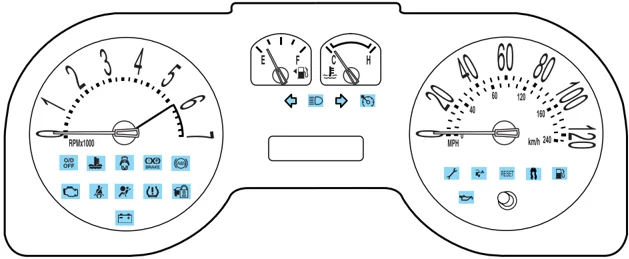
WARNING LIGHTS AND CHIMES
Base instrument cluster
Optional instrument cluster
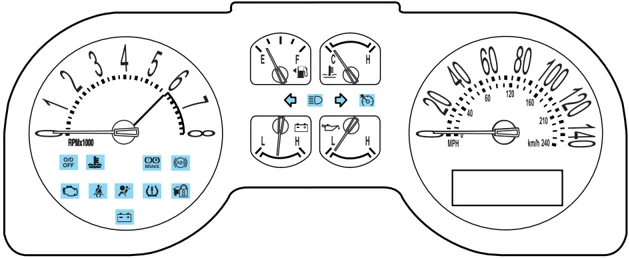
Warning lights and gauges can alert you to a vehicle condition that may become serious enough to cause extensive repairs. A warning light may illuminate when a problem exists with one of your vehicle's functions. Many lights will illuminate when you start your vehicle to make sure the bulbs work. If any light remains on after starting the vehicle, refer to the respective system warning light for additional information.
10
Instrument Cluster
Service Engine Soon: The Service Engine Soon indicator light illuminates when the ignition is first turned to the ON position to check the bulb. Solid illumination after the engine is started indicates the On Board Diagnostics System (OBD-II) has detected a malfunction. Refer to On board diagnostics (OBD-II) in the Maintenance and Specifications chapter. If the light is blinking, engine misfire is occurring which could damage your catalytic converter. Drive in a moderate fashion (avoid heavy acceleration and deceleration) and have your vehicle serviced immediately by your authorized dealer.

Under engine misfire conditions, excessive exhaust temperatures could damage the catalytic converter, the fuel system, interior floor coverings or other vehicle components, possibly causing a fire.
Check fuel cap (if equipped): Illuminates when the fuel cap may not be properly installed. Continued driving with this light on may cause the Service engine soon warning light to come on. Refer to Fuel filler cap in the Maintenance and Specifications chapter.

Brake system warning light: To confirm the brake system warning light is functional, it will momentarily illuminate when the ignition is turned to the ON position when the engine is not running, or in a position between ON and START, or by applying the parking brake when the ignition is turned to the ON position. If the brake system warning light does not illuminate at this time, seek service immediately from your authorized dealer. Illumination after releasing the parking brake indicates low brake fluid level and the brake system should be inspected immediately by your authorized dealer.

Driving a vehicle with the brake system warning light on is dangerous. A significant decrease in braking performance may occur. It will take you longer to stop the vehicle. Have the vehicle checked by your authorized dealer.
11

Instrument Cluster
Anti-lock brake system (if equipped): If the ABS light stays illuminated or continues to flash, a malfunction has been detected, have the system serviced immediately by your authorized dealer. Normal braking is still functional unless the brake warning light also is illuminated.

Airbag readiness: If this light fails to illuminate when ignition is turned to ON, continues to flash or remains on, have the system serviced immediately by your authorized dealer. A chime will also sound when a malfunction in the supplemental restraint system has been detected.

Safety belt: Reminds you to fasten your safety belt. A BeltMinder® chime will also sound to remind you to fasten your safety belt. Refer to the Seating and safety restraints chapter to activate/deactivate the BeltMinder® chime feature.

Charging system: Illuminates when the battery is not charging properly.
Engine oil pressure (if equipped): Illuminates when the oil pressure falls below the normal range, refer to Engine oil in the Maintenance and Specifications chapter.

Engine coolant temperature: Illuminates when the engine coolant temperature is high. Stop the vehicle as soon as possible, switch off the engine and let cool. Refer to Engine coolant in the Maintenance and Specifications chapter.

⚠ Never remove the coolant reservoir cap while the engine is running or hot.
12
Instrument Cluster
Low tire pressure warning: Illuminates when your tire pressure is low. If the light remains ON at start up or while driving, the tire pressure should be checked. Refer to Inflating Your Tires in the Tires, Wheels and Loading chapter. When the ignition is first turned to ON, the light will illuminate for 3 seconds to ensure the bulb is working. If the light does not turn ON, have the system inspected by your authorized dealer. For more information on this system, refer to Understanding Your Tire Pressure Monitoring System in the Tires, Wheels and Loading chapter.

Traction Control™ active: Flashes when the Traction Control™ is active. If the light remains on a malfunction has been detected; have the system serviced immediately, refer to the Driving chapter for more information.

Overdrive off (automatic transmission): Illuminates when the overdrive function of the transmission has been turned off, refer to the Driving chapter. If the light does not illuminate, have the transmission serviced soon, or damage may occur.
O/D OFF

Low fuel (if equipped): Illuminates when the fuel level in the fuel tank is at or near empty (refer to Fuel gauge in this chapter).

Speed control (if equipped): Illuminates when the speed control is engaged. Turns off when the speed control system is disengaged.

Door/Trunk ajar (if equipped): Illuminates when the ignition is in the ON position and any door or trunk is open.

13
Instrument Cluster
Anti-theft system: Flashes when the SecuriLock™ Passive Anti-theft System has been activated.

Electronic throttle control: Illuminates when the engine has defaulted to a 'limp-home' operation. Report the fault to a dealer at the earliest opportunity.

Turn signal: Illuminates when the left or right turn signal or the hazard lights are turned on. If the indicators stay on or flash faster, check for a burned out bulb.

High beams: Illuminates when the high beam headlamps are turned on.

Daytime running lamps (DRL) (if equipped): Illuminates when the Daytime running lamps are on. Also is an indication that the tail lamps, license plate lamps, side marker lamps and parking lamps are switched OFF.

⚠ Always remember to turn on your headlamps at dusk or during inclement weather. The Daytime Running Lamp (DRL) system does not activate the tail lamps and generally may not provide adequate lighting during these conditions. Failure to activate your headlamps under these conditions may result in a collision.
Key-in-ignition warning chime: Sounds when the key is left in the ignition in the OFF/LOCK or ACCESSORY position and the driver's door is opened.
Headlamps on warning chime: Sounds when the headlamps or parking lamps are on, the ignition is off (the key is not in the ignition) and the driver's door is opened.
14
Instrument Cluster
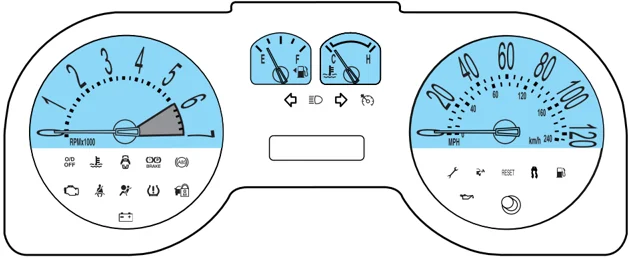
GAUGES
Base instrument cluster gauges
Optional instrument cluster gauges
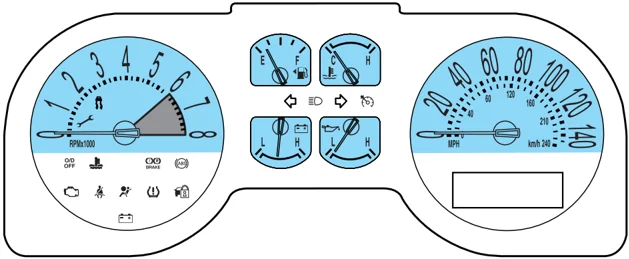
Refer to Message Center (if equipped) in the Driver Controls chapter to select one of six preset colors or one user definable color (MyColor) for the nighttime gauge backlighting.
15
Instrument Cluster
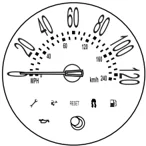
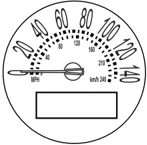
Speedometer: Indicates the current vehicle speed.
• Base instrument cluster

• Optional instrument cluster
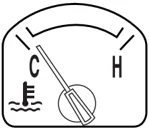
Engine coolant temperature gauge: Indicates engine coolant temperature. At normal operating temperature, the needle will be in the normal range (between “H” and “C”). If it enters the red section, the engine is overheating. Stop the vehicle as soon as safely possible, switch off the engine and let the engine cool.
Never remove the coolant reservoir cap while the engine is running or hot.
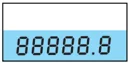
Odometer: Registers the total miles (kilometers) of the vehicle.
• Base instrument cluster
16
Instrument Cluster
- Optional instrument cluster Refer to Message Center in the Driver Controls chapter on how to switch the display from Metric to English.
Trip odometer: Registers the miles (kilometers) of individual journeys.
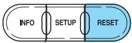
- Base instrument cluster Press and release the RESET button on the cluster to toggle between odometer and trip odometer display. To reset, press and hold for less than 2 seconds.
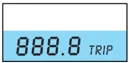
- Optional instrument cluster Press and release the message center INFO button until TRIP mode appears in the display. Press the RESET button to reset.
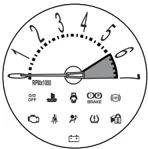
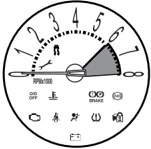
Tachometer: Indicates the engine speed in revolutions per minute. Driving with your tachometer pointer continuously at the top of the scale may damage the engine.
- Base instrument cluster
- Optional instrument cluster
17
Instrument Cluster
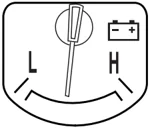
Battery voltage gauge (if equipped): Indicates the battery voltage when the ignition is in the ON position. If the pointer moves and stays outside the normal operating range, have the vehicle’s electrical system checked by your authorized dealer as soon as possible.
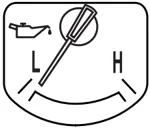
- Engine oil pressure gauge (if equipped): Indicates engine oil pressure. The needle should stay in the normal operating range (between “L” and “H”). If the needle falls below the normal range, stop the vehicle, turn off the engine and check the engine oil level. Add oil if needed. If the oil level is correct (and gauge reads no/low oil pressure ........ ), shut down the engine immediately and contact your authorized dealer for service.
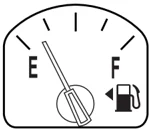
Fuel gauge: Indicates approximately how much fuel is left in the fuel tank (when the ignition is in the ON position). The fuel gauge may vary slightly when the vehicle is in motion or on a grade.
The FUEL icon and arrow indicates which side of the vehicle the fuel filler door is located.
Refer to Filling the tank in the Maintenance and Specifications chapter for more information.
18