Technical Data SL 320
Model
SL320(129 063)¹
Engine
- Mode of operation: 4-stroke engine, gasoline injection
- No. of cylinders: 6
- Bore: 3.54 in (89.90 mm)
- Stroke: 3.30 in (84.00 mm)
- Total piston displacement: 195.2 cu.in (3199 cm³)
- Compression ratio: 10
- Output acc.to SAE J 1349: 228 hp/5600rpm (170 kW/5600 rpm)
- Maximum torque acc. To SAE J 1349: 232 ft-lb/3750 rpm (315 Nm/3750 rpm)
- Maximum engine speed: 6700 rpm
- Firing order: 1-5-3-6-2-4
- Poly – V belts length: 2445mm
Rims - Tires
- Rims (light alloy rims): 8J x 16 H 2
- Wheel offset: 1.3 in (34 mm)
- Summer tires: Radial-ply tires: 255/55 ZR 16
- Winter tires: Radial-ply tires: 255/55 R 16 93 T M+S, 255/55 R 16 93 H M+S
Electrical System
- Generator (alternator): 14 V/100 A
- Starter motor: 12 V/1.7 kW
- Battery: 12 V/100Ah
- Spark plugs: Bosch F 9 DCO, Beru 14 F-9 DUO, Champion C 12 YCC
- Electrode gap: 0.032 in (0.8 mm)
- Tightening: 15-22 ft-lb.(20-30 Nm)
¹ The quoted data apply only to the standard vehicle. See an authorized Mercedes-Benz dealer for the corresponding data of all specials bodies and special Equipment.
128
Technical Data SL 320
Weights
| Item | Value |
|---|---|
| Hardtop load max. | 66 lb (30 kg) |
| Trunk load max. | 220 lb (100 kg) |
see certification tag
Main Dimension
| Item | Value |
|---|---|
| Overall vehicle length | 176.0 in (4470 mm) |
| Overall vehicle width | 71.3 in (1812 mm) |
| Overall height: | |
| Soft top | 51.1 in (1298 mm) |
| Hardtop | 50.7 in (1288 mm) |
| Wheel base | 99.0 in (2515 mm) |
| Track, front | 60.4 in (1535 mm) |
| Track, rear | 60.0 in (1523 mm) |
129
Technical Data SL 500
Model
SL500(129067)¹
Engine
- Mode of operation: 4-stroke engine, gasoline injection
- No. of cylinders: 8
- Bore: 3.80 in (96.50 mm)
- Stroke: 3.35 in (85.00 mm)
- Total piston displacement: 303.5 cu. in (4973 cm³)
- Compression ratio: 10
- Output acc. to SAE J 1349: 315 hp/5600rpm (235 kW/5600 rpm)
- Maximum torque acc. To SAE J 1349: 347 ft-lb/3900 rpm (470 Nm/3900 rpm)
- Maximum engine speed: 6000 rpm
- Firing order: 1-5-4-8-6-3-7-2
- Poly – V belts length: 2523 mm
Transmission
- Downshift points:
- D to 3: 117 mph (189 km/h)
- 3 to 2: 75 mph (121 km/h)
- 2 to B: 44 mph (71 km/h)
Rims - Tires
- Rims (light alloy rims): 8J x 16 H 2
- Wheel offset: 1.3 in (34 mm)
- Summer tires:
- Radial-ply tires: 255/55 ZR 16
- Winter tires:
- Radial-ply tires: 255/55 R 16 93 T M+S
- Radial-ply tires: 255/55 R 1693 H M+S
Electrical System
- Generator (alternator): 14 V/143 A
- Starter motor: 12 V/1.7 kW
- Battery: 12 V/100Ah
- Spark plugs:
- Bosch F 9 DCO
- Beru 14 F-9 DUO
- Champion C 12 YCC
- Electrode gap: 0.8 mm (0.032 in)
- Tightening torque: 15-22 ft-lb.(20-30 Nm)
¹ The quoted data apply only to the standard vehicle. See an authorized Mercedes-Benz dealer for the corresponding data of all specials bodies and special Equipment.
Technical Data SL 500
Weights
see certification tag
| Hardtop load max. | 66 lb (30 kg) |
|---|---|
| Trunk load max. | 220 lb (100 kg) |
Main Dimension
| Overall vehicle length | 176.0 in (4470 mm) |
|---|---|
| Overall vehicle width | 71.3 in (1812 mm) |
| Overall height: | |
| Soft top | 51.1 in (1298 mm) |
| Hardtop | 50.7 in (1288 mm) |
| Wheel base | 99.0 in (2515 mm) |
| Track, front | 60.4 in (1535 mm) |
| Track, rear | 60.0 in (1523 mm) |
131
Technical Data SL 600
Model
SL600(129076)¹
Engine
- Mode of operation: 4-stroke engine, gasoline injection
- No. of cylinders: 12
- Bore: 3.50 in (89.00 mm)
- Stroke: 3.16 in (80.20 mm)
- Total piston displacement: 365.4.in (5987)
- Compression ratio: 10:1
- Output acc.to SAE J 1349: 389 hp/5200rpm (290 kW/5200 rpm)
- Maximum torque acc. To SAE J 1349: 421 ft-lb/3800 rpm (570 Nm/3800 rpm)
- Maximum engine speed: 6000 rpm
- Firing order: 1-12-5-8-3-10-6-7-2-11-4-9
- Poly – V-belts length: 2585mm
Transmission
- Downshift points, D to 3: 117 mph (189 km/h)
- 3 to 2: 75 mph (121 km/h)
- 2 to B: 44 mph (71 km/h)
Rims - Tires
- Rims (light alloy rims): 8J x 16 H 2
- Wheel offset: 1.3 in (34 mm)
- Summer tires: Radial-ply tires: 255/55 ZR 16
- Winter tires: Radial-ply tires: 255/55 R 16 93 T M+S, 255/55 R 1693 H M+S
Electrical System
- Generator (alternator): 14 V/100 A
- Starter motor: 12 V/2.2 kW
- Battery: 12 V/100 Ah
- Spark plugs: Bosch F 9 DCO, Beru 14 F-9 DUO, Champion C 12 YCC
- Electrode gap: 0.8 mm (0.032 in)
- Tightening: 15-22 ft-lb.(20-30 Nm)
¹ The quoted data apply only to the standard vehicle. See an authorized Mercedes-Benz dealer for the corresponding data of all specials bodies and special Equipment.
132
Technical Data SL 600
Weights
see certification tag
| Hardtop load max. | 66 lb (30 kg) |
|---|---|
| Trunk load max. | 220 lb (100 kg) |
Main Dimension
| Overall vehicle length | 178.0 in (4520 mm) |
|---|---|
| Overall vehicle width | 71.3 in (1812 mm) |
| Overall height: | |
| Soft top | 51.3 in (1303 mm) |
| Hardtop | 50.9 in (1293 mm) |
| Wheel base | 99.0 in (2515 mm) |
| Track, front | 60.4 in (1535 mm) |
| Track, rear | 60.0 in (1523 mm) |
133
Fuels, Coolants, Lubricants etc. - Capacities
Vehicle components and their respective lubricants must match
Therefore use only brands tested and recommended by us.
Please refer to the Factory Approved Service Products pamphlet,
or inquire at your authorized Mercedes-Benz dealer.
| Model | Capacity | Fuels, coolants, lubricants etc. | |
|---|---|---|---|
| Engine with oil filter | SL 320 | 7.9 US qt (7.5 l) | Recommended engine oils |
| SL 500 | 8.5 US qt (8.0 l) | ||
| SL 600 | 11.6 US qt (11.0 l) | ||
| Automatic transmission | SL 320 | Initial fill: 7.5 US qt (7.1 l)Fluid change: 6.3 US qt (6.0 l) | Automatic transmission fluid |
| SL 500 | Initial fill: 9.1 US qt (8.6 l) | ||
| SL 600 | Fluid change: 8.1 US qt (7.71 l) | ||
| Rear axle | 1.4 US qt (1.3 l) | Hypoid gear oil SAE 90, 85 W 90 | |
| Hydraulic system for adaptive damping System ( ADS ) | approx. 4.8 US qt ( 4.5 l ) | MB Hydraulic fluid | |
| Power steering | approx. 1.1 US qt ( 1.0 l ) | MB Power steering fluid | |
| Front wheel hubs | approx. 2.1 oz ( 60 g ) each | High temperature roller bearing grease |
| Model | Capacity | Fuels, coolants, lubricants etc. |
|---|---|---|
| Accelerator control linkage | Hydraulic fluid | |
| Brake system | approx. 0.5 US qt ( 0.5 l ) | MB Brake fluid |
| Windshield washer and headlamp cleaning system | approx. 5.3 US qt ( 5.0 l ) | MB Windshield washer concentrate “S” $^{1}$ |
| Cooling system | SL 320 | approx. 12.2 US qt ( 11.5 l ) |
| SL 500 | approx. 16.4 US qt ( 15.5 l ) | |
| SL 600 | approx. 21.1 US qt ( 20.0 l ) | |
| Fuel tank including a reserve of | approx. 21.1 US gal ( 80 l )approx. 2.6 US gal ( 10 l ) | Premium unleaded gasoline: Posted Octane 91 ( Avg. of 96 RON/86 MON ) |
| Air conditioner system | R-134a refrigerant and special Lubricant ( Never R-12 ) |
$^{1}$ Use MB Windshield Washer Concentrate “S” and water for temperatures above freezing or MB Windshield Washer Concentrate “S” and commercially available premixed windshield washer solvent/antifreeze for temperatures below freezing. Follow suggested mixing ratios, see Windshield/Headlamp Washer System in Index.
135
Engine Oils
Engine oils are specifically tested for their suitability in our engines. Therefore, use only engine oils recommended by Mercedes-Benz. Information on recommended brands is available at your authorized Mercedes-Benz dealer.
Please follow maintenance booklet recommendations for scheduled oil changes. Failure to do so could result in engine damage not covered by the Mercedes-Benz Limited Warranty.
Engine Oil Additives
Do not blend oil additives with engine oil. They may be harmful to the engine operation Damage or malfunctions resulting from blending oil additives are not covered by the Mercedes-Benz Limited Warranty.
Air Conditioner Refrigerant
Ozone-friendly HFC-134a refrigerant and special lubricating oil is used in the air conditioner system. Never use R-12 (CFC) or mineral-based lubricating oil, otherwise damage to the system will occur.
Brake fluid
During vehicle operation, the boiling point of the brake fluid is continuously reduced through the absorption of moisture from the atmosphere. Under extremely hard operating conditions, this moisture content can lead to the formation of bubbles in the system thus reducing the system's efficiency. The brake fluid must therefore be replaced every two years, preferably in the spring. It is recommended to use only brake fluid approved by Mercedes- Benz. Your authorized Mercedes- Benz dealer will provide you with additional information.
Premium Unleaded Gasoline
Caution ! To maintain the engine's durability and performance, premium unleaded gasoline must be used. If premium unleaded is not available and low octane fuel is used, follow these precautions:
- have the fuel tank filled only partially with unleaded regular and fill up with premium un- leaded as soon as possible,
- avoid full throttle driving and abrupt acceleration,
- do not exceed an engine speed of 3000 rpm, if the vehicle is loaded with a light load such as two persons and no luggage,
- do not exceed ²/s of maximum accelerator pedal position, if the vehicle is fully loaded or operating in mountainous terrain
136
Fuel Requirements
Use only Premium unleaded meeting ASTM standard D 439:
The octane number (posted at the pump) must be 91min. It is an average of both, the Research (R) octane number and the Motor (M) octane number: [(R + M)/2]. This is also known as ANTI-KNOCK INDEX.
Unleaded gasoline containing oxygenates such as Ethanol, I PA, IBA and TBA can be used provided the ratio of any one of these oxygenates to gasoline does not exceed 10%, MTBE not to exceed 15%.
The ratio of Methanol to gasoline must not exceed 3% plus additional
Using mixtures of Ethanol and Methanol is not allowed. Gasohol, which contains 10% Ethanol and 90% unleaded gasoline, can be used.
These blends must also meet all other fuel requirements such as resistance to spark knock, boiling range, vapor pressure etc..
Gasoline Additives
A major concern among engine manufacturers is carbon build up caused by gasoline. Mercedes- Benz recommends to use only quality gasoline containing additives that prevent the build up of carbon deposits.
After an extended period of using fuels without such additives, carbon deposits can build up especially on the intake valves and in the combustion area, leading to engine performance problems such as:
• warm-up hesitation,
• unstable idle,
• knocking/pinging,
• misfire
• power loss.
Do not blend other specific fuel additives with fuel. They only result in unnecessary cost, and may be harmful to the engine operation. Damage or malfunctions resulting from poor fuel quality or from blending specific fuel additives are not covered by the Mercedes-Benz Limited Warranty.
137
Coolants
The engine coolant is a mixture of water and anticorrosion/anti-freeze, which provides:
- corrosion protection
- freeze protection
- boiling protection (by increasing the boiling point).
The cooling system was filled at the factory with a coolant providing freeze protection to approx. -22 °F (-30 °C) and corrosion protection.
The coolant solution must be used year round to provide the necessary corrosion protection and increase in the boil-over protection. You should have it replaced every 3 years.
To provide the important corrosion protection, the solution must be at least 45% anticorrosion/antifreeze (equals a freeze protection to approx. -22 °F [-30 °C]). If you use a solution that is more than 55% anticorrosion/antifreeze (freeze protection to approx. -49 °F [-45°C]), the engine temperature will increase due to the lower.
heat transfer capability of the solution. Therefore, do not use more than this amount of anti-corrosion/antifreeze.
If the coolant level is low, water and MB anticorrosion/antifreeze should be used to bring it up to the proper level (have cooling system checked for signs of leakage).
The water in the cooling system must meet minimum requirements, which are usually satisfied by normal drinking water. If you are not sure about the water quality, consult your authorized Mercedes-Benz dealer.
Anticorrosion/antifreeze
Your vehicle contains a number of aluminum parts. The use of aluminum components in motor vehicle engines necessitates that anticorrosion/antifreeze coolant used in such engines be specifically formulated to protect the aluminum parts. (Failure to use such anticorrosion/antifreeze coolant will result in a significantly shortened service life.
Therefore the following product is strongly recommended for use in your car: Mercedes-Benz Anticorrosion/Antifreeze Agent.
Before the start of the winter season (or once a year in the hot southern regions), you should have the anticorrosion/antifreeze concentration checked. The coolant is also regularly checked each time you bring your vehicle to your authorized Mercedes-Benz dealer for maintenance service.
Anticorrosion/antifreeze quantity
Consumer Information This has been prepared as required of all manufacturers of passenger cars under Title 49, Code of U.S. Federal Regulations, Part 575 pursuant to the "National Traffic and Motor Vehicle Safety Act of 1966".
Uniform Tire Quality Grading Refer to the tire sidewall for the specific tire grades for the tires with which this vehicle is equipped.
All passenger car tires must conform to federal safety requirements in addition to these grades.
Treadwear The treadwear grade is a comparative rating based on the wear rate of the tire when tested under controlled conditions on a specified government test course. For example, a tire graded 150 would wear one and one-half (11/2) times as well on the government course as a tire graded 100. The relative performance of tires "depends upon the actual conditions of their use, however, and may depart significantly from the norm due to variations in driving habits, service practices and differences in road characteristics and climate.
Traction "A", "B", "C" The traction grades, from highest to lowest, are "A", "B" and "C" and they represent the tire's ability to stop on wet pavement as measured under controlled conditions on specified government test surfaces of asphalt and concrete. A tire marked "C" may have poor traction performance.
Warning! The traction grade assigned to this tire is based on braking (straight ahead) traction tests and does not include cornering (turning) traction.
Temperature "A", "B", "C" The temperature grades are "A" (the highest). "B" and "C", representing the tire's resistance to the generation of heat and its ability .to dissipate heat when tested under controlled conditions on a specified indoor laboratory test wheel. Sustained high temperature can cause the material of the tire to degenerate and reduce tire life, and excessive temperature can lead to sudden tire failure. The grade "C" corresponds to a level of performance which all passenger car tires must meet under the Federal Motor Vehicle Safety Standard No. 109 Grades "B" and "A" represent higher levels of performance on the laboratory test wheel than the minimum required by law.
Warning! The temperature grade for this tire is established for a tire that is properly inflated and not overloaded. Excessive speed, underinflation, or excessive loading, either separately or in combination, can cause excessive heat build up and possible tire failure.
139
Problems with your Vehicle
If you should experience a problem with your vehicle, particularly one that you believe may affect its safe operation, we urge you to immediately contact your authorized Mercedes-Benz dealer to have the problem diagnosed and corrected if required. If the matter is not handled to your satisfaction, please discuss the problem with the dealership management, or if necessary contact the Owner Service Manager at the Mercedes-Benz Regional Office nearest you (see Owner's Service and Warranty Information booklet for addresses). You may also write directly to us at the following addresses:
In the U.S.A.: Customer Assistance Center Mercedes-Benz of North America Inc. One Mercedes Drive Montvale, NJ 07645-0350
In Canada: Owner Service Department Mercedes-Benz Canada Inc. 849 Eglinton Avenue East Toronto, Ontario, M4G 2L5
140
For the U.S.A. only. The following text is published as required of manufacturers under Title 49, Code of U.S. Federal Regulations, Part 575 pursuant to the "National Traffic and Motor Vehicle Safety Act of 1966".
Reporting Safety Defects
If you believe that your vehicle has a defect which could cause a crash or could cause injury or death, you should immediately inform the National Highway Traffic Safety Administration (NHTSA) in addition to notifying Mercedes-Benz of North America Inc..
If NHTSA receives similar complaints, it may open an investigation, and if it finds that a safety defect exists in a group of vehicles, it may order a recall and remedy campaign. However, NHTSA cannot become involved in individual problems between you, your dealer, or Mercedes- Benz of North America Inc..
To contact NHTSA, you may either call the Auto Safety Hotline toll-free at 1-800- 424-9393 (or 366-0123 in Washington, D.C. area) or write to: NHTSA, U.S. Department of Transportation, Washington, D.C. 20590. You can also obtain other information about motor vehicle safety from the Hotline.
141
142
Index
143
ABS 77, 79, 88 Acceleration slip control (ASR) 89 Adaptive damping system (ADS) 91 ADS 91, 136 Air conditioner refrigerant 138 Airbag 45 Alarm system 33 Antenna 64-65, 72, 116 Anti-theft alarm system 33 Anticorrosion/antifreeze 93, 97,137,140 Antilock brake system (ABS) 88 Armrest 39 Ashtray 123 ASR 87, 89, 93 Automatic climate control 22 Automatic transmission 75 Automatic transmission fluid level, checking 99
Battery 107 Battery not being charged Charge indicator lamp 15,82 Brake fluid 17,87,114,137-138 Brake pads worn Brake pad wear indicator lamp 87 Brake warning lamp Brake fluid low 87 Brake warning lamp test 87 Brakes 16,18,74,76-79,81,89
Capacities: Fuels, coolants, lubricants etc. 136 Catalytic converter 14 Cellular telephone 72 Central locking system 29 Check regularly and before a long trip 148 Child restraint 43, 47, 49 Cleaning and care of the vehicle 114 Clock, setting 56 Combination switch 52 Consumer information 141 Coolant level low Adding coolant 97 Low engine coolant level warning lamp 85 Coolant level, checking 97 Coolant temperature gauge 84 -85 Coolants 140 Cruise control 80
144
Display illumination 56 Drinking and driving 74 Driving instructions 16 Driving off 74
Electronic Traction System (ETS) 89 Emergency tensioning retractor (ETR) 44 Emission control 93 Engine malfunction "CHECK ENGINE" malfunction indicator lamp 93 Engine oil consumption 83 Engine oil level low Low engine oil level warning lamp 82 Engine oil level, checking 98 Engine oil pressure gauge 15, 82 Engine oils 134, 136 Engine speed limit Overrevving 77, 79 Exterior lamp failure indicator lamp 86 Exterior lamp switch 51
First aid kit 100 Fuel Fuel requirements 139 Gasoline additives 138 - 139 Premium unleaded gasoline 14, 137-138 Fuel consumption gauge 83 Fuel filler flap, manual release 123 Fuel reserve warning lamp 84 Fuses 108 Hardtop 63, 122 Headlights 51 Heated seats 38 Hood 96
Identification plates 128 Indicator lamp symbols 13 Instrument cluster 12 Interior central locking system 32 Interior lighting 59 Jump starting 111 Keys, vehicle 26 Lamps, exterior Fog lamps 51 Headlamps 51, 86, 109 High mounted stop lamp 86 License plate lamp 51, 111 Taillamps 51, 110, 115 Layout of poly-V-belt drive 125 Lighter 58 Low engine oil Level warning lamp 83
145
Maintenance 4, 8 Memory 35 Mirrors, adjusting 54 Orthopedic seat backrest 37 Outside temperature indicator 84 Parking brake 15-18, 63, 65, 67 - 68, 74 -79, 87, 89, 99, 101, 103, 111 Power seats 34 Power windows 60 Problems with your vehicle 140 Rear view mirrors Exterior rear view mirrors 54 Inside rear view mirror 54 - 55, 59 Rear window defroster 60 Remote control, infrared 27, 118 Replacing bulbs 109 Roadside assistance 5 Roll bar 61 Roll bar warning lamp 86
Safety guidelines for the seat belt, emergency tensioning retractor and airbag 48 Seat belt and backrest lock warning lamp 86 Seat belts and warning system 40 Ski rack 121 Sliding roof Emergency operation 32 Snow chains 90, 94 Soft top 67, 117, 119 Spare parts service 123 Spare wheel 100 SRS malfunction 45 Starting and turning off the engine 15 Steering column, adjusting 39 Steering lock 50 Storage compartments 57 Stowing things in the vehicle 100 Sun visors 55 Supplemental restraint system (SRS) 40,44
Tachometer 83 Technical data 128 Tire inflation pressure 106 Tires 17-18,89,93, 101-102, 106, 128, 130, 132, 139 Towing the vehicle 113 Trip odometer 71 Trunk lamp 100 Trunk 30 Trunk, separate locking and unlocking 30 Turn signals 52-53, 113, 127 Vanity mirrors 55 Vehicle data card Vehicle jack 101 Vehicle tools 101 Warranty coverage 127 Washing the car 115 Wheels Alloy wheels 116 Rims and tires 101-102 Wheels, changing 103 Wind screen 70, 117 Windshield/headlamp washer system Fluid level low 85 Washer fluid mixing ratio 53 Winter driving 94 Winter driving instructions 19 Wiper blades, replacing 122
146
Service and Literature
Your authorized Mercedes-Benz dealer has trained technicians and original Mercedes-Benz parts to service your vehicle properly. For expert advice and quality service, see your authorized Mercedes-Benz dealer.
If you are interested in obtaining service literature for your vehicle, please contact your authorized Mercedes-Benz dealer.
We consider this to be the best way to obtain accurate information for your vehicle.
Warning!
To help avoid personal injury, be extremely careful when performing any maintenance work or repairs, improper or incomplete service may damage the vehicle or its equipment, which may in turn result in personal injury.
if you have any question about carrying out some service, turn to the advice of an authorized Mercedes-Benz dealer.
147
Check Regularly and Before a Long Trip
 P47-0003-B11A
P47 0001-1111A
P01-0010-B24D
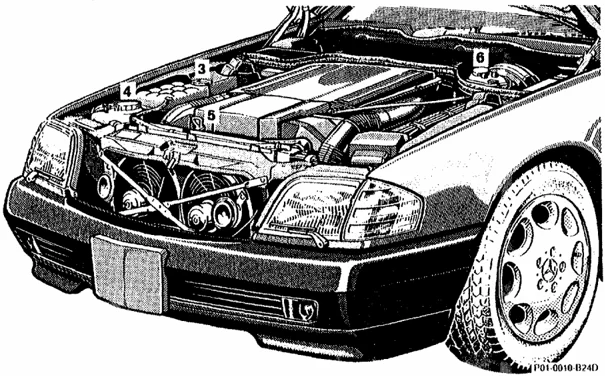
The engine compartment of model SL 500 is illustrated.
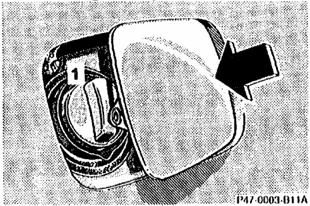
1 Fuel Supply To add fuel turn cap to the left and hold on to it until possible pressure in tank has been released, then remove cap. Failure to do so could result in personal injury,
2 Tire Inflation Pressure Check at least every two weeks. For details see Index.
3 Coolant Level See Index.
4 Windshield Washer System, Headlamp Cleaning System See Index.
5 Engine Oil Level See Index.
6 Brake Fluid See Index.
Vehicle Lighting: Check function and cleanliness. For replacement of light bulbs, see Index.
148