COMFORT ADJUSTMENT
SEAT BELTS
Seat belt precautions
Lexus strongly urges that the driver and passengers in the vehicle be properly restrained at all times with the seat belts provided. Failure to do so could increase the chance of injury and/or the severity of injury in accidents.
The seat belts provided for your vehicle are designed for people of adult size, large enough to properly wear them.
Child. Use a child restraint system appropriate for the child until the child becomes large enough to properly wear the vehicle's seat belts. See "Child restraint" on page 111 for details.
If a child is too large for a child restraint system, the child should sit in the rear seat and must be restrained using the vehicle's seat belt. According to accident statistics, the child is safer when properly restrained in the rear seat than in the front seat.
If a child must sit in the front seat, the seat belts should be worn properly. Do not let the child sit on your lap. It does not provide sufficient restraint. If an accident occurs and the seat belts are not worn properly, the force of the rapid inflation of the airbag may cause severe injury to the child.
Do not allow the child to stand up or kneel on either rear or front seats. An unrestrained child could suffer serious injury or death during emergency braking or a collision.
Pregnant woman. Lexus recommends the use of a seat belt. Ask your doctor for specific recommendations. The lap belt should be worn securely and as low as possible over the hips and not on the waist.
Injured person. Lexus recommends the use of a seat belt. Depending on the injury, first check with your doctor for specific recommendations.
CAUTION Persons should ride in their seats properly wearing their seat belts whenever the vehicle is moving. Otherwise, they are much more likely to suffer serious bodily injury or death in the event of sudden braking or a collision.
When using the seat belts, observe the following:
- Use the belt for only one person at a time. Do not use a single belt for two or more people – even children.
- Avoid reclining the seatbacks too much. The seat belts provide maximum protection when the seatbacks are in the upright position. (See "Adjusting seatback angle" on page 77.)
- Be careful not to damage the belt webbing or hardware. Take care that they do not get caught or pinched in the seat or doors.
- Inspect the belt system periodically. Check for cuts, fraying, and loose parts. Damaged parts should be replaced. Do not disassemble or modify the system.
88
COMFORT ADJUSTMENT
- Keep the belts clean and dry. If they need cleaning, use a mild soap solution or lukewarm water. Never use bleach, dye, or abrasive cleaners – they may severely weaken the belts. (See "Cleaning the interior" on page 318 for instructions.)
- Replace the belt assembly (including bolts) if it has been used in a severe impact. The entire assembly should be replaced even if damage is not obvious.
Fastening front and rear seat belts
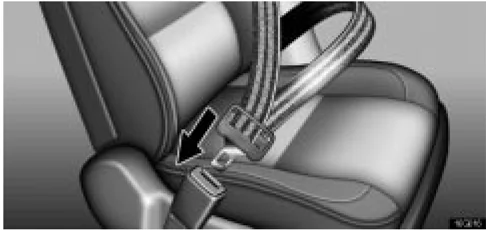
Adjust the seat as needed and sit up straight and well back in the seat. To fasten your belt, pull it out of the retractor and insert the tab into the buckle.
You will hear a click when the tab locks into the buckle.
The seat belt length automatically adjusts to your size and the seat position.
The retractor will lock the belt during a sudden stop or on impact. It also may lock if you lean forward too quickly. A slow, easy motion will allow the belt to extend, and you can move around freely.
When a passenger's shoulder belt is completely extended and is then retracted even slightly, the belt is locked in that position and cannot be extended. This feature is used to hold the child restraint system securely. (For details, see "Child restraint" on page 111.) To free the belt again, fully retract the belt and then pull the belt out once more.
If the seat belt cannot be pulled out of the retractor, firmly pull the belt and release it. You will then be able to smoothly pull the belt out of the retractor.
CAUTION
- After inserting the tab, make sure the tab and buckle are locked and that the belt is not twisted.
- Do not insert coins, clips, etc. in the buckle as this may prevent you from properly latching the tab and buckle.
- If the seat belt does not function normally, immediately contact your Lexus dealer. Do not use the seat until the seat belt is fixed. It cannot protect an adult occupant or your child from injury.
89

COMFORT ADJUSTMENT
 Adjust the position of the lap and shoulder belts.
[1] Position the lap belt as low as possible on your hips – not on your waist.
[2] Adjust it to a snug fit by pulling the shoulder portion upward through the latch plate.
CAUTION
- Both high-positioned lap belts and loose-fitting belts could cause serious injuries due to sliding under the lap belt during a collision or other unintended result. Keep the lap belt positioned as low on hips as possible.
- For your safety, do not place the shoulder belt under your arm.
 Adjust the shoulder anchor position to your size.
To raise the anchor position, push the anchor up. To lower the anchor position, support the anchor while you push the lock release button then slide the anchor down. After adjustment, make sure the anchor is locked in position.
CAUTION
Always make sure the shoulder belt is positioned across the center of your shoulder. The belt should be kept away from your neck, but not falling off your shoulder. Failure to do so could reduce the amount of protection in an accident and cause severe injuries in a collision.
90
COMFORT ADJUSTMENT
 To release the belt, press the buckle release button and allow the belt to retract.
If the belt does not retract smoothly, pull it out and check for kinks or twists. Then make sure it remains untwisted as it retracts.
Seat belt comfort guides
 The seat belt comfort guides are installed on the outside rear seats to relieve uncomfortableness from the shoulder belt when it is applied closer to a child’s neck (at the age of 10 or so), by pulling the shoulder belt a little forward.
Slide the seat belt comfort guide forward to adjust the shoulder belt.
The seat belt comfort guide should not be in the forward position for other purposes.
91
COMFORT ADJUSTMENT
CAUTION Always make sure the shoulder belt is positioned across the center of the child's shoulder. The belt should be kept away from the child's neck, and should not fall off the child's shoulder. Failure to observe these precautions could reduce the effectiveness of the seat belt in an accident, causing death or serious injury.
Seat belt extender
If your seat belts cannot be fastened securely because they are not long enough, a personalized seat belt extender is available from your Lexus dealer free of charge.
Please contact your local Lexus dealer to order the proper required length for the extender. Bring the heaviest coat you expect to wear for proper measurement and selection of length. Additional ordering information is available at your Lexus dealer.
CAUTION When using the seat belt extender, observe the following precautions. Failure to follow these instructions could reduce the effectiveness of the seat belt restraint system in case of vehicle accident, increasing the chance of personal injury.
- Remember that the extender provided for you may not be safe when used on a different vehicle, for another person, or at a different seating position than the one originally intended.
- Be sure to wear the seat belt without the seat belt extender if you can fasten the seat belt without the extender.
92
COMFORT ADJUSTMENT
- Do not use the seat belt extender when installing a child restraint system on the front or rear passenger seat. If installing a child restraint system with the seat belt extender connected to the seat belt, the seat belt will not securely hold the child restraint system, which could cause death or serious injury to the child or other passengers in the event of collision.
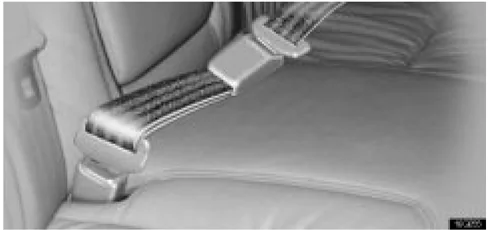
To connect the extender to the seat belt, insert the tab into the seat belt buckle so that the "PRESS" signs on the buckle release buttons of the extender and the seat belt are both facing outward as shown.
You will hear a click when the tab locks into the buckle.
When releasing the seat belt, press on the buckle release button on the extender, not on the seat belt. This helps prevent damage to the vehicle interior and extender itself.
When not in use, remove the extender and store in the vehicle for future use.
CAUTION
- After inserting the tab, make sure the tab and buckle are locked and that the belt is not twisted.
- Do not insert coins, clips, etc. in the buckle as this may prevent you from properly latching the tab and buckle.
- If the seat belt does not function normally, immediately contact your Lexus dealer. Do not use the seat until the seat belt is fixed. It cannot protect an adult occupant or your child from injury.
93

COMFORT ADJUSTMENT
Front seat belt pretensioners
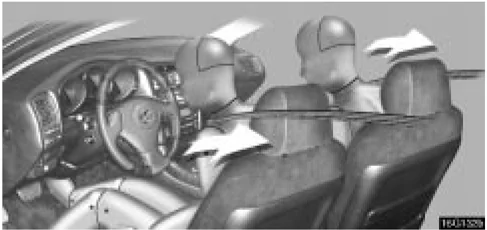
The driver and front passenger’s seat belt pretensioners are designed to be activated in response to a severe frontal impact.
When the airbag sensor detects the shock of a severe frontal impact, the front seat belts are quickly drawn back by the retractor so that the belts snugly restrain the front seat occupants.
The front passenger seat belt pretensioner will not activate if there is no passenger sitting in the front passenger seat. However, the front passenger seat belt pretensioner may activate if luggage is put in the seat, or the seat belt is buckled up regardless of the presence of the occupant in the seat.
The seat belt pretensioners and SRS airbags may not operate together in case of collisions at certain speeds and angles.
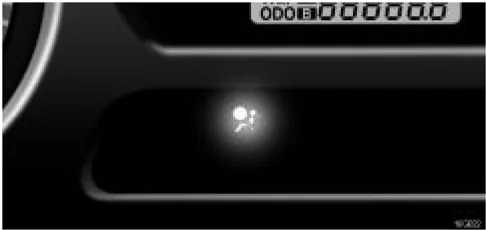
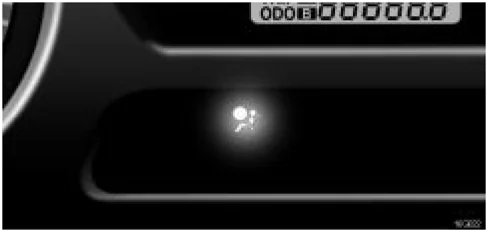
This indicator comes on when the ignition key is turned to the “ON” position. It goes off after about 6 seconds. This means the front seat belt pretensioners are operating properly.
This warning light system monitors the airbag sensor assembly, front airbag sensors, side and curtain shield airbag sensors, occupant detection sensor, seat belt buckle switch, front seat belt pretensioner assemblies, inflators, warning light, interconnecting wiring and power sources. (For details, see "Service reminder indicators and warning buzzers" on page 40.)
94
COMFORT ADJUSTMENT
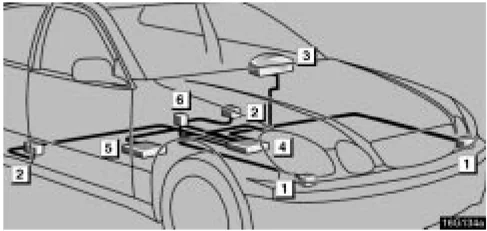
1 Front airbag sensor 2 Front seat belt pretensioner assembly 3 SRS warning light 4 Airbag sensor assembly 5 Occupant detection sensor 6 Seat belt buckle switch
The front seat belt pretensioner system consists mainly of the above components, and their locations are shown in the illustration.
The front seat belt pretensioners are controlled by the airbag sensor assembly. The airbag sensor assembly consists of a safing sensor and airbag sensor.
When the front seat belt pretensioners are activated, an operating noise may be heard and a small amount of smoke-like gas may be released. This gas is harmless and does not indicate that a fire is occurring.
Once the front seat belt pretensioners have been activated, the seat belt retractors remain locked.
CAUTION
Do not modify, remove, strike or open the front seat belt pretensioner assemblies, airbag sensor or surrounding area or wiring. Doing any of these may cause sudden operation of the front seat belt pretensioners or disable the system, which could result in death or serious injury.
Failure to follow these instructions can result in death or serious injury. Consult your Lexus dealer about any repairs and modifications.
NOTICE
Do not perform any of the following changes without consulting your Lexus dealer. Such changes can interfere with proper operation of the front seat belt pretensioners in some cases.
- Installation of electronic devices such as a mobile two-way radio, cassette tape player or compact disc player.
- Repairs on or near the front seat belt retractor assemblies.
- Modification of the suspension system.
- Modification of the front end structure.
- Attachment of a grille guard (bull bar, kangaroo bar, etc.), snowplow, winches or any other equipment to the front end.
95
COMFORT ADJUSTMENT
- Repairs made on or near the front fenders, front end structure or console.
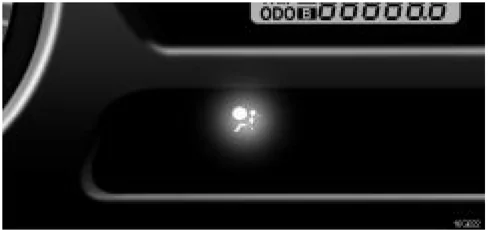
This front seat belt pretensioner system has a service reminder indicator to inform the driver of operating problems. If any of the following conditions occurs, this indicates a malfunction of the pretensioners. Contact your Lexus dealer as soon as possible to service the vehicle.
- When the ignition key is turned to the “ON” position, the light does not come on or flashes.
- The light flashes while driving.
- If either front seat belt does not retract or cannot be pulled out due to a malfunction or activation of the relevant front pretensioner.
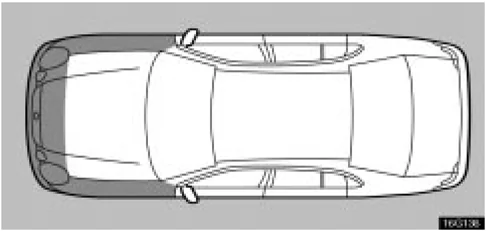
In the following cases, contact your Lexus dealer as soon as possible.
- The front of the vehicle (shaded in the illustration) were involved in an accident that did not cause the front seat belt pretensioners to operate.
- Either front seat belt pretensioner assembly or surrounding area is scratched, cracked, or otherwise damaged.
96
COMFORT ADJUSTMENT
SRS AIRBAGS
The SRS (Supplemental Restraint System) airbags are designed to provide further protection for the driver and front passenger in addition to the primary safety protection provided by the seat belts.
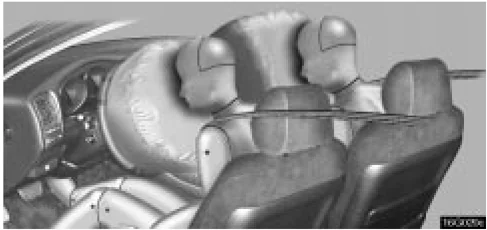
Driver and front passenger airbags
In response to a severe frontal impact, the driver and front passenger airbags work together with the seat belts to help reduce injury by inflating. The driver and front passenger airbags help to reduce injuries mainly to the driver's or front passenger's head or chest directly hitting the steering wheel or dashboard.
The front passenger airbag will not activate if there is no passenger sitting in the front passenger seat. However, the front passenger airbag may deploy if luggage is put in the seat, or the seat belt is buckled up regardless of the presence of the occupant in the seat.
Your vehicle is equipped with a crash sensing and diagnostic module, which will record the use of the seat belt restraint system by the driver when the front airbags are inflated.
Be sure to wear your seat belt properly.
CAUTION
The driver or front passenger who is too close to the steering wheel or dashboard during airbag deployment can be killed or seriously injured. Lexus strongly recommends that:
- The driver sit as far back as possible from the steering wheel while still maintaining control of the vehicle.
- The front passenger sit as far back as possible from the dashboard.
- All vehicle occupants be properly restrained using the available seat belts.
97
COMFORT ADJUSTMENT
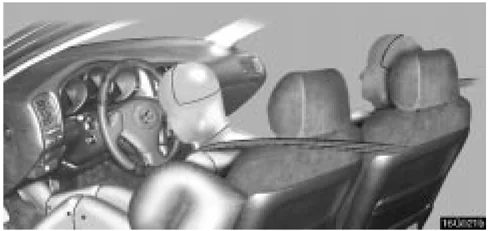
►Side airbags
In response to a severe side impact, the side airbags for the driver or front passenger work together with the seat belts to help reduce injury by inflating. The side airbags help to reduce injuries mainly to the driver’s or front passenger’s chest.
The side airbag on the passenger seat will not activate if there is no passenger sitting in the front passenger seat. However, the side airbag on the passenger seat may deploy if luggage is put in the seat, or the seat belt is buckled up regardless of the presence of the occupant in the seat.
Your vehicle is equipped with a crash sensing and diagnostic module, which will record the use of the seat belt restraint system by the driver when the side airbags are inflated.
Be sure to wear your seat belt properly.
CAUTION
The side airbags inflate with considerable force. To avoid potential death or serious injury when they inflate, the driver and front passenger must:
- Wear their seat belts properly.
- Remain properly seated with their back upright and against the seat at all times.
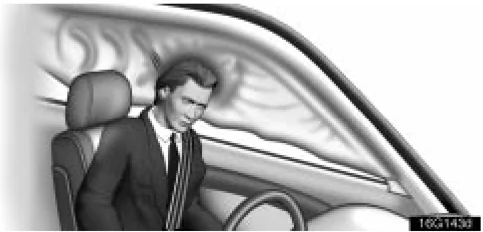
►Curtain shield airbags
In response to a severe side impact, the curtain shield airbags for the driver or front passenger work together with the seat belts by inflating to help reduce injury mainly to the driver’s or front passenger’s head.
The curtain shield airbag is activated even with no passenger in the front seat.
Be sure to wear your seat belt properly.
98
COMFORT ADJUSTMENT
Your vehicle is equipped with a crash sensing and diagnostic module, which will record the use of the seat belt restraint system by the driver when the curtain shield airbags are inflated.
CAUTION The curtain shield airbags inflate with considerable force. To avoid potential death or serious injury when they inflate, the driver and front passenger must:
- Wear their seat belts properly.
- Remain properly seated with their back upright and against the seat at all times.

The indicator comes on when the ignition key is turned to the "ON" position. It goes off after about 6 seconds. This means the SRS airbags are operating properly.
This warning light system monitors the airbag sensor assembly, front airbag sensors, side and curtain shield airbag sensors, occupant detection sensor, seat belt buckle switch, front seat belt pretensioner assemblies, inflators, warning light, interconnecting wiring and power sources. (For details, see "Service reminder indicators and warning buzzers" on page 40.)
The front airbags are designed to deploy in severe (usually frontal) collisions where the magnitude and duration of the forward deceleration of the vehicle exceeds the designed threshold level.
The front airbags will work if the severity of the impact is above the designed threshold level, comparable to an approximate 25 km/h (15 mph) collision in the U.S.A. and 30 km (18 mph) collision in Canada when the vehicle has the impact straight into a fixed barrier that does not move or deform.
99
COMFORT ADJUSTMENT
However, this threshold velocity will be considerably higher if the vehicle strikes an object, such as a parked vehicle or sign pole, which can move or deform on impact, or if the vehicle is involved in an underride collision (e.g. a collision in which the front of the vehicle "underrides", or goes under, the bed of a truck, etc.).
It is possible that in some collisions where the forward deceleration of the vehicle is very close to the designed threshold level, the SRS airbags and the seat belt pretensioners may not activate together.
For the safety of all occupants, always wear your seat belts properly.
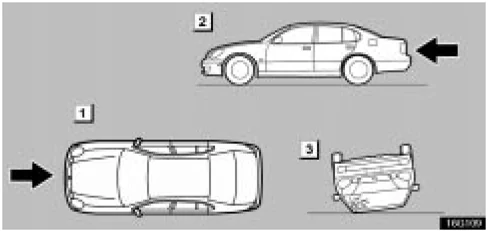
 1 Collision from the side 2 Collision from the rear
3 Vehicle rollover
The front airbags are generally not designed to inflate if the vehicle is involved in a side or rear collision, if it rolls over, or if it is involved in a low-speed frontal collision. But, whenever a collision of any type causes sufficient forward deceleration of the vehicle, deployment of the front airbags may occur.
100
COMFORT ADJUSTMENT
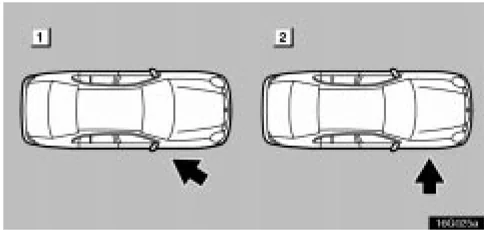
1 Collision from the side at an angle 2 Collision from the side to the vehicle body other than the passenger compartment
The side and curtain shield airbags may not inflate if the vehicle is subjected to a collision from the side at certain angles, or a collision to the side of the vehicle body other than the passenger compartment as shown in the illustration.
1 Collision from the front 2 Collision from the rear 3 Vehicle rollover
The side and curtain shield airbags are generally not designed to inflate if the vehicle is involved in a front or rear collision, if it rolls over, or if it is involved in a low-speed side collision.
101
COMFORT ADJUSTMENT
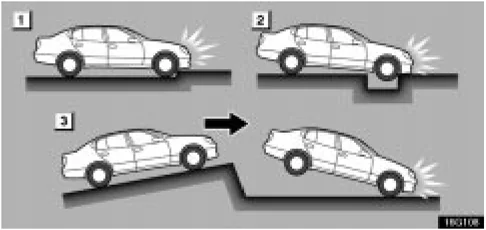
1 Hitting a curb, edge of pavement or hard material 2 Falling into or jumping over a deep hole 3 Landing hard or vehicle falling
The SRS airbags may also deploy if a serious impact occurs to the underside of your vehicle. Some examples are shown in the illustration.
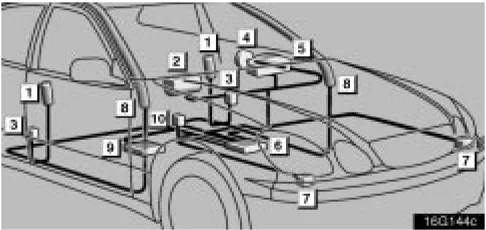
1 Side airbag module (airbag and inflator) 2 Airbag module for front passenger (airbag and inflator) 3 Side and curtain shield airbag sensor assembly 4 Airbag module for driver (airbag and inflator) 5 SRS warning light 6 Airbag sensor assembly 7 Front airbag sensor 8 Curtain shield airbag module (airbag and inflator) 9 Occupant detection sensor 10 Seat belt buckle switch
The SRS airbag system mainly consists of the above components, and their locations are shown in the illustration.
The airbag sensor assembly consists of a safing sensor and airbag sensors.
102
COMFORT ADJUSTMENT
The front airbag sensors constantly monitor the forward deceleration of the vehicle. If an impact results in a forward deceleration beyond the designed threshold level, the system triggers the airbag inflators. In a severe side impact, the side and curtain shield airbag sensor triggers the side and curtain shield airbag inflator. At this time a chemical reaction in the inflators very quickly fills the airbags with non-toxic gas to help restrain the forward or lateral motion of the occupants. The front airbags then quickly deflate, so that there is no obstruction of the driver's vision should it be necessary to continue driving.
When the airbags inflate, they produce a loud noise and release some smoke and residue along with non-toxic gas. This does not indicate a fire. This smoke may remain inside the vehicle for some time, and may cause some minor irritation to the eyes, skin or breathing. Be sure to wash off any residue as soon as possible to prevent any potential skin irritation with soap and water. If you can physically and safely exit the vehicle after a collision, you should do so at the first opportunity.
Deployment of the airbags happens in a fraction of a second, so the airbags must inflate with considerable force. While the system is designed to reduce serious injuries, primarily to the head and chest, it may also cause other, less severe injuries to the face, chest, arms and hands. These are usually in the nature of minor burns or abrasions and swelling, but the force of a deploying airbag can cause more serious injuries, especially if an occupant's hands, arms, chest or head is in close proximity to the airbag module at the time of deployment. This is why it is important for the occupant to; avoid placing any object or part of the body between the occupant and the airbag module; sit straight and well back into the seat; wear the available seat belt properly; and sit as far as possible from the airbag module, while still maintaining control of the vehicle.
Parts of the airbag module (steering wheel hub, airbag cover and inflator) may be hot for several minutes after deployment, so do not touch! The airbags inflate only once. The windshield may be damaged by absorbing some of the force of the inflating airbag.
103
COMFORT ADJUSTMENT
CAUTION
- The SRS airbag system is designed only as a supplement to the primary protection of the driver side and front passenger side seat belt systems. The front seat occupants can be killed or seriously injured by the inflating airbags if they do not wear the available seat belts properly. During sudden braking just before a collision, an unrestrained driver or front passenger can move forward into direct contact with or close proximity to the airbag which may then deploy during the collision. To ensure maximum protection in an accident, the driver and all passengers in the vehicle must wear their seat belts properly. Wearing a seat belt properly during an accident reduces the chances of death or serious injury or being thrown out of the vehicle. For instructions and precautions concerning the seat belt system, see "Seat belts" on page 88.
- Improperly seated and/or restrained infants and children can be killed or seriously injured by the deploying airbags. An infant or child who is too small to use a seat belt should be properly secured using a child restraint system. Lexus strongly recommends that all infants and children be placed in the rear seat of the vehicle and properly restrained. The rear seat is the safest for infants and children. For instructions concerning the installation of a child restraint system, see "Child restraint" on page 111 .
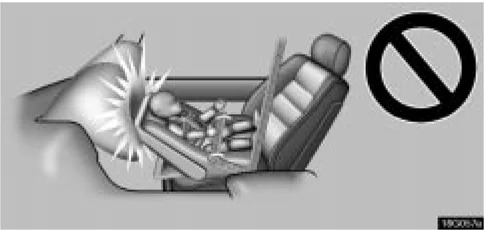
- Never put a rear-facing child restraint system on the front passenger seat because the force of the rapid inflation of the front passenger airbag can cause death or serious injury to the child.
104
COMFORT ADJUSTMENT
 ►Move seat fully back
- A forward-facing child restraint system should be allowed to be put on the front passenger seat only when it is unavoidable. Always move the seat as far back as possible, because the force of the deploying front passenger airbag could cause death or serious injury to the child.
- Do not allow the child to lean against the front door or around the front door even if the child is seated in a child restraint system. It is dangerous if the side airbag and curtain shield airbag inflate, because the impact could cause death or serious injury to the child.
For instructions concerning the installation of a child restraint system, see "Child restraint" on page 111.
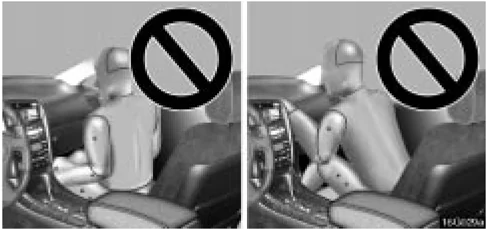
- Do not sit on the edge of the seat or lean against the dashboard when the vehicle is in use, since the front passenger airbag inflates with considerable speed and force. Otherwise, you may be killed or seriously injured. Sit up straight and well back in the seat, and always use your seat belt properly.
105
COMFORT ADJUSTMENT
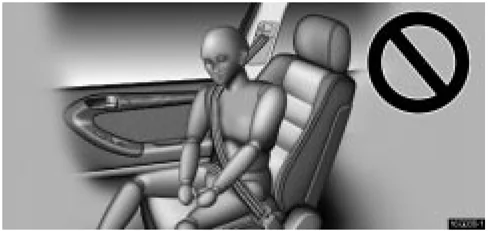
● Do not lean against the front door when the vehicle is in use, since the side airbag and curtain shield airbag inflate with considerable speed and force. Otherwise, you may be killed or seriously injured. Special care should be taken especially when you have a small child in the vehicle.
● Sit up straight and well back in the seat, distributing your weight evenly in the seat. Do not apply excessive weight to the outer side of the front seats on vehicles with side airbags.
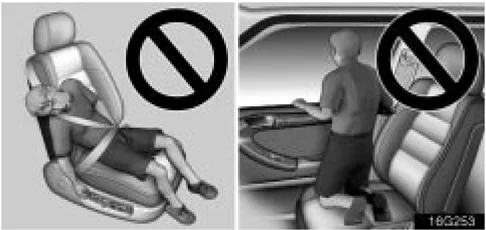
● Do not get your head closer to the area where the side airbag and curtain shield airbag inflate, since these airbags inflate with considerable speed and force. Otherwise, you may be killed or seriously injured. Special care should be taken especially when you have a small child in the vehicle.
● Do not allow a child to kneel on the front passenger seat facing the front passenger’s side door, since the side airbag and curtain shield airbag inflate with considerable speed and force. Otherwise, the child may be killed or seriously injured.
106