Fuel
Refer to Safety Precautions on page 74.
Fuel Recommendation
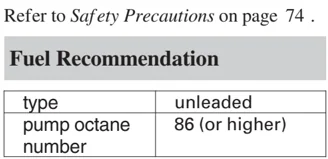
We recommend that you use unleaded fuel because it produces fewer engine deposits and extends the life of exhaust system components.
The use of leaded gas will damage the catalytic converter.
Your engine is designed to use any gasoline that has a pump octane number of 86 or higher. Gasoline pumps at service stations normally display the pump octane number. For information on the use of oxygenated fuels, see page 230.
100 Servicing Your Honda
Fuel
Use of lower octane gasoline can cause persistent “pinging” or “spark knock” (a loud rapping noise) which, if severe, can lead to engine damage. Light pinging experienced while operating under a heavy load, such as climbing a hill, is no cause for concern.
If pinging or spark knock occurs at a steady engine speed under normal load, change brands of gasoline. If pinging or spark knock persists, consult your Honda dealer.
Servicing Your Honda 101
Fuel
Never use stale or contaminated gasoline or an oil/gasoline mixture. Avoid getting dirt, dust, or water in the fuel tank.
Fuel Capacity
Fuel tank capacity: 5.81 US gal (22.0 ℓ)
Refueling Procedure
Refer to Safety Precautions on page 74.
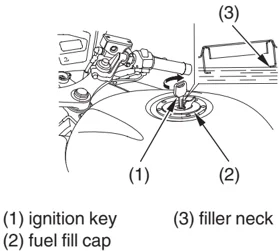
(1) ignition key (2) fuel fill cap (3) filler neck
- Insert the ignition key (1) in the fuel fill cap (2) and turn it clockwise.
102 Servicing Your Honda
Fuel
- Open the cap.
- Add fuel until the level reaches the bottom of the filler neck (3). Avoid overfilling the tank. There should be no fuel in the filler neck.
WARNING Gasoline is highly flammable and explosive. You can be burned or seriously injured when handling fuel.
- Stop the engine and keep heat, sparks and flame away.
- Handle fuel only outdoors.
- Wipe up spills immediately.
- After refueling, push the fuel fill cap closed until it snaps and locks.
- Remove the ignition key from the cap.
Servicing Your Honda 103
Engine Oil & Filter
Engine oil quality is a major factor that affects both the performance and the service life of the engine.
Using the proper oil (page 105) and filter, and regularly checking, adding, and changing oil will help extend your engine’s life. Even the best oil wears out. Changing oil helps get rid of dirt and deposits in the engine. Operating the engine with old or dirty oil can damage your engine. Running the engine with insufficient oil can cause serious damage to the engine and transmission.
Change the engine oil as specified in the maintenance schedule on page 81.
When running in very dusty conditions, oil changes should be performed more frequently than specified in the maintenance schedule.
104 Servicing Your Honda
Engine Oil & Filter
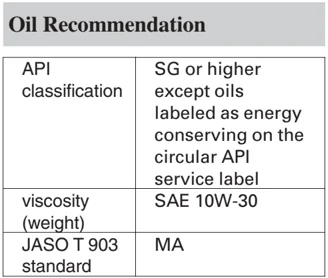
Oil Recommendation
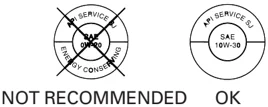
| API classification | SG or higher except oils labeled as energy conserving on the circular API service label |
|---|---|
| viscosity (weight) | SAE 10W-30 |
| JASO T 903 standard | MA |
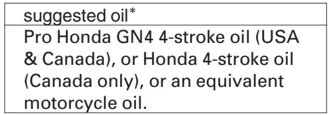
suggested oil*
Pro Honda GN4 4-stroke oil (USA & Canada), or Honda 4-stroke oil (Canada only), or an equivalent motorcycle oil.
- Suggested oils are equal in performance to SJ oils that are not labeled as energy conserving on the circular API service label.
(cont’d)
Servicing Your Honda 105
Engine Oil & Filter
- Your motorcycle does not need oil additives. Use the recommended oil.
- Do not use oils with graphite or molybdenum additives. They may adversely affect clutch operation.
- Do not use API SH or higher oils displaying a circular API "energy conserving" service label on the container. They may affect lubrication and clutch performance.
NOT RECOMMENDED OK
- Do not use non-detergent, vegetable, or castor based racing oils.
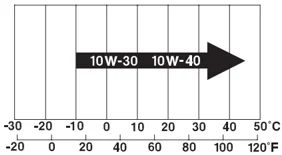
Other viscosities shown in the following chart may be used when the average temperature in your riding area is within the indicated range.
106 Servicing Your Honda
Engine Oil & Filter
JASO T 903 standard
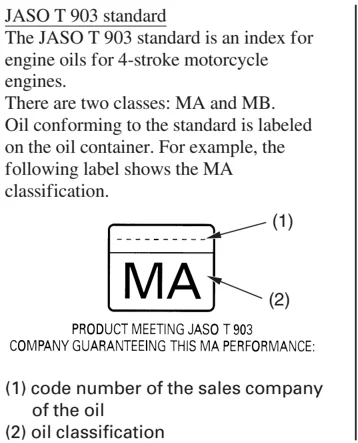
The JASO T 903 standard is an index for engine oils for 4-stroke motorcycle engines. There are two classes: MA and MB. Oil conforming to the standard is labeled on the oil container. For example, the following label shows the MA classification.
(1) code number of the sales company of the oil (2) oil classification
Servicing Your Honda 107
Engine Oil & Filter
Checking & Adding Oil
Refer to Safety Precautions on page 74.
RIGHT SIDE
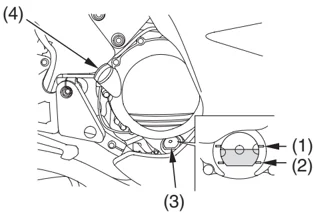
(1) upper level mark (2) lower level mark (3) oil inspection window (4) oil filler cap
- Park your motorcycle on its center stand on a firm, level surface.
- Start the engine and let it idle for 3 – 5 minutes. Make sure the low oil pressure indicator goes off. If the indicator remains on, stop the engine immediately.
- Stop the engine and wait 2 – 3 minutes.
- Check that the oil level is between the upper (1) and lower (2) level marks in the oil inspection window (3).
- If the oil is at or near the upper level mark — you do not have to add oil.
- If the oil is below or near the lower level mark — remove the oil filler cap (4) and add the recommended oil until it reaches the upper level mark. (Do not overfill.)
108 Servicing Your Honda
Engine Oil & Filter
- Reinstall the oil filler cap.
- Check for oil leaks.
Changing Engine Oil & Filter
Refer to Safety Precautions on page 74.
Your motorcycle’s oil filter has very specific performance requirements. Use a new genuine Honda oil filter or a filter of equal quality specified for your model.
NOTICE Using the wrong oil filter may result in leaks or premature engine damage.
Servicing Your Honda 109
Engine Oil & Filter
This procedure requires mechanical skill and professional tools such as a torque wrench and oil filter wrench, as well as a means for disposing of the drained fluid (page 180). If you do not have the skills or the tools, see your Honda dealer.
Drain the Engine Oil:
- Park your motorcycle on its center stand on a firm, level surface.
- If the engine is cold, start it and let it idle for 3 – 5 minutes. Turn the engine off. Wait 2 – 3 minutes for the oil to settle.
- Remove the lower fairing (page 93 ) and inner fairing (page 95 ).
- Place a drain pan under the crankcase drain bolt (1).
- To drain the oil, remove the oil filler cap, crankcase drain bolt, and sealing washer (2).
LEFT SIDE
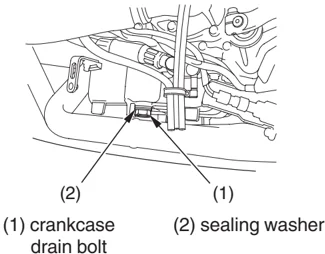
(2) (1) (1) crankcase drain bolt (2) sealing washer
110 Servicing Your Honda
Engine Oil & Filter
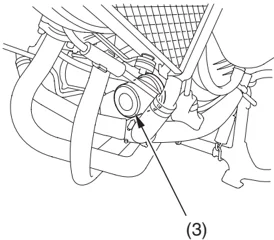
Install a New Oil Filter: 6. Remove the oil filter (3) with a filter wrench and let the remaining oil drain out. Discard the oil filter in an approved manner (page 180). 7. Pour the drained oil into a suitable container and dispose of it in an approved manner (page 180).
NOTICE Improper disposal of drained fluids is harmful to the environment.
LEFT SIDE
(3)
(3) oil filter
(cont'd)
Servicing Your Honda 111
Engine Oil & Filter
- Apply a thin coat of engine oil to the rubber seal (4) of a new oil filter.
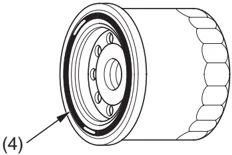
(4) oil filter rubber seal
-
Install the new oil filter and tighten it by hand.
-
Using an oil filter wrench attachment and a torque wrench, tighten the new oil filter to the specified torque: 20 lbf·ft (26 N·m , 2.7 kgf·m)
-
Check the condition of the sealing washer on the engine oil drain bolt. Replace the washer every other time the oil is changed. Install the engine oil drain bolt and tighten it to the specified torque: 22 lbf·ft (30 N·m , 3.1 kgf·m)
Add Engine Oil: 12. Fill the crankcase with the recommended oil (page 105 ), approximately: 3.3 US qt (3.1 ℓ) 13. Install the oil filler cap.
112 Servicing Your Honda
Engine Oil & Filter
- Start the engine and let it idle for a few minutes.
- Stop the engine. Wait several minutes.
- Check that the oil level is at the upper level mark in the oil inspection window (page 108 ).
- Check that there are no oil leaks.
- Install the lower fairings and inner fairing.
If a torque wrench is not used for installation, see your Honda dealer as soon as possible to verify proper assembly.
Servicing Your Honda 113
Coolant
Your motorcycle’s liquid cooling system dissipates engine heat through the coolant jacket that surrounds the cylinder and cylinder head.
Maintaining the coolant will allow the cooling system to work properly and prevent freezing, overheating, and corrosion.
Coolant Recommendation
Use Pro Honda HP coolant or an equivalent high quality ethylene glycol antifreeze containing corrosion protection inhibitors specifically recommended for use in aluminum engines. Check the antifreeze container label.
Use only distilled water as a part of the coolant solution. Water that is high in mineral content or salt may be harmful to the aluminum engine.
NOTICE
Using coolant with silicate inhibitors may cause premature wear of water pump seals or blockage of radiator passages. Using tap water may cause engine damage.
The factory provides a 50/50 solution of antifreeze and water in this motorcycle. This coolant solution is recommended for most operating temperatures and provides good corrosion protection.
Decreasing the concentration of antifreeze to less than 40% will not provide proper corrosion protection.
114 Servicing Your Honda
Coolant
Increasing the concentration of antifreeze is not recommended because it decreases cooling system performance. Higher concentrations of antifreeze (up to 60%) should only be used to provide additional protection against freezing. Check the cooling system frequently during freezing weather.
Checking & Adding Coolant
Refer to Safety Precautions on page 74.
LEFT SIDE
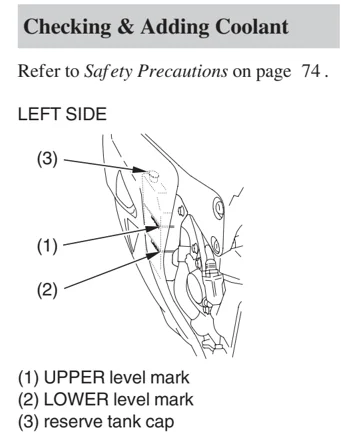
(1) UPPER level mark (2) LOWER level mark (3) reserve tank cap
Servicing Your Honda 115