Specifications
| Dimensions | |
|---|---|
| overall length | 83.5 in (2,120 mm) |
| overall width | 28.9 in (735 mm) |
| overall height | 47.0 in (1,195 mm) |
| wheelbase | 57.5 in (1,460 mm) |
| ground clearance | 4.9 in (125 mm) |
Technical Information 215
Specifications
Fuel & Lubricants
| Item | Specification |
|---|---|
| fuel recommendation | unleaded gasoline, pump octane number of 86 or higher |
| fuel tank capacity | 5.81 US gal (22.0 ℓ) |
| engine oil capacity | after disassembly: 4.0 US qt (3.8 ℓ)after draining: 3.1 US qt (2.9 ℓ)after draining & oil filter change: 3.3 US qt (3.1 ℓ) |
| engine oil recommendation | API Service Classification SG or higher except oils labeled as energy conserving on the circular API service label, SAE 10W-30, JASO T 903 standard MA, Pro Honda GN4 4-stroke oil (USA & Canada) or Honda 4-stroke oil (Canada only), or an equivalent motorcycle oil |
| drive chain lubricant | SAE 80 or 90 gear oil |
| cooling system, recommendation | Pro Honda HP Coolant or an equivalent high quality ethylene glycol antifreeze containing corrosion protection inhibitors specifically recommended for use in aluminum engines |
| cooling system, capacity | 3.09 US qt (2.92 ℓ) |
216 Technical Information
Specifications
Capacities
| passenger capacity | Operator and one passenger |
|---|---|
| maximum weight capacity | USA: 399 lbs (181 kg)Canada: 408 lbs (185 kg)rider, passenger, all cargo and accessories |
Engine Specifications
| displacement | 47.7 cu-in (782 cm³) |
|---|---|
| bore & stroke | 2.83 x 1.89 in (72.0 x 48.0 mm) |
| compression ratio | 11.6 : 1 |
| spark plug (standard) | IMR9B—9H (NGK) or VNH27Z (DENSO) |
| spark plug (cold climate) | IMR8B—9H (NGK) or VNH24Z (DENSO) |
| spark plug gap | 0.031—0.035 in (0.80—0.90 mm) no adjustment |
| valve clearance (cold) | intake 0.008 in (0.20 mm)exhaust 0.014 in (0.35 mm) |
| idle speed | 1,200 ± 100 rpm |
Technical Information 217
Specifications
| Power Transmission | |
|---|---|
| primary reduction | 1.939 |
| gear ratio, 1st | 2.846 |
| 2nd | 2.062 |
| 3rd | 1.578 |
| 4th | 1.291 |
| 5th | 1.111 |
| 6th | 0.965 |
| final reduction | 2.687 |
| standard sprocket sizes | drive (engine) sprocket: 16driven (rear wheel) sprocket: 43 |
| final drive | chainDID50VA8 or RK50HFOZ5 |
218 Technical Information
Specifications
Chassis & Suspension
| caster | 25°30′ |
|---|---|
| trail | 3.7 in (95 mm) |
| tire size, front | 120/70ZR17M/C (58W) |
| tire size, rear | 180/55ZR17M/C (73W) |
| tire type | radial—ply, tubeless |
| tire pressure, front (cold) | 36 psi (250 kPa , 2.50 kgf/cm²) |
| tire pressure, rear (cold) | 42 psi (290 kPa , 2.90 kgf/cm²) |
Electrical
| battery | 12V—10Ah or 12V—11Ah |
|---|---|
| generator | 0.497kW/5,000rpm |
Technical Information 219
Specifications
| Lights | |
|---|---|
| headlight | 12V—55W (4 bulbs) |
| brake/tail light | 12V—21/5W (2 bulbs) |
| turn signal lights | 12V—21W (front) |
| 12V—21W (rear) | |
| license light | 12V—8W |
220 Technical Information
Specifications
Technical Information 221
Break-in Guidelines
Help assure your motorcycle’s future reliability and performance by paying extra attention to how you ride during the first 300 miles (500 km).
During this period, avoid full-throttle starts and rapid acceleration.
222 Technical Information
Emission Control Systems
Exhaust Emission Requirements
The U.S. Environmental Protection Agency (EPA), the California Air Resources Board (CARB), and Environment Canada require that your motorcycle comply with applicable exhaust emissions standards during its useful life, when operated and maintained according to the instructions provided.
Noise Emission Requirements
The EPA also requires that motorcycles built after January 1, 1983 comply with applicable noise emission standards for one year or 3,730 miles (6,000 km) after the time of sale to the ultimate purchaser, when operated and maintained according to the instructions provided. (USA only)
Warranty Compliance
Compliance with the terms of the Distributor’s Warranties for Honda Motorcycle Emission Control Systems is necessary in order to keep the emissions system warranty in effect. (USA only)
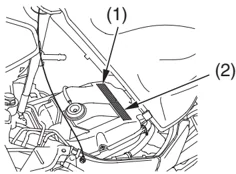
(1) vehicle emission control information label (2) vehicle emission control information label (Canada only)
Technical Information 223
Emission Control Systems
The Vehicle Emission Control Information label (1) (2) is attached to the air cleaner housing under the fuel tank.
Source of Exhaust Emissions
The combustion process produces carbon monoxide (CO), oxides of nitrogen (NOx) and hydrocarbons (HC). Control of hydrocarbons and oxides of nitrogen is very important because, under certain conditions, they react to form photochemical smog when subjected to sunlight. Carbon monoxide does not react in the same way, but it is toxic.
Honda Motor Co., Ltd. utilizes various systems to reduce carbon monoxide, oxides of nitrogen and hydrocarbons.
224 Technical Information
Emission Control Systems
Exhaust Emission Control System
The exhaust emission control system includes a secondary air injection system, PGM-FI system, two three-way catalytic converters, and two heated oxygen sensors.
No adjustment to these systems should be made although periodic inspection of the components is recommended.
PGM-FI System
The PGM-FI system uses sequential multiport fuel injection. It has four subsystems: Air Intake, Engine Control, Fuel Control, and Exhaust Control. The Engine Control Module (ECM) uses various sensors to determine how much air is going into the engine. It then controls how much fuel to inject under all operating conditions.
Ignition Timing Control System
The system constantly adjusts the ignition timing, reducing the amount of HC, CO and NOx produced.
Technical Information 225
Emission Control Systems
Secondary Air Injection System
The secondary air injection system introduces filtered air into the exhaust gases in the exhaust port. The secondary air injection system helps improve emission performance.
Three-Way Catalytic Converters
The three-way catalytic converters are in the exhaust system. Through chemical reactions, they convert HC, CO, and NOx in the engine’s exhaust to carbon dioxide (CO₂), nitrogen (N), and water vapor.
Evaporative Emission Control System
This motorcycle complies with the requirements of the California Air Resources Board (CARB) evaporative emission regulations. Fuel vapor from the fuel tank is directed into the charcoal canister and air cleaner where it is adsorbed and stored while the engine is stopped. When the engine is running and the purge control solenoid valve is open, fuel vapor in the charcoal canister and air cleaner is drawn into the engine through the throttle body.
226 Technical Information
Emission Control Systems
Crankcase Emission Control System
The engine is equipped with a closed crankcase system to prevent discharging crankcase emissions into the atmosphere. Blow-by gas is returned to the combustion chamber through the air cleaner and the intake manifold.
Problems That May Affect Motorcycle Exhaust Emissions
If you are aware of any of the following symptoms, have the vehicle inspected and repaired by your authorized Honda motorcycle dealer.
Symptoms:
- Hard starting or stalling after starting
- Rough idle
- Misfiring or backfiring during acceleration
- After-burning (backfiring)
- Poor performance (driveability) and poor fuel economy
Technical Information 227
Emission Control Systems
Noise Emission Control System TAMPERING WITH THE NOISE CONTROL SYSTEM IS PROHIBITED: U. S. federal law prohibits, or Canadian provincial laws may prohibit the following acts or the causing thereof: (1) The removal or rendering inoperative by any person, other than for purposes of maintenance, repair or replacement, of any device or element of design incorporated into any new vehicle for the purpose of noise control prior to its sale or delivery to the ultimate purchaser or while it is in use; or (2) the use of the vehicle after such device or element of design has been removed or rendered inoperative by any person.
AMONG THOSE ACTS PRESUMED TO CONSTITUTE TAMPERING ARE THE FOLLOWING ACTS:
- Removal of, or puncturing the muffler, baffles, header pipes or any other component which conducts exhaust gases.
- Removal of, or puncturing of any part of the intake system.
- Lack of proper maintenance.
- Replacing any moving parts of the vehicle, or parts of the exhaust or intake system, with parts other than those specified by the manufacturer.
228 Technical Information
Catalytic Converter
This motorcycle is equipped with two three-way catalytic converters. The catalytic converter contains precious metals that serve as catalysts, promoting chemical reactions to convert the exhaust gasses without affecting the metals.
The catalytic converters act on HC, CO, and NOx. A replacement unit must be an original Honda part or its equivalent.
The catalytic converters must operate at a high temperature for the chemical reactions to take place. They can set fire to any combustible materials that come near them. Park your motorcycle away from high grasses, dry leaves, or other flammables.
Defective catalytic converters contribute to air pollution, and can impair your engine’s performance. Follow these guidelines to protect your motorcycle’s catalytic converters.
• Always use unleaded gasoline. Even a small amount of leaded gasoline can contaminate the catalyst metals, making the catalytic converters ineffective.
• Keep the engine tuned-up.
• An engine that is misfiring may overheat the catalytic converters, causing damage to the converters or motorcycle. Have your motorcycle diagnosed and repaired if it is misfiring, backfiring, stalling or otherwise not running properly.
Technical Information 229