DRIVING TIPS
- Avoid unnecessary stopping and braking. Maintain a steady pace. Try to time the traffic signals so you only need to stop as little as possible or take advantage of through streets to avoid traffic lights. Keep a proper distance from other vehicles to avoid sudden braking. This will also reduce wear on your brakes.
- Avoid heavy traffic or traffic jams whenever possible.
- Do not rest your foot on the brake pedal. This causes premature wear, overheating and poor fuel economy.
- Maintain a moderate speed on highways. The faster you drive, the greater the fuel consumption. By reducing your speed, you will cut down on fuel consumption.
- Keep the front wheels in proper alignment. Avoid hitting the curb and slow down on rough roads. Improper alignment not only causes faster tire wear but also puts an extra load on the engine, which, in turn, wastes fuel.
- Keep the bottom of your vehicle free from mud, etc. This not only lessens weight but also helps prevent corrosion.
- Keep your vehicle tuned-up and in top shape. A dirty air cleaner, improper valve clearance, dirty plugs, dirty oil and grease, brakes not adjusted, etc. all lower engine performance and contribute to poor fuel economy. For longer life of all parts and lower operating costs, keep all maintenance work on schedule, and if you often drive under severe conditions, see that your vehicle receives more frequent maintenance. (For scheduled maintenance information, please refer to the "Owner's Manual Supplement / Scheduled Maintenance".)
CAUTION
Never turn off the engine to coast down hills. Your power steering and brake booster will not function without the engine running. Also, the emission control system operates properly only when the engine is running.
232
SECTION 4
IN CASE OF AN EMERGENCY
In case of an emergency
- If your engine stalls while driving ........ 234
- If your vehicle will not start ........ 234
- If you cannot increase the engine speed ........ 238
- If your vehicle overheats ........ 238
- If you have a flat tire (vehicles with run-flat tires) ........ 239
- If you have a flat tire (vehicles with standard tires) ........ 241
- If your vehicle becomes stuck ........ 249
- If your vehicle needs to be towed ........ 250
- If the retractable hardtop does not close ........ 256
- If you cannot shift automatic transmission selector lever ........ 270
- Lexus link system ........ 271
- If you lose your keys or lock yourself out ........ 281
2003 SC430 from May '03 Prod. (OM24449U) 233

IN CASE OF AN EMERGENCY
IF YOUR ENGINE STALLS WHILE DRIVING
If your engine stalls while driving . . . .
- Reduce your speed gradually, keeping a straight line. Move cautiously off the road to a safe place.
- Turn on your emergency flashers.
- Try starting the engine again.
If the engine will not start, see "If your vehicle will not start".
CAUTION If the engine is not running, the power assist for the brakes and steering will not work, so steering and braking will be much harder than usual.
IF YOUR VEHICLE WILL NOT START
(a) Simple checks Before making these checks, make sure you have followed the correct starting procedure instructions in "How to start the engine" on page 198 and that you have sufficient fuel. Since your vehicle is equipped with the engine immobiliser system, also check whether the other keys will start the engine. If they work, your key may be broken. Have the key checked at your Lexus dealer. If none of your keys work, there may be a malfunction in the immobiliser system. Call your Lexus dealer. See "Keys" on page 8.
If the engine is not turning over or is turning over too slowly –
- Check that the battery terminals are tight and clean.
- If the battery terminals are O.K., switch on the interior light.
- If the light is out, dim or goes out when the starter is cranked, the battery is discharged. You may try jump starting. See "(c) Jump starting" for further instruction.
If the light is O.K., but the engine still will not start, it needs adjustment or repair. Call a Lexus dealer, Roadside Assistance or Customer Service Assistance. (See "Foreword".)
234
IN CASE OF AN EMERGENCY
NOTICE Do not pull-or push-start the vehicle. It may damage the vehicle or cause a collision when the engine starts. Also the three-way catalytic converter may overheat and become a fire hazard.
If the engine turns over at its normal speed but will not start –
- The engine may be flooded because of repeated cranking. See "(b) Starting a flooded engine" for further instructions.
- If the engine still will not start, it needs adjustment or repair. Call a Lexus dealer, Roadside Assistance or Customer Service Assistance. (See "Foreword".)
(b) Starting a flooded engine If the engine will not start, your engine may be flooded because of repeated cranking.
If this happens, turn the ignition switch to "START" with the accelerator pedal fully depressed. Continue this operation for 30 seconds and then stop cranking. Then try starting the engine with your foot off the accelerator pedal.
If the engine does not start after 30 seconds of cranking, release the ignition switch, wait a few minutes and try again.
If the engine still will not start, it needs adjustment or repair. Call a Lexus dealer, Roadside Assistance or Customer Service Assistance. (See "Foreword".)
NOTICE Do not crank for more than 30 seconds at a time. This may overheat the starter and wiring systems.
(c) Jump starting To avoid serious personal injury and damage to your vehicle which might result from battery explosion, acid burns, electrical burns, or damaged electronic components, these instructions must be followed precisely.
If you are unsure about how to follow this procedure, we strongly recommend that you seek help from your Lexus dealer, Roadside Assistance or Customer Service Assistance. (See "Foreword".)
2003 SC430 from May '03 Prod. (OM24449U) 235
IN CASE OF AN EMERGENCY
CAUTION
- Batteries contain sulfuric acid which is poisonous and corrosive. Wear protective safety glasses when jump starting, and avoid spilling acid on your skin, clothing, or vehicle.
- If you should accidentally get acid on yourself or in your eyes, remove any contaminated clothing and flush the affected area with water immediately. Then get immediate medical attention. If possible, continue to apply water with a sponge or cloth while en route to the medical office.
- The gas normally produced by a battery will explode if a flame or spark is brought near. Use only standardized jumper cables and do not smoke or light a match while jump starting.
- Warning: Battery posts, terminals and related accessories contain lead and lead compounds, chemicals known to the State of California to cause cancer and reproductive harm. Wash hands after handling.
NOTICE
The battery used for boosting must be 12 V. Do not jump start unless you are sure that the booster battery is correct.
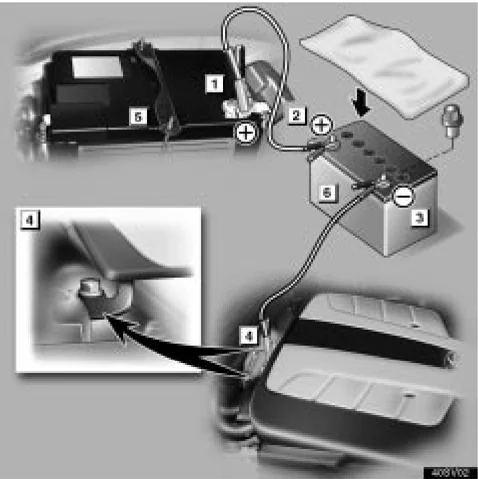
► 5 Discharged battery 6 Booster battery
JUMP STARTING PROCEDURE
- If the booster battery is installed in another vehicle, make sure the vehicles are not touching. Turn off all unnecessary lights and accessories.
236
IN CASE OF AN EMERGENCY
- If required, remove all the vent plugs from the booster battery. Lay a cloth over the open vents on the booster battery. (This helps reduce the explosion hazard, personal injuries and burns.)
If the booster battery is an extended maintenance interval battery, it is not necessary to remove the vent plugs.
-
If the engine in the vehicle with the booster battery is not running, start it and let it run for about 5 minutes. During jump starting, run the engine at about 2000 rpm with the accelerator pedal lightly depressed.
-
Locate positive (+) and negative (–) terminals of each battery. Connect the jumper cables in the exact order ( [1] [2] [3] [4] ) shown in the illustration.
[1] Connect a positive (red) jumper cable clamp to the positive (+) terminal of the discharged battery.
[2] Connect the clamp at the other end of the positive (red) cable to the positive (+) terminal of the booster battery.
[3] Connect a negative (black) cable clamp to the negative (–) terminal of the booster battery.
[4] Connect the clamp at the other end of the negative (black) cable to a solid, stationary, unpainted metallic point (such as shown in the illustration) away from the battery. Do not connect it to or near any part that moves when the engine is cranked.
CAUTION When making the connections, to avoid serious injury, do not lean over the battery or accidentally let the jumper cables or clamps touch anything except the correct battery terminals or the ground.
-
Start your engine in the normal way. After starting, run it at about 2000 rpm for several minutes with the accelerator pedal lightly depressed.
-
Carefully disconnect the cables in the exact reverse order: the negative cable and then the positive cable.
-
Carefully dispose of the battery cover cloths which may now contain sulfuric acid.
-
If removed, replace all the battery vent plugs.
If the cause of your battery discharging is not apparent (for example, lights left on), you should have it checked at your Lexus dealer.
NOTICE When disconnecting the battery, be sure to cancel the theft deterrent system. Otherwise, the system could activate an alarm and lock the unlocked door(s) automatically.
2003 SC430 from May '03 Prod. (OM24449U) 237
IN CASE OF AN EMERGENCY
IF YOU CANNOT INCREASE THE ENGINE SPEED
If the engine speed does not increase when the accelerator pedal is depressed, the electronic throttle control system may be faulty. Move the vehicle to a safe place by means of creeping and call a Lexus dealer for assistance:
- Depress the brake pedal and shift to the "D" position.
- Gradually release the brake pedal, and the vehicle starts to move by creeping. After arriving at a safe place, stop the vehicle and call a Lexus dealer for assistance.
CAUTION
- The above method of moving the vehicle is for emergency. Use it only for moving minimum distances to a safe place.
- Be especially careful to prevent erroneous pedal operation.
IF YOUR VEHICLE OVERHEATS
If your engine coolant temperature gauge indicates overheating, if you experience a loss of power, or if you hear a loud knocking or pinging noise, the engine has probably overheated.
When the engine overheats
Pull safely off the road, stop the vehicle and turn on your emergency flashers. Put the transmission in "P" and apply the parking brake.
A: If steam is coming from your engine:
Turn off the engine. Leave the hood closed until there is no sign of steam or coolant. Your engine could have been seriously damaged already. Call your Lexus dealer for assistance.
CAUTION
To help avoid personal injury, keep the hood closed until there is no steam. Escaping steam or coolant is sign of very high pressure.
B: If no steam is coming from your engine:
Leave the engine running and turn off the air conditioning. Check the following.
- Is the cooling fan operating?
- Is the coolant in the acceptable range?
- Is the engine drive belt O.K.?
238
IN CASE OF AN EMERGENCY
CAUTION
- When the engine is running, keep hands and clothing away from the moving fan and engine drive belt.
- Do not attempt to remove the radiator cap when the engine and radiator are hot. Serious injury could result from scalding hot fluid and steam blown out under pressure.
If the cooling fan is not operating or the coolant is not in the acceptable range, turn off the engine and call your Lexus dealer.
If both conditions are O.K., after the engine coolant temperature has cooled to normal, continue driving your vehicle.
If the engine coolant temperature does not cool down, or your vehicle overheats again, have it checked as soon as possible by your Lexus dealer.
IF YOU HAVE A FLAT TIRE (Vehicles with run-flat tires)
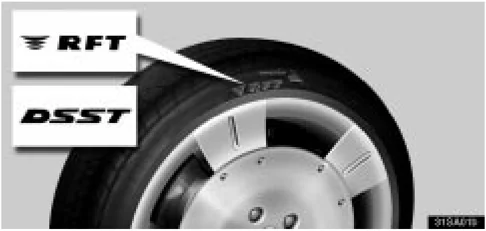
You can continue driving a vehicle with run-flat tires even if any tire goes flat. It is able to run for a maximum of 160 km (100 miles) at a speed below 90 km/h (55 mph) after the low tire pressure warning light blinks and chimes sound. When you drive your vehicle after the low tire pressure warning light blinks and chimes sound, the tire must be replaced. Do not use the repaired tire. A spare tire is not provided on the vehicle with run-flat tires.
Observe the following precautions and take your vehicle to the nearest Lexus dealer or authorized tire dealer.
2003 SC430 from May '03 Prod. (OM24449U) 239
IN CASE OF AN EMERGENCY
CAUTION If the low tire pressure warning light comes on or blinks and chimes sound, take your vehicle to the nearest Lexus dealer or authorized tire dealer as soon as possible, observing the following instructions:
- Decelerate as soon as possible to the most appropriate speed that conditions permit. Do not drive for longer than 160 km (100 miles) or over 90 km/h (55 mph).
- Avoid abrupt steering wheel maneuvering and braking. If the vehicle tires deteriorate, you could lose control of the steering wheel or the brakes, causing death or serious injury.
NOTICE
- Do not use liquid sealants for a flat tire as air pressure sensors will be damaged.
- Take due care not to go over a curb stone and be careful of the holes in the road because deflated tire pressure affects tire cushion performance. The wheels, tires, body, suspension and other components could be damaged.
- Your ground clearance is reduced if the run-flat tire goes flat so avoid driving over obstacles and drive slowly on rough, unpaved roads and speed bumps. Also, do not attempt to go through an automatic car wash as the vehicle may get caught, resulting in damage.
- When the tires must be replaced, have them replaced by the nearest Lexus dealer or authorized tire dealer. The tire pressure sensors will be affected by the installation or removal of tires.
- When the tires must be replaced, replace the grommets for air pressure sensors as well.
240
IN CASE OF AN EMERGENCY
IF YOU HAVE A FLAT TIRE (Vehicles with standard tires)
⚠ CAUTION If the low tire pressure warning light blinks and chimes sound, observe the following instructions:
- Decelerate as soon as possible to the most appropriate speed that conditions permit.
- Avoid abrupt steering wheel maneuvering and braking. If the vehicle tires deteriorate, you could lose control of the steering wheel or the brakes, causing death or serious injury.
- The warning system may not activate immediately if bursts or sudden air leakage should occur.
- Reduce your speed gradually, keeping a straight line. Move cautiously off the road to a safe place – well away from the traffic. Avoid stopping on the center divider of a highway. Park on a level spot with firm ground.
- Stop the engine and turn on your emergency flashers.
- Firmly set the parking brake and put the transmission in "P".
- Have everyone get out of the vehicle on the side away from traffic.
- Read the following instructions thoroughly.
⚠ CAUTION When jacking, be sure to observe the following to reduce the possibility of personal injury:
- Follow jacking instructions.
- Do not put any part of your body under a vehicle supported by a jack. Otherwise, personal injury may occur.
- Do not start or run the engine while your vehicle is supported by the jack.
- Stop the vehicle on a level firm ground, firmly set the parking brake and put the transmission in "P". Block the wheel diagonally opposite to the one being changed if necessary.
- Make sure to set the jack properly in the jack point. Raising the vehicle with jack improperly positioned will damage the vehicle or may allow the vehicle to fall off the jack and cause personal injury.
- Never get under the vehicle when the vehicle is supported by the jack alone.
- Use the jack only for lifting your vehicle during wheel changing.
- Do not raise the vehicle with someone in the vehicle.
- When raising the vehicle, do not put an object on or under the jack.
- Raise the vehicle only high enough to remove and change the tire.
241
IN CASE OF AN EMERGENCY
NOTICE
- Do not use liquid sealants for a flat tire as air pressure sensors will be damaged.
- Do not continue driving with a deflated tire. Driving even a short distance can damage a tire beyond repair.
- When the tires must be repaired or replaced, have them repaired or replaced by the nearest Lexus dealer or authorized tire dealer. The tire pressure sensors will be affected by the installation or removal of tires.
- When the tires must be replaced, replace the grommets for air pressure sensors as well.
Compact spare tire
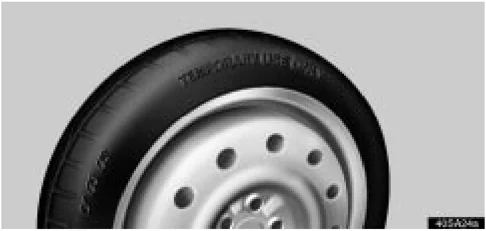
The compact spare tire is designed for temporary emergency use only.
The compact spare tire is identified by the distinctive wheel design and color and special wording “TEMPORARY USE ONLY” molded into the side wall of the tire.
To keep the compact spare tire noticeable, do not hide the wheel by a wheel cover or such.
The compact spare tire saves space in your luggage compartment, and its lighter weight helps to improve fuel economy and permits easier installation in case of a flat tire.
242
IN CASE OF AN EMERGENCY
The compact spare tire can be used many times, if necessary. It has tread life of up to 4800 km (3000 miles) depending on road conditions and your driving habits. When tread wear indicators appear on the tire, replace the tire. (See “Checking and replacing tires on page 323.)
CAUTION
- The compact spare tire was designed especially for your Lexus. Do not use it on any other vehicle.
- Do not use more than one compact spare tire at the same time.
- The pressure for the compact spare tire must be 420 kPa (4.3 kgf/cm², 4.2 bar, 60 psi).
- Do not exceed 80 km/h (50 mph) when driving with the compact spare tire.
- The standard tire should be repaired and reinstalled as soon as possible.
- Avoid sudden acceleration, sudden deceleration and sharp turns with the compact spare tire.
NOTICE Your ground clearance is reduced when the compact spare tire is installed so avoid driving over obstacles and drive slowly on rough, unpaved roads and speed bumps. Also, do not attempt to go through an automatic car wash as the vehicle may get caught, resulting in damage.
INFORMATION As the spare tire is not equipped with the tire pressure sensor, low pressure of the spare tire will not be warned.
Changing procedure

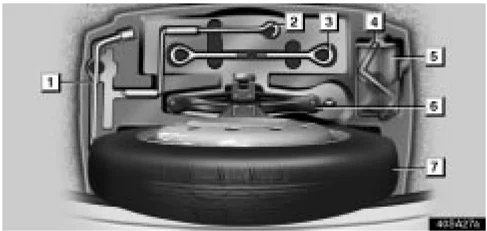
1 Wrench 2 Jack handle 3 Towing eyelet 4 Allen wrench 5 Tool bag 6 Jack 7 Spare tire
- Get the tool, jack and spare tire.
To prepare yourself for an emergency, you should familiarize yourself with the use of the jack and each tool, and their storage locations.
The air pressure gauge is located in the tool bag. The Allen wrench under the tool bag is provided to close the retractable hardtop manually in case the retractable hardtop does not close. The towing eyelet is needed in emergency towing.
2003 SC430 from May '03 Prod. (OM24449U) 243
IN CASE OF AN EMERGENCY
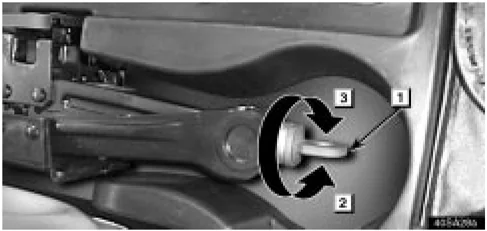
► 1 Joint 2 When removing the jack, turn the joint by hand in the "contract" direction until the jack is free. 3 When storing, turn the joint by hand in the "expand" direction until the jack is firmly secured to prevent it from flying forward during a collision or sudden braking.
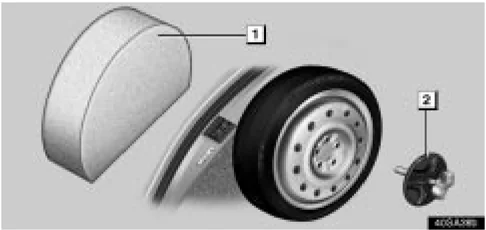
To remove the spare tire: 1 Remove the tire cover. 2 Loosen the bolt and remove it. When storing the spare tire, place it with the outer side of the wheel facing the inside of the vehicle. Then bolt the tire in place to prevent the tire from flying forward during a collision or sudden braking.
244
IN CASE OF AN EMERGENCY
 4C6A28
- Block the wheel diagonally opposite the flat tire to keep the vehicle from rolling when it is jacked up.
When blocking the wheel, place a wheel block in front of one of the front wheels or behind one of the rear wheels.
 4C6A30a
- Loosen all the wheel nuts.
Always loosen the wheel nuts before raising the vehicle.
Turn the wheel nuts counterclockwise to loosen them. To get maximum leverage, fit the wrench to the nut so that the handle is on the right side, as shown above. Grab the wrench near the end of the handle and pull up on the handle. Be careful that the wrench does not slip off the nut.
Do not remove the nuts yet – just unscrew them about one-half turn.
⚠ CAUTION Never use oil or grease on the bolts or nuts. The nuts may loosen and the wheels may fall off, which could cause a serious accident.
2003 SC430 from May '03 Prod. (OM24449U) 245

IN CASE OF AN EMERGENCY
 408A31
- Position the jack at the jack points as shown. Make sure the jack is positioned on a level and solid surface.
 40BA32a
- After making sure no one is in the vehicle, raise it high enough so that the spare tire can be installed.
Allow for the fact that you need more ground clearance when putting on the spare tire than when removing the flat tire.
To raise the vehicle, insert the jack handle into the jack (it is a loose fit) and turn it clockwise. As the jack touches the vehicle and begins to lift, double-check that it is properly positioned.
⚠ CAUTION Never get under the vehicle when the vehicle is supported by the jack alone.
246
IN CASE OF AN EMERGENCY
 6. Remove the wheel nuts and remove the flat tire.
Lift the flat tire straight off and put it aside.
 Before putting on the wheel, remove any corrosion on the mounting surfaces with a wire brush or such. Installation of wheels without good metal-to-metal contact at the mounting surface can cause wheel nuts to loosen and eventually cause a wheel to come off while driving.
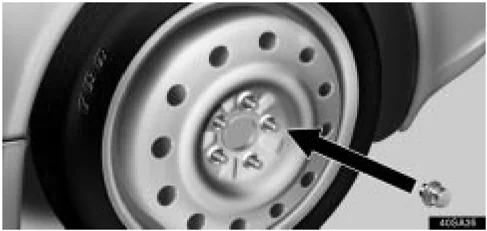
- Reinstall all the wheel nuts finger tight. Align the holes in the wheel with the bolts. Then lift up the wheel and get at least the top bolt started through its hole. Wiggle the tire and press it back over the other bolts.
Reinstall the wheel nuts and tighten them as much as you can by hand. Press the tire back and see if you can tighten them more.
CAUTION Never use oil or grease on the bolts or nuts. Doing so may lead to overtightening the nuts and damaging the bolts. The nuts may loosen and the wheels may fall off, which could cause a serious accident. If there is oil or grease on any bolt or nut, clean it.
2003 SC430 from May '03 Prod. (OM24449U) 247