ENGINE
LUBRICATION SYSTEM
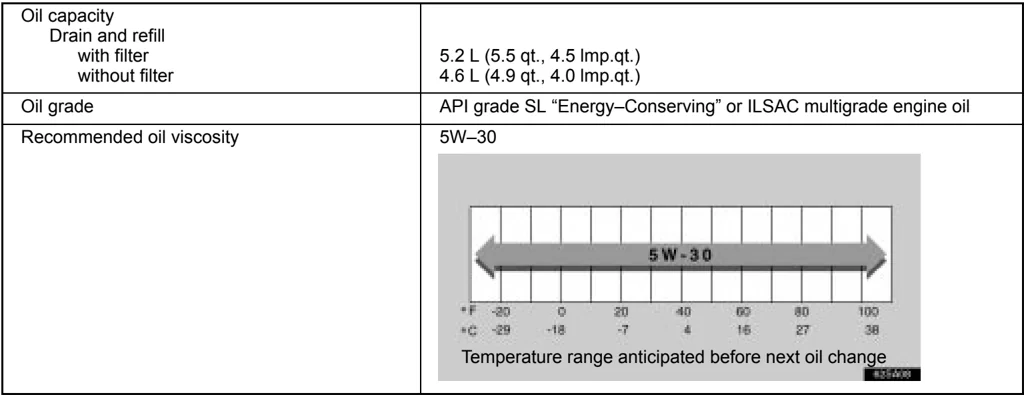
| Oil capacity | 5.2 L (5.5 qt., 4.5 Imp.qt.)4.6 L (4.9 qt., 4.0 Imp.qt.) |
|---|---|
| Oil grade | API grade SL “Energy-Conserving” or ILSAC multigrade engine oil |
| Recommended oil viscosity | 5W–30Temperature range anticipated before next oil change |
NOTE:
“Toyota Genuine Motor Oil” is filled in your Lexus vehicle. Use Lexus approved “Toyota Genuine Motor Oil” or equivalent to satisfy the above grade and viscosity. Please contact your Lexus dealer for further details.
2003 SC430 from May ’03 Prod. (OM24449U) 301
ENGINE
– COOLING SYSTEM
NOTE: “Toyota Genuine Long Life Coolant” is filled in your Lexus vehicle. In order to avoid technical problems, we strongly recommend using “Toyota Genuine Long Life Coolant” or equivalent. Please contact your Lexus dealer for further details.
– IGNITION SYSTEM
– ELECTRICAL SYSTEM
ENGINE
FUEL
Fuel type Your vehicle must use only unleaded gasoline.
To help prevent gas station mixups, your Lexus has a smaller fuel tank opening. The special nozzle on pumps with unleaded fuel will fit it, but the larger standard nozzle on pumps with leaded gas will not.
At a minimum, the gasoline you use should meet the specifications of ASTM D4814 in the U.S.A. and CGSB 3.5–M93 in Canada.
NOTICE Do not use leaded gasoline. Use of leaded gasoline will cause the three-way catalytic converter to lose its effectiveness and the emission control system to function improperly. Also, this can increase maintenance costs.
Octane rating Select premium unleaded gasoline with an Octane Rating of 91 (Research Octane Number 96) or higher for optimum engine performance. However, if such premium type cannot be obtained, you may temporarily use unleaded gasoline with an Octane Rating as low as 87 (Research Octane Number 91).
Use of unleaded fuel with an octane number or rating lower than stated above will cause persistent heavy knocking. If severe, this will lead to engine damage.
If your engine knocks ...
If you detect heavy knocking even when using the recommended fuel, or if you hear steady knocking while holding a steady speed on level roads, consult your Lexus dealer.
However, occasionally, you may notice light knocking for a short time while accelerating or driving up hills. This is normal and there is no need for concern.
Gasoline containing detergent additives Lexus recommends the use of gasoline that contains detergent additives to avoid build-up of engine deposits.
However, all gasoline sold in the U.S. contains detergent additives to keep clean and/or clean intake systems.
303
ENGINE
Quality gasoline Automotive manufacturers in the U.S., Europe and Japan have developed a specification for quality fuel named World-Wide Fuel Charter (WWFC) that is expected to be applied world wide. The WWFC consists of three categories that depend on required emission levels. In the U.S., category 3 has been adopted. The WWFC improves air quality by providing for better emissions in vehicle fleets, and customer satisfaction through better vehicle performance.
Cleaner burning gasoline Cleaner burning gasoline, including reformulated gasoline that contains oxygenates such as ethanol or MTBE is available in many areas.
Lexus recommends the use of cleaner burning gasoline and appropriately blended reformulated gasoline. These types of gasoline provide excellent vehicle performance, reduce vehicle emissions, and improve air quality.
Oxygenates in gasoline Lexus allows the use of oxygenate blended gasoline where the oxygenate content is up to 10% ethanol or 15% MTBE. If you use gasohol in your Lexus, be sure that it has an octane rating no lower than 87.
Lexus does not recommend the use of gasoline containing methanol.
Gasoline containing MMT Some gasoline contain an octane enhancing additive called MMT (Methylcyclopentadienyl Manganese Tricarbonyl).
Lexus does not recommend the use of gasoline that contains MMT. If fuel containing MMT is used, your emission control system may be adversely affected. The Malfunction Indicator Lamp on the instrument cluster may come on. If this happens, contact your Lexus dealer for service.
Gasoline quality In a very few cases, you may experience driveability problems caused by the particular gasoline that you are using. If you continue to have unacceptable driveability, try changing gasoline brands. If this does not rectify your problem, then consult your Lexus dealer.
NOTICE
- Do not use gasohol other than stated above. It will cause fuel system damage or vehicle performance problems.
- If driveability problems are encountered (poor hot starting, vaporizing, engine knock, etc.), discontinue its use.
304
ENGINE
- Take care not to spill gasohol during refueling. Gasohol may cause paint damage.
Fuel tank capacity 75 L (19.8 gal., 16.5 Imp.gal.)
FUEL PUMP SHUT OFF SYSTEM
The fuel pump shut off system stops supplying fuel to the engine to minimize the risk of fuel leakage when the engine stalls or an airbag inflates upon collision. To restart the engine after the fuel pump shut off system activates, turn the ignition switch to “ACC” or “LOCK” once and start it.
⚠ CAUTION Inspect the ground under the vehicle before restarting the engine. If you find that liquid has leaked onto the ground, it is the fuel system that has been damaged and it is in need of repair. In this case, do not restart the engine.
2003 SC430 from May ’03 Prod. (OM24449U) 305
ENGINE
FACTS ABOUT ENGINE OIL CONSUMPTION
Functions of engine oil
Engine oil has the primary function of lubricating and cooling the inside of the engine, and plays a major role in maintaining the engine in proper working order.
Engine oil consumption
It is normal that an engine should consume some engine oil during normal engine operation. The causes of oil consumption in a normal engine are as follows.
- Oil is used to lubricate pistons, piston rings and cylinders. A thin film of oil is left on the cylinder wall when a piston moves downwards in the cylinder. High negative pressure generated when the vehicle is decelerating sucks some of this oil into the combustion chamber. This oil as well as some part of the oil film left on the cylinder wall is burned by the high temperature combustion gases during the combustion process.
- Oil is also used to lubricate the stems of the intake valves. Some of this oil is sucked into the combustion chamber together with the intake air and is burned along with the fuel. High temperature exhaust gases also burn the oil used to lubricate the exhaust valve stems.
The amount of engine oil consumed depends on the viscosity of the oil, the quality of the oil and the way the vehicle is driven.
More oil is consumed by high-speed driving and frequent acceleration and deceleration.
A new engine consumes more oil, since its pistons, piston rings and cylinder walls have not become conditioned.
Oil consumption: Max. 1.0 L per 1000 km (1.1 qt./600 miles, 0.9 Imp·qt./600 miles).
When judging the amount of oil consumption, keep in mind that the oil may have become diluted, making it difficult to judge the true level accurately.
For example, if a vehicle is used for repeated short trips and consumes a normal amount of oil, the dipstick may not show any drop in the oil level at all, even after 1000 km (600 miles) or more. This is because the oil is gradually becoming diluted with fuel or moisture, making it appear that the oil level has not changed.
The diluting ingredients evaporate out when the vehicle is then driven at high speeds, as on an expressway, making it appear that oil is excessively consumed after driving at high speeds.
306
ENGINE
Importance of engine oil level check One of the most important points in proper vehicle maintenance is to keep the engine oil at the optimum level so that oil function will not be impaired. Therefore, it is essential that the oil level be checked regularly. Lexus recommends that the oil level be checked every time you refuel the vehicle.
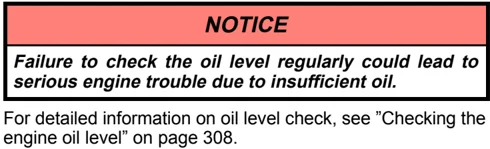
NOTICE Failure to check the oil level regularly could lead to serious engine trouble due to insufficient oil.
For detailed information on oil level check, see "Checking the engine oil level" on page 308.
USED ENGINE OIL
CAUTION
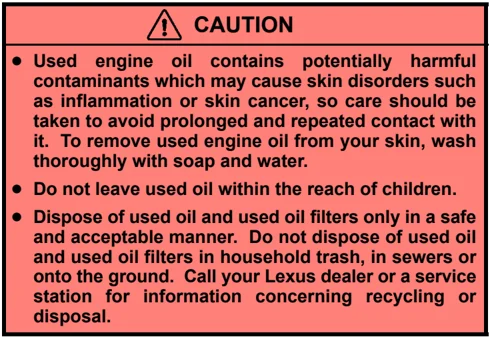
- Used engine oil contains potentially harmful contaminants which may cause skin disorders such as inflammation or skin cancer, so care should be taken to avoid prolonged and repeated contact with it. To remove used engine oil from your skin, wash thoroughly with soap and water.
- Do not leave used oil within the reach of children.
- Dispose of used oil and used oil filters only in a safe and acceptable manner. Do not dispose of used oil and used oil filters in household trash, in sewers or onto the ground. Call your Lexus dealer or a service station for information concerning recycling or disposal.
307
ENGINE
CHECKING THE ENGINE OIL LEVEL
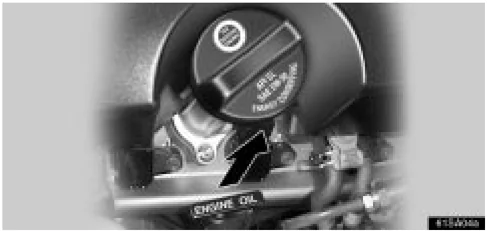
With the engine at operating temperature and turned off, check the oil level on the dipstick.
- To get a true reading, the vehicle should be on a level ground. After turning off the engine, wait a few minutes for the oil to drain back into the bottom of the engine.
- Pull the dipstick out, hold a rag under the end and wipe it clean.
- Standing up on the left side of the vehicle, reinsert the dipstick in the direction so that the "ENGINE OIL" on top should be read correctly and push it in as far as it will go, or the reading will not be correct.
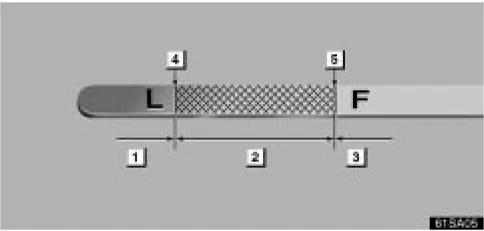
[1] Add oil [2] O.K. [3] Too full
- Pull the dipstick out and look at the oil level while holding a rag under the end. If it is between the full line ( [5] ) and the low line ( [4] ), it is O.K.
NOTICE Be careful not to drop the engine oil on the vehicle components.
308
ENGINE
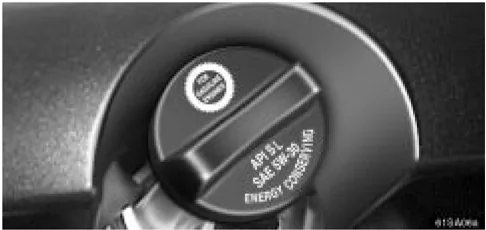
If the oil level is below or only slightly above the low line, add engine oil of the same type as already in the engine.
Remove the oil filler cap and add engine oil a little at a time, checking the dipstick. We recommend that you use a funnel when adding oil. The approximate quantity of oil needed to fill between the low line and the full line on the dipstick is indicated below for reference.
When the level reaches within the correct range, return the filler cap and turn the cap clockwise until you hear a click.
Oil quantity. L (qt., Imp. qt.) 1.5 (1.6, 1.3)
NOTICE
- Be careful not to spill the engine oil on the vehicle components.
- Avoid overfilling, or the engine could be damaged.
- Check the oil level on the dipstick once again after adding the oil.
309
ENGINE
Engine oil selection
"Toyota Genuine Motor Oil" is filled in your Lexus vehicle. Use Lexus approved "Toyota Genuine Motor Oil" or equivalent to satisfy the following grade and viscosity.
Oil grade: API grade SL "Energy–Conserving" or ILSAC multigrade engine oil.
Recommended viscosity: 5W–30
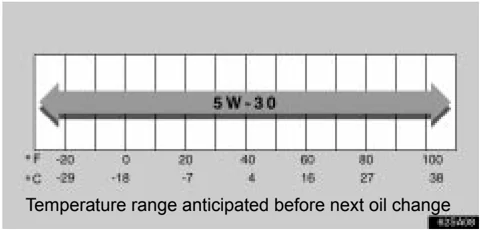
SAE 5W–30 is the best choice for your vehicle, for good fuel economy, and good starting in cold weather.
If SAE 5W–30 is not available, SAE 10W–30 may be used. However, it should be replaced with SAE 5W–30 at the next oil change.
Oil identification marks
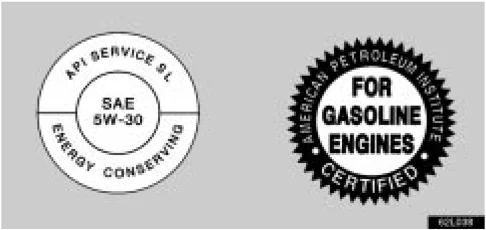
►API Service Symbol ►ILSAC Certification Mark
Either or both API registered marks are added to some oil containers to help you select the oil you should use.
- The API Service Symbol is located anywhere on the outside of the container.
The top portion of the label shows the oil quality by API (American Petroleum Institute) designation such as SL. The center portion of the label shows the SAE viscosity grade such as SAE 5W–30. "Energy–Conserving", shown in the lower portion, indicates that the oil has fuel–saving capabilities.
- The ILSAC (International Lubricant Standardization and Approval Committee) Certification Mark is displayed on the front of the container.
310
To ensure excellent lubrication performance for your engine, “Toyota Genuine Motor Oil” is available, which has been specifically tested and approved for all Lexus engines.
Please contact your Lexus dealer for further details about “Toyota Genuine Motor Oil”.
ENGINE
CHECKING THE ENGINE COOLANT LEVEL
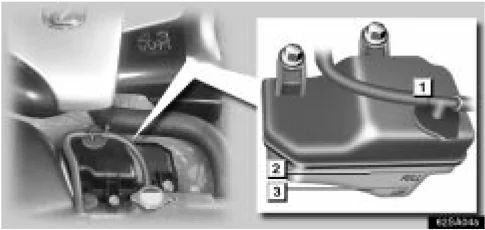
► 1 Reservoir cap 2 Upper line 3 Lower line
Look at the see-through coolant reservoir when the engine is cold. The coolant level is satisfactory if it is between the "FULL" and "LOW" lines on the reservoir. If the level is low, add ethylene-glycol type coolant for a proper corrosion protection of aluminum components.
The coolant level in the reservoir will vary with engine temperature. However, if the level is on or below the "LOW" line, add coolant. Bring the level up to the "FULL" line.
Always use ethylene-glycol type coolant for a proper corrosion protection of aluminum components. See information in the next column.
311
ENGINE
If the coolant level drops within a short time after replenishing, there may be a leak in the system. Visually check the radiator, hoses, engine coolant filler cap, radiator cap and drain cock and water pump.
If you can find no leak, have your Lexus dealer test the cap pressure and check for leaks in the cooling system.
CAUTION To prevent burning yourself, do not remove the radiator cap when the engine is hot.
Coolant type selection
Use of improper coolants may damage your engine cooling system. Your coolant must contain ethylene-glycol type coolant for proper corrosion protection of your engine that contains aluminum components. We have used “Toyota Genuine Long Life Coolant” in your Lexus vehicle. In order to avoid technical problems, we strongly recommend using “Toyota Genuine Long Life Coolant” or equivalent.
In addition to preventing freezing and subsequent damage to the engine, this type of coolant will also prevent corrosion. Further supplemental inhibitors or additives are neither needed nor recommended.
Read the coolant container for information on freeze protection. Follow the manufacturer’s directions for how much to mix with plain water (preferably demineralized water or distilled water). The total capacity of the cooling system is given on pages 302.
We recommend a 50% solution for your Lexus, to provide protection down to about –35°C (–31°F). When it is extremely cold, to provide protection down to about –50°C (–58°F), a 60% solution is recommended. Do not use more than 70% solution for better coolant performance.
NOTICE Do not use alcohol type antifreeze or plain water alone.
312
ENGINE
The engine cooling system is integral to maximizing performance of your Lexus vehicle. In line with this, it is strongly recommended that you use “Toyota Genuine Long Life Coolant” for protecting the system, as it is an ethylene-glycol based premium antifreeze coolant with excellent corrosion protection properties that has been specifically formulated for use in Lexus vehicles.
Please contact your Lexus dealer for further details about “Toyota Genuine Long Life Coolant”.
CHECKING THE RADIATOR AND CONDENSER
If either of the above parts are extremely dirty or you are not sure of their condition, take your vehicle to a Lexus dealer.
CAUTION To prevent burning yourself, be careful not to touch the radiator or condenser when the engine is hot.
NOTICE To prevent damage to the radiator and condenser, do not perform the work by yourself.
313

ENGINE
SPARK PLUGS
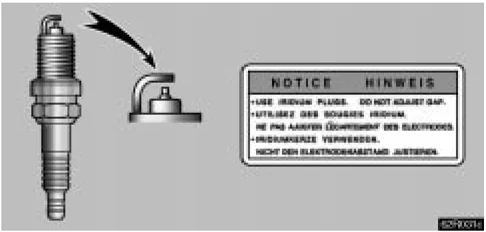
Your engine is fitted with iridium-tipped spark plugs.
NOTICE Use only iridium-tipped spark plugs and do not adjust gaps for your engine performance and smooth drivability.
314
SECTION 6 – 3
SERVICE PROCEDURES AND SPECIFICATIONS
Chassis
- Specifications . . . . . . . . . . . . . . . . . . . . . . . . . . . . . . . . . . . . . . . . . . . . . . . . . . . . . . . . . . . . . . . . . . . . . . . . . . . . . . . . . . . . . . . . . . . . . . . . . . . . . . . . . . . . . . . . . . . . . . . . . . . . . . . . . . . . . . . . . . . . . . . . . . . . . . . . . . . . . . . . . . . . . . . . . . . . . . . . . . . . . . . . . . . . . . . . . . . . . . . . . . . . . . . . . . . . . . . . ........ 316
- Checking brake fluid . . . . . . . . . . . . . . . . . . . . . . . . . . . . . . . . . . . . . . . . . . . . . . . . . . . . . . . . . . . . . . . . . . . . . . . . . . . . . . . . . . . . . . . . . . . . . . . . . . . . . . . . . . . . . . . . . . . ........ 319
- Checking power steering fluid . . . . . . . . . . . . . . . . . . . . . . . . . . . . . . . . . . . . . . . . . . . . . . . . . . . . . . . . . . . . . . . . . . . . . . . . . . . . . . . . . . . . . . . . . . . . . . . . . . . . . . . . . . . . . . . ........

CHASSIS
SPECIFICATIONS
– DIFFERENTIAL
| Oil capacity | 1.35 L (1.42 qt., 1.19 Imp.qt.) | |
|---|---|---|
| Oil type and viscosity | Vehicles without synthetic oil information label | Hypoid gear oil API GL–5Above –18°C (0°F): SAE 90Below –18°C (0°F): SAE 80W or SAE 80W–90 |
| Vehicles with synthetic oil information label* | Toyota Genuine Differential Synthetic gear oilAPI GL–5 SAE 75W–90 or its equivalent |
NOTE:
Vehicles with synthetic oil information label only:
The following label is affixed on the right side of the differential carrier. Use the type and viscosity shown on the label when the differential oil is replaced.
SYNTHETIC ONLY SAE 75W-90 API GL-5
Synthetic oil information label
NOTICE
Vehicles with synthetic oil information label only:
Use of differential oil other than “Toyota Genuine Differential Synthetic gear oil API GL–5 SAE 75W–90” or its equivalent may damage the differential gear of your vehicle and diminish fuel efficiency. For the reasons mentioned above, Lexus recommends use of “Toyota Genuine Differential Synthetic gear oil API GL–5 SAE 75W–90”. Another differential oil of matching quality can also be used, (but note that despite the similarity in nomenclature between “Toyota Genuine Differential Synthetic gear oil API GL–5 SAE 75W–90” and oils that meet SAE 75W–90 specifications, compliance with the SAE specification does not guarantee that an oil has all characteristic required to avoid the problem described above.) If you are unable to locate an equivalent to “Toyota Genuine Differential Synthetic gear oil API GL–5 SAE 75W–90”, contact your Lexus dealer for further details or another duly qualified and equipped professional.
CHASSIS
– AUTOMATIC TRANSMISSION
| Fluid capacity Drain and refill | 1.8 L (1.9 qt., 1.6 Imp.qt.) |
|---|---|
| Fluid type | Toyota Genuine ATF Type T–IV* |
*Change automatic transmission fluid only as necessary. Generally, it is necessary to change automatic transmission fluid only if your vehicle is driven under one of the Special Operating Conditions listed in your “Owner’s Manual Supplement / Scheduled Maintenance”. When changing the automatic transmission fluid, use only “Toyota Genuine ATF Type T–IV” (ATF JWS3309 or NWS6500) to aid in assuring optimum transmission performance.
NOTICE
Using automatic transmission fluid other than Toyota Genuine ATF Type T–IV may cause deterioration in shift quality, locking up of your transmission accompanied by vibration, and ultimately damage the automatic transmission of your vehicle.
– BRAKES
| Pedal clearance *1 | 100 mm (3.9 in.) Min. |
|---|---|
| Pedal free play | 0.2 – 20 mm (0.008 – 0.08 in.) |
| Brake pad wear limit | 1.0 mm (0.04 in.) |
| Parking brake lining wear limit | 1.0 mm (0.04 in.) |
| Parking brake adjustment *2 | 7 – 9 clicks |
| Fluid type | SAE J1703 or FMVSS No. 116 DOT 3 |
*1: Minimum pedal clearance when depressed with the pressure of 196 N (20 kgf, 44 lbf.) with the engine running
*2: Parking brake adjustment when depressed with the pressure of 294 N (30 kgf, 66 lbf.)
– STEERING
| Free play | Less than 30 mm (1.2 in.) |
|---|---|
| Power steering fluid | Automatic transmission fluid DEXRON®II or III |
2003 SC430 from May ’03 Prod. (OM24449U) 317
CHASSIS
– TIRES AND WHEELS
Standard and run–flat tires:
Compact spare tire:
NOTE: For complete information on tires (e.g. replacing tires or replacing wheels), see “Checking tire pressure” through “Aluminum wheel precautions” on page 321 through 330.
CHASSIS
CHECKING BRAKE FLUID
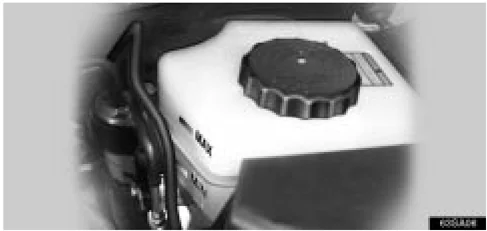
To check the fluid level, simply look at the see-through reservoir. The level should be between the "MAX" and "MIN" lines on the tank.
It is normal for the brake fluid level to go down slightly as the brake pads wear or when the fluid level in the accumulator is high.
If the reservoir needs frequent refilling, it may indicate a serious mechanical problem.
If the level is low, add FMVSS No.116 DOT 3 or SAE J1703 brake fluid to the brake reservoir.
Refilling brake fluid:
- Turn the ignition switch off.
- Depress the brake pedal more than 40 times.
- Remove the reservoir cap by hand. Add brake fluid up to the "MAX" line.
If you do not follow the procedure above, the reservoir may overflow.
Use only newly opened brake fluid. Once opened, brake fluid absorbs moisture from the air, and excess moisture can cause a dangerous loss of braking efficiency.
CAUTION Take care when filling the reservoir because brake fluid can harm your hands or eyes and damage painted surfaces. If fluid gets in your eyes, flush your eyes with clean water immediately. If you still feel uncomfortable with your eyes, go to the doctor.
NOTICE If you spill some of the fluid, be sure to wipe it off to prevent it from damaging the parts or paintwork.
2003 SC430 from May '03 Prod. (OM24449U) 319
CHASSIS
CHECKING POWER STEERING FLUID
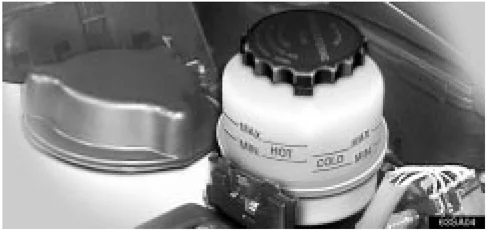
Check the fluid level on the dipstick. If necessary, add automatic transmission fluid DEXRON®II or III.
If the vehicle has been driven around 80 km/h (50 mph) for 20 minutes (a little more in frigid temperatures), the fluid is hot (60°C – 80°C or 140°F – 175°F). You may also check the level when the fluid is cold (about room temperature, 10°C – 30°C or 50°F – 85°F) if the engine has not been run for about five hours.
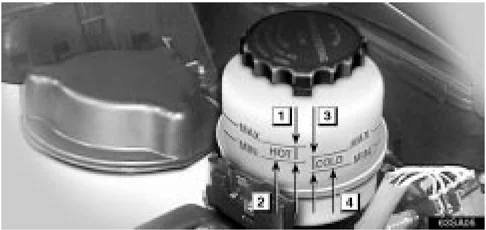
▶ 1 If hot O.K. 2 If hot add 3 If cold O.K. 4 If cold add
Clean all dirt off the reservoir and look at the fluid level. If the fluid is cold, the level should be in the "COLD" range. Similarly, if it is hot, the fluid level should be in the "HOT" range. If the level is at the low side of the appropriate range, add automatic transmission fluid DEXRON®II or III to bring the level within the range.
To remove the reservoir cap, turn it counterclockwise and lift up. To reinstall it, turn it clockwise. After replacing the reservoir cap, visually check the steering box case, vane pump and hose connections for leaks or damage.
320
CHASSIS
CAUTION The reservoir may be hot so be careful not to burn yourself.
NOTICE
- Avoid overfilling, or the power steering could be damaged.
- When adding the power steering fluid, avoid spilling it. The generator under the power steering reservoir could be damaged if fluid is spilled on it.
CHECKING TIRE PRESSURE
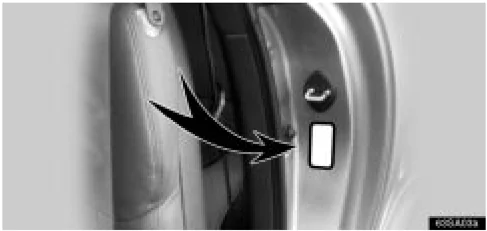
The recommended cold tire pressure, tire size and the vehicle capacity weight are given on the label.
You should check the tire pressure every two weeks, or at least once a month. And don't forget the spare, if so equipped. The pressure for the spare tire should be 420 kPa (4.3 kgf/cm², 4.2 bar, 60 psi).
Incorrect tire pressure may waste fuel, reduce the comfort of driving, reduce tire life and make your vehicle less safe to drive.
If a tire needs frequent refilling, have it checked by your Lexus dealer.
2003 SC430 from May '03 Prod. (OM24449U) 321

CHASSIS
CAUTION Keep your tire pressure properly inflated. Otherwise, the following conditions may occur and cause an accident resulting in death or serious injuries.
Low tire pressure (underinflation):
- Excessive wear
- Uneven wear
- Poor handling
- Possibility of blowouts from overheated tire.
- Poor sealing of the tire bead
- Wheel deformation and/or tire separation
High tire pressure (overinflation):
- Poor handling
- Excessive wear at the center of the tire tread
- A greater possibility of tire damage from road hazards
The following instructions for checking tire pressure should be observed:
- The pressure should be checked only when the tires are cold. If your vehicle has been parked for at least 3 hours and has not been driven for more than 1.5 km or 1 mile since, you will get an accurate cold tire pressure reading.
- If you cannot adjust the tire pressure when the tires are cold, add 10 to 20 kPa more to the front tires and rear tires than the cold tire pressure, but never exceed the maximum cold tire pressure molded on the tire sidewall.
- Always use a tire pressure gauge. The appearance of the tire can be misleading. Besides, tire pressures that are even just a few pounds off can degrade handling and ride.
- Do not bleed or reduce tire pressure after driving. It is normal for the tire pressure to be higher after driving.
- Never exceed the vehicle capacity weight. The passengers and luggage weight should be located so that the vehicle is balanced.
- Be sure to reinstall the tire valve caps. Without the valve caps, dirt or moisture could get into the valve core and cause air leakage. If the caps have been lost, have new ones put on as soon as possible.
CAUTION The pressure for the compact spare tire must be 420 kPa (4.3 kgf/cm², 4.2 bar, 60 psi).
322
CHASSIS
ROTATING TIRES
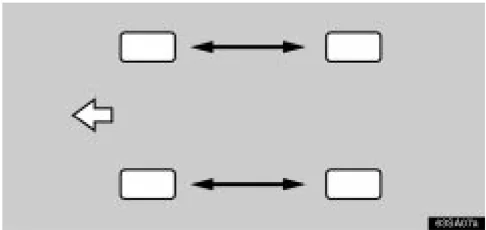
To equalize tire wear and help extend tire life, Lexus recommends that you rotate your tires according to the maintenance schedule. (For scheduled maintenance information, please refer to the “Owner’s Manual Supplement” or “Scheduled Maintenance”. ) However, the most appropriate timing for tire rotation may vary according to your driving habits and road surface conditions.
The wheel assemblies must be rotated as illustrated above.
When rotating tires, check for uneven wear and damage. Abnormal wear is usually caused by incorrect tire pressure, improper wheel alignment, out-of-balance wheels, or severe braking.
Before storing radial, snow or studded tires, mark the direction of rotation and be sure to install them in the same direction when using them again. Tires should be stored in a cool dry place.
CHECKING AND REPLACING TIRES
When to replace your tires
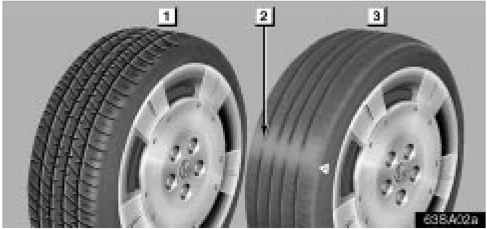
▶ 1 New tread 2 Tread wear indicator 3 Worn tread
Replace the tires when the tread wear indicators show. The location of the tread wear indicators is shown by the “TWI” or “ ” marks molded on the sidewall of each tire.
2003 SC430 from May ’03 Prod. (OM24449U) 323
CHASSIS
The tires on your Lexus have built-in tread wear indicators to help you know when the tires need replacement. When the tread depth wears to 1.6 mm (0.06 in.) or less, the indicators will appear. If you can see the indicators in two or more adjacent grooves, the tire should be replaced.
Your vehicle is equipped with 245/40ZR18 or 245/40ZR18 93Y tires: Your Lexus has been fitted with specially developed tires which provide exceptional dynamic performance under general road conditions. However your riding comfort may worsen a little and road noise may increase during driving. Riding comfort and road noise with the run-flat tires may be a little worse than that with the standard tires. You may also notice that your tires will wear more rapidly and tire grip performance will be reduced on the snowy and/or icy roads when compared to high aspect ratio tires, etc. Be sure to have snow tires or tire chains on the snowy and/or icy roads and drive carefully with the speed appropriate for road conditions.
NOTICE Low profile tire like 245/40ZR18 or 245/40ZR18 93Y may have greater damage than usual tires to its tire wheel when receiving impact from the road surface. Therefore, pay attention to the following.
- Be sure to use with proper tire pressure. If the tire pressure is low, the tire may have greater damage. For detailed information about tire pressure, see page 318 or 321.
- Avoid driving onto high, sharp-edged objects and other road hazards. Failure to do so can lead to severe tire damage.
The effectiveness of snow tires is lost if the tread wears down below 4 mm (0.16 in.).
If you have tire damage such as cuts, splits, cracks deep enough to expose the fabric, or bulges indicating internal damage, the tire should be replaced.
If a tire often goes flat or cannot be properly repaired due to the size or location of a cut or other damage, it should be replaced. If you are not sure, consult with your Lexus dealer.
If an air loss occurs while driving, do not continue driving with a deflated tire. Driving even a short distance can damage a tire beyond repair.
324
CHASSIS
Any tires which are over 6 years old must be checked by a qualified technician even if damage is not obvious. Tires deteriorate with age even if they have never or seldom been used. This also applies to the spare tire and tires stored for future use.
NOTICE
- When you purchase new tires, consult your Lexus dealer. If you change from run-flat tires to standard tires, a spare tire should also be purchased.
- When the tires must be repaired or replaced, have them repaired or replaced by Lexus dealer or authorized dealer. The tire pressure sensors will be affected by the installation or removal of tires.
- When the tires must be replaced, replace the grommets for air pressure sensors as well.
Uniform tire quality grading This information has been prepared in accordance with regulations issued by the National Highway Traffic Safety Administration of the U.S. Department of Transportation. It provides the purchasers and/or prospective purchasers of Lexus vehicles with information on uniform tire quality grading. Your Lexus dealer will help answer any questions you may have as you read this information. DOT quality grades – All passenger vehicle tires must conform to Federal Safety Requirements in addition to these grades. Quality grades can be found where applicable on the tire sidewall between tread shoulder and maximum section width. For example: Treadwear 200 Traction AA Temperature A Tread wear – The treadwear grade is a comparative rating based on the wear rate of the tire when tested under controlled conditions on a specified government test course. For example, a tire graded 150 would wear one and a half (1 – 1/2) times as well on the government course as a tire graded 100. The relative performance of tires depends upon the actual conditions of their use, however, and may depart significantly from the norm due to variations in driving habits, service practices and differences in road characteristics and climate.
2003 SC430 from May '03 Prod. (OM24449U) 325
CHASSIS
Traction AA, A, B, C – The traction grades, from highest to lowest, are AA, A, B and C, and they represent the tire’s ability to stop on wet pavement as measured under controlled conditions on specified government test surfaces of asphalt and concrete. A tire marked C may have poor traction performance.
Warning: The traction grade assigned to this tire is based on braking (straight ahead) traction tests and does not include cornering (turning) traction.
Temperature A, B, C – The temperature grades are A (the highest), B, and C, representing the tire’s resistance to the generation of heat and its ability to dissipate heat when tested under controlled conditions on a specified indoor laboratory test wheel. Sustained high temperature can cause the material of the tire to degenerate and reduce tire life, and excessive temperature can lead to sudden tire failure. The grade C corresponds to a level of performance which all passenger car tires must meet under the Federal Motor Vehicle Safety Standard No. 109. Grades B and A represent higher levels of performance on the laboratory test wheel than the minimum required by law.
Warning: The temperature grades for this tire are established for a tire that is properly inflated and not overloaded. Excessive speed, underinflation, or excessive loading, either separately or in combination, can cause heat buildup and possible tire failure.
Tire selection
When replacing a tire, use a tire of the same size and construction, and the same or greater load capacity as the originally installed tires.
Using any other size or type of tire may seriously affect handling, ride, speedometer/odometer calibration, ground clearance, and clearance between the body and tires or snow chains.
CAUTION Observe the following instructions. Otherwise, an accident may occur resulting in death or serious injuries.
• Do not mix radial, bias belted, or bias–ply tires on your vehicle, as this may cause dangerous handling characteristics resulting in loss of control.
• Do not mix run–flat tires or standard tires on your vehicle.
• Do not use tires other than the manufacturer’s recommended size, as this may cause dangerous handling characteristics resulting in loss of control.
If you need to change from conventional tires to radial tires or vice versa, replace them as a set.
326
CHASSIS
INSTALLING SNOW TIRES AND CHAINS
When to use snow tires or chains
Snow tires or chains are recommended when driving on snow or ice.
On wet or dry road, conventional or radial tires provide better traction than snow or studded tires.
Snow tire selection
If you need snow tires, select tires of the same size, construction and load capacity as the originally installed tires.
Do not use tires other than stated above. Since your vehicle has radial tires as original equipment, make sure your snow tires also have radial construction. Do not install studded tires without first checking local regulations for possible restrictions.
CAUTION Observe the following instruction. Otherwise, an accident may occur resulting in death or serious injuries.
- Do not use snow tires other than the manufacturer's recommended size, as this may cause dangerous handling characteristics resulting in loss of control.
Snow tire installation
Snow tires should be installed on all wheels.
Installing snow tires on the rear wheels only can lead to an excessive difference in road grip capability between the front and rear tires which could cause loss of vehicle control.
CAUTION
- Do not drive with the snow tires incorrectly inflated.
- Never drive over 120 km/h (75 mph) with any type of snow tires.
Tire chain selection
Regulations regarding the use of tire chains vary according to location or type of road. Always check the local regulations before installing chains.
Use SAE Class "S" type radial tire chains, with the exception of radial cable chains or V-bar type chains.
Chain installation
Install the chains on the rear tires as tightly as possible. Do not use tire chains on the front tires. Retighten chains after driving 0.5 – 1.0 km (1/4 – 1/2 mile).
When installing chains on your tires, carefully follow the instructions of the chain manufacturer.
2003 SC430 from May '03 Prod. (OM24449U) 327
CHASSIS
NOTICE
- When the snow tires must be repaired or replaced, have them repaired or replaced by Lexus dealer or authorized tire dealer. The tire pressure sensor will be affected by the installation or removal of snow tires.
- When the snow tires must be replaced, replace the grommets for air pressure sensors as well.
- Do not attempt to use a tire chain on the compact spare tire, as it may result in damage to the vehicle as well as the tire.
INFORMATION
If the chains are installed, the air pressure warning system may not operate properly.
CAUTION
-
Do not exceed 50 km/h (30 mph) or the chain manufacturer’s recommended speed limit, whichever is lower.
-
Drive carefully avoiding bumps, holes, and sharp turns, which may cause the vehicle to bounce.
-
Avoid sharp turns or locked-wheel braking, as use of chains may adversely affect vehicle handling.
-
When driving with chains installed, be sure to drive carefully. Slow down before entering curves to avoid losing control of the vehicle. Otherwise an accident may occur.
REPLACING WHEELS
As you might have difficulty in identifying a flat or deflated tire, a tire pressure warning system is provided on this vehicle.
When replacing the wheels, be sure to install air pressure sensors on the wheels.
There are 2 ways to set up the air pressure sensors.
a. Remove the sensor from the old wheel and install it to the new wheel.
b. Use a new wheel and sensor.
You have to register an ID code for a new sensor. Up to 2 sets of codes can be registered. As one ID for the originally installed sensor is registered at “MAIN” of the selector switch, use the “2nd” position to register an ID for the new sensor.
You do not need to re-register the ID code for any other replacements. For the use of the originally installed tires, put the selector switch at “MAIN” and for the use of tires purchased later, put the switch at “2nd”. For the sensor selector switch, see page 224.
328

CHASSIS
CAUTION
- Have the tires, wheels or sensors replaced and ID codes registered by Lexus dealer. If you need sensors, purchase from Lexus dealer.
- The use of non-genuine wheels will cause the air pressure sensor to transmit the electronic code in different manner, resulting in the failure of the system.
When to replace your wheels
If you have wheel damage such as bending, cracks or heavy corrosion, the wheel should be replaced.
If you fail to replace a damaged wheel, the tire may slip off the wheel or cause loss of handling control.
Wheel selection
When replacing wheels, care should be taken to ensure that they are equivalent to those removed in load capacity, diameter, rim width, and offset.
Correct replacement wheels are available at your Lexus dealer.
A wheel of a different size or type may adversely affect handling, wheel and bearing life, brake cooling, speedometer/odometer calibration, stopping ability, headlight aim, bumper height, vehicle ground clearance, and tire or snow chain clearance to the body and chassis.
Replacement with used wheels is not recommended as they may have been subjected to rough treatment or high mileage and could fail without warning. Also, bent wheels which have been straightened may have hidden structural damage and therefore should not be used. Never use an inner tube in a leaking wheel which is designed for a tubeless tire.
CAUTION Observe the following instruction. Otherwise, an accident may occur resulting in death or serious injuries.
- Do not use wheels other than the manufacturer's recommended size, as this may cause dangerous handling characteristics resulting in loss of control.
2003 SC430 from May '03 Prod. (OM24449U) 329
CHASSIS
ALUMINUM WHEEL PRECAUTIONS
- When installing aluminum wheels, check that the wheel nuts are tight after driving your vehicle the first 1600 km (1000 miles).
- If you have rotated, repaired, or changed your tires, check that the wheel nuts are still tight after driving 1600 km (1000 miles).
- When using tire chains, be careful not to damage the aluminum wheels.
- Use only the Lexus wheel nuts and wrench designed for your aluminum wheels.
- When balancing your wheels, use only Lexus balance weights or equivalent and a plastic or rubber hammer.
- As with any wheel, periodically check your aluminum wheels for damage. If damaged, replace immediately.
SUSPENSION AND CHASSIS
CAUTION Do not modify the suspension/chassis with lift kits, spacers, springs, etc. It can cause dangerous handling characteristics, resulting in loss of control.
330
SECTION 6 – 4
SERVICE PROCEDURES AND SPECIFICATIONS
Electrical components
- Specifications . . . . . . . . . . . . . . . . . . . . . . . . . . . . . . . . . . . . . . . . . . . . . . . . . . . . . . . . . . . . . . . . . . . . . . . . . . . . . . . . . . . . . . . . . . . . . . . . . . . . . . . . . . . . . . . . . . . . . . . . . . . . . . . . . . . . . . . . . . . . . . . . . . . . . . . . . . . . . . . . . . . . . . . . . . . . . . . . . . . . . . . . . . . . . . . . . . . . . . . . . . . . . . . . ........ 332
- Checking battery condition . . . . . . . . . . . . . . . . . . . . . . . . . . . . . . . . . . . . . . . . . . . . . . . . . . . . . . . . . . . . . . . . . . . . . . . . . . . . . . . . . . . . . . . . . . . . . . . . . . . . . . . . . . . . . . . . ........ 336
- Battery recharging precautions . . . . . . . . . . . . . . . . . . . . . . . . . . . . . . . . . . . . . . . . . . . . . . . . . . . . . . . . . . . . . . . . . . . . . . . . . . . . . . . . . . . . . . . . . . . . . . . . . . . . . . . . . . . ........

ELECTRICAL COMPONENTS
SPECIFICATIONS –LOCATION OF FUSES
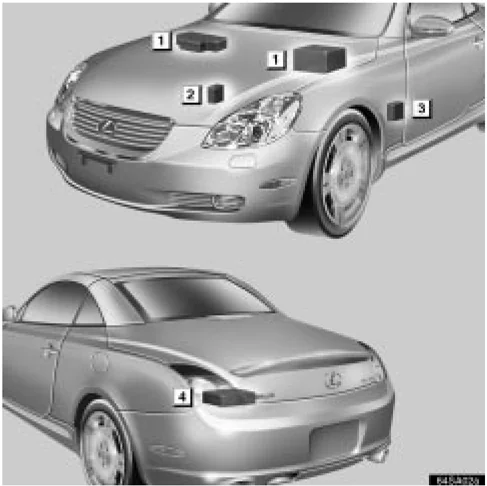
▶ 1 Engine compartment 2 Passenger’s side kick panel 3 Driver’s side kick panel 4 Trunk
– FUSES
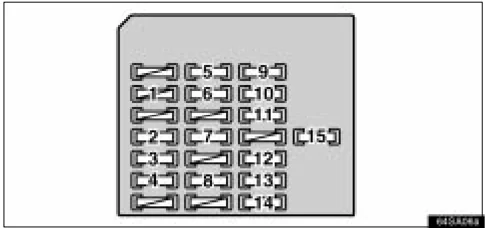
▶Driver’s side kick panel
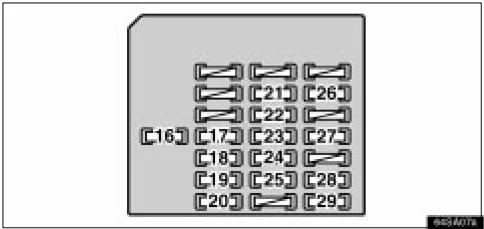
▶Passenger’s side kick panel
332
ELECTRICAL COMPONENTS
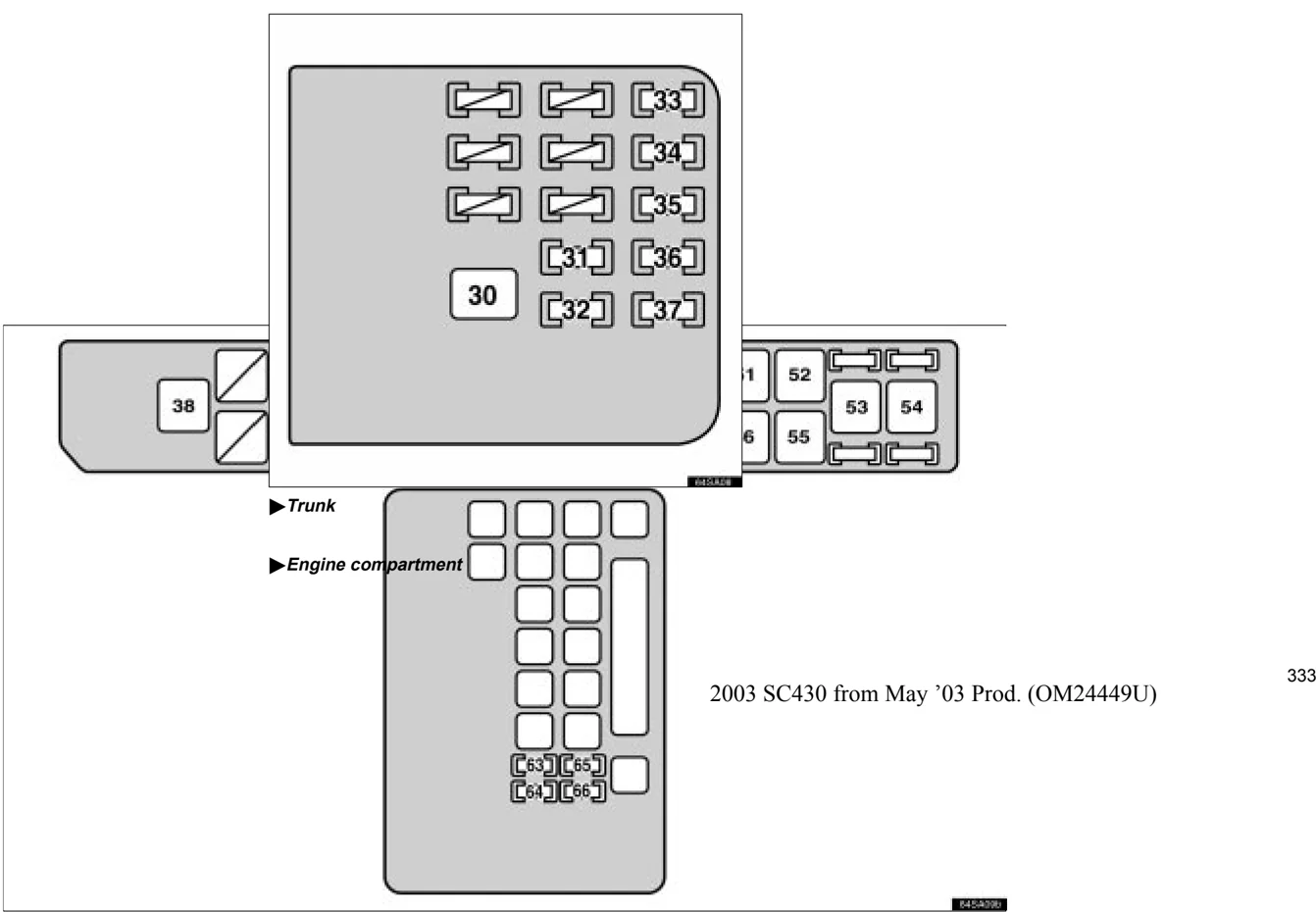
►Trunk ►Engine compartment
333