STARTING AND DRIVING
2 Cancelling the preset speed You can cancel the preset speed by either of the following: a. Pulling the control lever in the "CANCEL" direction. b. Depressing the brake pedal.
If the vehicle speed falls below about 40 km/h (25 mph), the preset speed will be automatically cancelled.
If the vehicle speed drops 16 km/h (10 mph) below the preset speed, the preset speed will also automatically be cancelled.
If the preset speed automatically cancels out for other than these reasons, have your vehicle checked by your Lexus dealer at the earliest opportunity.
3 Resetting to a faster speed Press the control lever upward in the "RES/ACC" direction and hold it. Release the lever when the desired speed is attained. While the lever is held upward, the vehicle will gradually gain speed.
When the difference between the actual vehicle speed and the set speed is less than 5 km/h (3 mph), the set speed can be increased 1.6 km/h (1 mph) each time by pressing the control lever upward in the "RES/ACC" direction quickly within 0.6 seconds.
However, a quicker way to reset is to accelerate the vehicle and then press the control lever downward in the "SET/COAST" direction.
4 Resetting to a slower speed Press the control lever downward in the "SET/COAST" direction and hold it. Release the lever when the desired speed is attained. While the lever is held downward, the vehicle speed will gradually decrease.
When the difference between the actual vehicle speed and the set speed is less than 5 km/h (3 mph), the set speed can be lowered 1.6 km/h (1 mph) each time by pressing the control lever downward in the "SET/COAST" direction quickly within 0.6 seconds.
However, a quicker way to reset is to depress the brake pedal and then press the control lever downward in the "SET/COAST" direction.
Even if you downshift the transmission from "D" position to "4" with the cruise control on, engine braking will not be applied because the cruise control is not cancelled. To decrease the vehicle speed, reset to a slower speed with the cruise control lever or depress the brake pedal. If you use the brake pedal, cruise control is cancelled.
5 Resuming the preset speed If the preset speed is cancelled by pulling the control lever or by depressing the brake pedal or vehicle stability control activation, pushing the lever up in the "RES/ACC" direction will restore the speed set prior to cancellation. However, once the vehicle speed falls below about 40 km/h (25 mph), the preset speed will not be resumed.
208
STARTING AND DRIVING
Cruise control failure warning
If the "CRUISE" indicator light in the instrument cluster flashes when using the cruise control, push the main switch to turn the system off and then push it again to turn it on.
If any of the following conditions then occurs, there is some trouble in the cruise control system.
- The indicator light does not come on.
- The indicator light flashes again.
- The indicator light goes out after it comes on.
If this is the case, contact your Lexus dealer and have your Lexus inspected.
TRACTION CONTROL SYSTEM
The traction control system automatically helps control the spinning of the rear wheels which may occur when accelerating on slippery road surfaces, thus assisting driver to control the driving power of the rear wheels.
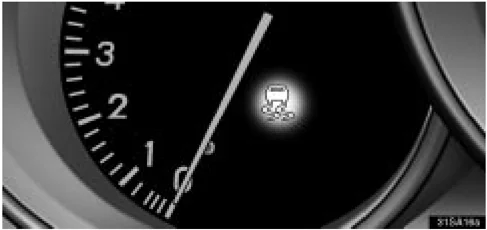
►Slip indicator light
When you turn the ignition switch on, this system always turns on. Leave the system on during ordinary driving so that it can operate when needed. When traction control is applied, the slip indicator light blinks.
You may hear a sound in the engine compartment for a few seconds when the engine is started or just after the vehicle begins to move. This means that the traction control system is in the self-check mode, and does not indicate malfunction.
When the traction control system is operating, you may feel vibration of your vehicle, caused by operation of the brakes. This indicates the system is functioning properly.
203 SC430 from May '03 Prod. (OM24449U) 209
STARTING AND DRIVING
When getting the vehicle out of mud or new snow, etc. the traction control system will help operate to prevent the wheels from spinning.
To turn off the traction control system, see page 211.
CAUTION
Under certain slippery road conditions, full traction of the vehicle and power to the rear wheels cannot be maintained, even though the traction control system is in operation. Do not drive the vehicle under any speed or maneuvering conditions which will cause the vehicle to lose traction. In situations where the road surface is covered with ice or snow, your vehicle should be fitted with snow tires or tire chains. Always drive at an appropriate and cautious pace.
VEHICLE STABILITY CONTROL SYSTEM
The vehicle stability control system helps provide integrated control of the systems such as an anti-lock brake system, traction control, engine control, etc. This system automatically controls the output of the brakes or engine to help prevent the vehicle from skidding when cornering on a slippery road surface or abrupt steering wheel operation occurs.
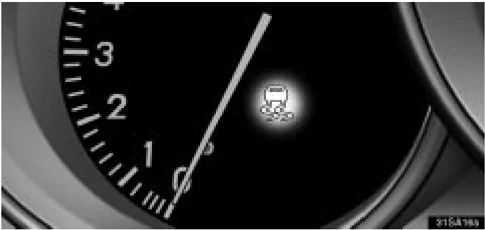
►Slip indicator light
If the vehicle is going to skid during driving, the slip indicator light flashes and an alarm sounds intermittently.
The vehicle stability control activates when the vehicle speed is about more than 15 km/h (9 mph).
210
STARTING AND DRIVING
You may hear a sound in the engine compartment for a few seconds when the engine is started or just after the vehicle begins to move. This means that the vehicle stability control is in the self-check mode and does not indicate a malfunction.
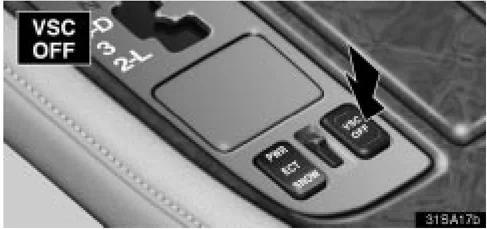
You can turn off the vehicle stability control system by pushing the "VSC OFF" switch. The "VSC OFF" indicator comes on. At this time, the traction control system also turns off. You cannot turn off either one of them. Pushing the "VSC OFF" switch a second time turns the system back on and extinguishes the "VSC OFF" indicator light. When you turn the ignition switch on, this system always turns on.
Vehicle stability control system failure warning
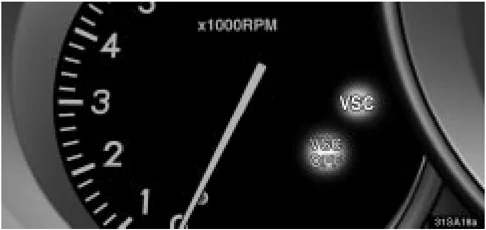
These lights warn when there is a problem somewhere in the vehicle stability control system or traction control system. If the "VSC" warning light and "VSC OFF" indicator light come on, have your vehicle checked by Lexus dealer as soon as possible. The lights will come on when the ignition switch is turned to "ON", and will go off after about a few seconds. The lights may stay on for 60 seconds after the ignition switch is turned to the "ON" position. It is normal if they go out after a while. Depressing the brake pedal repeatedly may turn on the lights. It is normal if they go out after a few seconds.
211
STARTING AND DRIVING
If the "VSC" warning light and "VSC OFF" indicator light come on, the vehicle stability control system does not activate, however, it is no problem to continue your driving.
CAUTION
- Do not rely excessively on the vehicle stability control system. Even if the vehicle stability control system is operating, you must always drive carefully and attentively to avoid serious injury. Reckless driving will result in an unexpected accident. If the slip indicator light flashes, sounding an alarm, special care should be taken while driving.
- Only use tires of specified size. The size, manufacturer, brand and tread pattern for all 4 tires should be the same. If you use the tires other than specified, or different type or size, the vehicle stability control system may not function correctly. When replacing the tires or wheels, contact your Lexus dealer.
BRAKE SYSTEM
This brake system has 2 independent hydraulic circuits. If either circuit should fail, the other will still work. However, the pedal will be harder to press, and your stopping distance will increase. Also, the brake system warning light may come on.
CAUTION
Do not drive your vehicle with only a single brake system. Have your brakes fixed immediately.
Brake booster
The brake booster uses brake fluid pressurized by the pump to power-assist the brakes. If the brake booster fails during driving, the brake system warning light comes on and buzzer sounds continuously. In this case, the brakes may not work properly. If they do not work well, depress the brake pedal firmly. If the brake system warning light comes on, immediately stop your vehicle and contact your Lexus dealer.
The brake system warning light may stay on for about 60 seconds after the ignition switch is turned to the "ON" position. It is normal if the light turns off after a while.
Depressing the brake pedal repeatedly may turn on the brake system warning light and buzzer. It is normal if the light goes out and the buzzer stops sounding after a few seconds.
212
STARTING AND DRIVING
You may hear a small sound in the engine compartment after the engine is started or the brake pedal is depressed repeatedly. This is a pump pulsating sound of the brake system, and it is not a malfunction.
CAUTION
- Do not pump the brake pedal if the engine stalls. Each push on the pedal uses up your brake fluid pressure reserve.
- Even if the power assist is completely lost, the brakes will still work. But you will have to push the pedal hard, much harder than normal. And your braking distance will increase.
Anti-lock brake system
The anti-lock brake system is designed to automatically help prevent lock-up of the wheels during a sudden braking or braking on slippery road surfaces. This assists in providing directional stability and steering performance of the vehicle under these circumstances.
Effective way to press the ABS brake pedal: When the anti-lock brake system function is in action, you may feel the brake pedal pulsating and hear a noise. In this situation, to let the anti-lock brake system work for you, just hold the brake pedal down more firmly. Do not pump the brake in a panic stop. This will result in reduced braking performance.
The anti-lock brake system becomes operative after the vehicle has accelerated to a speed in excess of approximately 10 km/h (6 mph). It stops operating when the vehicle decelerates to a speed below approximately 5 km/h (3 mph).
Depressing the brake pedal on slippery road surfaces such as on a manhole cover, a steel plate at a construction site, joints in a bridge, etc. on a rainy day tends to activate the anti-lock brake system.
You may hear a click or motor sound in the engine compartment for a few seconds when the engine is started or just after the vehicle begins to move. This means that the anti-lock brake system is in the self-check mode, and does not indicate a malfunction.
When the anti-lock brake system is activated, the following conditions may occur. They do not indicate a malfunction of the system:
- You may hear the anti-lock brake system operating and feel the brake pedal pulsating and the vibrations of the vehicle body and steering wheel. You may also hear the motor sound in the engine compartment even after the vehicle is stopped.
- At the end of the anti-lock brake system activation, the brake pedal may move a little forward.
213
STARTING AND DRIVING
CAUTION
Do not overestimate the anti-lock brake system: Although the anti-lock brake system assists in providing vehicle control, it is still important to drive with all due care and maintain a moderate speed and safe distance from the vehicle in front of you, because there are limits to the vehicle stability and effectiveness of steering wheel operation even with the anti-lock brake system on.
If tire grip performance exceeds its capability, or if hydroplaning occurs during high speed driving in the rain, the anti-lock brake system does not provide vehicle control.
Anti-lock brake system is not designed to shorten the stopping distance: Always drive at a moderate speed and maintain a safe distance from the vehicle in front of you. Compared with vehicles without an anti-lock brake system, your vehicle may require a longer stopping distance in the following cases:
-
Driving on rough, gravel or snow-covered roads.
-
Driving with tire chains installed.
-
Driving over the steps such as the joints on the road.
-
Driving on roads where the road surface is pitted or has other differences in surface height.
Install all 4 tires of specified size at appropriate pressure: The anti-lock brake system detects vehicle speeds using the speed sensors for respective wheels' turning speeds. The use of tires other than specified may fail to detect the accurate turning speed resulting in a longer stopping distance.
214
STARTING AND DRIVING
"ABS" warning light
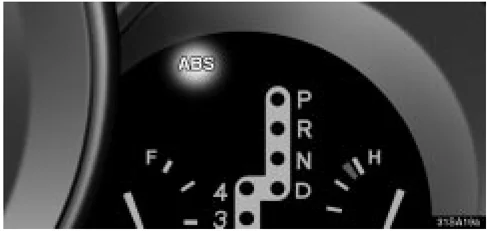
The light comes on when the ignition switch is turned to the “ON” position. If the anti-lock brake system and the brake assist system work properly, the light turns off after a few seconds. Thereafter, if either of the systems malfunctions, the light comes on again.
When the “ABS” warning light is on (and the brake system warning light is off), the anti-lock brake system, the brake assist system, the traction control system and/or the vehicle stability control system do/does not operate, but the brake system still operates conventionally.
When the “ABS” warning light is on (and the brake system warning light is off), the anti-lock brake system does not operate so that the wheels could lock up during a sudden braking or braking on slippery road surfaces.
If either of the following conditions occur, this indicates a malfunction somewhere in the components monitored by the warning light system. Contact your Lexus dealer as soon as possible to service the vehicle.
- The light does not come on when the ignition switch is turned to the “ON” position, or remains on.
- The light comes on while you are driving.
A warning light turning on briefly during operation does not indicate a problem.
CAUTION
If the “ABS” warning light remains on together with the brake system warning light, immediately stop your vehicle at a safe place and contact your Lexus dealer.
In this case, not only the anti-lock brake system will fail but also the vehicle will become extremely unstable during braking.
Either of the following conditions may occur, but does not indicate a malfunction:
- The light may stay on for about 60 seconds after the engine is started. It is normal if it turns off after a while.
- Depressing the brake pedal repeatedly may turn on the light. It is normal if it turns off after a few seconds.
2003 SC430 from May ’03 Prod. (OM24449U) 215
STARTING AND DRIVING
Drum-in-disc type parking brake system Your vehicle has a drum-in-disc type parking brake system. This type of brake system needs bedding-down of the brake shoes periodically or whenever the parking brake shoes and/or drums are replaced.
Have your Lexus dealer perform the bedding-down.
Brake assist system If you slam the brakes on such as in an emergency, the brake assist system provides more powerful braking.
If you slam the brakes on, more powerful braking will be applied. At this time, you may hear a sound in the engine compartment and feel the vibrations of the brake pedal. This does not indicate a malfunction.
The brake assist system becomes operative after the vehicle has accelerated to a speed in excess of approximately 10 km/h (6 mph). It stops operating when the vehicle decelerates to a speed below approximately 5 km/h (3 mph).
The brake assist system may not work for about 60 seconds after the engine is started.
For an explanation of this system's warning light, see "ABS" warning light on page 45 or 215.
BRAKE PAD WEAR LIMIT INDICATORS
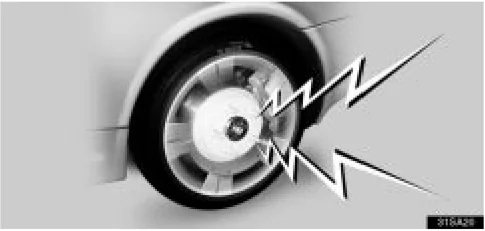
The brake pad wear limit indicators on your disc brakes give a warning noise when the brake pads are worn to the extent that replacement is required.
If you hear a squealing or scraping noise while driving, have the brake pads checked and replaced by your Lexus dealer as soon as possible. Expensive rotor damage can result if the pads are not replaced when needed.
216
TIRE INFORMATION
This vehicle can be equipped with either run-flat tires (RFT) or standard tires. You can continue driving on the vehicle with run-flat tires even if any tire goes flat. It is able to run for a maximum of 160 km (100 miles) at a speed below 90 km/h (55 mph) after the low tire pressure warning light blinks and chimes sound. When you drive your vehicle after the low tire pressure warning light blinks and chimes sound, the tire must be replaced. Do not use the repaired tire. A spare tire is not provided on the vehicle with run-flat tires.
The tire pressure warning system is equipped to warn you of the low tire pressure.
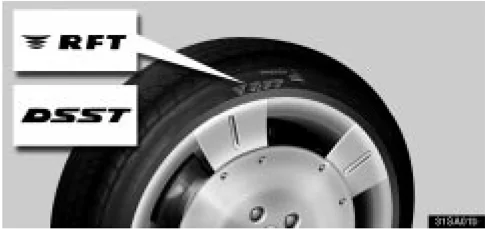
A "RFT" or "DSST" mark is molded on the sidewall of the run-flat tire.
If you cannot distinguish between the standard tire and run-flat tire, consult Lexus dealer.
STARTING AND DRIVING
A spare tire is not provided on the vehicle equipped with run-flat tires. Confirm whether your vehicle is equipped with a spare tire or not. If you have a flat tire, you have to take a different action depending on whether the tires are standard tires or run-flat tires.
Run-flat tires characteristics:
The vehicle with run-flat tires allows you to continue driving for up to 160 km (100 miles) at the moderate speed and do not ever exceed 90 km/h (55 mph) even with a flat tire. After such usage, the tire must be replaced. If you are not sure, consult your Lexus dealer. If you have a flat tire, decrease the speed and drive at lower speed to reduce the extent to which the tire is damaged.
However, in some conditions (such as at high temperatures), you could not continue driving for up to 160 km (100 miles).
The use of non-genuine wheels may prohibit optimum performance.
The run-flat tires equipped on this vehicle are ones dedicated for SC430. Do not use them on another model.
Do not mix run-flat tires with standard tires.
The tire warranty book covers the detailed information on run-flat tires. For details, see the tire warranty book.
217
STARTING AND DRIVING
Tire pressure warning system
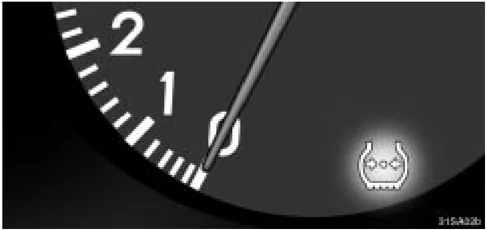
This light and chimes warn you that the tire pressure is low. This light comes on when the ignition switch is turned to the “ON” position and goes off after a few seconds. This means the low tire pressure warning light is operating properly.
If the warning light does not go off, or comes on or blinks during driving, or the chimes sound, this indicates that air pressure is low. Make sure there is no flat tire. If the warning light comes on again even after air is put in the tires, a tire may be flat or the system may be malfunctioning.
If this warning light comes on, the action you must take is different depending on the type of tires used.
If you drive over about 180 km/h (112 mph) with the tires not inflated at the designated pressure for high speed driving, the warning light may turn on. If the tires are at the designated pressure for ordinary speed driving, decreasing the speed will turn off the warning light. (For the designated pressure for high speed driving, see “Specifications” on page 318.)
This warning light may turn on due to natural causes such as natural air leaks or tire pressure changes caused by temperature. In this case, adjusting the tire pressure will turn off the warning light. For details about adjusting the tire pressure, see “Checking tire pressure” on page 321.
Vehicles with run–flat tires:
If the warning light is on, the tire pressure is lower than specified.
Stop your vehicle at a safe place as soon as possible and check that the tire pressure is as specified on the tire pressure label. The air pressure gauge is located in the tool bag. If the warning light comes on or blinks even after tire pressure adjustment, it is probable that you have a flat tire. If you cannot verify the tire pressure soon, go to the nearest Lexus dealer or authorized tire dealer at the moderate speed and do not ever exceed 90 km/h (55 mph) and have all your vehicle’s tires checked and adjusted. And whether there is a flat tire or not should be also checked at this time. If any tire must be replaced, see “If you have a flat tire” on page 239.
If the warning light does not go off about more than 15 minutes after air is put in the deflated tire, the system might be malfunctioning. Consult your Lexus dealer.
218
STARTING AND DRIVING
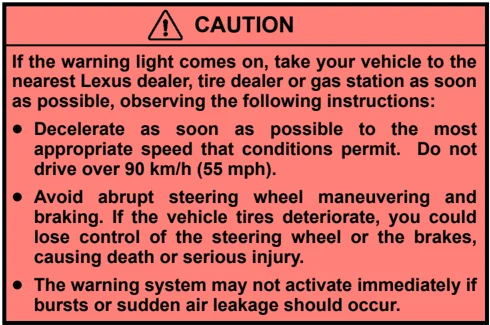
CAUTION If the warning light comes on, take your vehicle to the nearest Lexus dealer, tire dealer or gas station as soon as possible, observing the following instructions:
- Decelerate as soon as possible to the most appropriate speed that conditions permit. Do not drive over 90 km/h (55 mph).
- Avoid abrupt steering wheel maneuvering and braking. If the vehicle tires deteriorate, you could lose control of the steering wheel or the brakes, causing death or serious injury.
- The warning system may not activate immediately if bursts or sudden air leakage should occur.
If the warning light blinks and chimes sound every few minutes, the tire pressure is very low.
Decrease your speed as soon as possible and take your vehicle to the nearest Lexus dealer or authorized tire dealer at a speed below 90 km/h (55 mph).
When you drive your vehicle after the low tire pressure warning light blinks and chimes sound, the tire must be replaced. Do not use the repaired tire.
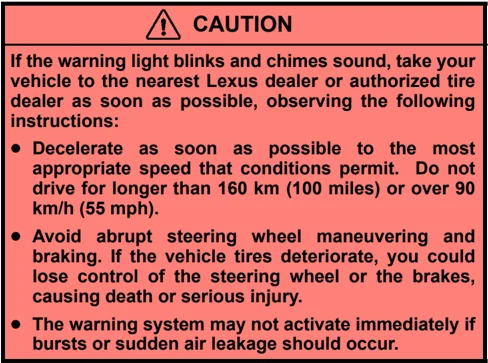
CAUTION If the warning light blinks and chimes sound, take your vehicle to the nearest Lexus dealer or authorized tire dealer as soon as possible, observing the following instructions:
- Decelerate as soon as possible to the most appropriate speed that conditions permit. Do not drive for longer than 160 km (100 miles) or over 90 km/h (55 mph).
- Avoid abrupt steering wheel maneuvering and braking. If the vehicle tires deteriorate, you could lose control of the steering wheel or the brakes, causing death or serious injury.
- The warning system may not activate immediately if bursts or sudden air leakage should occur.
219
STARTING AND DRIVING
NOTICE
- Do not use liquid sealants for a flat tire as air pressure sensors will be damaged.
- Take due care not to go over a curb stone and be careful of the holes in the road because deflated tire pressure affects tire cushion performance. The wheels, tires, body, suspension and other components could be damaged.
- Your ground clearance is reduced if the run-flat tire goes flat so avoid driving over obstacles and drive slowly on rough, unpaved roads and speed bumps. Also, do not attempt to go through an automatic car wash as the vehicle may get caught, resulting in damage.
- When the tires must be replaced, have them replaced by the nearest Lexus dealer or authorized tire dealer. The tire pressure sensor will be affected by the installation or removal of tires.
- When the tires must be replaced, replace the grommets for air pressure sensors as well.
Vehicles with standard tires: If the warning light is on, the tire pressure is lower than specified.
Stop your vehicle at a safe place as soon as possible and check that the tire pressure is as specified on the tire pressure label. The air pressure gauge is located in the tool bag. If the warning light comes on or blinks even after tire pressure adjustment, it is probable that you may be a flat tire. If the tire goes flat, change to the spare tire. (See page 241).
The spare tire is not equipped with the tire pressure sensor. So, the warning light remains on even if the spare tire is mounted.
If the warning light does not go off more than 15 minutes after air is put in the deflated tire, the system might be malfunctioning. Consult your Lexus dealer.
CAUTION
If the warning light comes on, observe the following instructions:
- Decelerate as soon as possible to the most appropriate speed that conditions permit.
- Avoid abrupt steering wheel maneuvering and braking. If the vehicle tires deteriorate, you could lose control of the steering wheel or the brakes, causing death or serious injury.
220
STARTING AND DRIVING
If the warning light blinks and chimes sound every few minutes, the tire pressure is very low.
Stop your vehicle at a safe place as soon as possible and check that the tire pressure is as specified on the tire pressure label. The air pressure gauge is located in the tool bag. Locate the deflated tire and change to the spare tire. For the procedure for changing the tire, see “If you have a flat tire (Vehicles with standard tires)” on page 241.
The spare tire is not equipped with the tire pressure sensor. So, the warning light remains on even if the spare tire is mounted.
CAUTION If the warning light blinks and chimes sound, observe the following instructions:
- Decelerate as soon as possible to the most appropriate speed that conditions permit.
- Avoid abrupt steering wheel maneuvering and braking. If the vehicle tires deteriorate, you could lose control of the steering wheel or the brakes, causing death or serious injury.
- The warning system may not activate immediately if bursts or sudden air leakage should occur.
NOTICE
- Do not use liquid sealants for a flat tire as air pressure sensors will be damaged.
- When the tires must be repaired or replaced, have them repaired or replaced by the nearest Lexus dealer or authorized tire dealer. The tire pressure sensors will be affected by the installation or removal of tires.
- When the tires must be replaced, replace the grommets for air pressure sensors as well.
System malfunction The warning light comes on if the system does not work properly.
The system will be disabled in the conditions below:
- Electric devices or facilities using similar radio wave frequencies are nearby.
- If a radio set at similar frequencies is in use.
- Much snowflakes or ice gets on the vehicle, in particular, around the wheels or wheel housings.
- The sensor battery is expired.
- The tires not equipped with air pressure sensor are used.
- Although the tires are equipped with air pressure sensors, the selector switch (see page 224) is set to other tire setting.
221
STARTING AND DRIVING
CAUTION
- The use of non-genuine wheels will cause the air pressure sensors to transmit the electronic code in different manner, resulting in the failure of the system.
- The use of different type of tires with genuine wheels may also cause the malfunction of the system.
INFORMATION If the chains are installed, the air pressure warning system may not operate properly.
For vehicles sold in U.S.A.
This device complies with Part 15 of the FCC Rules. Operation is subject to the following two conditions: (1) This device may not cause harmful interference, and (2) this device must accept any interference received, including interference that may cause undesired operation.
NOTICE: This equipment has been tested and found to comply with the limits for a Class B digital device, pursuant to Part 15 of the FCC Rules. These limits are designed to provide reasonable protection against harmful interference in a residential installation. This equipment generates, uses and can radiate radio frequency energy and, if not installed and used in accordance with the instructions, may cause harmful interference to radio communications. However, there is no guarantee that interference will not occur in a particular installation. If this equipment does cause harmful interference to radio or television reception, which can be determined by turning the equipment off and on, the user is encouraged to try to correct the interference by one or more of the following measures:
- Reorient or relocate the receiving antenna.
- Increase the separation between the equipment and receiver.
222
STARTING AND DRIVING
- Connect the equipment into an outlet on a circuit different from that to which the receiver is connected.
- Consult the dealer or an experienced radio / TV technician for help.
FCC WARNING: Changes or modifications not expressly approved by the party responsible for compliance could void the user's authority to operate the equipment.
For vehicles sold in Canada
Operation is subject to the following two conditions: (1) this device may not cause interference, and (2) this device must accept any interference, including interference that may cause undesired operation of the device.
Replacing tires and wheels
As you might have difficulty in locating a flat or deflated tire, an air pressure warning system should be installed on the tires of this vehicle.
When replacing the wheels, be sure to install air pressure sensors on the wheels.
There are 3 ways to set up the air pressure sensors: a. Remove the sensor from the old wheel and install it to the new wheel. b. Keep the same wheel with air pressure sensor and replace the tire alone. c. Use a new wheel and sensor.
You have to register an ID code for a new sensor. Up to 2 sets of codes can be registered. As one ID for the originally installed sensor is registered at "MAIN" of the selector switch, use the "2nd" position to register an ID for the new sensor.
You do not need to re-register the ID code for any other replacements. For the use of the originally installed tires, put the selector switch at "MAIN" and for the use of tires set purchased later, put the switch at "2nd". For the sensor selector switch, see page 224.
223
STARTING AND DRIVING
CAUTION
- Have the tires, wheels or sensors replaced and ID codes registered by Lexus dealer. If you need sensors, purchase from Lexus dealer.
- The use of non-genuine wheels will cause the air pressure sensors to transmit the electronic code in different manner, resulting in the failure of the system.
Selector switch
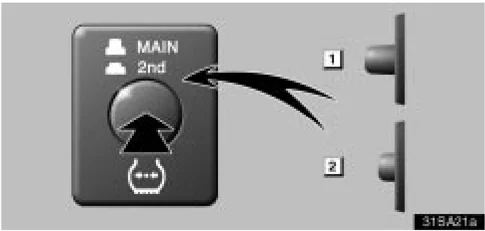
► 1 Main position 2 2nd position
The selector switch is located on the right side in the glove box.
The ID code is given in the sender built in the air pressure sensor. To activate the air pressure warning system, it is necessary to register the ID code of the sender on the selector switch in the vehicle.
2 sets of ID codes can be registered. The code of the tires originally installed on the vehicle is registered on the switch at "MAIN". Have a new tires set with new air pressure sensors registered at "2nd" by Lexus dealer.
ID codes should be registered by Lexus dealer. Once registered, change the setting position each time you purchase tires and wheels. Re-registration is not required.
When purchasing new tires, consult your Lexus dealer.
224
STARTING AND DRIVING
CAUTION When the tires whose ID code is registered at “MAIN” are used, the system does not work properly with the selector switch set at “2nd”. If the tires whose ID code is registered at “2nd” are stored nearby, the system will detect their tire pressure (and vice versa).
Liquid sealants for flat tires
NOTICE Do not use liquid sealants for flat tires as the air pressure sensors will be damaged.
TYPES OF TIRES
Determine what kind of tires your vehicle is originally equipped with.
- Summer tires Summer tires are high-speed capability tires best suited to highway driving under dry conditions.
Since summer tires do not have the same traction performance as snow tires, summer tires are inadequate for driving on snow-covered or icy roads. For driving on snow-covered or icy roads, we recommend using snow tires. If installing snow tires, be sure to replace all four tires.
- All season tires All season tires are designed to provide better traction in snow and to be adequate for driving in most winter conditions, as well as for use all year round.
All season tires, however, do not have adequate traction performance compared with snow tires in heavy or loose snow. Also, all season tires fall short in acceleration and handling performance compared with summer tires in highway driving.
225
STARTING AND DRIVING
CAUTION
- Do not mix summer and all season tires on your vehicle as this can cause dangerous handling characteristics, resulting in loss of control.
- Do not use tires other than the manufacturer's designated tires, and never mix tires or wheels of the sizes different from the originals.
226
SECTION 3 – 2
STARTING AND DRIVING
Driving tips
- Break-in period . . . . . . . . . . . . . . . . . . . . . . . . . . . . . . . . . . . . . . . . . . . . . . . . . . . . . . . . . . . . . . . . . . . . . . . . . . . . . . . . . . . . . . . . . . . . . . . . . . . . . . . . . . . . . . . . . . . . . . . . . . . . . . . . . . . . . . . . . . . . . . . . . . . . . . . . . . . . . . . . . . . . . . . . . . . . . . . . . . . . . . . . . . . . . . . . . . . . . . . . . . . . . . . . . . . . . . . . . . . . ........ 228
- Operation in foreign countries . . . . . . . . . . . . . . . . . . . . . . . . . . . . . . . . . . . . . . . . . . . . . . . . . . . . . . . . . . . . . . . . . . . . . . . . . . . . . . . . . . . . . . . . . . . . . . . . . . . . . . . . . . . ........ 228
- Tips for driving in various conditionss . . . . . . . . . . . . . . . . . . . . . . . . . . . . . . . . . . . . . . . . . . . . . . . . . . . . . . . . . . . . . . . . . . . . . . . . . . . . . . . . . . . . . . . . . . . . . . . . . . . . . . . . ........

DRIVING TIPS
BREAK-IN PERIOD
Drive gently and avoid high speeds.
You need not follow a break-in schedule with your new Lexus. But following a few simple tips for the first 1600 km (1000 miles) can add to the future economy and long life of your vehicle:
• Avoid full throttle acceleration when starting and driving. • Avoid racing the engine. • Try to avoid hard stops during the first 300 km (200 miles). • Do not drive for a long time at any single speed, either fast or slow.
OPERATION IN FOREIGN COUNTRIES
If you plan to drive your Lexus in another country ... First, comply with the vehicle registration laws. Second, confirm the availability of the correct fuel (unleaded and minimum octane rating).
TIPS FOR DRIVING IN VARIOUS CONDITIONS
• Always slow down in gusty crosswinds. This will allow you much better control. • Drive slowly onto curbs and, if possible, at a right angle. Avoid driving onto high, sharp-edged objects and other road hazards. Failure to do so can lead to severe tire damage such as a tire burst. Drive slowly when passing over bumps or travelling on a bumpy road. Otherwise, the impact could cause severe damage to the tires and/or wheels. • When parking on a hill, turn the front wheels until they touch the curb so that the vehicle will not roll. Apply the parking brake, and place the transmission in "P". If necessary, block the wheels. • Washing your vehicle or driving through deep water may get the brakes wet. To see whether they are wet, check that there is no traffic near you and then press the pedal lightly. If you do not feel a normal braking force, the brakes are probably wet. To dry them, drive the vehicle cautiously while lightly pressing the brake pedal with the parking brake applied. If they still do not work safely, pull to the side of the road and call a Lexus dealer for assistance.
228
DRIVING TIPS
CAUTION
-
Before driving off, make sure the parking brake is fully released and that the parking brake reminder light is off.
-
Do not leave your vehicle unattended while the engine is running.
-
Do not rest your foot on the brake pedal while driving. It can cause dangerous overheating, needless wear, and poor fuel economy.
-
To drive down a long or steep hill, reduce your speed and downshift. Remember, if you ride the brakes excessively, they may overheat and not work properly. See page 202.
-
Be careful when accelerating, upshifting, downshifting or braking on a slippery surface. The abrupt change in engine speed, such as sudden acceleration or engine braking, could cause the vehicle to spin or skid.
-
Do not drive in excess of the speed limit. Even if the legal speed limit permits it, do not drive over 140 km/h (85 mph) unless your vehicle has high-speed capability tires. Driving over 140 km/h (85 mph) may result in tire failure, loss of control and possible injury. Be sure to consult a tire dealer to determine whether the tires on your vehicle are high-speed capability tires or not before driving at such speeds.
-
Do not continue normal driving when the brakes are wet. If they are wet, your vehicle will require a longer stopping distance, and it may pull to one side when the brakes are applied. Also, the parking brake will not hold the vehicle securely.
WINTER DRIVING TIPS
Make sure your coolant is properly protected against freezing.
Your coolant must contain ethylene–glycol type coolant for a proper corrosion protection of aluminum components. Use “Toyota Genuine Long Life Coolant” or equivalent. See "Checking the engine coolant level" on page 311 for instructions.
NOTICE
Do not use alcohol type antifreeze or plain water alone.
When it is extremely cold, we recommend to use 60% solution for your Lexus, to provide protection down to about –50°C (–58°F). Do not use more than 70% solution for better coolant performance.
Check the condition of the battery and cables.
Cold temperatures reduce the capacity of any battery, so it must be in top shape to provide enough power for winter starting. Page 336 tells you how to visually inspect the battery. Your Lexus dealer and most service stations will be pleased to check the battery charge level.
2003 SC430 from May '03 Prod. (OM24449U) 229
DRIVING TIPS
Make sure the engine oil viscosity is suitable for the cold weather.
See page 310 for recommended viscosity. Leaving a heavy summer oil in your vehicle during winter months may cause harder starting. If you are not sure about which oil to use, call your Lexus dealer – they will be pleased to help.
Check the electronic ignition system for loose connections or obvious damage.
Keep the door locks from freezing.
Squirt lock de-icer or glycerine into the locks to keep them from freezing.
Use a washer fluid containing an antifreeze solution.
This product is available at your Lexus dealer and most auto parts stores. Follow the manufacturer's directions for how much to mix with water.
NOTICE Do not use engine antifreeze or any other substitute because it may damage your vehicle's paint.
Do not use your parking brake when there is a possibility it could freeze.
When parking, put the transmission into "P" and block the front wheels. Do not use the parking brake, or snow or water accumulated in and around the parking brake mechanism may freeze the parking brake, making it hard to release.
Keep ice and snow from accumulating under the fenders. Ice and snow built up under your fenders can make steering difficult. During bad winter driving, stop and check under the fenders occasionally.
Depending on where you are driving, we recommend you carry some emergency equipment.
Some of the things you might put in the vehicle are tire chains, window scraper, bag of sand or salt, flares, small shovel, jumper cables, etc.
DINGHY TOWING
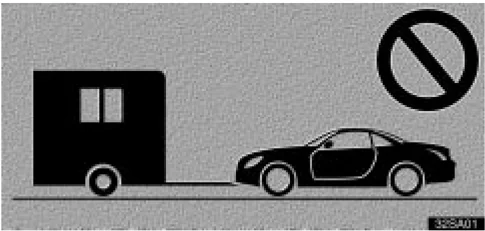
Your vehicle is not designed to be dinghy towed (with four wheels on the ground) behind a motorhome.
230
DRIVING TIPS
NOTICE Do not tow your vehicle with four wheels on the ground. This may cause serious damage to your vehicle.
TRAILER TOWING
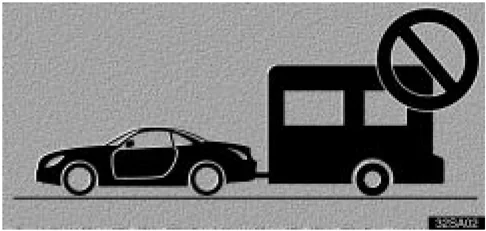
Lexus does not recommend towing a trailer with your vehicle. It is not designed for trailer towing.
HOW TO SAVE FUEL AND MAKE YOUR VEHICLE LAST LONGER
Improving fuel economy is easy – just take it easy. It will help make your vehicle last longer, too. Here are some specific tips on how to save money on both fuel and repairs:
- Keep your tires inflated at the correct pressure. Check the pressure every two weeks, or at least once a month. Underinflation causes tire wear and wastes fuel.
- Do not carry unneeded weight in your vehicle. Excess weight puts a heavier load on the engine, causing greater fuel consumption.
- Avoid lengthy warm-up idling. Once the engine is running smoothly, begin driving – but gently. Remember, however, that on cold winter days this may take a little longer.
- Accelerate slowly and smoothly. Avoid jackrabbit starts.
- Avoid long engine idling. If you have a long wait and you are not in traffic, it is better to turn off the engine and start again later.
- Avoid engine over-revving. Use a gear position suitable for the road on which you are traveling.
- Avoid continuous speeding up and slowing down. Stop-and-go driving wastes fuel.
2003 SC430 from May '03 Prod. (OM24449U) 231