SECTION 3 – 1
STARTING AND DRIVING
Starting and driving
- Three-way catalytic converters . . . . . . . . . . . . . . . . . . . . . . . . . . . . . . . . . . . . . . . . . . . . . . . . . . . . . . . . . . . . . . . . . . . . . . . . . . . . . . . . . . . . . . . . . . . . . . . . . . . . . . . . . . . . . . . . . . . . . . . . . . . . . . . . . . . . . . . . . . . . . . . . . . . . . . . . . . . . . . . . . . . . . . . . . . . . . . . . . . . . . . . . . . . . . . . . . . . . . . . . . . . . . . . . ........ 194
- Engine exhaust caution . . . . . . . . . . . . . . . . . . . . . . . . . . . . . . . . . . . . . . . . . . . . . . . . . . . . . . . . . . . . . . . . . . . . . . . . . . . . . . . . . . . . . . . . . . . . . . . . . . . . . . . . . . . . . . . . ........ 195
- Before starting the engine . . . . . . . . . . . . . . . . . . . . . . . . . . . . . . . . . . . . . . . . . . . . . . . . . . . . . . . . . . . . . . . . . . . . . . . . . . . . . . . . . . . . . . . . . . . . . . . . . . . . . . . . . . . . . . . ........

STARTING AND DRIVING
THREE-WAY CATALYTIC CONVERTERS
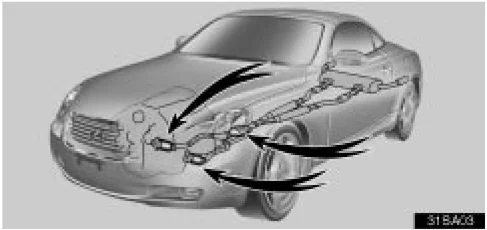
Three-way catalytic converters are emission control devices installed in the exhaust system. The purpose is to reduce pollutants in the exhaust gas.
CAUTION
- Keep people and combustible materials away from the exhaust pipe while the engine is running. The exhaust gas is very hot.
- Do not drive, idle or park your vehicle over anything that might burn easily such as grass, leaves, paper or rags.
NOTICE
A large amount of unburned gases flowing into the three-way catalytic converter may cause it to overheat and create a fire hazard. To prevent this and other damage, observe the following precautions:
- Use only unleaded gasoline.
- Do not drive with an extremely low fuel level; running out of fuel could cause the engine to misfire, creating an excessive load on the three-way catalytic converter.
- Do not allow the engine to run at idle speed for more than 20 minutes.
- Avoid racing the engine.
- Do not push-start or pull-start your vehicle.
- Do not turn off the ignition while the vehicle is moving.
- Keep your engine in good running order. Malfunctions in the engine electrical system, electronic ignition system or fuel system could cause an extremely high three-way catalytic converter temperature.
194
STARTING AND DRIVING
- If the engine becomes difficult to start or stalls frequently, take your vehicle in for a check-up as soon as possible. Remember, your Lexus dealer knows your vehicle and its three-way catalytic converter system best.
- To ensure that the three-way catalytic converter and the entire emission control system operate properly, your vehicle must receive the periodic inspections required by the Lexus Maintenance Schedule. For scheduled maintenance information, refer to the “Owner’s Manual Supplement / Scheduled Maintenance”.
ENGINE EXHAUST CAUTION
CAUTION
- Avoid inhaling the engine exhaust. It contains carbon monoxide, which is a colorless and odorless gas. It can cause unconsciousness or even death.
- Make sure the exhaust system has no holes or loose connections. The system should be checked from time to time. If you hit something, or notice a change in the sound of the exhaust, have the system checked immediately.
- Do not run the engine in a garage or enclosed area except for the time needed to drive the vehicle in or out. The exhaust gases cannot escape, making this a particularly dangerous situation.
- Do not remain for a long time in a parked vehicle with the engine running. If it is unavoidable, however, do so only in an unconfined area and adjust the heating or cooling system to force outside air into the vehicle.
- Keep the trunk lid closed while driving. An open or unsealed trunk lid may cause exhaust gases to be drawn into the vehicle.
195
STARTING AND DRIVING
- To allow proper operation of your vehicle's ventilation system, keep the inlet grilles in front of the windshield clear of snow, leaves, or other obstructions.
- If you smell exhaust fumes in the vehicle, drive with the windows open and the trunk lid closed. Have the cause immediately located and corrected.
BEFORE STARTING THE ENGINE
- Check the area around the vehicle before entering it.
- Adjust seat position, seatback angle, head restraint height and steering wheel angle.
- Adjust the inside and outside rear view mirrors.
- Lock all doors.
- Fasten seat belts.
Remember to check that the service reminder indicators function when turning the ignition switch to "ON", and check the fuel gauge to see that you have sufficient fuel.
IGNITION SWITCH WITH STEERING LOCK
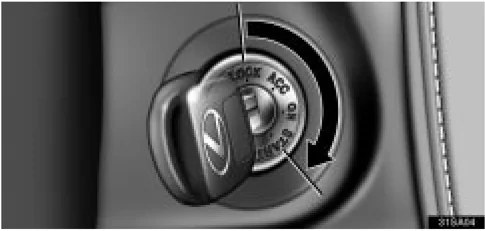
"START" – Starter motor on. The key will return to the "ON" position when released.
For starting tips, see page 198.
"ON" – Engine on and all accessories on.
This is the normal driving position.
NOTICE
Do not leave the ignition switch in the "ON" position if the engine is not running. The battery will discharge and the electronic ignition system could be damaged.
196
"ACC" – Accessories such as the radio operate, but the engine is off.
If you leave the key in the "ACC" or "LOCK" position and open the driver's door, a buzzer will remind you to remove the key.*
NOTE: The volume or interval of beep sound can be changed. Ask your Lexus dealer for details.
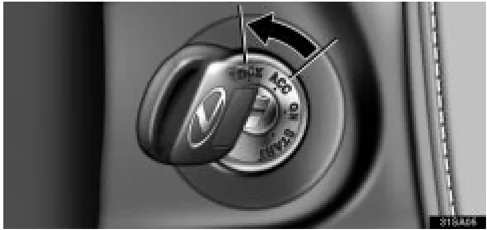
"LOCK" – Engine is off and the steering wheel is locked. The ignition key can be removed only at this position.
To turn the ignition switch from "ACC" to the "LOCK" position, you must put the transmission selector lever in the "P" position.
Once you remove the key, the engine immobiliser system is automatically set. See "Engine immobiliser system" on page 11.
When starting the engine, the key may seem stuck at the "LOCK" position. To free it, first be sure the key is pushed all the way in, and then rock the steering wheel slightly while turning the key gently.
STARTING AND DRIVING
If, in an emergency, you must turn the engine off while the vehicle is moving, turn the ignition switch only to "ACC".
PARKING BRAKE
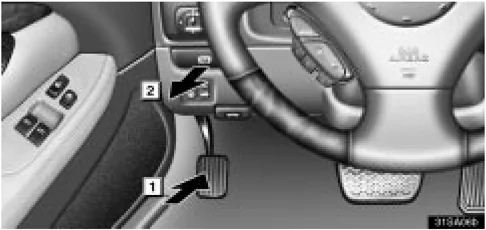
[1] To set: Fully depress the parking brake pedal. [2] To release: Pull the parking brake release lever.
Before leaving your vehicle, firmly apply the parking brake.
⚠ CAUTION
Before driving, make sure the parking brake is fully released and that the parking brake reminder light is off.
197
STARTING AND DRIVING
HOW TO START THE ENGINE
Before cranking
- Apply the parking brake firmly.
- Turn off unnecessary lights and accessories.
- Put the selector lever in "P". If you need to restart the engine while the vehicle is moving, put the selector lever in "N". A starter safety device will prevent the starter from operating if the selector lever is in any drive position.
- Depress the brake pedal and hold it to the floor until driving off.
Starting the engine
Before starting the engine, be sure to follow the instructions in "Before cranking".
Normal starting procedure
The multiport fuel injection system/sequential multiport fuel injection system in your engine automatically controls the proper air-fuel mixture for starting. You can start a cold or hot engine as follows:
With your foot off the accelerator pedal, crank the engine by turning the ignition switch to "START". Release it when the engine starts.
Engine should be warmed up by driving, not in idle. For warming up drive with smoothly turning engine until engine coolant temperature is within normal range.
If the engine stalls ...
Simply restart it, using the correct procedure given in normal starting.
If the engine will not start
See "If your vehicle will not start" on page 234.
NOTICE
- Do not crank for more than 30 seconds at a time. This may overheat the starter and wiring systems.
- Do not race a cold engine.
- If the engine becomes difficult to start or stalls frequently, have the engine checked immediately.
198
AUTOMATIC TRANSMISSION
Your automatic transmission has a shift lock system to minimize the possibility of incorrect operation. This means you can only shift out of "P" position when the brake pedal is depressed with the ignition switch in "ON" position. (★)
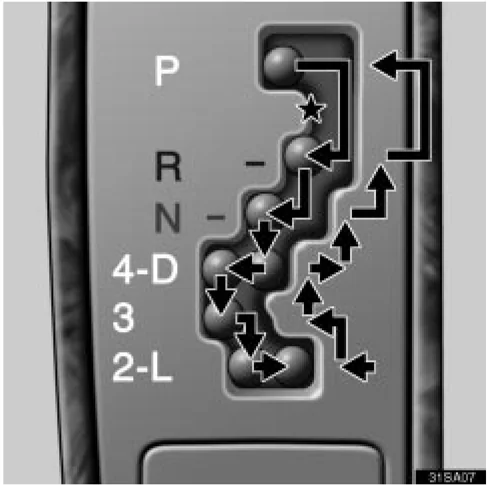
▶The shift position is displayed on the instrument cluster.
P: Parking, engine starting and key removal position R: Reverse position N: Neutral position D: Normal driving position (Shifting into overdrive possible) 4: Position for engine braking (Shifting into overdrive not possible)
When the cruise control is being used, even if you downshift from "D" to "4", engine braking will not be enabled because the cruise control is not cancelled. For the operation to decrease the vehicle speed, see page 208.
3, 2: Position for more powerful engine braking L: Position for maximum engine braking
STARTING AND DRIVING
199
STARTING AND DRIVING
Correct use of the automatic transmission is explained in the following parts. (a) Normal driving (b) Using engine braking (c) Using the "3", "2" and "L" positions (d) Backing up (e) Parking (f) Good driving practice (g) If you cannot shift the selector lever
(a) Normal driving
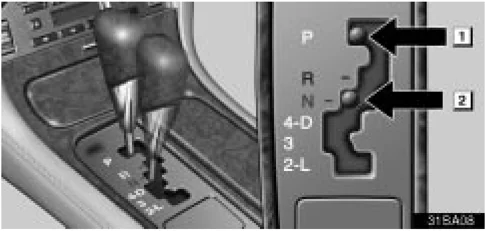
1 "P" (Park) position 2 "N" (Neutral) position
- Start the engine as instructed in "How to start the engine" on page 198.
The transmission must be in "P" or "N". The engine will not start in any drive position even if the ignition switch is turned to "START".
STARTING AND DRIVING
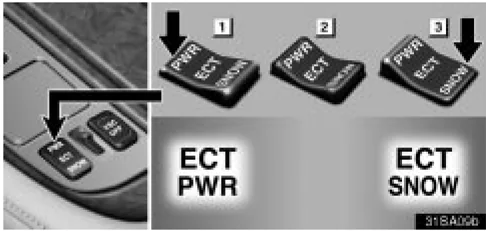
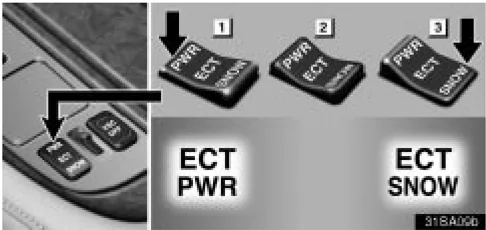
► 1 Power position 2 Normal position 3 Snow position
- Set the driving pattern selector switch to the "Normal" position.
Your transmission has a driving pattern selector switch which allows you to select "Power", "Normal" or "Snow" mode to suit your driving condition. For ordinary driving, Lexus recommends that you use the "Normal" position to improve fuel economy.
- For more powerful acceleration and sporty driving, use the "Power" position.
In the "Power" position, the "ECT PWR" light in the instrument cluster is on and the transmission is shifted up at higher vehicle speeds and shifted down more responsively than in the "Normal" position.
For "Snow" mode, see "Electronic Throttle Control System" on page 205.
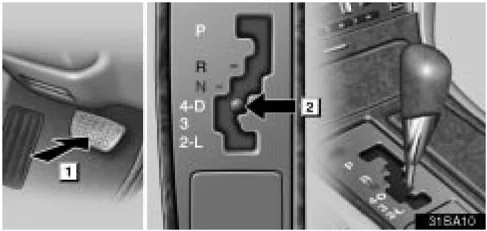
► 1 Brake pedal 2 "D" (Drive) position
- With your foot holding down the brake pedal, shift the selector lever to "D".
Always use the "D" position to improve fuel economy and quiet driving. Only in this position, shifting into the overdrive gear is possible. However, while the engine coolant temperature is low, the transmission will not shift into the overdrive gear even in the "D" position. (See "(b) Using engine braking" and "(f) Good driving practice" for exceptions.)
CAUTION Never put your foot on the accelerator pedal while shifting.
203 SC430 from May '03 Prod. (OM24449U) 201
STARTING AND DRIVING
- Release the parking brake and brake pedal. Depress the accelerator pedal slowly for smooth starting.
In normal cruising, the vehicle will start in first gear and automatically shift up to the most suitable gear. On inclines, declines or winding roads, etc., the vehicle shifts up and down automatically according to the running conditions to obtain the suitable driving power and engine braking.
When the lever is in the "4" position, the automatic transmission system will select the most suitable gear for the running conditions such as hill climbing, hard towing, etc.
If you need to accelerate rapidly while driving, depress the accelerator pedal to the full throttle position. This provides more acceleration by automatically downshifting the transmission to the next lower gear or beyond, depending on the vehicle speed.
If engine braking is needed, such as in descending a long hill, see "(b) Using engine braking".
(b) Using engine braking
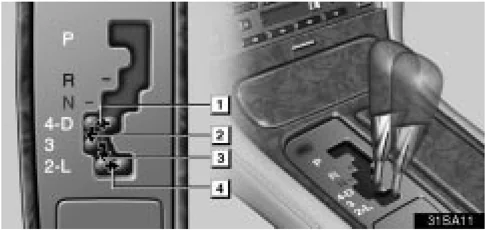
To use the braking power of the engine, downshift the transmission in the way described below:
1 Shift into the "4" position. The transmission will downshift to fourth gear and engine braking will be obtained.
When the cruise control is being used, even if you downshift from "D" to "4", engine braking will not be applied because the cruise control is not cancelled. If you need to decrease the vehicle speed, see page 208.
2 Shift into the "3" position. The transmission will downshift to third gear when the vehicle speed is or becomes lower than 137 km/h (85 mph) and more powerful engine braking will be obtained.
202
STARTING AND DRIVING
[3] Shift into the "2" position. The transmission will downshift to second gear when the vehicle speed is or becomes lower than 82 km/h (51 mph) and more powerful engine braking than that of "3" position will be obtained.
[4] Shift into the "L" position. The transmission will downshift to first gear when the vehicle speed is or becomes lower than 39 km/h (24 mph) and maximum engine braking will be applied.
CAUTION Be careful when downshifting on a slippery surface. The abrupt change in engine speed could cause the vehicle to spin or skid.
(c) Using the "3", "2" and "L" positions The "3", "2" and "L" positions are used for strong engine braking as described previously.
With the selector lever in "3", "2" or "L", you can start the vehicle in motion as with the lever in "D".
With the selector lever in "3" or "2", the vehicle will start in first gear and automatically shift to third or second gear.
With the selector lever in "L", the transmission is engaged in first gear.
NOTICE
- Be careful not to over-rev the engine. Watch the tachometer to keep engine rpm from going into the red zone. The approximate maximum allowable speed for each position is given below for your reference: "3" . . . 147 km/h (92 mph) "2" . . . 96 km/h (60 mph) "L" . . . 62 km/h (39 mph)
- Do not continue hill climbing or hard towing for a long time in the "3", "2" or "L" position. This may cause severe automatic transmission damage from overheating. To prevent such damage, "4" position should be used in hill climbing or hard towing.
203

STARTING AND DRIVING
(d) Backing up
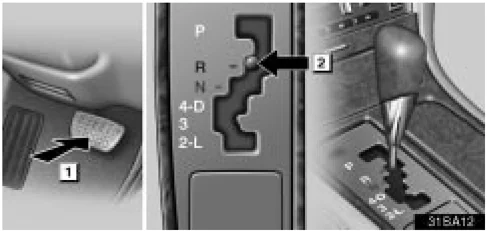
▶ 1 Brake pedal 2 "R" (Reverse) position
- Bring the vehicle to a complete stop.
- With the brake pedal held down with your foot, shift the selector lever to the "R" position.
NOTICE Never shift into reverse while the vehicle is moving.
When you are backing up, you can adjust the outside rear view mirrors down quickly. For details, see page 101.
(e) Parking
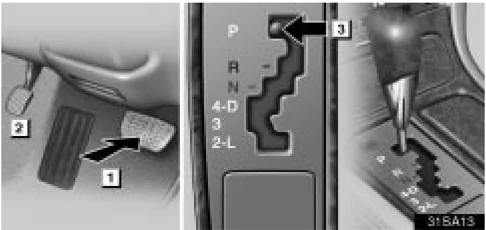
▶ 1 Brake pedal 2 Parking brake pedal 3 "P" (Park) position
- Bring the vehicle to a complete stop.
- Depress the parking brake pedal fully.
- With the brake pedal held down with your foot, shift the selector lever to the "P" position.
CAUTION Never attempt to move the selector lever into "P" under any circumstances while the vehicle is moving. Serious mechanical damage and loss of vehicle control may result.
204
STARTING AND DRIVING
(f) Good driving practice If the transmission repeatedly shifts up and down between fourth and overdrive gears when climbing a gentle slope, shift the selector lever to the "4" position. Be sure to shift the selector lever to the "D" position after climbing the slope.
CAUTION Always keep your foot on the brake pedal while stopped with the engine running. This prevents the vehicle from creeping.
NOTICE Always use the brake pedal or the parking brake to hold the vehicle on an upgrade. Do not attempt to hold the vehicle using the accelerator pedal, as this can cause the transmission to overheat.
(g) If you cannot shift the selector lever If you cannot shift the selector lever even though the brake pedal is depressed, use the shift lock override button. For instructions, see "If you cannot shift automatic transmission selector lever" on page 270.
ELECTRONIC THROTTLE CONTROL SYSTEM
The electronic throttle control system always maintains appropriate engine output in relation to the accelerator opening in all driving conditions.

1 Power position 2 Normal position 3 Snow position
The electronic throttle control system has 3 modes: Normal, Power and Snow modes. Normal mode: For ordinary driving, Lexus recommends that you use the normal mode to improve fuel economy. Power mode: For more powerful acceleration and sporty driving.
205
STARTING AND DRIVING
In the power mode, the "ECT PWR" light in the instrument cluster is on and the transmission is shifted up at higher vehicle speeds and shifted down more responsively than in the normal mode.
To return to the normal mode, push the driving pattern selector switch lightly on the "SNOW" side.
Snow mode: For slippery road surfaces such as in snow. In this mode, the spinning of the rear wheels is controlled appropriately.
When you push the driving pattern selector switch on the "SNOW" side, the snow mode is turned on and the "ECT SNOW" light in the instrument cluster comes on.
To return to the normal mode, push the driving pattern selector switch on the "SNOW" side again.
When you turn the ignition switch off in the snow mode, the mode automatically changes to the normal mode.
CRUISE CONTROL
The cruise control allows you to cruise the vehicle at a desired speed over 40 km/h (25 mph) with your foot off the accelerator pedal.
Your cruising speed can be maintained although a slight speed change may occur when driving up or down a gradient, within the limits of engine performance. On steeper hills, a great speed change will occur so it is better to drive without the cruise control.
When the cruise control is on, the driving pattern of the automatic transmission is fixed in the normal position, regardless of the position of the selector switch.
CAUTION
- To help maintain maximum control of your vehicle, do not use the cruise control when driving in heavy or varying traffic, or on slippery (rainy, icy or snow-covered) or winding roads.
- Avoid vehicle speed increases when driving downhill. If the vehicle speed is too fast in relation to the cruise control set speed, cancel the cruise control then downshift the transmission to use engine braking to slow down.
206
STARTING AND DRIVING
Turning the system on
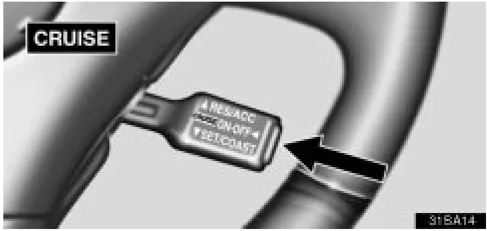
To operate the cruise control, push the main switch. This turns the system on. The indicator light in the instrument cluster shows that you can now set your desired cruising speed. Another push on the switch will turn the system completely off.
When the ignition switch is turned off, the main switch is also automatically turned off. To use the cruise control again, push the main switch again to turn it on.
CAUTION To avoid accidental cruise control engagement, keep the main switch off when not using the cruise control.
Setting operation
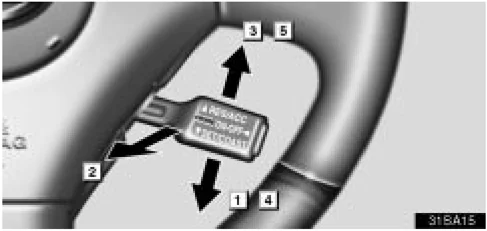
▶Each function is described below.
1 Setting at a desired speed.
The transmission must be in "D" or "4" before you set the cruise control speed.
Bring the vehicle to the desired speed, press the control lever downward in the "SET/COAST" direction and release it. This sets the vehicle at that speed. Now you may take your foot off the accelerator pedal. If you need acceleration – for example, when passing – depress the accelerator pedal enough for the vehicle to exceed the set speed. When you release the accelerator pedal, the vehicle will return to the speed set prior to the acceleration.
2003 SC430 from May '03 Prod. (OM24449U) 207