Getting started
Driving
Intermittent wiping
► Set the wiper switch to position I.
Intermittent wiping is interrupted when the vehicle is at a standstill and a front door is opened.
Single wipe
► Press combination switch briefly in direction of arrow ①.
The windshield wipers wipe one time without washer fluid.
Wiping with windshield washer fluid
► Push combination switch in direction of arrow ① past the resistance point.
The windshield wipers operate with washer fluid.
For information on filling up the washer reservoir, see “Windshield washer system and headlamp cleaning system*” (▷ page 303).
! If anything blocks the windshield wipers (leaves, snow, etc.), switch them off immediately.
- For safety reasons, withdraw SmartKey from starter switch before attempting to remove any blockage.
- Remove blockage.
- Turn the windshield wipers on again.
If windshield wipers fail to function at all in switch position I,
- set the combination switch to the next highest wiper speed
- have the windshield wipers checked at the nearest authorized Mercedes-Benz Center
52
Getting started
Driving
Problems while driving
The engine runs erratically and misfires
- An ignition cable may be damaged.
- The engine electronics may not be operating properly.
- Unburned gasoline may have entered the catalytic converter and damaged it.
- Give very little gas.
- Have the problem repaired by an authorized Mercedes-Benz Center as soon as possible.
The coolant temperature is above 248°F (120°C)
The coolant is too hot and is no longer cooling the engine.
- Stop the vehicle as soon as possible and turn off the engine. Allow engine and coolant to cool.
- Check the coolant level and add coolant if necessary (> page 301).
In case of accident
If the vehicle is leaking gasoline:
- Do not start the engine under any circumstances.
- Notify local fire and/or police authorities.
If the extent of the damage cannot be determined:
- Notify an authorized Mercedes-Benz Center.
If no damage can be determined on the
- major assemblies
- fuel system
- engine mount:
- Start the engine in the usual manner.
53
Getting started
Parking and locking
You have now completed your first drive. You have properly stopped and parked your vehicle. End your drive as follows.
Warning! Vehicles with manual transmission: Wait until the vehicle is stationary before removing the SmartKey from the starter switch. The vehicle cannot be steered when the SmartKey is removed.
Warning! With the engine not running, there is no power assistance for the brake and steering system. In this case, it is important to keep in mind that a considerably higher degree of effort is necessary to brake and steer the vehicle.
Warning! Do not park this vehicle in areas where combustible materials such as grass, hay or leaves can come into contact with the hot exhaust system, as these materials could be ignited and cause a vehicle fire.
To reduce the risk of personal injury as a result of vehicle movement, before turning off the engine and leaving the vehicle always:
- Keep right foot on brake pedal.
- Firmly depress parking brake pedal.
- Move the gear selector lever to position P (manual transmission: first or reverse gear).
- Slowly release brake pedal.
- When parked on an incline, turn front wheels towards the road curb.
- Turn the SmartKey in the starter switch to position 0 and remove the SmartKey from the starter switch.
- Take the SmartKey with you and lock the vehicle when leaving.
Parking brake

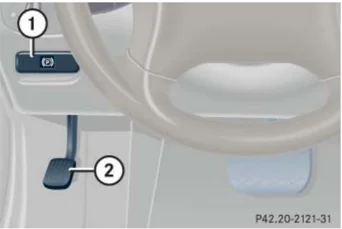
① Release handle ② Parking brake
► Step firmly on parking brake pedal ②.
When the engine is running, the warning lamp BRAKE (USA only) or (i) (Canada only) in the instrument cluster will be illuminated.
54
Getting started
Parking and locking
Warning!
When leaving the vehicle, always remove the SmartKey from the starter switch, take it with you, and lock the vehicle. Do not leave children unattended in the vehicle, or with access to an unlocked vehicle. Children could release the parking brake and/or move the gear selector lever from position P, either of which could result in an accident and/or serious injury.
Warning!
Getting out of your vehicle with the gear selector lever not fully engaged in position P is dangerous. Also, when parked on an incline, position P alone may not prevent your vehicle from moving, possibly hitting people or objects.
Always set the parking brake in addition to shifting to position P (manual transmission: first or reverse gear).
When parked on an incline, turn front wheel towards the road curb.
Switching off headlamps
▶ Turn the exterior lamp switch to 0 (▷ page 49).
For more information on headlamps, see “Lighting” (▷ page 117).
55
Getting started
Parking and locking
Turning off engine
- Place the gear selector lever in position P (manual transmission: first or reverse gear).
Always set the parking brake in addition to shifting to position P (manual transmission: first or reverse gear).
On slopes, turn the front wheels towards the road curb.
- Turn the SmartKey in the starter switch to position 0 and remove the SmartKey from the starter switch. The immobilizer is activated.
Vehicles with automatic transmission: The SmartKey can only be removed from the starter switch with the gear selector lever in position P.
- Press the seat belt release button (▷ page 44).
Allow the retractor to completely rewind the seat belt by guiding the latch plate.
With the SmartKey removed and the driver's door open, a warning sounds if the vehicle's exterior lamps are not switched off.
Warning!
To prevent possible personal injury, always keep hands and fingers away from the door openings when closing the doors. Be especially careful when small children are around.
Before closing doors, make sure there is no possibility of someone getting caught in a door during closing.
- After exiting the vehicle, press the lock button [icon] on the SmartKey (▷ page 32).
All turn signal lamps flash three times. The locking knobs in the doors move down. The anti-theft alarm system* is armed.
Warning!
When leaving the vehicle, always remove the SmartKey from the starter switch, take it with you, and lock the vehicle. Do not leave children unattended in the vehicle, or with access to an unlocked vehicle. Unsupervised use of vehicle equipment may cause an accident and/or serious personal injury.
For more information, see "Locking and unlocking" (▷ page 94).
56
Safety and Security
Occupant safety
Panic alarm*
Driving safety systems
Anti-theft systems
57
Safety and Security
Occupant safety
In this section you will learn the most important facts about the restraint system components of the vehicle.
- Seat belts (▷ page 64)
- Child restraints (▷ page 77)
- Lower anchors and tethers for children (LATCH) (▷ page 78)
Supplemental Restraint System (SRS) with
- Air bags (▷ page 59)
- Air bag control unit (with crash sensors)
- Emergency tensioning device (ETD) for seat belts (▷ page 67)
Air bag system components with
- indicator lamp (▷ page 75)
- Front passenger seat with Occupant Classification System (OCS) (▷ page 71)
As independent systems, their protective functions work in conjunction with each other.
For information on infants and children traveling with you in the vehicle and restraint systems for infants and children, see "Children in the vehicle" (▷ page 68).
The SRS system conducts a self-test when the ignition is switched on and in regular intervals while the engine is running. This facilitates early detection of malfunctions. The SRS indicator lamp in the instrument cluster comes on when the ignition is switched on and goes out no later than a few seconds after the engine has been started.
The SRS components are in operational readiness if the SRS indicator lamp is not lit when the engine is running.
A malfunction in the system has been detected if the SRS indicator lamp:
- fails to go out after approximately four seconds after the engine was started
- does not come on at all.
- comes on after the engine was started or while driving.
58
Safety and Security
Occupant safety
Warning!
In the event that the SRS indicator lamp comes on during driving or does not come on at all, the SRS self-check has detected a malfunction. For your safety, we strongly recommend that you visit an authorized Mercedes-Benz Center immediately to have the system checked; otherwise the SRS may not deploy when needed in an accident, which could result in serious or fatal injury, or it might deploy unexpectedly and unnecessarily which could also result in injury.
In addition, improper work on the SRS creates a risk of rendering the SRS inoperative or causing unintended air bag deployment. Work on the SRS must therefore only be performed by qualified technicians. Contact an authorized Mercedes-Benz Center.
If it is necessary to modify an air bag system to accommodate a person with disabilities, contact your local authorized Mercedes-Benz Center or call our Customer Assistance Center at 1-800-FOR-MERCedes (1-800-367-6372) for details.
Air bags
Warning!
Air bags are designed to reduce the potential of injury and fatality in certain frontal impacts (front air bags) or side impacts (side impact air bags and head protection window curtain air bags). However, no system available today can totally eliminate injuries and fatalities.
The deployment of the air bags temporarily releases a small amount of dust from the air bags. This dust, however, is neither injurious to your health, nor does it indicate a fire in the vehicle. The dust might cause some temporary breathing difficulty for people with asthma or other breathing trouble. To avoid this, you may wish to get out of the vehicle as soon as it is safe to do so. If you have any breathing difficulty but cannot get out of the vehicle after the air bag inflates, then get fresh air by opening a window or door.
59
Safety and Security
Occupant safety
Warning!
To reduce the risk of injury when the front air bags inflate, it is very important for the driver and front passenger to always be in a properly seated position and to wear their respective seat belts.
For maximum protection in the event of a collision always be in normal seated position with your back against the backrest. Fasten your seat belt and make sure that it is properly positioned on your body.
Since the air bag inflates with considerable speed and force, a proper seating and hands on steering wheel position will help to keep you at a safe distance from the air bag. Occupants who are unbelted, out of position or too close to the air bag can be seriously injured by an air bag as it inflates with great force in the blink of an eye:
- Sit properly belted in a nearly upright position with your back against the seat backrest.
- Adjust the driver seat as far as possible rearward, still permitting proper operation of vehicle controls. The distance from the center of the driver's breastbone to the center of the air bag cover on the steering wheel must be at least 10 in (25 cm) or more. You should be able to accomplish this by a combination of adjustments to the seat and steering wheel. If you have any problems, please see an authorized Mercedes-Benz Center.
- Do not lean your head or chest close to the steering wheel or dashboard.
- Keep hands on the outside of steering wheel rim. Placing hands and arms inside the rim can increase the risk and potential severity of hand/arm injury when driver front air bag inflates.
- Adjust the front passenger seat as far as possible rearward from the dashboard when the seat is occupied.
- Occupants, especially children, should never place their bodies or lean their heads in the area of the door where the side impact air bag inflates. This could result in serious injuries or death should the air bag be triggered. Always sit nearly upright, properly use the seat belts and use an appropriately sized infant or toddler restraint or booster seat recommended for the size and weight of the child.
Failure to follow these instructions can result in severe injuries to you or other occupants.
If you sell your vehicle, it is important that you make the buyer aware of this safety information. Be sure to give the buyer this Operator's Manual.
60
Safety and Security
Occupant safety
Warning!
Accident research shows that the safest place for children in an automobile is in the rear seat.
It should be noted that with respect to both front and rear side impact air bags there is a possibility for a side impact air bag related injury if occupants, especially children, are not properly seated or restrained when next to a side impact air bag which needs to deploy rapidly in a side impact in order to do its job.
To help avoid the possibility of injury, please follow these guidelines:
(1) Occupants, especially children, should never place their bodies or lean their heads in the area of the door where the side impact air bag inflates. This could result in serious injuries or death should the side impact air bag be deployed.
(2) Always sit nearly upright, properly use the seat belts and for children 12 years old and under, use an appropriately sized infant or toddler restraint or booster seat recommended for the size and weight of the child.
(3) Always wear seat belts properly.
If you believe that, even with the use of these guidelines, it would be safer for your rear seat occupants to have the rear mounted side impact air bags deactivated, then deactivation can be accomplished upon your written request to do so at an authorized Mercedes-Benz Center at an additional cost.
Please contact your local authorized Mercedes-Benz Center or call our Customer Assistance Center at 1-800-FOR-MERCedes (1-800-367-6372) for details.
Air bags are designed to deploy only in certain frontal impacts (front air bags) and in side impacts (side impact and head protection window curtain air bags) which exceed preset thresholds. Only during these events will they provide their supplemental protection.
The driver and passengers should always wear their seat belts. Otherwise it is not possible for air bags to provide their supplemental protection.
61
Safety and Security
Occupant safety
In case of other types of impacts and impacts below air bag deployment thresholds, air bags will not deploy. The driver and passengers will then be protected to the extent possible by a properly fastened seat belt. A properly fastened seat belt is also needed to provide the best possible protection in a rollover.
We caution you not to rely on the presence of the air bags in order to avoid wearing your seat belt.
It is important to your safety and that of your passengers that you replace deployed air bags and repair any malfunctioning air bags to make sure that the vehicle will continue to provide supplemental crash protection for occupants.
Safety guidelines for the seat belt, emergency tensioning device and air bag
Warning!
- Damaged seat belts or belts that were highly stressed in an accident must be replaced and their anchoring points must also be checked. Only use belts installed or supplied by an authorized Mercedes-Benz Center.
- Air bags and emergency tensioning devices (ETDs) are designed to function on a one-time-only basis. An air bag or ETD that is deployed must be replaced.
- Do not pass belts over sharp edges. They could tear.
- Do not make any modification that could change the effectiveness of the belts.
- Do not bleach or dye seat belts as this may severely weaken them. In a crash they may not be able to provide adequate protection.
- No modifications of any kind may be made to any components or wiring of the SRS. This includes changing or removing any component or part of the SRS, the installation of additional trim material, badges, etc. over the steering wheel hub, passenger front air bag cover, door trim panels, or door frame trims, and installation of additional electrical/electronic equipment on or near SRS components and wiring. Keep area between air bags and occupants free from objects (e.g. packages, purses, umbrellas, etc.).
- Do not hang items such as coat hangers from the coat hooks or handles over the door. These items may turn into projectiles and cause head and other injuries when curtain air bag is deployed.
- Never place your feet on the instrument panel, dashboard, or on the seat. Always keep both feet on the floor in front of the seat.
- Air bag system components will be hot after an air bag has inflated. Do not touch.
62
Safety and Security
Occupant safety
- In addition, improper repair work on the SRS creates a risk of rendering the SRS inoperative or causing unintended air bag deployment. Work on the SRS must therefore only be performed by qualified technicians. Contact an authorized Mercedes-Benz Center.
- For your protection and the protection of others, when scrapping the air bag unit or emergency tensioning device, our safety instructions must be followed. These instructions are available from your authorized Mercedes-Benz Center.
- Given the considerable deployment speed, required inflation volume, and the textile structure of the air bags, there is the possibility of abrasions or other more significant injuries resulting from air bag deployment.
When you sell your vehicle we strongly urge you to give notice to the subsequent owner that it is equipped with an SRS by alerting them to the applicable section in the Operator's Manual.
Front air bags
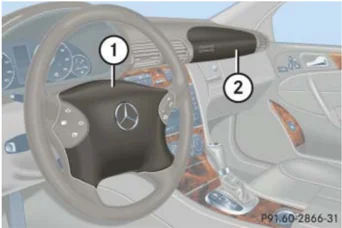
① Driver's air bag ② Passenger front air bag
Driver and front passenger air bags are deployed:
- in the event of certain frontal impacts
- if impact exceeds a preset deployment threshold
- independently of the side impact air bags
The front air bags in this vehicle have been designed to inflate in two stages. This allows the air bag to have different rates of inflation that are based on the rate of relevant vehicle deceleration as assessed by the air bag control unit.
On the front passenger side, the front air bag deployment is additionally influenced by the passenger's weight category as identified by the Occupant Classification System (OCS) (▷ page 71).
The lighter the front passenger side occupant, the higher the vehicle deceleration rate required for the second stage inflation of the air bag.
63
Safety and Security
Occupant safety
The air bags will not deploy in impacts which do not exceed the system’s deployment thresholds. You will then be protected by the fastened seat belts.
The passenger front air bag will only be deployed if:
- the system, based on OCS weight sensor readings, senses that the front passenger seat is occupied
- the [icon] indicator lamp in the center console is not lit (> page 75)
- the impact exceeds a preset deployment treshold
Side impact air bags, window curtain air bags
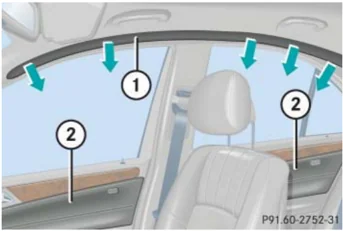
① Window curtain air bag ② Side impact air bags
The side impact air bags and window curtain air bags are deployed:
- on the impacted side of the vehicle
- in impacts exceeding a preset deployment threshold
- independently of the front air bags
The side impact air bags and window curtain air bags are not deployed in impacts which do not exceed the system’s deployment threshold.
Seat belts
When the engine is started, the seat belt telltale [icon] illuminates to remind you and your passengers to fasten your seat belts.
If the driver’s seat belt is not fastened before the engine is started, the seat belt telltale [icon] illuminates and a warning chime sounds for approximately six seconds when the engine is started.
The use of seat belts and infant and child restraint systems is required by law in all 50 states, the District of Columbia, the U.S. territories and all Canadian provinces.
Even where this is not the case, all vehicle occupants should have their seat belts fastened whenever the vehicle is in motion.
For more information, see “Fastening the seat belt” (> page 43).
64
Safety and Security
Occupant safety
i For information on infants and children traveling with you in the vehicle and restraint systems for infants and children, see “Children in the vehicle” (▷ page 68).
Warning!
Always fasten your seat belt before driving off. Always make sure all of your passengers are properly restrained, even those sitting in the rear and pregnant women.
Failure to wear and properly fasten and position your seat belt greatly increases your risk of injuries and their likely severity in an accident. You and your passengers should always wear seat belts.
If you are ever in an accident, your injuries can be considerably more severe without your seat belt properly buckled. Without your seat belt buckled, you are much more likely to hit the interior of the vehicle or be ejected from it. You can be seriously injured or killed.
In the same crash, the possibility of injury or death is lessened if you are properly wearing your seat belt. Air bags can only protect as they are designed if the occupants are properly wearing their seat belts.
Warning!
Never ride in a moving vehicle with the seat backrest in an excessively reclined position as this can be dangerous. You could slide under the seat belt in a collision. If you slide under it, the belt would apply force at the abdomen or neck. That could cause serious or even fatal injuries. The seat backrest and seat belt provide the best restraint when the wearer is in a nearly upright position and the belt is properly positioned on the body.
Warning!
Never let more people ride in the vehicle than there are seat belts available. Be sure everyone riding in the vehicle is correctly restrained with a separate seat belt. Never use a seat belt for more than one person at a time.
65
Safety and Security
Occupant safety
Warning!
Damaged seat belts or belts that were highly stressed in an accident must be replaced and their anchoring points must also be checked.
Only use seat belts which have been approved by Mercedes-Benz.
Do not make any modifications to the seat belts. This can lead to unintended activation of the ETDs or to failure.
Do not bleach or dye seat belts as this may severely weaken them. In a crash they may not be able to provide adequate protection.
Have all work carried out only by qualified technicians. Contact an authorized Mercedes-Benz Center.
Warning!
USE SEAT BELTS PROPERLY
- Seat belts can only work when used properly. Never wear seat belts in any other way than as described in this section, as that could result in serious injuries in case of an accident.
- Each occupant should wear their seat belt at all times, because seat belts help reduce the likelihood of and potential severity of injuries in accidents, including rollovers. The integrated restraint system includes SRS (driver air bag, passenger front air bag, side impact air bags, head protection window curtain air bags for side windows), ETD (seat belt emergency tensioning device), and front seat knee bolsters.
The system is designed to enhance the protection offered to properly belted occupants in certain frontal (front air bags and ETD) and side (side impact and window curtain air bags and ETD) impacts which exceed preset deployment thresholds.
- Never wear the shoulder belt under your arm, against your neck or off your shoulder. In a frontal crash, your body would move too far forward. That would increase the chance of head and neck injuries. The belt would also apply too much force to the ribs or abdomen, which could severely injure internal organs such as your liver or spleen.
66
Safety and Security
Occupant safety
- Never wear belts over rigid or breakable objects in or on your clothing, such as eyeglasses, pens, keys, etc., as these might cause injuries.
- Position the lap belt as low as possible on your hips and not across the abdomen. If the belt is positioned across your abdomen, it could cause serious injuries in a crash.
- Never use a seat belt for more than one person at a time. Do not fasten a seat belt around a person and another person or other objects.
- Belts should not be worn twisted. In a crash, you wouldn’t have the full width of the belt to distribute impact forces. The twisted belt against your body could cause injuries.
- Pregnant women should also use a lap-shoulder belt. The lap belt portion should be positioned as low as possible on the hips to avoid any possible pressure on the abdomen.
- Never place your feet on the instrument panel, dashboard, or on the seat. Always keep both feet on the floor in front of the seat.
- When using a seat belt to secure infant or toddler restraints or children in booster seats, always follow the child seat manufacturer’s instructions.
Emergency tensioning device (ETD), seat belt force limiter
The seat belts for the front and rear outer seats are equipped with emergency tensioning devices and belt force limiters.
The ETD is designed to activate in the following cases:
- in frontal or rear-end impacts exceeding a preset severity level.
- if the restraint systems are operational and functioning correctly, see SRS indicator lamp (▷ page 58).
! The ETDs for the front seats will only activate if the front seat belts are fastened (latch plate properly inserted into buckle).
The ETDs for the rear outer seats will activate with or without the respective seat belts fastened.
67
Safety and Security
Occupant safety
In an impact, emergency tensioning devices remove slack from the belts. Belt force limiters reduce the force exerted by the seat belts on occupants during a crash.
Warning! An emergency tensioning device (ETD) that was activated must be replaced.
When disposing of the emergency tensioning device, our safety instructions must be followed. These are available at your authorized Mercedes-Benz Center.
Children in the vehicle
If an infant or child is traveling with you in the vehicle:
- Secure the child using an infant or child restraint appropriate to the age and size of the child.
- Make sure that the infant or child is properly secured at all times while the vehicle is in motion.
Infant and child restraint seats and information on choosing an appropriate restraint system can be obtained from any Mercedes-Benz Center.
Infant and child restraint systems
We recommend all infants and children be properly restrained at all times while the vehicle is in motion.
All lap-shoulder belts except the driver's seat belt have special seat belt retractors for secure fastening of child restraints.
To fasten a child restraint, follow child restraint instructions for mounting. Then pull the shoulder belt out completely and let it retract. During seat belt retraction, a ratcheting sound can be heard to indicate that the special seat belt retractor is activated. The belt is now locked. Push down on child restraint to take up any slack.
To deactivate, release seat belt buckle and let seat belt retract completely. The seat belt can again be used in the usual manner.
68
Safety and Security
Occupant safety
i Information on child seats with mounting fittings for tether anchorages (▷ page 77).
For information on LATCH-type child seat mounts (▷ page 78).
**! ** The use of infant or child restraints is required by law in all 50 states, the District of Columbia, the U.S. territories and all Canadian provinces.
Infants and small children should be seated in an appropriate infant or child restraint system, properly secured by a lap/shoulder belt or, if so equipped, a top tether anchorage point and a child restraint lower anchorage system that complies with U.S. Federal Motor Vehicle Safety Standards 213 and 225 and Canadian Motor Vehicle Safety Standards 213 and 210.2.
Warning! Never release the seat belt buckle while the vehicle is in motion, since the special seat belt retractor will be deactivated.
**! ** A statement by the child restraint manufacturer of compliance with this standard can be found on the instruction label on the restraint and in the instruction manual provided with the restraint.
When using any infant, or toddler restraint, or booster seat, be sure to carefully read and follow all manufacturer’s instructions for installation and use.
Please read and observe warning labels affixed to the inside of the vehicle and to infant or child restraints.
Warning! According to accident statistics, children are safer when properly restrained in the rear seating positions than in the front seating position. Thus, we strongly recommend that children be placed in the rear seats whenever possible. Regardless of seating position, children 12 years old and under must be seated and properly secured in an appropriate infant or child restraint recommended for the size and weight of the child.
The infant or child restraint must be properly secured with the vehicle’s seat belt, the seat belt and top tether strap, or lower anchors and top tether strap, fully in accordance with the child seat manufacturer’s instructions. ▷▷
69
Safety and Security
Occupant safety
Children can be killed or seriously injured by an inflating air bag. Note the following important information when circumstances require you to place a child in the front passenger seat:
-
Your vehicle is equipped with air bag technology designed to turn off the front passenger front air bag in your vehicle when the OCS senses the weight of a typical 12-month-old child or less along with the weight of a standard appropriate child restraint on the front passenger seat.
-
A child in a rear-facing child restraint on the front passenger seat will be seriously injured or even killed if the front passenger front air bag inflates in a collision which could occur under some circumstances, even with the air bag technology installed in your vehicle. The only means to completely eliminate this risk is to never place a child in a rear-facing child restraint in the front seat. We therefore strongly recommend that you always place a child in a rear-facing child restraint in the back seat.
-
If you must install a rear-facing child restraint on the front passenger seat because circumstances require you to do so, make sure that the indicator lamp is illuminated, indicating that the front passenger air bag is deactivated. Should the indicator lamp not illuminate or go out while the restraint is installed, please check installation. Periodically check the indicator lamp while driving to make sure the indicator lamp is illuminated. If the indicator lamp goes out or remains out, do not transport a child on the front passenger seat until the system has been repaired. A child in a rear-facing child restraint on the front passenger seat will be seriously injured or even killed if the front passenger front air bag inflates.
-
If you have to place a child in a forward-facing child restraint on the front passenger seat, move the seat as far back as possible, use the proper child restraint recommended for the age, size and weight of the child, and secure child restraint with the vehicle’s seat belt according to the child seat manufacturer’s instructions. For children larger than the typical 12-month-old child, the front passenger air bag may or may not be activated (▷ page 73).
70
Safety and Security
Occupant safety
Warning!
Infants and small children should never share a seat belt with another occupant. During an accident, they could be crushed between the occupant and seat belt.
A child’s risk of serious or fatal injuries is significantly increased if the child restraints are not properly secured in the vehicle and/or the child is not properly secured in the child restraint.
Children too big for a toddler restraint must ride in seats using regular seat belts. Position shoulder belt across chest and shoulder, not face or neck. A booster seat may be necessary to achieve proper belt positioning for children from 41 lbs until they reach a height where a lap/shoulder belt fits properly without a booster.
When the child restraint is not in use, remove it from the vehicle or secure it with the seat belt to prevent the child restraint from becoming a projectile in the event of an accident.
Do not leave children unattended in the vehicle, even if the children are secured in a child restraint system. Unsupervised children in a child restraint system may use vehicle equipment and may cause an accident and/or serious personal injury.
Occupant Classification System
The Occupant Classification System (OCS) automatically turns the front passenger front air bag on or off based on the classified occupant weight category determined by weight sensor readings from the front passenger seat.
The system does not deactivate the front passenger side impact air bag, the window curtain air bag and the emergency tensioning device.
Occupants must sit properly belted in a nearly upright position with their back against the seat backrest and feet on the floor to be correctly classified. If the occupant’s weight is transferred to another object in the vehicle (e.g. by leaning on armrests), the OCS may not be able to properly approximate the occupant’s weight category.
71
Safety and Security
Occupant safety
i If your seat, including your trim cover and cushion needs to be serviced in any way, take the vehicle to your authorized Mercedes-Benz Center.
Only seat accessories approved by Mercedes-Benz may be used.
Both driver and the front passenger should always use the [icon: PASS AIR BAG OFF] indicator lamp as an indication of whether or not the front passenger is properly positioned.
Warning!
If the [icon: PASS AIR BAG OFF] indicator lamp illuminates when an adult or someone larger than a small individual is in the front passenger seat, have the front passenger re-position himself or herself in the seat until the [icon: PASS AIR BAG OFF] indicator lamp goes out.
More information about air bag display messages (▷ page 354).
In the event of a collision, the air bag control unit will not allow front passenger front air bag deployment when the OCS classified the front passenger seat occupant as being up to or less than the weight of a typical 12-month-old child in a standard child restraint or if the front passenger seat is sensed as being empty.
When the OCS senses that the front passenger seat occupant is classified as being up to or less than the weight of a typical 12-month-old child in a standard child restraint, the [icon: PASS AIR BAG OFF] indicator lamp will illuminate when the engine is started and remain illuminated, indicating that the front passenger front air bag is deactivated.
When the OCS senses that the front passenger seat is classified as being empty, the [icon: PASS AIR BAG OFF] indicator lamp will illuminate when the engine is started and remain illuminated, indicating that the front passenger front air bag is deactivated.
72
Safety and Security
Occupant safety
When the OCS senses that the front passenger seat occupant is classified as being heavier than the weight of a typical 12-month-old child seated in a standard child restraint or as being a small individual (such as a young teenager or a small adult), the [icon] indicator lamp will illuminate for approximately six seconds when the engine is started and then, depending on occupant weight sensor readings from the seat, remain illuminated or go out. With the [icon] indicator lamp illuminated, the front passenger front air bag is deactivated. With the [icon] indicator lamp out, the front passenger front air bag is activated.
When the OCS senses that the front passenger seat occupant is classified as an adult or someone larger than a small individual, the [icon] indicator lamp will illuminate for approximately six seconds when the engine is started and then go out, indicating that the front passenger front air bag is activated.
If the [icon] indicator lamp is illuminated, the front passenger front air bag is deactivated and will not be deployed.
If the [icon] indicator lamp is not illuminated, the front passenger front air bag is activated and will be deployed:
- in the event of certain frontal impacts
- if impact exceeds a preset deployment threshold
- independently of the side impact air bags.
If the front passenger front air bag is deployed, the rate of inflation will be influenced by:
- the rate of relevant vehicle deceleration as assessed by the air bag control unit
- front passenger’s weight category as identified by the Occupant Classification System (OCS).
Warning!
According to accident statistics, children are safer when properly restrained in the rear seating positions than in the front seating position. Thus, we strongly recommend that children be placed in the rear seats whenever possible. Regardless of seating position, children 12 years old and under must be seated and properly secured in an appropriate infant or child restraint recommended for the size and weight of the child.
The infant or child restraint must be properly secured with the vehicle’s seat belt, the seat belt and top tether strap, or lower anchors and top tether strap, fully in accordance with the child seat manufacturer’s instructions.
73
Safety and Security
Occupant safety
Children can be killed or seriously injured by an inflating air bag. Note the following important information when circumstances require you to place a child in the front passenger seat:
-
Your vehicle is equipped with air bag technology designed to turn off the front passenger front air bag in your vehicle when the system senses the weight of a typical 12-month-old child or less along with the weight of a standard appropriate child restraint on the front passenger seat.
-
A child in a rear-facing child restraint on the front passenger seat will be seriously injured or even killed if the front passenger front air bag inflates in a collision which could occur under some circumstances, even with the air bag technology installed in your vehicle. The only means to completely eliminate this risk is to never place a child in a rear-facing child restraint in the front seat. We therefore strongly recommend that you always place a child in a rear-facing child restraint in the back seat.
-
If you must install a rear-facing child restraint on the front passenger seat because circumstances require you to do so, make sure that the [icon] indicator lamp is illuminated, indicating that the front passenger front air bag is deactivated. Should the [icon] indicator lamp not illuminate or go out while the restraint is installed, please check installation. Periodically check the [icon] indicator lamp while driving to make sure the [icon] indicator lamp is illuminated. If the [icon] [icon] indicator lamp goes out or remains out, do not transport a child on the front passenger seat until the system has been repaired. A child in a rear-facing child restraint on the front passenger seat will be seriously injured or even killed if the passenger front air bag inflates.
-
If you have to place a child in a forward-facing child restraint on the front passenger seat, move the seat as far back as possible, use the proper child restraint recommended for the age, size and weight of the child, and secure child restraint with the vehicle’s seat belt according to the child seat manufacturer’s instructions. For children larger than the typical 12-month-old child, the front passenger front air bag may or may not be activated (▷ page 73).
74
Safety and Security
Occupant safety
i Deployment of the driver front air bag does not mean that the front passenger front air bag also should have deployed.
The Occupant Classification System (▷ page 71) may have determined:
- that the seat was empty or occupied by the weight up to or less than that of a typical 12-month-old child seated in a standard child restraint - both instances where the system suppresses deployment of the front passenger front air bag even though the impact met the criteria and was of sufficient severity to deploy the driver front air bag.
- that the seat was occupied by a small individual (such as a young teenager or a small adult) or a child weighing more than the weight of a typical 12-month-old child in a standard child restraint - instances where the system may suppress deployment of the front passenger front air bag even though the impact met the criteria and was of sufficient severity to deploy the driver front air bag.
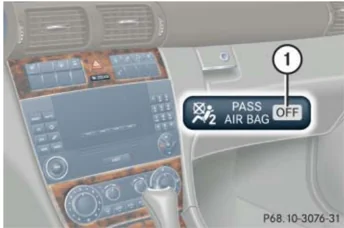
The [icon] indicator lamp is located in the center console.

① Front passenger front air bag off indicator lamp
The [icon] indicator lamp will be illuminated, except with the SmartKey removed or in starter switch position 0.
75
Safety and Security
Occupant safety
Warning!
If the SRS indicator lamp and the [icon] indicator lamp are lit at the same time, there is a malfunction in the Occupant Classification System. The front passenger front air bag will be deactivated in this case.
In order to ensure proper operation of the air bag system and OCS:
-
Have the system checked as soon as possible by qualified technicians. Contact an authorized Mercedes-Benz Center.
-
Sit properly belted in a nearly upright position with your back against the seat backrest.
-
Do not lean on the armrests or lift yourself from the seat by using the handle over the door as this may cause the OCS to be unable to correctly approximate the occupant weight category.
-
Only have the seat repaired or replaced by an authorized Mercedes-Benz Center.
-
Read and observe all warnings in this chapter.
Self-test Occupant Classification System
After turning the SmartKey in the starter switch to position 1 or 2, the [icon] indicator lamp located in the center console illuminates. If an adult occupant is properly sitting on the front passenger seat and the system senses the occupant as being an adult, the [icon] indicator lamp will illuminate and go out after approximately six seconds.
If the seat is not occupied and the system senses the front passenger seat as being empty, the [icon] indicator lamp will illuminate and not go out.
Warning!
If the [icon] indicator lamp should not illuminate, the system is not functioning. You must see an authorized Mercedes-Benz Center before seating any child on the front passenger seat.
More information can be found in the "Practical hints" section (▷ page 350).
Warning!
Never place anything between seat cushion and child seat (e.g. pillow), since it reduces the effectiveness of the Occupant Classification System. The bottom of the child seat must make full contact with the passenger seat cushion. An incorrectly mounted child seat could cause injuries to the child in case of an accident, instead of increasing protection for the child.
Follow the manufacturer's instructions for installation of child seats.
76