DRIVING TIPS
CAUTION
Always observe the following precautions to minimize the risk of serious personal injury or damage to your vehicle:
-
Drive carefully when off the road. Do not take unnecessary risks by driving in dangerous places.
-
Do not grip the steering wheel spokes when driving off-road. A bad bump could jerk the wheel and injure your hands. Keep both hands and especially your thumbs on the outside of the rim.
-
Always check your brakes for effectiveness immediately after driving in sand, mud, water or snow.
-
After driving through tall grass, mud, rock, sand, rivers, etc., check that there is no grass, bush, paper, rags, stone, sand, etc. adhering or trapped on the underbody. Clear off any such matter from the underbody. If the vehicle is used with these materials trapped or adhering to the underbody, a breakdown or fire could occur.
-
In a rollover crash, an unbelted person is significantly more likely to die than a person wearing a seat belt. Therefore, the driver and all passengers should fasten their seat belts whenever the vehicle is moving.
-
When driving off-road or in rugged terrain, do not drive at excessive speeds, jump, make sharp turns, strike objects, etc. This may cause loss of control or vehicle rollover causing death or serious injury. You are also risking expensive damage to your vehicle's suspension and chassis.
NOTICE
- If driving through water, such as when crossing shallow streams, first check the depth of the water and the bottom of the river bed for firmness. Drive slowly and avoid deep water.
- Take all necessary safety measures to ensure that water damage to the engine or other components does not occur.
Water entering the engine air intake will cause severe engine damage.
Water can wash the grease from wheel bearings, causing rusting and premature failure, and may also enter the differentials, transmission and transfer case, reducing the gear oil's lubricating qualities.
- Sand and mud that has accumulated in brake drums and around brake discs may affect braking efficiency and may damage brake system components.
277
DRIVING TIPS
- Always perform a maintenance inspection after each day of off-road driving that has taken you through rough terrain, sand, mud, or water. For scheduled maintenance information, refer to the “Owner’s Manual Supplement / Scheduled Maintenance”.
WINTER DRIVING TIPS
Make sure your coolant is properly protected against freezing.
Your coolant must contain ethylene-glycol type coolant for a proper corrosion protection of aluminum components. Use "Toyota Genuine Long Life Coolant" or equivalent. See "Checking the engine coolant level" on page 354 for instructions.
NOTICE Do not use alcohol type antifreeze or plain water alone.
When it is extremely cold, we recommend to use 60% solution for your Lexus, to provide protection down to about –50°C (–58°F). Do not use more than 70% solution for better coolant performance.
Check the condition of the battery and cables.
Cold temperatures reduce the capacity of any battery, so it must be in top shape to provide enough power for winter starting. Page 379 tells you how to visually inspect the battery. Your Lexus dealer and most service stations will be pleased to check the battery charge level.
Make sure the engine oil viscosity is suitable for the cold weather.
See page 352 for recommended viscosity. Leaving a heavy summer oil in your vehicle during winter months may cause harder starting. If you are not sure about which oil to use, call your Lexus dealer – they will be pleased to help.
278
DRIVING TIPS
Check the electronic ignition system for loose connections or obvious damage.
Keep the door locks from freezing.
Squirt lock de-icer or glycerine into the locks to keep them from freezing.
Use a washer fluid containing an antifreeze solution.
This product is available at your Lexus dealer and most auto parts stores. Follow the manufacturer's directions for how much to mix with water.
NOTICE Do not use engine antifreeze or any other substitute because it may damage your vehicle’s paint.
Do not use your parking brake when there is a possibility it could freeze.
When parking, put the transmission into "P" and block the front wheels. Do not use the parking brake, or snow or water accumulated in and around the parking brake mechanism may freeze the parking brake, making it hard to release.
Keep ice and snow from accumulating under the fenders.
Ice and snow built up under your fenders can make steering difficult. During bad winter driving, stop and check under the fenders occasionally.
Depending on where you are driving, we recommend you carry some emergency equipment.
Some of the things you might put in the vehicle are tire chains, window scraper, bag of sand or salt, flares, small shovel, jumper cables, etc.
DINGHY TOWING
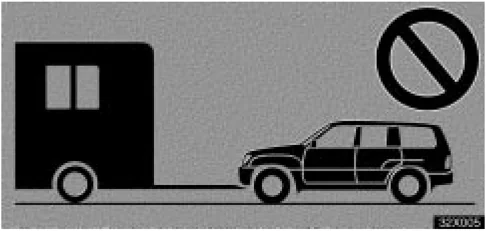
Your vehicle is not designed to be dinghy towed (with four wheels on the ground) behind a motorhome.
NOTICE Do not tow your vehicle with four wheels on the ground. This may cause serious damage to your vehicle.
279
DRIVING TIPS
TRAILER TOWING
Your vehicle is designed primarily as a passenger-and-load carrying vehicle. Towing a trailer will have an adverse effect on handling, performance, braking, durability and driving economy (fuel consumption, etc.). Your safety and satisfaction depend on the proper use of correct equipment and cautious driving habits. For your safety and the safety of others, you must not overload your vehicle or trailer. Lexus warranties do not apply to damage or malfunction caused by towing a trailer for commercial purposes. Ask your local Lexus dealer for further details before towing.
CAUTION When disconnecting a trailer, put the vehicle height in the "LO" (Low) mode and push the height control switch to turn off the active height control suspension. Otherwise, the vehicle height may be changed because of the automatic leveling function, resulting in an accident. For details, see "Active height control suspension (AHC)" on page 250.
Weight limits
Before towing, make sure the total trailer weight, gross vehicle weight, gross axle weight and trailer tongue load are all within the limits.
The total trailer weight and tongue load can be measured with platform scales found at a highway weighing station, building supply company, trucking company, junk yard, etc.

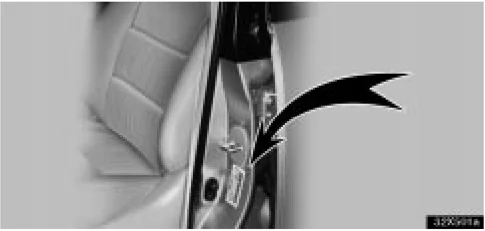
▶Certification label
280
DRIVING TIPS
CAUTION
-
The maximum gross trailer weight (trailer weight plus cargo weight) must never exceed 2268 kg (5000 lb.) for vehicles with equipped. For details, contact your Lexus dealer. If towing a trailer and cargo weighing over 907 kg (2000 lb.), it is necessary to use a sway control device with sufficient capacity. The combination of the gross trailer weight added to the total weight of the vehicle, occupants and vehicle cargo must never exceed a total of 4945 kg (10900 lb.). Exceeding the maximum weight of the trailer, the vehicle, or the vehicle and trailer combination, can cause an accident resulting in serious personal injuries.
-
Trailer hitch assemblies have different weight capacities established by the hitch manufacturer. Even though the vehicle may be physically capable of towing a higher weight, the operator must determine the maximum weight rating of the particular hitch assembly and never exceed the maximum weight rating specified for the trailer hitch. Exceeding the maximum weight rating set by the trailer hitch manufacturer can cause an accident resulting in serious personal injuries.
-
The gross vehicle weight must not exceed the Gross Vehicle Weight Rating (GVWR) indicated on the Certification Label. The gross vehicle weight is the sum weight of the unloaded vehicle, driver, passengers, luggage, hitch and trailer tongue load. It also includes the weight of any special equipment installed on your vehicle.
-
The load on either the front or rear axle resulting from distribution of the gross vehicle weight on both axles must not exceed the Gross Axle Weight Rating (GAWR) listed on the Certification Label.
-
Maximum tongue weight for a weight carrying hitch is 227 kg (500 lb.).
281
DRIVING TIPS
 ►Total trailer weight ►Tongue load
- The trailer cargo load should be distributed so that the tongue load is 9 to 11 % of the total trailer weight, not exceeding the maximum of 227 kg (500 lb.).
- Never load the trailer with more weight in the back than in the front. About 60 % of the trailer load should be in the front half of the trailer and the remaining 40 % in the rear.
Tow hitch receiver
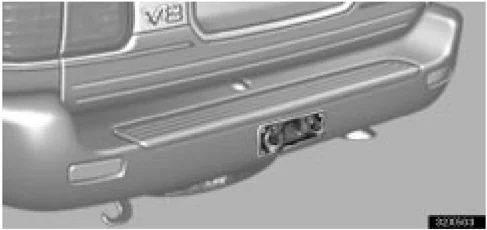
A tow hitch receiver should be installed as shown before towing.
CAUTION
- Never attempt to remove or install a tow hitch. For removal or installation, contact your authorized Lexus dealer.
- A tow hitch receiver is rated for weight carrying towing only up to 2268 kg (5000 lb.) Only use this tow hitch receiver on your vehicle. Do not use this tow hitch receiver on any other vehicle.
282

Hitches
- Use only weight carrying hitch hardware designed for the total trailer weight with the factory installed hitch.
- If you wish to install an aftermarket hitch, the hitch must be bolted securely to the vehicle frame and installed according to the hitch manufacturer’s instructions.
- Lexus recommends the ball mount assembly be removed when not towing to prevent injury and to prevent damage in the event of a rear end collision. After removing the ball mount assembly, install the grommet to the hitch to prevent entry of dirt and mud.
Trailer ball
Follow these easy steps to properly determine the correct trailer ball for your application:
- Determine the correct trailer ball size for the trailer coupler. Most couplers are stamped with the required trailer ball size. The sizes you’ll most likely find stamped on the coupler are:
| Trailer Class | Typical Trailer Ball Size |
|---|---|
| III | 2 5/16 in. |
| II | 2 in. |
| I | 1 7/8 in. |
- Select the appropriate trailer ball to match or exceed the gross trailer weight rating of the trailer. The trailer ball load rating should be printed on the top of the ball.
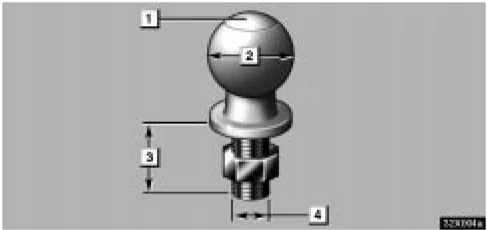
-
Trailer ball load rating
-
Ball diameter
-
Shank length
-
Shank diameter
-
When mounted in the ball mount, the threaded ball shank must protrude beyond the bottom of the lock washer and nut at least 2 threads. The trailer ball shank must be matched to the ball mount hole diameter size.
DRIVING TIPS
Matching trailer ball height to trailer coupler height
No matter which class of tow hitch applies, for a safe trailer hookup, the trailer ball setup on must be the proper height for the coupler on the trailer.
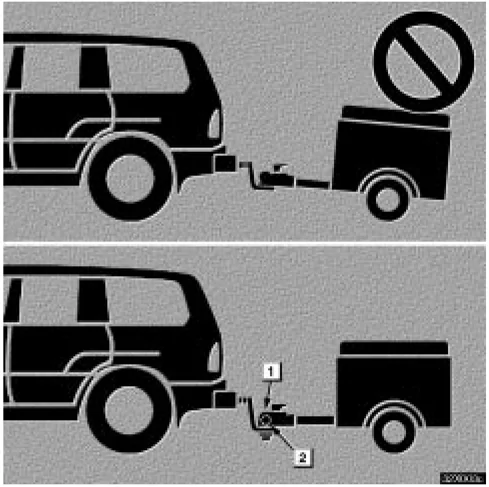
▶ 1 Coupler 2 Trailer ball
Brakes and safety chains
- Lexus recommends trailers with brakes that conform to any applicable federal and state/provincial regulations.
- A safety chain must always be used between the towing vehicle and the trailer. Leave sufficient slack in the chain for turns. The chain should cross under the trailer tongue to prevent the tongue from dropping to the ground in case it becomes damaged or separated. For correct safety chain procedures, consult your Lexus dealer.
⚠ CAUTION
- If the total trailer weight exceeds 453 kg (1000 lb.), trailer brakes are required.
- Never tap into your vehicle's hydraulic system as it will lower its braking effectiveness.
- Never tow a trailer without using a safety chain securely attached to both the trailer and the vehicle. If damage occurs to the coupling unit or hitch ball, there is possible danger of the trailer wandering over into another lane.
284
DRIVING TIPS
Tires
-
Ensure that your vehicle's tires are properly inflated. Adjust the tire pressure to the recommended cold tire pressure indicated below:
Tire pressure, kPa (kgf/cm² or bar, psi) Front 220 (2.2, 32)) Rear 240 (2.4, 35)
-
The trailer tires should be inflated to the pressure recommended by the trailer manufacturer in respect to the total trailer weight.
Trailer lights
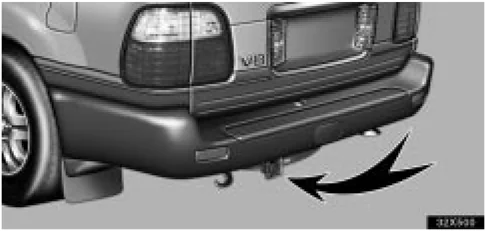
- Your vehicle is equipped with a wire harness stored in the rear end underbody. Some models are fitted with a socket for trailer lights under the rear bumper. Use either of them to connect and operate the trailer lights. However, the trailer lights must comply with federal, state/provincial and local regulations. See your local recreational vehicle dealer or rental agency for the correct type of wiring and relays for your trailer. Check for correct operation of the turn signals and stop lights each time you hitch up. Direct splicing may damage your vehicle's electrical system and cause a malfunction of your lights.
Break-in schedule
- Lexus recommends that you do not tow a trailer with a new vehicle or a vehicle with any new power train component (engine, transmission, differential, wheel bearing, etc.) for the first 800 km (500 miles) of driving.
285
DRIVING TIPS
Maintenance
- If you tow a trailer, your vehicle will require more frequent maintenance due to the additional load. For this information, please refer to the scheduled maintenance information in the “Owner’s Manual Supplement / Scheduled Maintenance”.
- Retighten all fixing bolts of the towing ball and bracket after approximately 1000 km (600 miles) of trailer driving.
Connecting a trailer
Stop your vehicle and a trailer in line and perform the following:
- Put the active height control suspension in the "LO" (low) mode. Turn the ignition switch off or push the height control switch to turn off the active height control suspension.
- Connect a trailer.
- Turn the ignition switch on or push the height control switch to turn on the active height control suspension. Select the "N" (normal) mode with the height select switch.
When a vehicle loaded with 4 occupants tows a trailer of about 1800 kg (4000 lb.) with more than about 180 kg (400 lb.) tongue load, the normal mode may not be selected with the height control indicator "LO". However, there is no problem to continue normal driving. Drive with sufficient care because of large load.
Disconnecting a trailer
Stop your vehicle and a trailer in line and perform the following:
- Put the active height control suspension in the "LO" mode. (Make sure the vehicle height is in the "LO" mode by pushing the height select switch on the "▼"side.)
- Turn the ignition switch off or push the height control switch to turn off the active height control suspension.
- Set the supporting leg of a trailer on the ground and raise the hitch by 100 mm (4 in.)
- Turn the ignition switch on or push the height control switch to turn on the active height control suspension.
- Wait for about 20 seconds until the rear vehicle height is lowered by the automatic leveling function.
- Make sure the hitch is disconnected. If not, raise the hitch higher and repeat steps 2 through 5.
- Move the vehicle forward in the "LO" mode where the hitch does not touch anything in the "N" mode.
- Put the active height control suspension in the "N" mode.
286
DRIVING TIPS
Pre-towing safety check
- Check that your vehicle remains level when a loaded or unloaded trailer is hitched. Do not drive if the vehicle has an abnormal nose-up or nose-down condition, and check for improper tongue load, overload, worn suspension or other possible causes.
- Make sure the trailer cargo is securely loaded so that it cannot shift.
- Check that your rear view mirrors conform to any federal, state/provincial or local regulations. If they do not, install required rear view mirrors appropriate for towing purposes.
Trailer towing tips When towing a trailer, your vehicle will handle differently than when not towing. The three main causes of vehicle-trailer accidents are driver error, excessive speed and improper trailer loading. Keep these in mind when towing:
- Before starting out, check the operation of the lights and all vehicle-trailer connections. After driving a short distance, stop and recheck the lights and connections. Practice turning, stopping and backing with a trailer in an area away from traffic until you learn the feel.
- Backing with a trailer is difficult and requires practice. Grip the bottom of the steering wheel and move your hand to the left to move the trailer to the left. Move your hand to the right to move the trailer to the right. (This procedure is generally opposite to that when backing without a trailer.) Also, just turn the steering wheel a little at a time, avoiding sharp or prolonged turning. Have someone guide you when backing to reduce the risk of an accident.
- Because stopping distance may be increased, vehicle-to-vehicle distance should be increased when towing a trailer. For each 16 km/h (10 mph) of speed, allow at least one vehicle and trailer length between you and the vehicle ahead. Avoid sudden braking as you may skid, resulting in jackknifing and loss of control. This is especially true on wet or slippery surfaces.
- Avoid jerky starts or sudden acceleration.
287
DRIVING TIPS
- Avoid jerky steering and sharp turns. The trailer could hit your vehicle in a tight turn. Slow down before making a turn to avoid the need of sudden braking.
- Remember that when making a turn, the trailer wheels will be closer than the vehicle wheels to the inside of the turn. Therefore, compensate for this by making a larger than normal turning radius with your vehicle.
- Crosswinds and rough roads will adversely affect handling of your vehicle and trailer, causing sway. Pay attention to the rear from time to time to prepare yourself for being passed by large trucks or buses, which may cause your vehicle and trailer to sway. If swaying happens, firmly grip the steering wheel and reduce speed immediately but gradually. Never increase speed. If it is necessary to reduce speed, brake slowly. Steer straight ahead. If you make no extreme correction with the steering or brakes, your vehicle and trailer will stabilize.
- Be careful when passing other vehicles. Passing requires considerable distance. After passing a vehicle, do not forget the length of your trailer and be sure you have plenty of room before changing lanes.
- In order to maintain efficient engine braking and electrical charging performance, do not use overdrive. Transmission must be "4" position.
- Because of the added load of the trailer, your vehicle's engine may overheat on hot days (at temperatures over 30°C [85°F]) when going up a long or steep grade with a trailer. If the engine coolant temperature gauge indicates overheating, immediately turn off the air conditioning (if in use), pull your vehicle off the road and stop in a safe spot.
See "If your vehicle overheats" on page 297.
- Always place wheel blocks under both the vehicle and trailer wheels when parking. Apply the parking brake firmly. Put the transmission in "P". Avoid parking on a slope with a trailer, but if it cannot be avoided, do so only after performing the following:
- Apply the brakes and keep them applied.
- Have someone place wheel blocks under both the vehicle and trailer wheels.
- When the wheel blocks are in place, release your brakes slowly until the blocks absorb the load.
- Apply the parking brake firmly.
- Shift into "P" and turn off the engine.
288
DRIVING TIPS
When restarting out after parking on a slope:
- With the transmission in "P" position, start the engine. Be sure to keep the brake pedal depressed.
- Shift into the "3", "2", "L" or "R" position.
- Release the parking brake and brake pedal and slowly pull or back away from the wheel blocks. Stop and apply your brakes.
- Have someone retrieve the blocks.
CAUTION
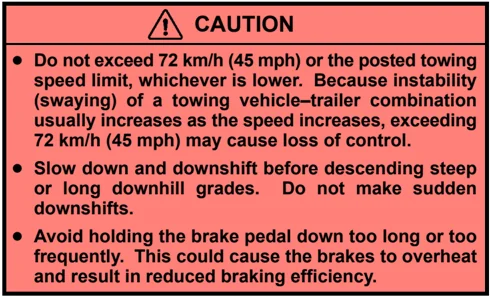
- Do not exceed 72 km/h (45 mph) or the posted towing speed limit, whichever is lower. Because instability (swaying) of a towing vehicle–trailer combination usually increases as the speed increases, exceeding 72 km/h (45 mph) may cause loss of control.
- Slow down and downshift before descending steep or long downhill grades. Do not make sudden downshifts.
- Avoid holding the brake pedal down too long or too frequently. This could cause the brakes to overheat and result in reduced braking efficiency.
HOW TO SAVE FUEL AND MAKE YOUR VEHICLE LAST LONGER
Improving fuel economy is easy – just take it easy. It will help make your vehicle last longer, too. Here are some specific tips on how to save money on both fuel and repairs:
- Keep your tires inflated at the correct pressure. Check the pressure every two weeks, or at least once a month. Underinflation causes tire wear and wastes fuel.
- Do not carry unneeded weight in your vehicle. Excess weight puts a heavier load on the engine, causing greater fuel consumption.
- Avoid lengthy warm-up idling. Once the engine is running smoothly, begin driving – but gently. Remember, however, that on cold winter days this may take a little longer.
- Accelerate slowly and smoothly. Avoid jackrabbit starts.
- Avoid long engine idling. If you have a long wait and you are not in traffic, it is better to turn off the engine and start again later.
- Avoid engine over-revving. Use a gear position suitable for the road on which you are traveling.
289
DRIVING TIPS
- Avoid continuous speeding up and slowing down. Stop-and-go driving wastes fuel.
- Avoid unnecessary stopping and braking. Maintain a steady pace. Try to time the traffic signals so you only need to stop as little as possible or take advantage of through streets to avoid traffic lights. Keep a proper distance from other vehicles to avoid sudden braking. This will also reduce wear on your brakes.
- Avoid heavy traffic or traffic jams whenever possible.
- Do not rest your foot on the brake pedal. This causes premature wear, overheating and poor fuel economy.
- Maintain a moderate speed on highways. The faster you drive, the greater the fuel consumption. By reducing your speed, you will cut down on fuel consumption.
- Keep the front wheels in proper alignment. Avoid hitting the curb and slow down on rough roads. Improper alignment not only causes faster tire wear but also puts an extra load on the engine, which, in turn, wastes fuel.
- Keep the bottom of your vehicle free from mud, etc. This not only lessens weight but also helps prevent corrosion.
- Keep your vehicle tuned-up and in top shape. A dirty air cleaner, improper valve clearance, dirty plugs, dirty oil and grease, brakes not adjusted, etc. all lower engine performance and contribute to poor fuel economy. For longer life of all parts and lower operating costs, keep all maintenance work on schedule, and if you often drive under severe conditions, see that your vehicle receives more frequent maintenance. (For scheduled maintenance information, please refer to the "Owner's Manual Supplement / Scheduled Maintenance".)
290
291