1 Safety — Seats, seat belts and supplemental restraint system
- Seats ........ 1-2 Front manual seat adjustment
- (for Coupe models) ........ 1-3 Front power seat adjustment
- (for Coupe models — if so equipped) ........ 1-4 Front power seat adjustment
- (for Roadster models) ........ 1-5
- Seat lifter (for driver’s seat) ........ 1-7 Tilting and reclining passenger’s seat from driver’s
- seat ........ 1-7
- Head restraint adjustment ........ 1-9
- Seat belts ........ 1-10
- Precautions on seat belt usage ........ 1-10
- Child safety ........ 1-12
- Obtaining an air bag ON/OFF switch ........ 1-13
- After an air bag ON/OFF switch is installed ........ 1-13
- Pregnant women ........ 1-14
- Injured persons ........ 1-14
- Three-point type seat belt with retractor ........ 1-14
- Seat belt extenders ........ 1-16
- Seat belt maintenance ........ 1-17
- Child restraints ........ 1-17
- Precautions on child restraints ........ 1-17 Child restraint installation on front passenger
- seat ........ 1-20 Top tether strap child restraint
- (Coupe models) ........ 1-25
- Booster seats ........ 1-26
- Precautions on booster seats ........ 1-26 Booster seat installation on front passenger
- seat ........ 1-29
- Supplemental restraint system ........ 1-30
- Precautions on supplemental restraint system ........ 1-30 Components of the supplemental restraint
- system ........ 1-35
- Supplemental air bag warning labels ........ 1-40
- Supplemental air bag warning light ........ 1-41
SEATS
 Sit upright and well back.
SSS0133
WARNING
-
Do not ride in a moving vehicle when the seatback is reclined. This can be dangerous. The shoulder belt will not be against your body. In an accident, you could be thrown into it and receive neck or other serious injuries. You could also slide under the lap belt and receive serious internal injuries.
-
For the most effective protection when the vehicle is in motion, the seat should be upright. Always sit well back in the seat and adjust the seat belt properly. See “Precautions on seat belt usage” later in this section.
1-2 Safety — Seats, seat belts and supplemental restraint system
FRONT MANUAL SEAT ADJUSTMENT (for Coupe models)
WARNING
- Do not adjust the driver’s seat while driving so full attention may be given to vehicle operation. The seat may move suddenly and could cause loss of control of the vehicle.
- After adjustment, gently rock in the seat to make sure it is securely locked.

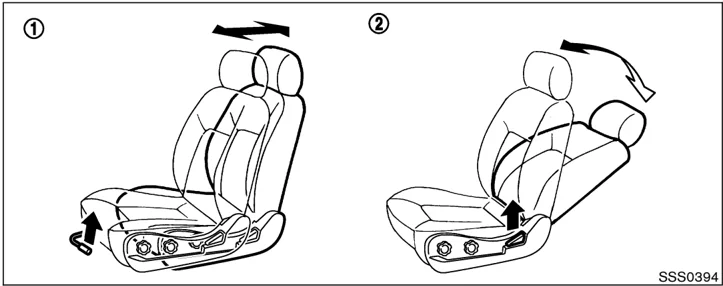
① Forward and backward Pull the lever up while you slide the seat forward or backward to the desired position. Release the lever to lock the seat in position. When sliding the passenger's seat backward, be careful not to crush items in the seatback pocket against the rear floor box.
② Reclining To recline the seatback, pull the lever up and lean back. To bring the seatback forward again, pull the lever and move your body forward. The seatback will move forward. The reclining feature allows adjustment of the seatback for occupants of different sizes for added comfort and to help obtain proper seat belt fit. See "Precautions on seat belt usage" later in this section. The seatback may also be reclined to allow occupants to rest when the vehicle is parked.
Safety — Seats, seat belts and supplemental restraint system 1-3
FRONT POWER SEAT ADJUSTMENT (for Coupe models — if so equipped)
WARNING
- Do not adjust the driver’s seat while driving so full attention may be given to vehicle operation.
- Do not leave children unattended inside the vehicle. They could unknowingly activate switches or controls. Unattended children could become involved in serious accidents.
Operating tips
- The seat motor has an auto-reset overload protection circuit. If the motor stops during operation, wait 30 seconds, then reactivate the switch.
- Do not operate the power support seat for a long period of time when the engine is off. This will discharge the battery.
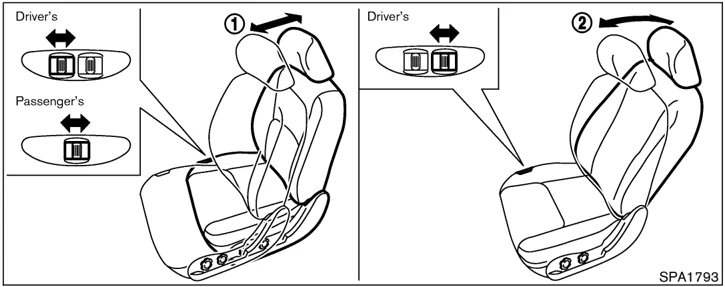
① Forward and backward Moving the sliding switch forward or backward will slide the seat forward or backward to the desired position.
When sliding the passenger’s seat backward, be careful not to crush items in the seatback pocket against the rear floor box.
② Reclining (for driver’s seat) Move the reclining switch backward until the desired angle is obtained. To bring the seatback forward, move the switch forward and move your body forward. The seatback will move forward.
② Reclining (for passenger’s seat) The passenger’s seat is equipped with a manual lever for reclining. See “Front manual seat adjustment” earlier in this section.
The reclining feature allows adjustment of the seatback for occupants of different sizes for added comfort and to help obtain proper seat belt fit. See “Precautions on seat belt usage” later in this section. The seatback may also be reclined to allow occupants to rest when the vehicle is parked.
1-4 Safety — Seats, seat belts and supplemental restraint system
FRONT POWER SEAT ADJUSTMENT (for Roadster models)
WARNING
- Do not adjust the driver’s seat while driving so full attention may be given to vehicle operation.
- Do not leave children unattended inside the vehicle. They could unknowingly activate switches or controls. Unattended children could become involved in serious accidents.
 SSS0472
Operating tips
- The seat motor has an auto-reset overload protection circuit. If the motor stops during operation, wait 30 seconds, then reactivate the switch.
- Do not operate the power support seat for a long period of time when the engine is off. This will discharge the battery.
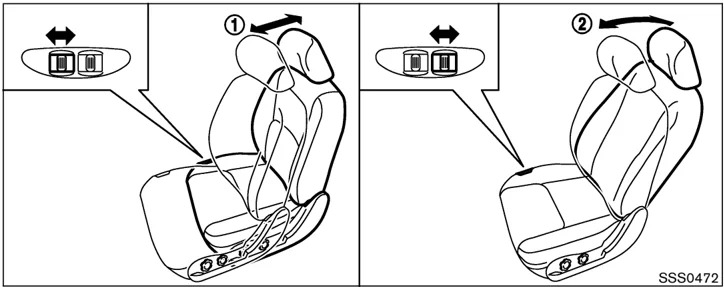
① Forward and backward
Moving the sliding switch forward or backward will slide the seat forward or backward to the desired position.
When sliding the passenger's seat backward, be careful not to crush items in the seatback pocket against the rear floor box.
② Reclining
Move the reclining switch backward until the desired angle is obtained. To bring the seatback forward, move the switch forward and move your body forward. The seatback will move forward.
The reclining feature allows adjustment of the seatback for occupants of different sizes for added comfort and to help obtain proper seat belt fit. See "Precautions on seat belt usage" later in this section. The seatback may also be reclined to allow occupants to rest when the vehicle is parked.
Automatic passenger seatback tilt function
The passenger seatback will automatically tilt forward and backward during the soft top open/close operation. If you need to cancel this function or when a child restraint is installed in the passenger's seat, push the seatback tilt
Safety — Seats, seat belts and supplemental restraint system 1-5
cancel switch to the CANCEL position. For more information about operation conditions, see “Soft top” in the “3. Pre-driving checks and adjustments” section. For the cancel switch, see “Tilting and reclining passenger’s seat from driver’s seat” later in this section.
 SSS0272
Ventilated net seats (if so equipped)
The ventilated net seats are designed for good ventilation while driving. Net cloth is used on the surface of the seatback and the cushion as shown.
CAUTION
-
The seat is made of netted materials. Be careful not to snag your jewelry, such as a ring, bracelet or watch, on the seat.
-
When using these seats, avoid wearing clothing with soft fabrics (wool, etc.). Clothing may be damaged as it rubs against the netted material.
1-6 Safety — Seats, seat belts and supplemental restraint system

 SPA1715
Type A SEAT LIFTER (for driver's seat)
Type A (except for ventilated net seat) Turn either dial to adjust the angle and height of the seat cushion to the desired position.
 SSS0202
Type B Type B (for ventilated net seat)
Turn the dial and adjust the angle of the seat cushion to the desired position.
 SSS0203
Coupe models TILTING AND RECLINING PASSENGER'S SEAT FROM DRIVER'S SEAT
The passenger seatback can be adjusted from the driver's seat to make it easier for the driver to use the rear parcel box or rear floor box, or to help the passenger get in the vehicle.
Coupe models (manual type)
To tilt or recline the passenger seatback, pull up the lever Ⓐ located on the back side of it, and move the seatback forward or backward.
Safety — Seats, seat belts and supplemental restraint system 1-7
 Roadster models — Type A
SSS0273
 Roadster models — Type B
SSS0274
Roadster models (power type)
The power seatback tilt switch Ⓑ and the seatback tilt cancel switch Ⓒ are located on the back side of the passenger seatback as shown.
Tilting/reclining operation:
To tilt the passenger seatback forward, push the top ( [icon] side) of the power seatback tilt switch Ⓑ for more than 0.5 seconds. The seatback will automatically tilt forward. To stop the movement, push the top or bottom of the switch.
To tilt or adjust the seatback backward, push and hold the bottom ( [icon] side) of the power switch" later in this section.)
- when the passenger seat belt is fastened.
- when the vehicle speed reaches 4 MPH (7 km/h) and more.
The automatic tilting/reclining movement will be stopped:
- when any of the above 4 conditions occur.
- when the power seatback tilt switch (top or bottom) is pushed again.
- when the seatback is moved with the soft top open/close operation.
When this interruption occurs, you cannot move the seatback backward from the stopped position with the power seatback tilt switch. Use the reclining switch (on the seat cushion) to select the seatback position.
Operation conditions:
The power seatback tilt switch does not activate under the following conditions.
- when the passenger seat sliding/reclining switches on the seat cushion are being operated.
- when the seat tilt cancel switch is in the CANCEL position. (See "Seatback tilt cancel
1-8 Safety — Seats, seat belts and supplemental restraint system
 SSS0275
Seatback tilt cancel switch:
When the seatback tilt cancel switch is pushed to the CANCEL position, the tilting/reclining operation using the power seat-back tilt switch Ⓑ will be cancelled. Only the sliding/reclining switches (located on the seat cushion) are operational. Push the seatback tilt cancel switch to the AUTO position to reactivate the power seatback tilt switch.
This cancel switch is linked with the automatic passenger seatback tilt function of the soft top operation. See “Soft top” in the “3. Pre-driving checks and adjustments” section.
CAUTION
When a child restraint is installed in the passenger seat, be sure to turn the seat-back tilt cancel switch to the CANCEL position. Otherwise, the child restraint may be damaged.
 SSS0204
HEAD RESTRAINT ADJUSTMENT
To raise the head restraint, just pull it up. To lower, push the lock knob Ⓐ and push the head restraint down.
The ventilated net seats (if so equipped for Roadster models) have non-adjustable head restraints.
Safety — Seats, seat belts and supplemental restraint system 1-9
 SSS0178A
Adjust the head restraints so the center is level with the center of your ears.
WARNING
Head restraints should be adjusted properly as they may provide significant protection against injury in an accident. Do not remove them. Check the adjustment after someone else uses the seat.
SEAT BELTS
PRECAUTIONS ON SEAT BELT USAGE
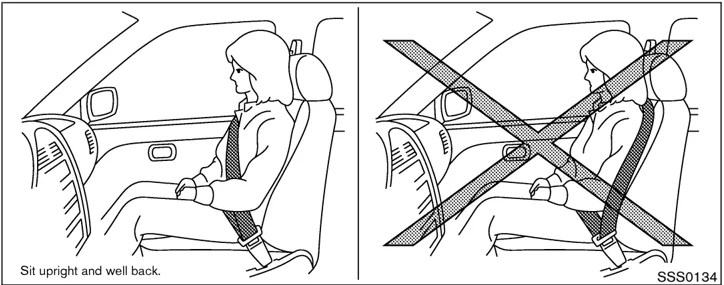
If you are wearing your seat belt properly adjusted and you are sitting upright and well back in your seat, your chances of being injured or killed in an accident and/or the severity of injury may be greatly reduced. NISSAN strongly encourages you and all of your passengers to buckle up every time you drive, even if your seating position includes a supplemental air bag.
Most states, provinces or territories require that seat belts be worn at all times when a vehicle is being driven.
1-10 Safety — Seats, seat belts and supplemental restraint system
Sit upright and well back. SSS0136
WARNING
- Every person who drives or rides in this vehicle should use a seat belt at all times.
- The seat belt should be properly adjusted to a snug fit. Failure to do so may reduce the effectiveness of the entire restraint system and increase the chance or severity of injury in an accident. Serious injury or death can occur if the seat belt is not worn properly.
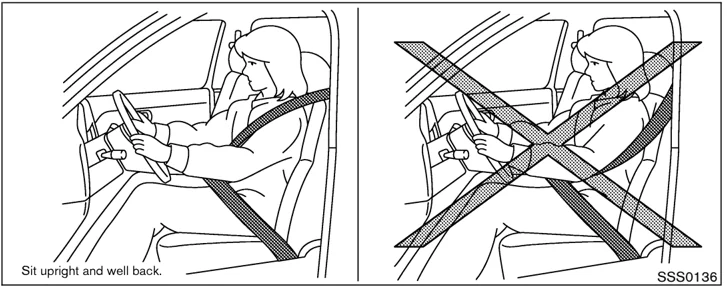
- Always route the shoulder belt over your shoulder and across your chest. Never run the belt behind your back, under your arm or across your neck. The belt should be away from your face and neck, but not falling off your shoulder.
- Position the lap belt as low and snug as possible AROUND THE HIPS, NOT THE WAIST. A lap belt worn too high could increase the risk of internal injuries in an accident.
- Be sure the seat belt tongue is securely fastened to the proper buckle.
- Do not wear the seat belt inside out or twisted. Doing so may reduce its effectiveness.
- Do not allow more than one person to use the same seat belt.
- Never carry more people in the vehicle than there are seat belts. This vehicle has only two seating positions. Never allow anyone to ride in the luggage area.
- If the seat belt warning light glows continuously while the ignition is turned ON with all doors closed and all seat belts fastened, it may indicate a malfunction in the system. Have the system checked by a NISSAN dealer.
Safety — Seats, seat belts and supplemental restraint system 1-11
Sit upright and well back. SSS0134
SSS0016
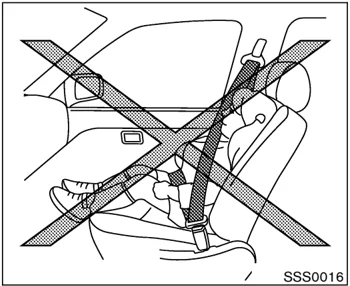
- Once the pre-tensioner seat belt has activated, it cannot be reused and must be replaced together with the retractor. See a NISSAN dealer.
- Removal and installation of the pre-tensioner seat belt system components should be done by a NISSAN dealer.
- All seat belt assemblies, including retractors and attaching hardware, should be inspected after any collision by a NISSAN dealer. NISSAN recommends that all seat belt as- semblies in use during a collision be replaced unless the collision was minor and the belts show no damage and continue to operate properly. Seat belt assemblies not in use during a collision should also be inspected and replaced if either damage or improper operation is noted.
CHILD SAFETY
Children need adults to help protect them. They need to be properly restrained.
In addition to the general information in this manual, child safety information is available from many other sources, including doctors, teachers, government traffic safety offices, and community organizations. Every child is different, so be sure to learn the best way to transport your child.
There are three basic types of child restraint systems:
- Rear facing child restraint
1-12 Safety — Seats, seat belts and supplemental restraint system
• Front facing child restraint • Booster seat
WARNING
- Never let a child 12 or under ride in this vehicle. Do not attempt to hold them in your lap or arms.
- Never let a child stand or kneel on any seat and do not allow a child in the cargo areas while the vehicle is moving. The child could be seriously injured or killed in an accident or sudden stop.
Your vehicle is equipped with a supplemental front impact air bag system for the front passenger. See "Supplemental restraint system" later in this section. Therefore, children 12 or under should not ride in this vehicle without installing an air bag ON/OFF switch.
OBTAINING AN AIR BAG ON/OFF SWITCH
If you must transport a child in this vehicle, you may be eligible to have an air bag ON/OFF switch installed. US and Canadian governments have procedures that allow you to apply for permission to have your vehicle fitted with an air bag ON/OFF switch. Such a switch is available for purchase from NISSAN. If you have questions about the government application procedures, contact the NISSAN Consumer Affairs Department listed earlier in this manual.
AFTER AN AIR BAG ON/OFF SWITCH IS INSTALLED
WARNING
Infants and children need special protection. The vehicle's seat belts may not fit them properly. The shoulder belt may come too close to the face or neck. The lap belt may not fit over their small hip bones. In an accident, an improperly fitting seat belt could cause serious or fatal injury. Always use appropriate child restraints.
All US states and provinces of Canada require the use of approved child restraints for infants and small children. (See "Child restraints" later in this section.)
Also, there are other types of child restraints available for larger children for additional protection.
Infants
Infants up to at least 1 year old should be placed in a rear facing child restraint. NISSAN recommends that infants be placed in child restraints that comply with Federal Motor Vehicle Safety Standards or Canadian Motor Vehicle Safety Standards. You should choose a child restraint that fits your vehicle and always follow the manufacturer's instructions for installation and use.
Small children
Children that are over 1 year old and weigh between 20 lbs (9 kg) and 40 lbs (18 kg) can be placed in a forward facing child restraint. Refer to the manufacturer's instructions for minimum and maximum weight and height recommendations. NISSAN recommends that small children be placed in child restraints that comply with Federal Motor Vehicle Safety Standards or Canadian Motor Vehicle Safety Standards. You should choose a child restraint that fits your vehicle and always follow the manufacturer's instructions for installation and use.
Larger children
Children who are too large for child restraint
Safety — Seats, seat belts and supplemental restraint system 1-13
systems should be seated and restrained by the seat belts which are provided. The seat belt may not fit properly if the child is less than 4 feet 9 inches (142.5 cm) tall and weighs between 40 lbs (18 kg) and 80 lbs (36 kg). A booster seat should be used to obtain proper seat belt fit.
NISSAN recommends that a child be placed in a commercially available booster seat if the shoulder belt in the child's seating position fits close to the face or neck or if the lap portion of the seat belt goes across the abdomen. The booster seat should raise the child so that the shoulder belt is properly positioned across the top, middle portion of the shoulder and the lap belt is low on the hips. A booster seat can only be used in seating positions that have a three-point type seat belt. The booster seat should fit the vehicle seat and have a label certifying that it complies with Federal Motor Vehicle Safety Standards or Canadian Motor Vehicle Safety Standards. Once the child has grown so the shoulder belt is no longer on or near the face and neck, use the shoulder belt without the booster seat.
PREGNANT WOMEN
NISSAN recommends that pregnant women use seat belts. The seat belt should be worn snug, and always position the lap belt as low as possible around the hips, not the waist. Place the shoulder belt over your shoulder and across your chest. Never run the lap/shoulder belt over your abdominal area. Contact your doctor for specific recommendations.
INJURED PERSONS
NISSAN recommends that injured persons use seat belts, depending on the injury. Check with your doctor for specific recommendations.
THREE-POINT TYPE SEAT BELT WITH RETRACTOR

● For the most effective protection when the vehicle is in motion, the seat should be upright. Always sit well back in the seat and adjust the seat belt properly.
WARNING
- Every person who drives or rides in this vehicle should use a seat belt at all times.
- Do not ride in a moving vehicle when the seatback is reclined. This can be dangerous. The shoulder belt will not be against your body. In an accident, you could be thrown into it and receive neck or other serious injuries. You could also slide under the lap belt and receive serious internal injuries.
1-14 Safety — Seats, seat belts and supplemental restraint system
 Fastening the seat belts
- Adjust the seat. See “Seats” earlier in this section.
- Slowly pull the seat belt out of the retractor and insert the tongue into the buckle until it clicks.
- The retractor is designed to lock during a sudden stop or on impact. A slow pulling motion will permit the belt to move, and allow you some freedom of movement in the seat.
- If the seat belt cannot be pulled from its fully retracted position, firmly pull the belt and release it. Then smoothly pull the belt out of the retractor.
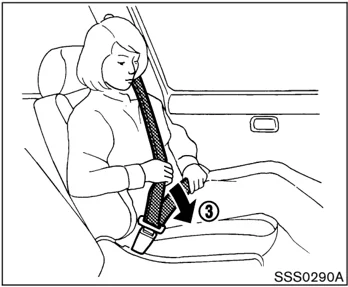
- Position the lap belt portion low and snug on the hips as shown.
- Pull the shoulder belt portion toward the retractor to take up extra slack. Be sure the shoulder belt is routed over your shoulder and across your chest.
The front passenger seat belt has a locking mechanism for child restraint installation. It is referred to as the automatic locking mode. (Also remember, if you need to install a child restraint, first obtain an air bag ON/OFF switch and turn the passenger air bag OFF.)
When the locking mechanism is activated the seat belt cannot be extended again until the seat belt tongue is detached from the buckle and fully retracted. For additional information, see “Child restraints” later in this section.
The automatic locking mode should be used only for child restraint installation. During normal seat belt use by a passenger, the locking mode should not be activated. If it is activated it may cause uncomfortable seat belt tension.
WARNING
When fastening the seat belts, be certain that the seatbacks are completely secured in the latched position. If they are not completely secured, passengers may be injured in an accident or sudden stop.
Safety — Seats, seat belts and supplemental restraint system 1-15
ward. The retractor should lock and restrict further belt movement.
If the retractor does not lock during this check or if you have any questions about belt operation, see a NISSAN dealer.
 SSS0326
Unfastening the seat belts
To unfasten the belt, push the button on the buckle. The seat belt will automatically retract.
Checking seat belt operation
Your seat belt retractors are designed to lock belt movement using two separate methods:
- when the belt is pulled quickly from the retractor.
- when the vehicle slows down rapidly.
You can check their operation as follows:
- grasp the shoulder belt and pull quickly for-
1-16 Safety — Seats, seat belts and supplemental restraint system
 SSS0588
Shoulder belt arm
The shoulder belt arm should be adjusted to the position best for you. (See “Precautions on seat belt usage” earlier in this section.)
To adjust, pull the shoulder belt arm. Pulling the arm forward will allow an easy access to the belt.
SEAT BELT EXTENDERS
If, because of body size or driving position, it is not possible to properly fit the lap-shoulder belt and fasten it, an extender is available. The extender adds approximately 8 in (200 mm) of length and may be used for either the driver or passenger seating position. See a NISSAN
dealer for assistance if the extender is required.
WARNING
- Only NISSAN seat belt extenders, made by the same company which made the original equipment seat belts, should be used with NISSAN seat belts.
- Persons who can use the standard seat belt should not use an extender. Such unnecessary use could result in serious personal injury in the event of an accident.
- Never use seat belt extenders to install child restraints. If the child restraint is not secured properly, the child could be seriously injured in a collision or a sudden stop. (Also remember never to use a child restraint unless an air bag ON/OFF switch has been installed and is being used properly.)
SEAT BELT MAINTENANCE
- To clean the seat belt webbings, apply a mild soap solution or any solution recommended for cleaning upholstery or carpets. Then brush the webbing, wipe it with a cloth and allow it to dry in the shade. Do not allow the seat belts to retract until they are completely dry.
- If dirt builds up in the shoulder belt guide of the seat belt anchors, the seat belts may retract slowly. Wipe the shoulder belt guide with a clean, dry cloth.
- Periodically check to see that the seat belt and the metal components such as buckles, tongues, retractors, flexible wires and anchors work properly. If loose parts, deterioration, cuts or other damage on the webbing is found, the entire belt assembly should be replaced.
CHILD RESTRAINTS
PRECAUTIONS ON CHILD RESTRAINTS
WARNING
The information in this section is provided only for those owners who have received permission to install an air bag ON/OFF switch and the switch has been installed. See "Obtaining an air bag ON/OFF switch" earlier in this manual. Never let children 12 or under ride in this vehicle unless an air bag ON/OFF switch is installed and it is being properly used.
WARNING
- Infants and small children should always be placed in an appropriate child restraint while riding in the vehicle. Failure to use a child restraint can result in serious injury or death.
- Infants and small children should never be carried on your lap. It is not
Safety — Seats, seat belts and supplemental restraint system 1-17
possible for even the strongest adult to resist the forces of a severe accident. The child could be crushed between the adult and parts of the vehicle. Also, do not put the same seat belt around both your child and yourself.
- Never install a child restraint in the front seat unless an air bag ON/OFF switch has been installed and the air bag has been turned OFF. An inflating supplemental air bag could seriously injure or kill your child.
- An improperly installed child restraint could lead to serious injury or death in an accident.
CAUTION
For Roadster models, when installing a child restraint, be sure to turn off the automatic passenger seatback tilt function with the seatback tilt cancel switch (located on the back of the passenger seatback). Otherwise, the child restraint may be damaged. See “Tilting and reclining passenger’s seat from driver’s seat” earlier in this section for detailed information.
In general, child restraints are designed to be installed with the lap portion of a lap/shoulder seat belt.
The proper restraint depends on the child’s size. Generally, infants (up to about 1 year and less than 20 lb (9 kg)) should be placed in rear facing child restraints. Front facing child restraints are available for children who outgrow rear facing child restraints.
Child restraints for infants and children of various sizes are offered by several manufacturers. When selecting any child restraint, keep the following points in mind:
- choose only a restraint with a label certifying that it complies with Federal Motor Vehicle Safety Standard 213 or Canadian Motor Vehicle Safety Standard 213.
- check the child restraint in your vehicle to be sure it is compatible with the vehicle’s seat and seat belt system.
- if the child restraint is compatible with your vehicle, place your child in the child restraint and check the various adjustments to be sure the child restraint is compatible with your child. Choose a child restraint that is designed for your child’s height and weight. Always follow all recommended procedures.
All US states and Canadian provinces require that infants and small children be restrained in approved child restraints at all times while the vehicle is being operated.
WARNING
- Improper use of a child restraint can increase the risk or severity of injury for both the child and other occupants of the vehicle.
- Follow all of the child restraint manufacturer’s instructions for installation and use. When purchasing a child restraint, be sure to select one which will fit your child and vehicle. It may not be possible to properly install some types of child restraints in your vehicle.
1-18 Safety — Seats, seat belts and supplemental restraint system
- If the child restraint is not anchored properly, the risk of a child being injured in a collision or a sudden stop greatly increases.
- Adjustable seatbacks should be positioned to fit the child restraint, but as upright as possible.
- After attaching the child restraint, test it before you place the child in it. Push it from side to side. Try to tug it forward and check to see if the belt holds the restraint in place. If the restraint is not secure, tighten the belt as necessary. You may need to try a different child restraint. Not all child restraints fit in all types of vehicles.
- If you install a front facing child restraint in the front seat, see “Child restraint installation on front passenger seat” later in this section.
- When your child restraint is not in use, keep it secured with a seat belt to prevent it from being thrown around in case of a sudden stop or accident.
CAUTION
Remember that a child restraint left in a closed vehicle can become very hot. Check the seating surface and buckles before placing your child in the child restraint.
Safety — Seats, seat belts and supplemental restraint system 1-19
 Move seat fully back.
SSS0261
CHILD RESTRAINT INSTALLATION ON FRONT PASSENGER SEAT
WARNING
- Never install a child restraint in the front passenger seat unless an air bag ON/OFF switch has been installed and the air bag has been turned OFF. Supplemental front air bags inflate with great force. A child restraint could be struck by the supplemental front air bag in a crash and could seriously injure or kill your child.
- The three-point seat belt in your vehicle is equipped with an automatic locking mode retractor which must be used when installing a child restraint.
- Failure to use the retractor's locking mode will result in the child restraint not being properly secured. The restraint could tip over or otherwise be unsecured and cause injury to the child in a sudden stop or collision.
CAUTION
Turn off the automatic passenger seat-back tilt function by turning the seat-back tilt cancel switch to the CANCEL position. (Roadster models)
1-20 Safety — Seats, seat belts and supplemental restraint system
 Move seat fully back.
SSS0301C
Front facing — step 2
Front facing
If you must install a child restraint in the front seat, follow these steps:
- Turn the air bag ON/OFF switch to the OFF position.
Turn the seatback tilt cancel switch to the CANCEL position. (Roadster models only)
- Position the child restraint on the front passenger seat. Move the seat to the rear-most position. Adjust the head restraint to its highest position (if so equipped). The direction of the child restraint depends on the type of the child restraint and the size of the child. Always follow the restraint manufacturer's instructions.
The back of the child restraint should be secured against the vehicle seatback. If necessary, adjust or remove the head restraint to obtain the correct child restraint fit. See "Head restraint adjustment" earlier in this section. If the head restraint is removed, store it in a secure place. Be sure to install the head restraint when the child restraint is removed. If the seating position does not have an adjustable head restraint and it is interfering with the proper child restraint fit, try a different child restraint.
 SSS0253D
Front facing — step 3
- Route the seat belt tongue through the child restraint and insert it into the buckle until you hear and feel the latch engage. Be sure to follow the child restraint manufacturer's instructions for belt routing.
Safety — Seats, seat belts and supplemental restraint system 1-21
 SSS0254D
Front facing — step 4
4. Pull on the shoulder belt until all of the belt is fully extended. At this time, the belt retractor is in the automatic locking mode (child restraint mode). It reverts back to emergency locking mode when the belt is fully retracted.
 SSS0331D
Front facing — step 5
5. Allow the belt to retract. Pull up the belt to remove any slack in the belt.
 SSS0302B
Front facing — step 6
6. Before placing the child in the child restraint, use force to push the child restraint from side to side, and tug it forward to make sure that it is securely held in place. It should not move more than 1 in (25 mm). If it does move more than 1 in (25 mm), pull again on the shoulder belt to further tighten the child restraint. If unable to properly secure the restraint, try a different child restraint. Not all child restraints fit in all types of vehicles.
- Check that the retractor is in the automatic locking mode by trying to pull more belt out of the retractor. If you cannot pull any more belt webbing out of the retractor, the belt is in the automatic locking mode.
1-22 Safety — Seats, seat belts and supplemental restraint system
- Check to make sure that the child restraint is properly secured prior to each use. If the lap belt is not locked, repeat steps 4 through 7.
After the child restraint is removed and the seat belt is allowed to wind back into the retractor, the automatic locking mode (child restraint mode) is canceled.
 Move seat fully back
SSS0211A
Rear facing — step 2
Rear facing
When you install a child restraint in the front seat, follow these steps:
- Turn the air bag ON/OFF switch to the OFF position.
Turn the seatback tilt cancel switch to the CANCEL position. (Roadster models only)
- Position the child restraint on the front passenger seat. Move the seat to the rearmost position. The direction of the child restraint depends on the type of the child restraint and the size of the child. Always follow the restraint manufacturer's instructions.
 SSS0212A
Rear facing — step 3
- Route the seat belt tongue through the child restraint and insert it into the buckle until you hear and feel the latch engage. Be sure to follow the child restraint manufacturer's instructions for belt routing.
Safety — Seats, seat belts and supplemental restraint system 1-23
 Rear facing — step 4
SSS0213A
- Pull on the shoulder belt until all of the belt is fully extended. At this time, the belt retractor is in the automatic locking mode (child restraint mode). It reverts back to emergency locking mode when the belt is fully retracted.
 Rear facing — step 5
SSS0214A
- Allow the belt to retract. Pull up the belt to remove any slack in the belt.
 Rear facing — step 6
SSS0215A
-
Before placing the child in the child restraint, use force to push the child restraint from side to side, and tug it forward to make sure that it is securely held in place. It should not move more than 1 in (25 mm). If it does move more than 1 in (25 mm), pull again on the shoulder belt to further tighten the child restraint. If unable to properly secure the restraint, try a different child restraint. Not all child restraints fit in all types of vehicles.
-
Check that the retractor is in the automatic locking mode by trying to pull more belt out of the retractor. If you cannot pull any more belt webbing out of the retractor, the belt is in the automatic locking mode.
1-24 Safety — Seats, seat belts and supplemental restraint system
- Check to make sure that the child restraint is properly secured prior to each use. If the belt is not locked, repeat steps 4 through 7.
After the child restraint is removed and the seat belt is allowed to wind back into the retractor, the automatic locking mode (child restraint mode) is canceled.
 SSS0207
TOP TETHER STRAP CHILD RESTRAINT (Coupe models)
An anchor for a child restraint with a top tether is provided in this vehicle. However, a child restraint of this type should not be used in this vehicle unless an air bag ON/OFF switch has been installed and is being properly used. See “Obtaining an air bag ON/OFF switch” earlier in this manual.
If your child restraint has a top tether strap, it must be secured to the provided anchor point. Secure the child restraint with the seat belt. Guide the top tether strap under the head restraint as illustrated, and secure it to the anchor bracket. Tighten the strap according to manufacturer instructions to remove any slack.
WARNING
Child restraint anchor point is designed to withstand only those loads imposed by correctly fitted child restraints. Under no circumstance is it to be used for adult seat belts or harnesses.
Safety — Seats, seat belts and supplemental restraint system 1-25