9 Technical and consumer information
-
Capacities and recommended fuel/lubricants ........ 9-2
-
Fuel recommendation ........ 9-3
-
Engine oil and oil filter recommendation ........ 9-5
-
Recommended SAE viscosity number ........ 9-6 Air conditioner system refrigerant and lubricant
-
recommendations ........ 9-6
-
Specifications ........ 9-8
-
Engine ........ 9-8
-
Wheels and tires ........ 9-9
-
Dimensions and weights ........ 9-9 When traveling or registering your vehicle in
-
another country ........ 9-10
-
Vehicle identification ........ 9-10
-
Vehicle identification number (VIN) plate ........ 9-10
-
Vehicle identification number (chassis number) ........ 9-10
-
Engine serial number ........ 9-11
-
F.M.V.S.S./C.M.V.S.S. certification label ........ 9-11
-
Emission control information label ........ 9-11
-
Tire and loading information label ........ 9-12
-
Air conditioner specification label ........ 9-12
-
Installing front license plate ........ 9-13
-
Vehicle loading information ........ 9-14
-
Terms ........ 9-14
-
Vehicle load capacity ........ 9-15
-
Loading tips ........ 9-17
-
Measurement of weights ........ 9-17
-
Towing a trailer ........ 9-18
-
Maximum load limits ........ 9-18
-
Towing safety ........ 9-19
-
Flat towing ........ 9-22
-
Automatic transmission ........ 9-23
-
Manual transmission ........ 9-23
-
Uniform tire quality grading ........ 9-23
-
Emission control system warranty ........ 9-24
-
Reporting safety defects (US only) ........ 9-24 Readiness for inspection/maintenance (I/M) test
-
(US only) ........ 9-25
-
Event data recorders ........ 9-26 Owner’s manual/service manual order information ... 9-26
-
In the event of a collision ........ 9-27
CAPACITIES AND RECOMMENDED FUEL/ LUBRICANTS
The following are approximate capacities. The actual refill capacities may be a little different. When refilling, follow the procedure instructed in the “8. Maintenance and do-it-yourself” section to determine the proper refill capacity.
\begin{tabular}{|l|c|c|c|l|} \hline & \multicolumn{3}{c|}{Capacity (Approximate)} & Recommended \ \cline{2-4} & US measure & Imp measure & Liter & specifications \ \hline Fuel & 20 gal & 16-5/8 gal & 76 & Unleaded premium gasoline with an octane rating of at least 91 AKI (RON 96)1 \ \hline Engine oil (Drain and refill)2 & & & & \ \quad With oil filter change & 5 qt & 4-1/8 qt & 4.7 & \bullet API Certification Mark3, 4 \ \quad Without oil filter change & 4-5/8 qt & 3-7/8 qt & 4.4 & \bullet API grade SG/SH, Energy Conserving I & II or API grade SJ or SL, Energy Conserving3, 4 \ & & & & \bullet ILSAC grade GF-I, GF-II & GF-III2, 3 \ \hline Cooling system & & & & \ \quad With reservoir & 9-1/4 qt & 7-5/8 qt & 8.7 & Genuine NISSAN Long Life Antifreeze/Coolant or equivalent \ \quad Reservoir & 7/8 qt & 3/5 qt & 0.8 & \ \hline Automatic transmission fluid & — & — & — & Genuine NISSAN Matic J ATF5 \ \hline Manual transmission gear oil & — & — & — & Genuine NISSAN Manual Transmission Fluid (MTF) HQ Multi 75W-85 or API GL-4, Viscosity SAE 75W-85 or 75W-90 \ \hline Differential gear oil & — & — & — & API GL-5, Viscosity SAE 80W-906 \ \hline Power steering fluid (PSF) & Refill to the proper fluid level according to the instructions in & & & Genuine NISSAN PSF or equivalent7 \ \hline Brake and clutch fluid & the “8. Maintenance and do-it-yourself” section. & & & Genuine NISSAN Super Heavy Duty Brake Fluid8 or equivalent DOT 3 (U.S. FMVSS No. 116) \ \hline Multi-purpose grease & — & — & — & NLGI No. 2 (Lithium soap base) \ \hline Air conditioning system refrigerant & — & — & — & HFC-134a (R-134a)*9 \ \hline Air conditioning system lubricants & — & — & — & NISSAN A/C System Oil Type S or exact equivalent \ \hline Windshield washer fluid & — & — & — & Genuine NISSAN Windshield Washer Concentrate Cleaner & Anti-freeze or equivalent \ \hline \end{tabular}
*1: For additional information, see “Fuel recommendation” later in this section. *2: For additional information, see “Engine oil” in the “8. Maintenance and do-it-yourself” section for changing engine oil. *3: For additional information, see “Engine oil and oil filter recommendation” later in this section. *4: For additional information, see “Recommended SAE viscosity number” later in this section. *5: Using automatic transmission fluid other than Genuine NISSAN Matic J ATF will cause deterioration in driveability and automatic transmission durability, and may damage the automatic transmission, which is not covered by the NISSAN new vehicle limited warranty. *6: For hot areas, viscosity SAE 90 is suitable for ambient temperatures above 32°F (0°C). *7: For Canada, Nissan Automatic Transmission Fluid (ATF), DEXRON™III/MERCON™ or equivalent ATF may also be used. *8: Available in mainland US through a NISSAN dealer. *9: For additional information, see “Vehicle identification” in this section for air conditioner specification label.
9-2 Technical and consumer information
10% 20% 30% 40% 50% 60% 70% 80% 90%
FUEL RECOMMENDATION
Use unleaded premium gasoline with an octane rating of at least 91 AKI (Anti-Knock Index) number (Research octane number 96).
If premium gasoline is not available, unleaded regular gasoline with an octane rating of 87 AKI number (Research octane number 91) may be temporarily used, but only under the following precautions:
- Have the fuel tank filled only partially with unleaded regular gasoline, and fill up with unleaded premium gasoline as soon as possible.
- Avoid full throttle driving and abrupt acceleration.
However, for maximum vehicle performance, the use of unleaded premium gasoline is recommended.
CAUTION
-
Using a fuel other than that specified could adversely affect the emission control system, and may also affect the warranty coverage.
-
Under no circumstances should a leaded gasoline be used, because this will damage the three-way catalyst.
-
Do not use E-85 fuel in your vehicle. Your vehicle is not designed to run on E-85 fuel. Using E-85 fuel can damage the fuel system components and is not covered by the NISSAN vehicle limited warranty.
Gasoline specifications
NISSAN recommends using gasoline that meets the World-Wide Fuel Charter (WWFC) specifications where it is available. Many of the automobile manufacturers developed this specification to improve emission control system and vehicle performance. Ask your service station manager if the gasoline meets the WWFC specifications.
Reformulated gasoline
Some fuel suppliers are now producing reformulated gasolines. These gasolines are specially designed to reduce vehicle emissions. NISSAN supports efforts towards cleaner air and suggests that you use reformulated gasoline when available.
Gasoline containing oxygenates
Some fuel suppliers sell gasoline containing oxygenates such as ethanol, MTBE and methanol with or without advertising their presence. NISSAN does not recommend the use of fuels of which the oxygenate content and the fuel compatibility for your NISSAN cannot be readily determined. If in doubt, ask your service station manager.
If you use oxygenate-blend gasoline, please take the following precautions as the usage of such fuels may cause vehicle performance problems and/or fuel system damage.
- The fuel should be unleaded and have an octane rating no lower than that recommended for unleaded gasoline.
- If an oxygenate-blend, excepting a methanol blend, is used, it should contain no more than 10% oxygenate. (MTBE may, however, be added up to 15%.)
- If a methanol blend is used, it should contain no more than 5% methanol (methyl alcohol, wood alcohol). It should also contain a suitable amount of appropriate cosolvents and corrosion in-
Technical and consumer information 9-3
hibitors. If not properly formulated with appropriate cosolvents and corrosion inhibitors, such methanol blends may cause fuel system damage and/or vehicle performance problems. At this time, sufficient data is not available to ensure that all methanol blends are suitable for use in NISSAN vehicles.
If any undesirable driveability problems such as engine stalling and hard hot starting are experienced after using oxygenate-blend fuels, immediately change to a non-oxygenate fuel or a fuel with a low blend of MTBE.
Take care not to spill gasoline during refueling. Gasoline containing oxygenates can cause paint damage.
E-85 fuel
E-85 fuel is a mixture of approximately 85% fuel ethanol and 15% unleaded gasoline. E-85 can only be used in a Flexible Fuel Vehicle (FFV). Do not use E-85 fuel in your vehicle. U.S. government regulations require fuel ethanol dispensing pumps to be identified by a small, square, orange and black label with the common abbreviation or the appropriate percentage for that region.
Aftermarket fuel additives
NISSAN does not recommend the use of any aftermarket fuel additives (for example, fuel injector cleaner, octane booster, intake valve deposit removers, etc.) which are sold commercially. Many of these additives intended for gum, varnish or deposit removal may contain active solvents or similar ingredients that can be harmful to the fuel system and engine.
Octane rating tips
Using unleaded gasoline with an octane rating lower than recommended can cause persistent, heavy spark knock. (Spark knock is a metallic rapping noise.) If severe, this can lead to engine damage. If you detect a persistent heavy spark knock even when using gasoline of the above stated octane rating, or if you hear steady spark knock while holding a steady speed on level roads, have your dealer correct the condition. Failure to correct the condition is misuse of the vehicle, for which NISSAN is not responsible.
Incorrect ignition timing will result in knocking, after-run or overheating. This in turn may cause excessive fuel consumption or damage to the engine. If any of the above symptoms are encountered, have your vehicle checked at a NISSAN dealer or other competent service facility.
However, now and then you may notice light spark knock for a short time while accelerating or driving up hills. This is no cause for concern, because you get the greatest fuel benefit when there is light spark knock for a short time under heavy engine load.
9-4 Technical and consumer information
10% 20% 30% 40% 50% 60% 70% 80% 90%
① ②
STI0367A
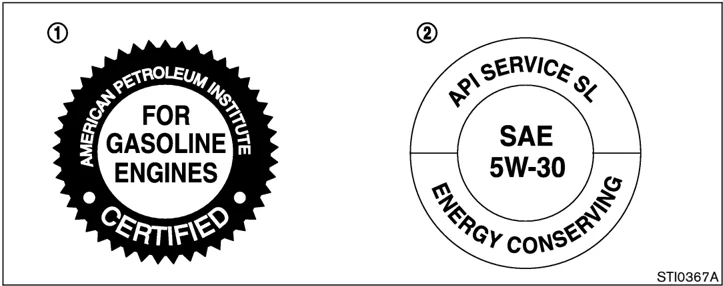
① API certification mark ② API service symbol
ENGINE OIL AND OIL FILTER RECOMMENDATION
Selecting the correct oil
It is essential to choose the correct grade, quality and viscosity engine oil to ensure satisfactory engine life and performance. See "Capacities and recommended fuel/lubircants" earlier in this section. NISSAN recommends the use of an energy conserving oil in order to improve fuel economy.
Select only engine oils that meet the American Petroleum Institute (API) certification or International Lubricant Standardization and Approval Committee (ILSAC) certification and SAE viscosity standard. These oils have the API certification mark on the front of the container. Oils which do not have the specified quality label should not be used as they could cause engine damage.
Oil additives
NISSAN does not recommend the use of oil additives. The use of an oil additive is not necessary when the proper oil type is used and maintenance intervals are followed.
Oil which may contain foreign matter or has been previously used should not be used.
Oil viscosity
The engine oil viscosity or thickness changes with temperature. Because of this, it is important that the engine oil viscosity be selected based on the temperatures at which the vehicle will be operated before the next oil change. The "Recommended SAE viscosity number" chart (on the next page) shows the recommended oil viscosities for the expected ambient temperatures. Choosing an oil viscosity other than that recommended could cause serious engine damage.
Selecting the correct oil filter
Your new NISSAN vehicle is equipped with a high-quality genuine NISSAN oil filter. When replacing, use a genuine NISSAN oil filter or its equivalent for the reason described in "Change intervals".
Change intervals
The oil and oil filter change intervals for your engine are based on the use of the specified quality oils and filters. Oil and filter other than the specified quality, or oil and filter change intervals longer than recommended could reduce engine life. Damage to engines caused by improper maintenance or use of incorrect oil and filter
Technical and consumer information 9-5
10% 20% 30% 40% 50% 60% 70% 80% 90%
quality and/or viscosity is not covered by the new NISSAN vehicle limited warranties.
Your engine was filled with a high quality engine oil when it was built. You do not have to change the oil before the first recommended change interval. Oil and filter change intervals depend upon how you use your vehicle.
Operation under the following conditions may require more frequent oil and filter changes:
- repeated short distance driving at cold outside temperatures
- driving in dusty conditions
- extensive idling
- towing a trailer
- stop and go commuting
Refer to the "NISSAN Service and Maintenance Guide" for the maintenance schedule.
RECOMMENDED SAE VISCOSITY NUMBER
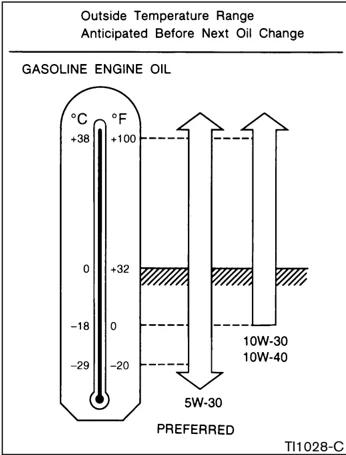
SAE 5W-30 viscosity oil is preferred for all ambient temperatures. SAE 10W-30 or 10W-40 viscosity oil may be used if the ambient temperature is above 0°F (–18°C).
AIR CONDITIONER SYSTEM REFRIGERANT AND LUBRICANT RECOMMENDATIONS
The air conditioner system in your NISSAN vehicle must be charged with the refrigerant HFC-134a (R-134a) and the lubricant, NISSAN A/C System Oil Type S or the exact equivalents.
CAUTION
The use of any other refrigerant or lubricant will cause severe damage to the air conditioning system and will require the replacement of all air conditioner system components.
The refrigerant HFC-134a (R-134a) in your NISSAN vehicle will not harm the earth's ozone layer. Although this refrigerant does not affect the earth's atmosphere, certain governmental regulations require the recovery and recycling of any refrigerant during automotive air conditioner system service. A NISSAN dealer has the trained technicians and equipment needed to recover and recycle your air conditioner system refrigerant.
9-6 Technical and consumer information
Contact a NISSAN dealer when servicing your air conditioner system.
Technical and consumer information 9-7
SPECIFICATIONS
ENGINE
| Model | VQ35DE |
|---|---|
| Type | Gasoline, 4-cycle |
| Cylinder arrangement | 6-cylinder, V-slanted at 60° |
| Bore x Stroke | in (mm) 3.760 x 3.205 (95.5 x 81.4) |
| Displacement | cu in (cm³) 213.5 (3,498) |
| Firing order | 1-2-3-4-5-6*1 |
| Idle speed | rpm |
| Ignition timing (B.T.D.C.) | degree/rpm See the emission control label on the underside of the hood. |
| CO percentage at idle speed | [No air] % |
| Spark plug | Standard PLFR5A-11 |
| Service option PLFR4A-11 (Hot), PLFR6A-11 (Cold) | |
| Spark plug gap (Normal) | in (mm) 0.043 (1.1) |
| Camshaft operation | Timing chain |
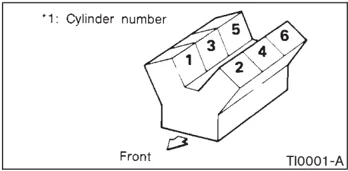
*1: Cylinder number
Front
TI0001-A
The spark ignition system of this vehicle meets all requirements of the Canadian Interference-Causing Equipment Regulations.
9-8 Technical and consumer information
10% 20% 30% 40% 50% 60% 70% 80% 90%
WHEELS AND TIRES
Road wheel
| Model | Type | Position | Size | Offset in (mm) |
|---|---|---|---|---|
| Coupe | Aluminum | Front | 18 x 8JJ | 1.18 (30) |
| Rear | 18 x 8-1/2JJ | 1.30 (33) | ||
| Front | 18 x 9JJ* | 1.18 (30) | ||
| Rear | 19 x 10JJ* | 1.18 (30) | ||
| Roadster | Aluminum | Front | 18 x 8JJ | 1.18 (30) |
| Rear | 18 x 8-1/2JJ | 1.30 (33) |
Tire
| Model | Type | Position | Size | Pressure (COLD) |
|---|---|---|---|---|
| Coupe | Conventional | Front | 225/45R18 91W | 240 kPa (35 psi) |
| Rear | 245/45R18 96W | 240 kPa (35 psi) | ||
| Front | 245/40R18 93W* | 240 kPa (35 psi) | ||
| Rear | 265/35R19 94W* | 240 kPa (35 psi) | ||
| Spare | — | T145/80D17 107M | 420 kPa (60 psi) | |
| Roadster | Conventional | Front | 225/45R18 91W | 240 kPa (35 psi) |
| Rear | 245/45R18 96W | 240 kPa (35 psi) | ||
| Spare | — | T145/80D17 107M | 420 kPa (60 psi) |
*: For option
DIMENSIONS AND WEIGHTS
| Vehicle body | Coupe | Roadster |
|---|---|---|
| Overall length in (mm) | 169.8 (4,314) | 169.8 (4,314) |
| Overall width in (mm) | 71.5 (1,815) | 71.5 (1,815) |
| Overall height in (mm) | 52.1 (1,323) | 52.5 (1,333) |
| Front tread in (mm) | 60.5 (1,536) | 60.5 (1,536) |
| Rear tread in (mm) | 60.6 (1,540)*1 | 60.6 (1,540) |
| 60.9 (1,546)*2 | ||
| Wheelbase in (mm) | 104.3 (2,650) | 104.3 (2,650) |
| Gross vehicle weight rating (GVWR) lb (kg) | ||
| Gross axle weight rating (GAWR) | See the F.M.V.S.S. or C.M.V.S.S. certification label on the driver's side lock pillar. | |
| Front lb (kg) | ||
| Rear lb (kg) |
*1: For model with 245/45R 18 tires *2: For model with 265/35R 19 tires
Technical and consumer information 9-9
WHEN TRAVELING OR REGISTERING YOUR VEHICLE IN ANOTHER COUNTRY
When planning to travel in another country, you should first find out if the fuel available is suitable for your vehicle’s engine.
Using fuel with too low an octane rating may cause engine damage. All gasoline vehicles must be operated with unleaded engine gasoline. Therefore, avoid taking your vehicle to areas where appropriate fuel is not available.
When transferring the registration of your vehicle to another country, state, province or district, it may be necessary to modify the vehicle to meet local laws and regulations.
The laws and regulations for motor vehicle emission control and safety standards vary according to the country, state, province or district; therefore, vehicle specifications may differ.
When any vehicle is to be taken into another country, state, province or district and registered, its modifications, transportation, and registration are the responsibility of the user. NISSAN is not responsible for any inconvenience that may result.
VEHICLE IDENTIFICATION
STI0320
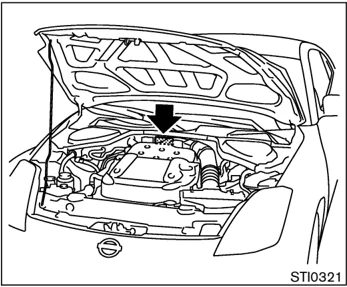
VEHICLE IDENTIFICATION NUMBER (VIN) PLATE
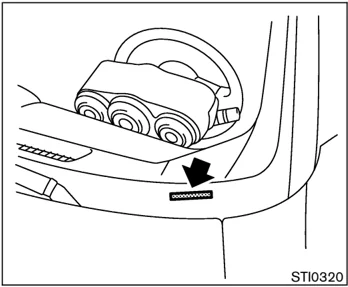
The vehicle identification number plate is attached as shown. This number is the identification for your vehicle and is used in the vehicle registration.
STI0321
VEHICLE IDENTIFICATION NUMBER (chassis number)
The number is stamped as shown.
9-10 Technical and consumer information
 STI0303C
ENGINE SERIAL NUMBER The number is stamped on the engine as shown.
 STI0322
F.M.V.S.S./C.M.V.S.S. CERTIFICATION LABEL
The Federal Motor Vehicle Safety Standards (F.M.V.S.S.) or Canadian Motor Vehicle Safety Standards (C.M.V.S.S.) certification label is affixed as shown. This label contains valuable vehicle information, such as: Gross Vehicle Weight Ratings (GVWR), Gross Axle Weight Rating (GAWR), month and year of manufacture, Vehicle Identification Number (VIN), etc. Review it carefully.
 STI0323
EMISSION CONTROL INFORMATION LABEL
The emission control information label is attached as shown.
Technical and consumer information 9-11
 STI0366
TIRE AND LOADING INFORMATION LABEL
The cold tire inflation pressure is shown on the Tire and Loading Information label affixed to the driver side center pillar.
 STI0325
AIR CONDITIONER SPECIFICATION LABEL
The air conditioner specification label is affixed inside of the hood as shown.
9-12 Technical and consumer information
10% 20% 30% 40% 50% 60% 70% 80% 90%
INSTALLING FRONT LICENSE PLATE
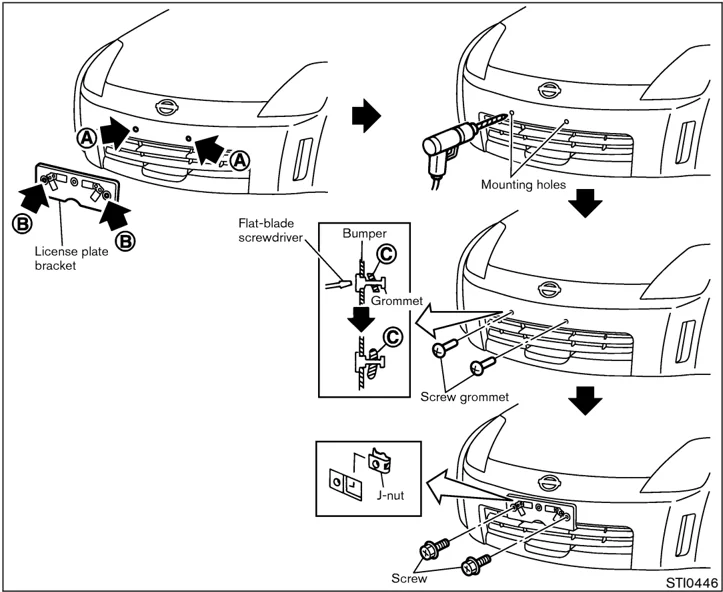
Use the following steps to mount the license plate:
Before mounting the license plate, confirm that the following parts are enclosed in the vinyl bag.
- License plate bracket
- J-nut x 2
- Screw x 2
- Screw grommet x 2
- Temporarily place the license plate bracket while aligning points of the front bumper fascia with holes Ⓑ in the license plate bracket.
- Remove the license plate bracket.
- Carefully drill two shallow pilot holes Ⓐ using a 0.39 in (10 mm) drill bit at the marked locations. (Be sure that the drill only goes through the fascia, or damage to the nut may occur.)
- Insert grommets into the hole on the fascia.
- Insert a flat-blade screwdriver into the grommet hole to add 90° turn onto the part Ⓒ.
- Insert a J-nut into the license plate bracket before placing the license plate bracket on the fascia.
- Install the license plate bracket with screws.
Technical and consumer information 9-13
- Install the license plate with bolts that are no longer than 0.55 in (14 mm).
VEHICLE LOADING INFORMATION
WARNING
- It is extremely dangerous to ride in a cargo area inside a vehicle. In a collision, people riding in these areas are more likely to be seriously injured or killed.
- Do not allow people to ride in any area of your vehicle that is not equipped with seats and seat belts.
- Be sure everyone in your vehicle is in a seat and using a seat belt properly.
TERMS
It is important to familiarize yourself with the following terms before loading your vehicle:
- Curb Weight (actual weight of your vehicle) - vehicle weight including: standard and optional equipment, fluids, emergency tools, and spare tire assembly. This weight does not include passengers and cargo.
- GVW (Gross Vehicle Weight) - curb weight plus the combined weight of passengers and cargo.
- GVWR (Gross Vehicle Weight Rating) - maximum total combined weight of the unloaded vehicle, passengers, luggage, hitch, trailer tongue load and any other optional equipment. This information is located on the F.M.V.S.S./C.M.V.S.S. label.
- GAWR (Gross Axle Weight Rating) - maximum weight (load) limit specified for the front or rear axle. This information is located on the F.M.V.S.S./C.M.V.S.S. label.
- GCWR (Gross Combined Weight Rating) - maximum total weight rating of the vehicle, passengers, cargo and trailer.
- Vehicle Capacity Weight, Load limit,
9-14 Technical and consumer information
Total load capacity - maximum total weight limit specified of the load (passengers and cargo) for the vehicle. This is the maximum combined weight of occupants and cargo that can be loaded into the vehicle. If the vehicle is used to tow a trailer, the trailer tongue weight must be included as part of the cargo load. This information is located on the Tire and Loading Information label.
● Cargo capacity - permissible weight of cargo, the subtracted weight of occupants from the load limit.
VEHICLE LOAD CAPACITY
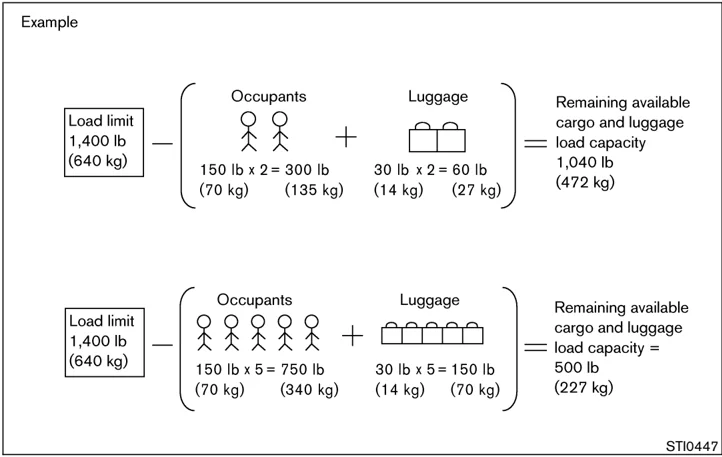
Do not exceed the load limit of your vehicle shown as “The combined weight of occupants and cargo” on the Tire and Loading Information label. Do not exceed the number of occupants shown as “Seating Capacity” on the Tire and Loading Information label.
To get “the combined weight of occupants and cargo”, add the weight of all occupants, then add the total luggage weight. Examples are shown in the following illustration.
10% 20% 30% 40% 50% 60% 70% 80% 90%
Technical and consumer information 9-15
Example
STI0447
Steps for determining correct load limit
-
Locate the statement “The combined weight of occupants and cargo should never exceed XXX kg or XXX lbs” on your vehicle’s placard.
-
Determine the combined weight of the driver and passengers that will be riding in your vehicle.
-
Subtract the combined weight of the driver and passengers from XXX kg or XXX lbs.
-
The resulting figure equals the available amount of cargo and luggage load capacity. For example, if the XXX amount equals 1400 lbs. and there will be five 150 lb. passengers in your vehicle, the amount of available cargo and luggage load capacity is 650 lbs. (1400 – 750 (5 × 150) = 650 lbs) or (640 – 340 (5 × 70) = 300 kg)
-
Determine the combined weight of luggage and cargo being loaded on the vehicle. That weight may not safely exceed the available cargo and luggage load capacity calculated in Step 4.
-
If your vehicle will be towing a trailer, load from your trailer will be transferred to your vehicle. Consult this manual to determine how this reduces the available cargo and luggage load capacity of your vehicle.
9-16 Technical and consumer information
Before driving a loaded vehicle, confirm that you do not exceed the Gross Vehicle Weight Rating (GVWR) or the Gross Axle Weight Rating (GAWR) for your vehicle. See “Measurement of Weights” later in this section.
Also check tires for proper inflation pressures. See the Tire and Loading Information label.
LOADING TIPS
-
The GVW must not exceed GVWR or GAWR as specified on the F.M.V.S.S./C.M.V.S.S. certification label.
-
Do not load the front and rear axle to the GAWR. Doing so will exceed the GVWR.
WARNING
-
Properly secure all cargo with ropes or straps to help prevent it from sliding or shifting. Do not place cargo higher than the seatbacks. In a sudden stop or collision, unsecured cargo could cause personal injury.
-
Do not load your vehicle any heavier than the GVWR or the maximum front and rear GAWRs. If you do, parts of your vehicle can break, tire damage could occur, or it can change the way your vehicle handles. This could result in loss of control and cause personal injury.
-
Overloading not only could shorten the life of your vehicle and the tire, but can also cause unsafe vehicle handling and long braking distances. This may cause a premature tire failure, which could result in a serious accident and personal injury. Failures caused by over loading are not covered by the vehicle’s warranty.
MEASUREMENT OF WEIGHTS
Secure loose items to prevent weight shifts that could affect the balance of your vehicle. When the vehicle is loaded, drive to a scale and weigh the front and the rear wheels separately to determine axle loads. Individual axle loads should not exceed either of the gross axle weight ratings (GAWR). The total of the axle loads should not exceed the gross vehicle weight rating (GVWR). These ratings are given on the vehicle certification label. If weight ratings are exceeded, move or remove items to bring all weights below the ratings.
TOWING A TRAILER
Roadster model: Do not tow a trailer with your vehicle.
Coupe model: Your new vehicle was designed to be used primarily to carry passengers and cargo. Remember that towing a trailer places additional loads on your vehicle's engine, drive train, steering, braking and other systems.
A NISSAN Towing Guide (U.S. only) is available on the website at www.nissanusa.com/ www.infiniti.com. This guide includes information on trailer towing capability and the special equipment required for proper towing.
WARNING
Overloading or improper loading of a trailer and its cargo can adversely affect vehicle handling, braking and performance and may lead to accidents.
CAUTION
- Do not tow a trailer or haul a heavy load for the first 500 miles (800 km).
Your engine, axle or other parts could be damaged.
- For the first 500 miles (800 km) that you tow a trailer, do not drive over 50 mph (80 km/h) and do not make starts at full throttle. This helps the engine and other parts of your vehicle wear in at the heavier loads.
CAUTION
Vehicle damage resulting from improper towing procedures are not covered by NISSAN warranties.
MAXIMUM LOAD LIMITS
Maximum trailer loads
Never allow the total trailer load to exceed 1,000 lb (454 kg). The total trailer load equals trailer weight plus its cargo weight. Towing loads greater than 1,000 lb (454 kg) or using improper towing equipment could adversely affect vehicle handling, braking and performance.
The ability of a vehicle to tow a trailer is not only related to the maximum trailer loads, but also the places you plan to tow. Tow weights appropriate for level highway driving may have to be reduced on very steep grades or in low traction situations (for example, on slippery boat ramps).
9-18 Technical and consumer information
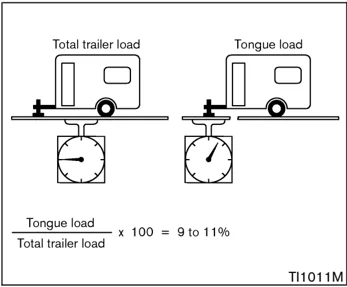
Tongue load
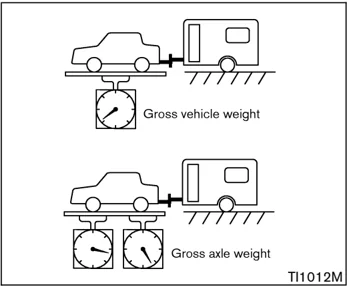
Keep the tongue load between 9 and 11% of the total trailer load within the maximum tongue load limits shown in the following Towing Load/Specification chart. If the tongue load becomes excessive, rearrange cargo to allow for proper tongue load.
Maximum gross vehicle weight/ maximum gross axle weight
The gross vehicle weight of the towing vehicle must not exceed. GVWR shown on the F.M.V.S.S./C.M.V.S.S. certification label. The gross vehicle weight equals the combined weight of the unloaded vehicle, passengers, luggage, hitch, trailer tongue load and any other optional equipment. In addition, front or rear gross axle weight must not exceed GAWR shown on the F.M.V.S.S./C.M.V.S.S. certification label.
TOWING LOAD/SPECIFICATION CHART Unit: lb (kg)
| MAXIMUM TOWING LOAD | 1,000 (454) |
|---|---|
| MAXIMUM TONGUE LOAD | 100 (45.4) |
TOWING SAFETY
Trailer hitch
Choose a proper hitch for a vehicle and trailer. Make sure the trailer hitch is securely attached to the vehicle, to help avoid personal injury or property damage due to sway caused by cross-winds, rough road surfaces or passing trucks.
Hitch ball
Choose a hitch ball of the proper size and weight rating for your trailer:
- The required hitch ball size is stamped on most trailer couplers. Most hitch balls also have the size printed on top of the ball.
- Choose the proper class hitch ball based on the trailer weight.
- The diameter of the threaded shank of the hitch ball must be matched to the ball mount hole diameter. The hitch ball shank should be
Technical and consumer information 9-19
no more than 1/16" smaller than the hole in the ball mount.
- The threaded shank of the hitch ball must be long enough to be properly secured to the ball mount. There should be at least 2 threads showing beyond the lock washer and nut.
Class I hitch
Class I trailer hitch equipment (receiver, ball mount and hitch ball) can be used to tow trailers of a maximum weight of 2,000 lb (909 kg).
You may add Class I trailer hitch equipment to the vehicle that has a 2,000 lb (909 kg) maximum weight rating, but your vehicle is only capable of towing the maximum trailer weights shown in the Towing Load/Specification Chart earlier in this section.
CAUTION
- Do not use axle-mounted hitches.
- The hitch should not be attached to or affect the operation of the impact-absorbing bumper.
- Do not modify the vehicle exhaust system, brake system, etc. to install a
trailer hitch.
- To reduce the possibility of additional damage if a vehicle is struck from the rear, where practical, remove the hitch and/or receiver when not in use.
- After the hitch is removed, seal the bolt holes to prevent exhaust fumes, water or dust from entering the passenger compartment.
- Regularly check that all trailer hitch mounting bolts are securely mounted.
Tire pressures
- When towing a trailer, inflate the vehicle tires to the recommended cold tire pressure indicated on the Tire and Loading Information label.
- Trailer tire condition, size, load rating and proper inflation pressure should be in accordance with the trailer and tire manufacturers' specifications.
Safety chains
Always use a suitable chain between a vehicle and the trailer. The safety chain should be crossed and should be attached to the hitch, not to the vehicle bumper or axle. Be sure to leave enough slack in the chain to permit turning corners.
Trailer lights
CAUTION
When splicing into the vehicle electrical system, a commercially available power-type module/converter must be used to provide power for all trailer lighting. This unit uses the vehicle battery as a direct power source for all trailer lights while using the vehicle tail light, stoplight and turn signal circuits as a signal source. The module/converter must draw no more than 15 milliamps from the stop and tail lamp circuits. Using a module/converter that exceeds these power requirements may damage the vehicle's electrical system. See a reputable trailer dealer to obtain
9-20 Technical and consumer information
the proper equipment and to have it installed.
Trailer lights should comply with federal and/or local regulations. When wiring the vehicle for towing, connect the stop and tail light pickup into the vehicle electrical circuit at a point between the sensor and stop light or light switch.
Trailer brakes
If your trailer is equipped with a braking system, make sure it conforms to federal and/or local regulations and that it is properly installed.
WARNING
Never connect a trailer brake system directly to the vehicle brake system.
Pre-towing tips
- Be certain a vehicle maintains a level position when a loaded and/or unloaded trailer is hitched. Do not drive the vehicle if it has an unusual nose-up or nose-down condition; check for improper tongue load, overload, worn suspension or other possible causes of these conditions.
- Always secure items in the trailer to prevent load shifts while driving.
- Load the trailer so approximately 60% of the trailer load is in the front half and 40% is in the back half.
- Check your hitch, trailer tire pressure, vehicle tire pressure, trailer light operation, and trailer wheel lug nuts every time you attach a trailer to the vehicle.
- Be certain your rear view mirrors conform to all federal, state and/or local regulations. If not, install any mirrors required for towing before driving the vehicle.
Trailer towing tips
In order to gain skill and an understanding of the vehicle's behavior, you should practice turning, stopping and backing up in an area which is free from traffic. Steering stability, and braking performance will be somewhat different than under normal driving conditions.
- Always secure items in the trailer to prevent load shift while driving.
- Avoid abrupt starts, acceleration or stops.
- Avoid sharp turns or lane changes.
- Always drive a vehicle at a moderate speed. Some states or provinces have specific speed limits for vehicles that are towing trailers. Obey the local speed limits.
- When backing up, hold the bottom of the steering wheel with one hand. Move your hand in the direction in which you want the trailer to go. Make small corrections and back up slowly. If possible, have someone guide you when you are backing up.
- Always block the wheels on both vehicle and trailer when parking. Parking on a slope is not recommended; however, if you must do so, and if a vehicle is equipped with automatic transmission, first apply the parking brake and block the wheels, and then move the transmission selector lever into the P (Park) position. If you move the selector lever to the P (Park) position before blocking the wheels and applying the parking brake, the transmission may get damaged.
- When going down a hill, shift into a lower gear and use the engine braking effect. When going up a long grade, downshift the transmission to a lower gear and reduce speed to reduce chances of engine overloading and/or overheating.
- If the engine coolant rises to an extremely high temperature when the air conditioning system is on, turn off the air conditioner. Coolant heat can be additionally vented by
Technical and consumer information 9-21
opening the windows, switching the fan control to high and setting the temperature control to the HOT position.
- Trailer towing consumes more fuel than normal circumstances.
- Avoid towing a trailer for the first 500 miles (800 km).
- Have a vehicle serviced more often than at intervals specified in the recommended maintenance schedule.
- When making a turn, your trailer wheels will be closer to the inside of the turn than your vehicle wheels. To compensate for this, make a larger than normal turning radius during the turn.
- Crosswinds and rough roads will adversely affect vehicle/trailer handling, possibly causing vehicle sway. When being passed by larger vehicles, be prepared for possible changes in crosswinds that could affect vehicle handling. If swaying does occur, firmly grip the steering wheel, steer straight ahead, and immediately (but gradually) reduce vehicle speed. This combination will help stabilize the vehicle. Never increase speed.
- Be careful when passing other vehicles. Passing while towing a trailer requires considerably more distance than normal passing.
Remember the length of the trailer must also pass the other vehicle before you can safely change lanes.
- To maintain engine braking efficiency and electrical charging performance, do not use 6th gear (manual transmission) or 5th position (automatic transmission).
- Avoid holding the brake pedal down too long or too frequently. This could cause the brakes to overheat, resulting in reduced braking efficiency.
- Increase your following distance to allow for greater stopping distances while towing a trailer. Anticipate stops and brake gradually.
- Do not use cruise control while towing a trailer.
- Check your hitch, trailer wiring harness connections, and trailer wheel lug nuts after 50 miles (80 km) of travel and at every break.
- When stopped in traffic for long periods of time in hot weather, put the vehicle in the P (Park) position.
When towing a trailer, change transmission oil more frequently. For additional information, see the "8. Maintenance and do-it-yourself" section.
FLAT TOWING
Towing your vehicle with all four wheels on the ground is sometimes called flat towing. This method is sometimes used when towing a vehicle behind a recreational vehicle, such as a motor home.
CAUTION
- Failure to follow these guidelines can result in severe transmission damage.
- Whenever flat towing your vehicle, always tow forward, never backward.
- DO NOT tow any automatic transmission vehicle with all four wheels on the ground (flat towing). Doing so WILL DAMAGE internal transmission parts due to lack of transmission lubrication.
- For emergency towing procedures, refer to "Towing recommended by NISSAN" in the "6. In case of emergency" section of this manual.
9-22 Technical and consumer information
AUTOMATIC TRANSMISSION To tow a vehicle equipped with an automatic transmission, an appropriate vehicle dolly MUST be placed under the towed vehicle's drive wheels. Always follow the dolly manufacturer's recommendations when using their product.
MANUAL TRANSMISSION
- Always tow with the manual transmission in Neutral.
- After towing 500 miles, start and idle the engine with the transmission in Neutral for two minutes. Failure to idle the engine after every 500 miles of towing may cause damage to internal transmission parts.
UNIFORM TIRE QUALITY GRADING DOT (Department Of Transportation) Quality Grades: All passenger car tires must conform to federal safety requirements in addition to these grades.
Quality grades can be found where applicable on the tire sidewall between tread shoulder and maximum section width. For example:
Treadwear 200 Traction AA Temperature A
Treadwear The treadwear grade is a comparative rating based on the wear rate of the tire when tested under controlled conditions on a specified government test course. For example, a tire graded 150 would wear one and one-half (1 1/2) times as well on the government course as a tire graded 100. The relative performance of tires depends upon the actual conditions of their use, however, and may depart significantly from the norm due to variations in driving habits, service practices and differences in road characteristics and climate.
Traction AA, A, B and C The traction grades, from highest to lowest, are AA, A, B, and C. Those grades represent the tire's ability to stop on wet pavement as measured under controlled conditions on specified government test surfaces of asphalt and concrete. A tire marked C may have poor traction performance.
WARNING The traction grade assigned to this tire is based on straight-ahead braking traction tests, and does not include acceleration, cornering, hydroplaning, or peak traction characteristics.
Temperature A, B and C The temperature grades are A (the highest), B, and C, representing the tire's resistance to the generation of heat and its ability to dissipate heat when tested under controlled conditions on a specified indoor laboratory test wheel. Sustained high temperature can cause the material of the tire to degenerate and reduce tire life, and excessive temperature can lead to sudden tire failure. The grade C corresponds to a level of performance which all passenger car tires must meet under the Federal Motor Safety Standard No. 109. Grades B and A represent higher levels of performance on the laboratory test wheel than the minimum required by law.
10% 20% 30% 40% 50% 60% 70% 80% 90%
Technical and consumer information 9-23
WARNING
The temperature grade for this tire is established for a tire that is properly inflated and not overloaded. Excessive speed, under-inflation, or excessive loading, either separately or in combination, can cause heat build-up and possible tire failure.
EMISSION CONTROL SYSTEM WARRANTY
Your NISSAN vehicle is covered by the following emission warranties.
For US:
- Emission Defects Warranty
- Emissions Performance Warranty (See Warranty Information Booklet for details.)
For Canada:
- Emission Control System Warranty
Details of these warranties may be found with other vehicle warranties in your Warranty Information Booklet that comes with your NISSAN vehicle. If you did not receive a Warranty Information Booklet, or it has become lost, you may obtain a replacement by writing to:
- Nissan North America, Inc. Consumer Affairs Department P.O. Box 191 Gardena, CA 90248-0191
- Nissan Canada Inc. 5290 Orbitor Drive Mississauga, Ontario, L4W 4Z5
REPORTING SAFETY DEFECTS (US only)
If you believe that your vehicle has a defect which could cause a crash or could cause injury or death, you should immediately inform the National Highway Traffic Safety Administration (NHTSA) in addition to notifying NISSAN.
If NHTSA receives similar complaints, it may open an investigation, and if it finds that a safety defect exists in a group of vehicles, it may order a recall and remedy campaign. However, NHTSA cannot become involved in individual problems between you, your dealer, or NISSAN.
To contact NHTSA, you may call the Vehicle Safety Hotline toll-free at 1-888-327-4236 (TTY: 1-800-424-9153); go to http://www.safercar.gov; or write to: Administrator, NHTSA, 400 Seventh Street, SW., Washington, DC 20590. You can also obtain other information about motor vehicle safety from http://www.safercar.gov.
You may notify NISSAN by contacting our Consumer Affairs Department, toll-
9-24 Technical and consumer information
free, at 1-800-NISSAN-1 (1-800-647-7261).
READINESS FOR INSPECTION/ MAINTENANCE (I/M) TEST (US only)
Due to legal requirements in some states/ areas, your vehicle may be required to be in what is called the "ready condition" for an Inspection/ Maintenance (I/M) test of the emission control system.
The vehicle is set to the "ready condition" when it is driven through certain driving patterns. Usually, the "ready condition" can be obtained by ordinary usage of the vehicle.
If a powertrain system component is repaired or the battery is disconnected, the vehicle may be reset to a not "ready condition". Before taking the I/M test, check the vehicle's inspection/ maintenance test readiness condition. Turn the ignition switch ON without starting the engine. If the Malfunction Indicator Lamp (MIL) comes on steady for 20 seconds and then blinks for 10 seconds, the I/M test condition is "not ready". If the MIL does not blink after 20 seconds, the I/M test condition is "ready".
If the MIL indicates the vehicle is in a "not ready" condition, drive the vehicle through the following pattern to set the vehicle to the ready condition. If you cannot or do not want to perform the driving pattern, a NISSAN dealer can conduct it for you.
WARNING
Always drive the vehicle in a safe and prudent manner according to traffic conditions and obey all traffic laws.
- Start the engine. Allow the engine to idle until the engine coolant temperature gauge needle points between the C and H (normal operating temperature).
- Accelerate the vehicle to 55 MPH (88 km/h), then quickly release the accelerator pedal completely and keep it released for at least 10 seconds.
- Quickly depress the accelerator pedal for a moment, then drive the vehicle at a speed of 53 to 60 MPH (86 to 96 km/h) for at least 9 minutes.
- Stop the vehicle. Leave the engine running.
- Accelerate the vehicle to 35 MPH (55 km/h) and maintain the speed for 20 seconds.
- Repeat steps 4 and 5 at least 10 times.
- Accelerate the vehicle to 55 MPH (88 km/h) and maintain the speed for at least 3 minutes.
- Stop the vehicle. Place the automatic trans-
Technical and consumer information 9-25
mission gear selector lever in the P (Park) or N (Neutral) position or the manual transmission shift lever in the N position.
-
Turn the engine off.
-
Repeat steps 1 through 8 at least one more time.
If step 1 through 7 is interrupted, repeat the preceding step. Any safe driving mode is acceptable between steps. Do not stop the engine until step 7 is completed.
EVENT DATA RECORDERS
Your vehicle is equipped with a variety of computers that monitor and control a number of systems to optimize performance and help service technicians with diagnosis and repair. Some of the computers monitor emission control systems, braking systems, engine systems, transmission systems, tire pressure systems and air bag systems. Some data about vehicle operation may be stored in the computers for use during servicing. Other data may be stored if a crash event occurs. For example, vehicle speed, brake application, steering angle, air bag readiness, air bag performance, and seat belt use by the driver or passenger may be recorded. These types of systems are sometimes called Event Data Recorders.
Special equipment can be used to access the electronic data that may be stored in the vehicle's computers (sounds are not recorded). NISSAN and NISSAN dealers have equipment to access some of this data; others may also have this equipment. The data may be retrieved during routine vehicle servicing or for special research. It might also be accessed with the consent of the vehicle owner or lessee, in response to a request by law enforcement, or as otherwise required or permitted by law.
OWNER'S MANUAL/SERVICE MANUAL ORDER INFORMATION
A genuine NISSAN Service Manual is the best source of service and repair information for your vehicle. Filled with wiring diagrams, illustrations and step-by-step diagnostic and adjustment procedures, this manual is the same one used by the factory trained technicians working at NISSAN dealerships. Also available are genuine NISSAN Owner's Manuals, and genuine NISSAN Service and Owner's Manuals for older NISSAN models.
For USA:
For current pricing and availability of genuine NISSAN Service Manuals for the 2000 model year and later, contact:
Tweddle Litho Company
1-800-450-9491
For current pricing and availability of genuine NISSAN Service Manuals for the 1999 model year and prior, see a NISSAN dealer, or contact:
Resolve Corporation
20770 Westwood Road
Strongsville, OH 44136
1-800-247-5321
9-26 Technical and consumer information
For current pricing and availability of genuine NISSAN Owner’s Manuals for this model year and prior, see a NISSAN dealer, or contact:
Resolve Corporation 20770 Westwood Road Strongsville, OH 44136 1-800-247-5321
For Canada:
To purchase a copy of a genuine NISSAN Service Manual or Owner’s Manual, please contact a NISSAN dealer. For the phone number and location of a NISSAN dealer in your area call the NISSAN Information Center at 1-800-387-0122 and a bilingual NISSAN representative will assist you.
Also available are Genuine NISSAN Service and Owner’s Manuals for older NISSAN models.
IN THE EVENT OF A COLLISION
Unfortunately, accidents do occur. In this unlikely event, there is some important information you should know. Many insurance companies routinely authorize the use of non-genuine collision parts in order to cut costs, among other reasons.
Insist on the use of Genuine NISSAN Collision Parts!
If you want your vehicle to be restored using parts made to NISSAN’s original exacting specifications — if you want to help it to last and hold its resale value, the solution is simple. Tell your insurance agent and your repair shop to only use Genuine NISSAN Collision Parts. NISSAN does not warrant non-NISSAN parts, nor does NISSAN’s warranty apply to damage caused by a non-genuine part.
Using Genuine NISSAN Parts can help protect your personal safety, preserve your warranty protection and maintain the resale value of your vehicle. And if your vehicle was leased, using Genuine NISSAN Parts may prevent or limit unnecessary excess wear and tear expenses at the end of your lease.
NISSAN designs its hoods with crumple zones to minimize the risk that the hood will penetrate the windshield of your vehicle in an accident. Non-genuine (imitation) parts may not provide such built-in safeguards. Also, non-genuine parts often show premature wear, rust and corrosion.
Why should you take a chance?
In over 40 states, the law says you must be advised if non-genuine parts are used to repair your vehicle. And some states have enacted laws that restrict insurance companies from authorizing the use of non-genuine collision parts during the new vehicle warranty. These laws help protect you, so you can take action to protect yourself.
It’s your right!
If you should need further information visit us at: www.nissanusa.com (for U.S. customers) or www.nissan.ca (for Canadian customers).
Technical and consumer information 9-27
MEMO
9-28 Technical and consumer information
10% 20% 30% 40% 50% 60% 70% 80% 90%
10 Index
A
- ABS (Anti-lock brake system) ........ 5-21
- Air bag ON/OFF switch ........ 1-13
Air bag system
Front (See supplemental front air bag - system) ........ 1-35
Side and curtain (See supplemental side
air bag and curtain side-impact air bag - system) ........ 1-37
- Air bag warning labels ........ 1-40
- Air bag warning light ........ 1-41, 2-15
- Air cleaner housing filter ........ 8-18 Air conditioner
- Air conditioner operation ........ 4-9
- Air conditioner service ........ 4-9, 4-12
- Air conditioner specification label ........ 9-12 Air conditioning system refrigerant and
- lubricant recommendations ........ 4-12, 9-6
- Heater and air conditioner (automatic) ........ 4-9
- Alcohol, drugs and driving ........ 5-5
- Anchor point location, Top tether strap ........ 1-26
- Antenna ........ 4-30
- Anti-lock Brake System (ABS) ........ 5-21
- Anti-lock brake warning light ........ 2-12 Appearance care
- Exterior appearance care ........ 7-2
- Interior appearance care ........ 7-4
- Audible reminders ........ 2-18
B
-
Audio operation precautions ........ 4-13
-
Audio system ........ 4-12
-
Steering wheel audio controls ........ 4-29 Autochanger
-
Compact Disc (CD) ........ 4-26 Automatic
-
Anti-glare inside mirror ........ 3-26 Automatic adjusting function (front
-
windows) ........ 2-41 Automatic passenger seatback tilt
-
function ........ 1-5, 3-17
-
Automatic transmission fluid (ATF) ........ 8-12
-
Driving with automatic transmission ........ 5-6, 5-9
-
Transmission selector lever lock release ........ 5-12
-
Avoiding collision and rollover ........ 5-5
-
Battery ........ 8-15
-
Battery saver system ........ 2-26
-
Before starting the engine ........ 5-8
-
Belts (See drive belts) ........ 8-17
-
Booster seats ........ 1-26 Brake
-
Anti-lock brake system (ABS) ........ 5-21
-
Brake and clutch fluid ........ 8-13
-
Brake booster ........ 8-22
-
Brake fluid ........ 8-14
-
Brake pedal ........ 8-21
C
-
Brake pedal check ........ 8-21
-
Brake system ........ 5-20
-
Parking brake check ........ 5-15, 8-21
-
Parking brake operation ........ 5-15
-
Warning light ........ 2-13
-
Break-in schedule ........ 5-18
-
Brightness control, Instrument panel ........ 2-27
-
Bulb check/instrument panel ........ 2-12
-
Bulb replacement ........ 8-26
-
Capacities and recommended fuel/lubricants ........ 9-2
-
Car phone or CB radio ........ 4-30
-
Card holder ........ 2-34
-
Cargo (See vehicle loading information) ........ 2-34
-
Cargo net ........ 2-34
-
Catalytic converter, Three way catalyst ........ 5-3
-
CD care and cleaning ........ 4-29
-
Child restraints ........ 1-17
-
Booster seats ........ 1-26
-
Installation on front passenger seat ........ 1-20
-
Precautions on child restraints ........ 1-17
-
Top tether strap anchor point location ........ 1-26
-
Child safety ........ 1-12
-
Chimes, Audible reminders ........ 2-18
-
Circuit breaker, Fusible link ........ 8-23
-
Cleaning exterior and interior ........ 7-2, 7-4
-
Clock ........ 2-31
- Clutch fluid ........ 8-13
- Coat hook ........ 2-39
- Cold weather driving ........ 5-25
- Compact Disc (CD) changer operation ........ 4-26
- Compact Disc (CD) player (See audio system) ........ 4-21
- Compact spare tire ........ 8-39
- Console box ........ 2-36 Control panel buttons (models with navigation system) 4-2 Controls Control panel buttons (display with navigation system) 4-2
- Heater and air conditioner controls (automatic) ........ 4-9
- Steering wheel audio controls ........ 4-29 Coolant
- Capacities and recommended fuel/lubricants ........ 9-2
- Changing engine coolant ........ 8-9
- Checking engine coolant level ........ 8-8
- Corrosion protection ........ 7-6
- Cruise control ........ 5-16
- Cup holders ........ 2-35 Curtain side-impact air bag system (See supplemental side air bag and curtain air bag system) 1-37
D
- Daytime running light system ........ 2-26 Defroster switch, Rear window and outside mirror defroster switch 2-24
- Dimensions and weights ........ 9-9
10-2
- Display controls (See control panel buttons), With navigation system ........ 4-2
- Door open warning light ........ 2-13
- Drive belts ........ 8-17 Driving
- Cold weather driving ........ 5-25
- Driving with automatic transmission ........ 5-6, 5-9
- Driving with manual transmission ........ 5-7, 5-13
- Precautions when starting and driving ........ 5-2
E
-
Economy, Fuel ........ 5-18
-
Elapsed time ........ 2-10
-
Emission control information label ........ 9-11
-
Emission control system warranty ........ 9-24 Engine
-
Before starting the engine ........ 5-8
-
Break-in schedule ........ 5-18
-
Capacities and recommended fuel/lubricants ........ 9-2
-
Changing engine coolant ........ 8-9
-
Changing engine oil and filter ........ 8-10
-
Checking engine coolant level ........ 8-8
-
Checking engine oil level ........ 8-10
-
Coolant temperature gauge ........ 2-6
-
Engine block heater ........ 5-26
-
Engine compartment check locations ........ 8-7
-
Engine cooling system ........ 8-8
-
Engine oil ........ 8-10
-
Engine oil and oil filter recommendation ........ 9-5
-
Engine oil viscosity ........ 9-5
-
Engine serial number ........ 9-11
-
Engine specifications ........ 9-8
-
If your vehicle overheats ........ 6-9
-
Oil pressure gauge ........ 2-7
-
Starting the engine ........ 5-9
-
Event data recorders ........ 9-26
-
Exhaust gas (Carbon monoxide) ........ 5-2
F Filter
- Air cleaner housing filter ........ 8-18
- Changing engine oil and filter ........ 8-10
- Flashers (See hazard warning flasher switch) ........ 2-27
- Flat tire ........ 6-2
- Flat tire, Tire pressure monitoring system (TPMS) ........ 5-3
- Flat towing ........ 9-22
- Floor mat cleaning ........ 7-5 Fluid
- Automatic transmission fluid (ATF) ........ 8-12
- Brake and clutch fluid ........ 8-13
- Brake fluid ........ 8-14
- Capacities and recommended fuel/lubricants ........ 9-2
- Engine coolant ........ 8-8
- Engine oil ........ 8-10
- Power steering fluid ........ 8-13
- Window washer fluid ........ 8-14
- FM-AM radio with Compact Disc (CD) player ........ 4-19
- FM-AM-SAT radio with Compact Disc (CD) changer ........ 4-23
- Front manual seat adjustment ........ 1-3
- Front power seat adjustment ........ 1-4, 1-5
Fuel Average fuel consumption 2-10 Capacities and recommended fuel/ lubricants 9-2 Distance to empty 2-9 Fuel-filler cap 3-23 Fuel-filler door 3-23 Fuel economy 5-18 Fuel octane rating 9-3 Fuel recommendation 9-3 Gauge 2-6 Fuses 8-22 Fusible links 8-23
G Garage door opener, HomeLink® Universal Transceiver 2-43 Gas cap 3-23 Gauge 2-3 Engine coolant temperature gauge 2-6 Engine oil pressure gauge 2-7 Fuel gauge 2-6 Odometer 2-4 Speedometer 2-4 Tachometer 2-5 Trip computer 2-8 Volt meter 2-8 General maintenance 8-2 Golf bag stowing 2-37
H Hatch, Rear hatch 3-9 Hazard warning flasher switch 2-27 Head restraints 1-9 Headlights Bulb replacement 8-27 Headlight switch 2-25 Xenon headlights 2-24 Heated seats 2-28 Heater Engine coolant heater 5-26 Heater and air conditioner (automatic) 4-9 HomeLink® Universal Transceiver 2-43 Hood release 3-8 Horn 2-28 How to stop alarm, Vehicle security 2-20
I Ignition switch 5-6 Automatic transmission models 5-6, 5-9 Key positions 5-7 Manual transmission models 5-7, 5-13 Immobilizer system 2-20 Indicator lights 2-16 Inside Automatic anti-glare mirror 3-26 Mirror 3-26 Inspection/maintenance (I/M) test 9-25 Instrument brightness control 2-27 Instrument panel 2-2 Instrument pocket 2-33
J Jump starting 6-7
K Keyless entry (See remote keyless entry system) 3-5 Keys 3-2
L Labels Air bag warning labels 1-40 Air conditioner specification label 9-12 Emission control information label 9-11 Engine serial number 9-11 F.M.V.S.S./C.M.V.S.S. certification label 9-11 Tire and loading information label 8-32, 9-12 Vehicle identification number (VIN) 9-10 License plate, Installing front license plate 9-13 Light Air bag warning light 1-41 Bulb replacement 8-26 Headlight switch 2-25 Headlights Bulb replacement 8-27 Interior lights 2-41 Luggage compartment light 2-42 Replacement 8-26
Interior light replacement 8-28 Interior lights 2-41 Interior trunk lid release 3-11
10-3
- Trunk light ........ 2-43
- Vanity mirror light ........ 2-42 Warning/indicator lights and audible
- reminders ........ 2-12, 2-16
- Xenon headlights ........ 2-24 Lights, Exterior and interior light replacement... 8-28 Loading information (See vehicle loading
- information) ........ 9-14 Lock
- Door locks ........ 3-3
- Power door lock ........ 3-3
- Rear floor box ........ 2-36
- Top latch lever ........ 3-16
- Trunk lid lock ........ 3-10
- Low tire pressure warning light ........ 2-14
- Luggage compartment light ........ 2-42
M
Maintenance
- Battery ........ 8-15
- General maintenance ........ 8-2
- Inside the vehicle ........ 8-3
- Maintenance information (display) ........ 4-3
- Maintenance precautions ........ 8-5
- Maintenance requirements ........ 8-2
- Outside the vehicle ........ 8-2
- Seat belt maintenance ........ 1-17
- Under the hood and vehicle ........ 8-4
- Malfunction indicator lamp (MIL) ........ 2-16
- Meters and gauges ........ 2-3 Meters and gauges, Instrument brightness
- control ........ 2-27
Mirror
- Automatic anti-glare inside mirror ........ 3-26
- Inside mirror ........ 3-26
- Outside mirror control ........ 3-27
- Outside mirrors ........ 3-27
N
- Net, Cargo net ........ 2-34
- Net, Ventilated net seats ........ 1-6
- New vehicle break-in ........ 5-18
- NISSAN Vehicle Immobilizer System ........ 2-19
- Engine start ........ 5-8
O
- Obtaining an air bag ON/OFF switch ........ 1-13
- Odometer ........ 2-4 Oil Capacities and recommended fuel/
- lubricants ........ 9-2
- Changing engine oil and filter ........ 8-10
- Checking engine oil level ........ 8-10
- Engine oil ........ 8-10
- Engine oil pressure gauge ........ 2-7
- Engine oil viscosity ........ 9-5
- Opening the soft top ........ 3-13
- Outside mirror control ........ 3-27
- Outside mirrors ........ 3-27
- Overheat, If your vehicle overheats ........ 6-9 Owner’s Manual/Service Manual order
- information ........ 9-26
P
Parking
- Brake check ........ 8-21
- Parking brake break-in ........ 5-21
- Parking brake check ........ 5-15
- Parking brake operation ........ 5-15
- Parking on hills ........ 5-15
- Parking/parking on hills ........ 5-19
- Phone, Car phone or CB radio ........ 4-30 Power
- Power door lock ........ 3-3
- Power front seat adjustment ........ 1-4, 1-5
- Power outlet ........ 2-32
- Power steering fluid ........ 8-13
- Power steering system ........ 5-20
- Power windows ........ 2-39
- Pre-tensioner seat belt system ........ 1-39 Precautions
- Audio operation ........ 4-13
- Braking precautions ........ 5-20
- Child restraints ........ 1-17
- Cruise control ........ 5-16
- Maintenance ........ 8-5
- Seat belt usage ........ 1-10
- Supplemental restraint system ........ 1-30
- When starting and driving ........ 5-2
- Push starting ........ 6-9
10-4
R
- Radio ........ 4-12
- Car phone or CB radio ........ 4-30 FM-AM-SAT radio with Compact Disc
- (CD) changer ........ 4-23 FM-AM radio with Compact Disc (CD)
- player ........ 4-19
- Steering wheel audio controls ........ 4-29 Readiness for inspection/maintenance (I/M)
- test (US only) ........ 9-25
- Rear floor box ........ 2-36
- Rear hatch ........ 3-9
- Rear parcel box ........ 2-37
- Rear power point ........ 2-32 Rear window and outside mirror defroster
- switch ........ 2-24
- Recorders, Event data ........ 9-26
- Registering your vehicle in another country ........ 9-10
- Remote keyless entry system ........ 3-5
- Reporting safety defects (US only) ........ 9-24
- Rollover ........ 5-5
- Roof, Soft top ........ 3-13
S
Safety
- Child seat belts ........ 1-12
- Reporting safety defects (US only) ........ 9-24
- Towing safety ........ 9-19
- Satellite (SAT) radio ........ 4-13 Seat
- Lever, Tilting passenger’s seat ........ 1-7
Seat adjustment
- Front manual seat adjustment ........ 1-3
- Front power seat adjustment ........ 1-4, 1-5
- Seatback tilt cancel switch ........ 1-9 Seat belt(s)
- Child safety ........ 1-12
- Infants ........ 1-13
- Injured persons ........ 1-14
- Larger children ........ 1-13
- Pre-tensioner seat belt system ........ 1-39
- Precautions on seat belt usage ........ 1-10
- Pregnant women ........ 1-14
- Seat belt cleaning ........ 7-5
- Seat belt extenders ........ 1-16
- Seat belt maintenance ........ 1-17
- Seat belts ........ 1-10
- Shoulder belt arm ........ 1-16
- Small children ........ 1-13
- Seat belt warning light ........ 2-15
- Three-point type with retractor ........ 1-14 Seat(s)
- Heated seats ........ 2-28
- Seats ........ 1-2
- Ventilated net seats ........ 1-6
- Secondary rear hatch release ........ 3-10
- Secondary trunk lid release ........ 3-12
- Security system, Vehicle security system ........ 2-19 Security systems (NISSAN Vehicle Immobilizer
- System), Engine start ........ 2-20 Security systems (See vehicle security
- system) ........ 2-19
- Servicing air conditioner ........ 4-9, 4-12
- Shift lock release ........ 5-12
Shifting
- Automatic transmission ........ 5-6, 5-9
- Manual transmission ........ 5-7, 5-13
- Shoulder belt arm ........ 1-16 Side air bag system (See supplemental side
- air bag and curtain air bag system) ........ 1-37 Soft top
- Care and cleaning ........ 7-2
- If the top does not open or close ........ 3-19
- Soft top care and cleaning ........ 7-2
- Soft top indicator light ........ 2-17, 3-17
- Soft top operation ........ 3-13
- Spark plugs ........ 8-18
- Speed, Average speed ........ 2-10
- Speed, Speed indicator ........ 2-9
- Speedometer ........ 2-4 Starting
- Before starting the engine ........ 5-8
- Jump starting ........ 6-7
- Precautions when starting and driving ........ 5-2
- Push starting ........ 6-9
- Starting the engine ........ 5-9 Steering
- Power steering fluid ........ 8-13
- Power steering system ........ 5-20
- Steering wheel switch for audio controls ........ 4-29
- Tilting steering wheel ........ 3-25
- Stopwatch ........ 2-10
- Storage ........ 2-33
- Stowing golf bags ........ 2-37
- Sun visors ........ 3-25
- Sunglasses holder ........ 2-33
- Supplemental air bag warning labels ........ 1-40
- Supplemental air bag warning light ........ 1-41, 2-15
10-5
Supplemental restraint system 1-30 Precautions on supplemental restraint system 1-30 Supplemental side and curtain air bag system 1-37 Switch Audio control steering wheel switch 4-29 Hazard warning flasher switch 2-27 Headlight switch 2-25 Ignition switch 5-6 Ignition switch automatic transmission models 5-6, 5-9 Ignition switch manual transmission models 5-7, 5-13 Power door lock switch 3-4 Rear window and outside mirror defroster switch 2-24 Traction control system (TCS) off switch 2-30 Turn signal switch 2-27 Vehicle dynamic control (VDC) off switch 2-29
T Tachometer 2-5 Temperature gauge, Engine coolant temperature gauge 2-6 Theft (NISSAN Vehicle Immobilizer System), Engine start 2-20 Three way catalyst 5-3 Tilting passenger’s seat 1-7 Tilting steering wheel 3-25 Tire Flat tire 6-2 Pressure indicator 2-10
Pressure, Low tire pressure warning light 2-14 Tire pressure monitoring system (TPMS) 5-3 Uniform tire quality grading 9-23 Tires Spare tire 8-39 Tire and loading information label 8-32, 9-12 Tire chains 8-37 Tire dressing 7-4 Tire pressure 8-30 Tire rotation 8-37 Types of tires 8-36 Wheel/tire size 9-9 Wheels and tires 8-30 Top If the top does not open or close 3-19 Soft top operation 3-13 Top latch lever 3-16 Top tether strap child restraint 1-25 Towing Flat towing 9-22 Tow truck towing 6-10 Towing a trailer 9-18 Towing load/specification chart 9-18 Towing safety 9-19 TPMS, Tire pressure monitoring system 5-3 Traction control system (TCS) 5-22 Traction control system (TCS) off switch 2-30 Trailer towing 9-18 Transceiver, HomeLink® Universal Transceiver 2-43 Transmission Automatic transmission fluid (ATF) 8-12 Driving with automatic transmission 5-6, 5-9 Driving with manual transmission 5-7, 5-13
Transmission selector lever lock release 5-12 Transmitter (See remote keyless entry system) 3-5 Traveling or registering your vehicle in another country 9-10 Trip computer 2-8 Trunk Trunk lid 3-10 Trunk light 2-43 Interior trunk lid release 3-11 Secondary trunk lid release 3-12 Turn signal switch 2-27
U Underbody cleaning 7-3 Uniform tire quality grading 9-23 Up-shift indicator (M/T models) 5-14 Up-shift indicator setting (rpm) (M/T models) 2-11
V Vanity mirror light 2-42 Vehicle Dimensions and weights 9-9 Identification number (VIN) 9-10 Loading information 9-14 Recovery (freeing a stuck vehicle) 6-12 Security system 2-19 Vehicle dynamic control (VDC) off switch 2-29 Vehicle dynamic control (VDC) system 5-23 Ventilated net seats 1-6 Ventilators 4-8 Volt meter 2-8
10-6
W
- Warning labels, Air bag warning labels ........ 1-40 Warning light
- Air bag warning light ........ 1-41, 2-15
- Anti-lock brake warning light ........ 2-12
- Brake warning light ........ 2-13
- Door open warning light ........ 2-13
- Low tire pressure warning light ........ 2-14
- Warning lights ........ 2-12
- Warning, Hazard warning flasher switch ........ 2-27 Warning, Tire pressure monitoring system (TPMS) ... 5-3
- Warning, Warning/indicator lights and audible reminders ........ 2-12
- Warranty, Emission control system warranty ........ 9-24 Washer switch
- Rear window wiper and washer switch ........ 2-23
- Windshield wiper and washer switch ........ 2-22
- Washing ........ 7-2
- Waxing ........ 7-3
- Weights (See dimensions and weights) ........ 9-9
- Wheel/tire size ........ 9-9
- Wheels and tires ........ 8-30
- Cleaning aluminum alloy wheels ........ 7-4
- Window washer fluid ........ 8-14 Window(s)
- Automatic adjusting function ........ 2-41
- Cleaning ........ 7-3
- Power windows ........ 2-39
- Windshield wiper and washer switch ........ 2-22
Wiper
- Rear window wiper and washer switch ........ 2-23
- Windshield wiper and washer switch ........ 2-22
- Wiper blades ........ 8-19
X
- Xenon headlights ........ 2-24
10-7
MEMO
10-8
GAS STATION INFORMATION
FUEL RECOMMENDATION:
Use unleaded premium gasoline with an octane rating of at least 91 AKI (Anti-Knock Index) number (Research octane number 96).
If premium gasoline is not available, unleaded regular gasoline with an octane rating of 87 AKI number (Research octane number 91) may be temporarily used, but only under the following precautions:
- Have the fuel tank filled only partially with unleaded regular gasoline, and fill up with unleaded premium gasoline as soon as possible.
- Avoid full throttle driving and abrupt acceleration.
However, for maximum vehicle performance, the use of unleaded premium gasoline is recommended.
CAUTION
-
Using a fuel other than that specified could adversely affect the emission control system, and may also affect the warranty coverage.
-
Under no circumstances should a leaded gasoline be used, because this will damage the three-way catalyst.
-
Do not use E-85 fuel in your vehicle. Your vehicle is not designed to run on E-85 fuel. Using E-85 fuel can damage the fuel system components and is not covered by the NISSAN vehicle limited warranty.
For additional information, see "Capacities and recommended fuel/lubricants" in the "9. Technical and consumer information" section.
ENGINE OIL RECOMMENDATION:
- API Certification Mark
- API grade SG/SH, Energy Conserving I & II or API grade SJ or SL, Energy Conserving
- ILSAC grade GF-I, GF-II & GF-III
- SAE 5W-30 viscosity oil is preferred for all ambient temperatures. SAE 10W-30 viscosity oil may be used for ambient temperatures above 0°F (–18°C).
See "Capacities and recommended fuel/lubricants" in the "9. Technical and consumer information" section for engine oil and oil filter recommendation.
COLD TIRE INFLATION PRESSURES:
See Tire and Loading Information label affixed to the driver's side center pillar.
NEW VEHICLE BREAK-IN PROCEDURES RECOMMENDATION:
During the first 1,200 miles (2,000 km) of vehicle use, follow the recommendations outlined in the "Break-in schedule" information found in the "5. Starting and driving" section of this Owner's Manual. Follow these recommendations for the future reliability and economy of your new vehicle.
QUICK REFERENCE
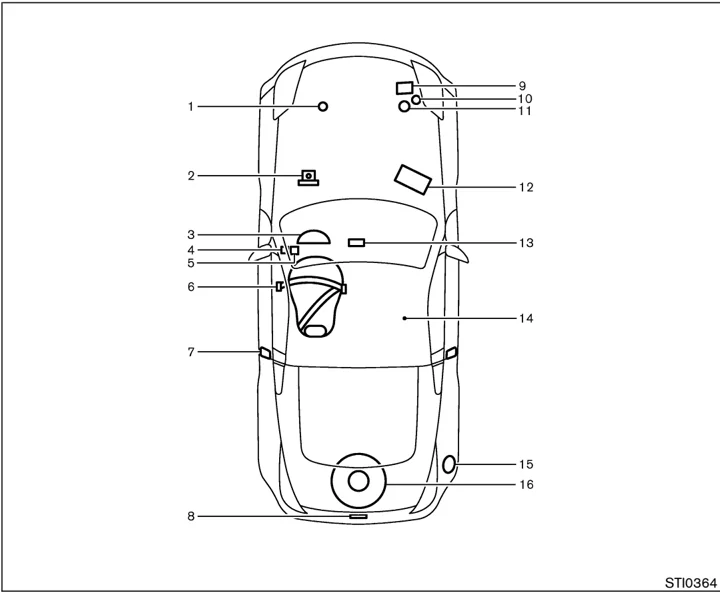
- Engine oil (P.8-10)
- Brake fluid (P.8-13)
- Meters and gauges (P.2-3)
- Fuel-filler door release (P.3-23)
- Hood release (P.3-8)
- Seat belt (P.1-10)
- Door lock/key (P.3-2)
- Rear hatch release (Coupe) (P.3-9) or Trunk lid release (Roadster) (P.3-10)
- Engine coolant (P.8-8)
- Window washer fluid (P.8-14)
- Power steering fluid (P.8-13)
- Battery (P.8-15)
- Audio system (P.4-12)/ Heater and air conditioner (P.4-9)
- Soft top (Roadster models) (P.3-13)
- Fuel (P.3-23, P.9-3)
- Spare tire (P.6-3, P.8-39)
STI0364