Emission Control Systems
Exhaust Emission Requirements
The U.S. Environmental Protection Agency (EPA), the California Air Resources Board (CARB), and Environment Canada require that your motorcycle comply with applicable exhaust emissions standards during its useful life, when operated and maintained according to the instructions provided.
Noise Emission Requirements
The EPA also requires that motorcycles built after January 1, 1983 comply with applicable noise emission standards for one year or 3,730 miles (6,000 km) after the time of sale to the ultimate purchaser, when operated and maintained according to the instructions provided. (USA only)
Warranty Compliance
Compliance with the terms of the Distributor’s Warranties for Honda Motorcycle Emission Control Systems is necessary in order to keep the emissions system warranty in effect. (USA only)
vehicle emission control information label
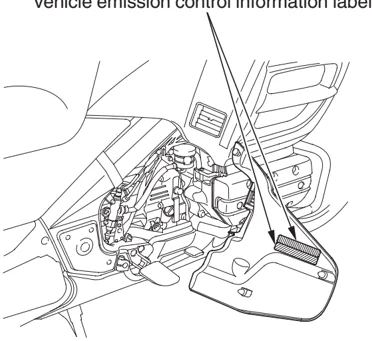
The Vehicle Emission Control Information label is attached behind the right engine side cover.
Emission Control Systems
Source of Exhaust Emissions
The combustion process produces carbon monoxide (CO), oxides of nitrogen (NOx) and hydrocarbons (HC). Control of hydrocarbons and oxides of nitrogen is very important because, under certain conditions, they react to form photochemical smog when subjected to sunlight. Carbon monoxide does not react in the same way, but it is toxic.
Honda Motor Co., Ltd. utilizes various systems to reduce carbon monoxide, oxides of nitrogen and hydrocarbons.
Exhaust Emission Control System
The exhaust emission control system includes a PGM-FI system, two warm-up oxidation catalysts, two three-way catalytic converters, two heated oxygen sensors, and a secondary air injection system.
No adjustment to these systems should be made although periodic inspection of the components is recommended.
PGM-FI System
The PGM-FI system uses sequential multiport fuel injection. It has four subsystems: Air Intake, Engine Control, Fuel Control, and Exhaust Control. The Engine Control Module (ECM) uses various sensors to determine how much air is going into the engine. It then controls how much fuel to inject under all operating conditions.
Ignition Timing Control System
The system constantly adjusts the ignition timing, reducing the amount of HC, CO and NOx produced.
Secondary Air Injection System
The secondary air injection system introduces filtered air into the exhaust gases in the exhaust port. The secondary air injection system helps improve emission performance.
Three-Way Catalytic Converters
The three-way catalytic converters are in the exhaust system. Through chemical reactions, they convert HC, CO, and NOx in the engine’s exhaust to carbon dioxide (CO₂), dinitrogen (N₂), and water vapor.
210 Technical Information
Emission Control Systems
Evaporative Emission Control System
This motorcycle complies with the requirements of the California Air Resources Board (CARB) evaporative emission regulations. Fuel vapor from the fuel tank is directed into the charcoal canister and air cleaner where it is adsorbed and stored while the engine is stopped. When the engine is running and the purge control solenoid valve is open, fuel vapor in the charcoal canister and air cleaner is drawn into the engine through the throttle body.
Crankcase Emission Control System
The engine is equipped with a closed crankcase system to prevent discharging crankcase emissions into the atmosphere. Blow-by gas is returned to the combustion chamber through the air cleaner and the intake manifold.
Technical Information 211
Emission Control Systems
Problems That May Affect Motorcycle Exhaust Emissions
If you are aware of any of the following symptoms, have the vehicle inspected and repaired by your authorized Honda motorcycle dealer.
Symptoms:
- Hard starting or stalling after starting
- Rough idle
- Misfiring or backfiring during acceleration
- After-burning (backfiring)
- Poor performance (driveability) and poor fuel economy
Noise Emission Control System
TAMPERING WITH THE NOISE CONTROL SYSTEM IS PROHIBITED: U. S. federal law prohibits, or Canadian provincial laws may prohibit the following acts or the causing thereof: (1) The removal or rendering inoperative by any person, other than for purposes of maintenance, repair or replacement, of any device or element of design incorporated into any new vehicle for the purpose of noise control prior to its sale or delivery to the ultimate purchaser or while it is in use; or (2) the use of the vehicle after such device or element of design has been removed or rendered inoperative by any person.
AMONG THOSE ACTS PRESUMED TO CONSTITUTE TAMPERING ARE THE FOLLOWING ACTS:
- Removal of, or puncturing the muffler, baffles, header pipes or any other component which conducts exhaust gases.
- Removal of, or puncturing of any part of the intake system.
- Lack of proper maintenance.
- Replacing any moving parts of the vehicle, or parts of the exhaust or intake system, with parts other than those specified by the manufacturer.
212 Technical Information
Catalytic Converters
This motorcycle is equipped with a two three-way catalytic converters. The catalytic converters contain precious metals that serve as catalysts, promoting chemical reactions to convert the exhaust gasses without affecting the metals.
The catalytic converter acts on HC, CO, and NOx. A replacement unit must be an original Honda part or its equivalent.
The catalytic converter must operate at a high temperature for the chemical reactions to take place. It can set fire to any combustible materials that come near it. Park your motorcycle away from high grasses, dry leaves, or other flammables.
Defective catalytic converters contribute to air pollution, and can impair your engine’s performance. Follow these guidelines to protect your motorcycle’s catalytic converters.
• Always use unleaded gasoline. Even a small amount of leaded gasoline can contaminate the catalyst metals, making the catalytic converters ineffective.
• Keep the engine tuned-up.
• Have your motorcycle diagnosed and repaired if it is misfiring, backfiring, stalling or otherwise not running properly.
Technical Information 213
Oxygenated Fuels
Some conventional gasolines are being blended with alcohol or an ether compound. These gasolines are collectively referred to as oxygenated fuels. To meet clean air standards, some areas of the United States and Canada use oxygenated fuels to help reduce emissions.
If you use an oxygenated fuel, be sure it is unleaded and meets the minimum octane rating requirement.
Before using an oxygenated fuel, try to confirm the fuel’s contents. Some states/provinces require this information to be posted on the pump.
The following are the EPA-approved percentages of oxygenates:
ETHANOL (ethyl or grain alcohol) 10% by Volume You may use gasoline containing up to 10% ethanol by volume. Gasoline containing ethanol may be marketed under the name “Gasohol”.
MTBE (Methyl Tertiary Butyl Ether) 15% by Volume You may use gasoline containing up to 15% MTBE by volume.
METHANOL (methyl or wood alcohol) 5% by Volume You may use gasoline containing methanol containing up to 5% methanol by volume as long as it also contains cosolvents and corrosion inhibitors to protect the fuel system. Gasoline containing more than 5% methanol by volume may cause starting and/or performance problems. It may also damage metal, rubber, and plastic parts of your fuel system.
214 Technical Information
Oxygenated Fuels
If you notice any undesirable operating symptoms, try another service station or switch to another brand of gasoline.
Fuel system damage or performance problems resulting from the use of an oxygenated fuel containing more than the percentages of oxygenates mentioned above are not covered under warranty.
Oxygenated fuels can damage paint and plastic. Be careful not to spill fuel when filling the fuel tank. Wipe up any spills immediately.
NOTICE
Oxygenated fuels can damage paint and plastic. Damage caused by spilled fuel is not covered by warranty.
Technical Information 215
216 Technical Information
Consumer Information
This section contains information on your warranty and how to get an official Honda service manual.
- Authorized Manuals ........ 218
- Warranty Coverage ........ 220
- Warranty Service ........ 221
- Contacting Honda ........ 222
- Your Honda Dealer ........ 223
- The Honda Rider’s Club (USA only) ........ 224
- Reporting Safety Defects (USA only) ........ 225
Consumer Information 217
Authorized Manuals
The Service Manual used by your authorized Honda dealer is available from Helm, Inc. (USA only, Canada: See your Honda dealer to order authorized manuals.)
Also available, but not necessary, to service your model is the Honda Common Service Manual which explains theory of operation and basic service information for various systems common to all Honda motorcycles, motor scooters and ATVs.
These Honda manuals are written for the professional technician, but most mechanically-capable owners should find them easy to use if they have the proper tools and observe proper safety standards. Special Honda tools are necessary for some procedures.
| Publication Item No. | Description | Price Each* |
|---|---|---|
| 61MCA04 | 2005 GL1800 Service Manual | $75.00 |
| 61MCAC04 | 2005 GL1800 SM/ETM CD-ROM | $60.00 |
| 61CM002 | Common Service Manual | $48.00 |
| 31MCA640 | 2005 GL1800 Owner’s Manual | $16.00 |
*Prices are subject to change without notice and without incurring obligation.
Order On-Line: www.helminc.com
Order Toll Free: 1-888-CYCLE93 (1-888-292-5393)
(NOTE: For Credit Card Orders Only)
Monday — Friday 8:00 AM — 6:00 PM EST
OR
By completing this form you can order the materials desired. You can pay by check or money order, or charge to your credit card. Mail to Helm, Inc. at the address shown on the back of this order form (USA only).
Canada: See your Honda dealer to order authorized manuals.
| Publication Item No. | Item Description | Qty. | Price Each* | Total Price |
|---|---|---|---|---|
| *Prices are subject to change without notice and without incurring obligation. | ||||
| Orders are mailed within 10 days. Please allow adequate time for delivery. | ||||
| Sub Total | ||||
| Purchaser’s Sales Tax | ||||
| Mich. Add 6 % | ||||
| Calif. Add 8.25 % | ||||
| Handling Charge | $5.00 | |||
| Grand Total |
218 Consumer Information
SHIP TO
NOTE: Dealers and Companies please provide dealer or company name, and also the name of the person to whose attention the shipment should be sent.
Customer Name _________________________________________________________________
Attention ________________________________________________________________________
Street Address - No P. O. Box Number ______________________________________ Apartment Number _________
City __________________________________________ State _________ Zip Code _________
Daytime Telephone Number ( ) _______________________
PAYMENT
[ ] Check or money order enclosed payable to Helm Inc. U.S. funds only. Do not send cash.
[ ] Check here if your billing address is different from the shipping address shown above.
[ ] MasterCard [ ] VISA [ ] Discover
Account Number □□□□ □□□□ □□□□ □□□□
Expiration: Mo. Yr. ____ — ____
Customer Signature __________________________________ Date ______________
These Publications cannot be returned for credit without receiving advance authorization within 14 days of delivery. On returns, a restocking fee may be applied against the original order.
HELM P.O. BOX 07280, DETROIT, MICHIGAN 48207
Consumer Information 219
Warranty Coverage
Your new Honda is covered by these warranties:
- Motorcycle Limited Warranty
- Exhaust Emission Warranty
- Noise Control Warranty
There are responsibilities, restrictions, and exclusions which apply to these warranties. Please read the Warranties Booklet given to you by your Honda dealer at the time of purchase. Be sure to keep your Honda owner’s card with your Warranties Booklet (USA only).
It is important to realize that your warranty applies to defects in material or workmanship of your Honda. Your warranty coverage does not apply to normal wear or deterioration associated with using the motorcycle.
Your warranty coverage will not be voided if you choose to perform your own maintenance. However, you should have the proper tools and service information and be mechanically qualified. Failures that occur due directly to improper maintenance are not covered.
Almost all of your warranty coverage can be extended through the Honda Protection Plan (USA only). For more information, see your Honda dealer.
220 Consumer Information
Warranty Service
Please remember that recommended maintenance interval servicing is not included in your warranty coverage. Additionally, your warranty does not apply to the normal wear of items (such as brakes, tires, etc.).
If you believe you have a problem with your motorcycle, call the service department of your Honda dealer. Make an appointment for an inspection and diagnosis. Remember, as the owner of the motorcycle, you will be asked to authorize that inspection. Your dealer will give you the results of the inspection. If the problem is covered under warranty, your dealer will perform the warranty repairs for you.
If you have questions about warranty coverage or the nature of the repair, it is best to talk to the service manager of your Honda dealer.
Sometimes, in spite of the best intentions of all concerned, a misunderstanding may occur. If you aren’t satisfied with your dealer’s handling of the situation, we suggest you discuss your problem with the appropriate member of the dealership’s management team. If the problem has already been reviewed with the Service Manager, Parts Manager, Sales Manager, etc., contact the Owner of the dealership or their designated representative.
Consumer Information 221
Contacting Honda
Your owner’s manual was written to cover most of the questions you might ask about your Honda. Any questions not answered in the owner’s manual can be answered by your Honda dealer. If your dealer doesn’t have the answer right away, they will get it for you.
If you have a difference of opinion with your dealer, please remember that each dealership is independently owned and operated. That’s why it’s important to work to resolve any differences at the dealership level.
If you wish to comment on your experiences with your Honda or with your dealer, please send your comments to the following address (USA only):
Motorcycle Division, American Honda Motor Co., Inc., P.O. Box 2220, Torrance, CA 90509-2220, mailstop: 100-4W-5B, telephone: (310) 532-9811.
Canada: Refer to the Warranties Booklet that was supplied with your vehicle.
Please include the following information in your letter:
- name, address, and telephone number
- product model, year, and frame/VIN serial number
- date of purchase
- dealer name and address
We will likely ask your Honda dealer to respond, or possibly acknowledge your comments directly.
222 Consumer Information
Your Honda Dealer
Once you purchase your new Honda, get familiar with the organization of your Honda dealer so you can utilize the full range of services available.
The service department is there to perform regular maintenance and unexpected repairs. It has the latest available service information from Honda. The service department will also handle warranty inspections and repairs.
The parts department offers Genuine Honda parts, Pro Honda products, Hondaline accessories (USA only), and Honda accessories and products (Canada only). The same quality that went into your Honda can be found in Genuine Honda replacement parts. You’ll also find comparable quality in the accessories and products available from the parts department.
The sales department offers the Honda Protection Plan to extend almost all of your warranty coverage (USA only).
Your Honda dealer can inform you about competition and other riding events in your area. You’ll also find that your dealer is a source of information about American Honda’s Rider Education Centers and the Honda Rider’s Club of America (USA only).
We’re sure you’ll be as pleased with the service your Honda dealer continues to provide after the sale as you are with the quality and dependability of your Honda.
Consumer Information 223
The Honda Rider’s Club (USA only)
One of the best ways to get the most enjoyment from owning and riding your Honda is through the Honda Rider’s Club of America. Your purchase of a new motorcycle, scooter, ATV or PWC from a participating U.S. Honda dealer entitles you to a complimentary one-year membership in the Club. There are hundreds of HRCA Chapter sponsoring dealers across the USA with events and activities almost every weekend. Membership benefits include:
• 24 hour, toll-free roadside assistance for your new Honda (includes roadside assistance for your transport vehicle as long as your Honda is aboard or in tow). • Vehicle transport to the nearest Honda dealer or service center, if necessary. • An exclusive HRCA website complete with access to the official Honda Common Service Manual, contests, insider information and more. • Reimbursement (up to $75) for Motorcycle Safety Foundation training. Separate free training from the Specialty Vehicle Institute of America for ATV owners. • One full year of the Honda Red Rider magazine or Honda Red Rider ATV (for ATV purchasers). • Discounts from HRCA partners for experienced rider courses. • Discounted vehicle insurance from the HRCA’s insurance partner. • Racing contingency programs and assistance at selected dual-sport, off-road, and motocross events.
Contact your Honda dealer for more information or call: 1 800-847-HRCA or log on to www.hrca.honda.com.
224 Consumer Information
Reporting Safety Defects (USA only)
If you believe that your vehicle has a defect which could cause a crash or could cause injury or death, you should immediately inform the National Highway Traffic Safety Administration (NHTSA) in addition to notifying American Honda Motor Co., Inc.
If NHTSA receives similar complaints, it may open an investigation, and if it finds that a safety defect exists in a group of vehicles, it may order a recall and remedy campaign. However, NHTSA cannot become involved in individual problems between you, your dealer, or American Honda Motor Co., Inc.
To contact NHTSA, you may either call the Auto Safety Hotline toll-free at 1-800-424-9393 (or 366-0123 in Washington, D.C. area) or write to: NHTSA, U.S. Department of Transportation, Washington, D.C. 20590.
You can also obtain other information about motor vehicle safety from the Hotline.
Consumer Information 225
Table of Contents
The following presents the contents of each section of your owner’s manual.
-
MOTORCYCLE SAFETY ........ 1
-
Important Safety Information ........ 2
-
Accessories & Modifications ........ 4
-
Safety Labels ........ 6
-
INSTRUMENTS & CONTROLS ........ 11
-
Component Locations ........ 12
-
Gauges & Indicators ........ 15 Multi-display
-
Opening/Ending Ceremony ........ 21
-
On/Off-Opening/Ending Ceremony ........ 22
-
Special Massage for Opening/Ending Ceremony ........ 23
-
Odometer/Tripmeter ........ 25
-
Display Illumination Adjustment ........ 26
-
Digital Clock ........ 27
-
Air Temperature Meter ........ 28
-
Travel Trunk & Saddlebags Open Indicator ........ 29 Controls & Features
-
Ignition Switch ........ 30
-
Engine Stop Switch ........ 31
-
Start/Reverse Button ........ 32
-
Reverse (RVS) Switch ........ 32
-
Cruise Control Switches ........ 32
-
Headlight Dimmer Switch ........ 33
-
Turn Signal Switch ........ 33
-
Horn Button ........ 34
-
Audio Control Switches ........ 34
-
Hazard Warning System Switch ........ 34
-
Headlight Beam Adjustment Knob ........ 35
-
Rear Spring Pre-load Adjustment Switch ........ 35
-
Ventilation Controls ........ 35
-
Windshield Height Adjustment ........ 35
226 Table of Contents
Table of Contents
- BEFORE RIDING ........ 37
- Are You Ready to Ride? ........ 38
- Protective Apparel ........ 38
- Rider Training ........ 40
- Is Your Motorcycle Ready to Ride? ........ 41
- Pre-ride Inspection ........ 41
- Load Limits & Guidelines ........ 43
- Loading ........ 43
- Load Limits ........ 44
- Loading Guidelines ........ 44
- Cargo Compartment ........ 45
- Travel Trunk & Saddlebags ........ 45
- Remote Transmitter ........ 49
- Fairing Pockets ........ 53
- Trunk Side Pockets ........ 54
- Comfort & Convenience Adjustment ........ 55
- Windshield Height Adjustment ........ 56
- Side Ventilation Louvers ........ 57
- Windshield Ventilation Louver ........ 57
- Accessories ........ 58
- Accessory (ACC) Terminal ........ 58
Table of Contents 227
Table of Contents
- BASIC OPERATION & RIDING ........ 59
- Safe Riding Precautions ........ 60
- Starting & Stopping the Engine ........ 61
- Preparation ........ 61
- Starting Procedure ........ 62
- Flooded Engine ........ 62
- Bank Angle Sensor Ignition Cut-off System ........ 63
- How to Stop the Engine ........ 63
- Shifting Gears ........ 64
- While You Are Riding ........ 65
- Reverse Riding ........ 66
- Braking ........ 68 Anti-Lock Brake System (ABS)
- (GL1800A) ........ 70
- ABS Indicator Light (GL1800A) ........ 71
- Parking ........ 73
- Theft-Prevention Tips ........ 75
- Riding with a Passenger or Cargo ........ 76
- Riding with Cruise Control ........ 77
- Cruise Control ........ 77
- To Set Cruise Control ........ 78
- To Change the Set Speed ........ 78
- To Cancel Cruise Control ........ 79
- Riding in Bad Weather ........ 80
228 Table of Contents
Table of Contents
- AUDIO SYSTEMS ........ 81
- AM/FM Radio ........ 82
- Radio Antenna ........ 82
- Controls Locations ........ 83
- AUDIO System ........ 84
- Switch Output ........ 84
- VOLUME Control ........ 85
- Select Band ........ 86
- Select Station ........ 87
- Preset Stations ........ 88
- Auto Select ........ 89
- Tone Control ........ 90
- Fader Control ........ 91
- Muting ........ 91
- Ambience (AMB) ........ 92
- Beep Set ........ 92
- Auto Volume Control (AVC) ........ 93
- Weather Information ........ 94
- Weather Band (WB) ........ 94
- Auxiliary Function ........ 95
- Auxiliary (AUX) Input ........ 95
- Input Jack Setup ........ 96
- Intercom System ........ 98
- System Control ........ 98
- VOLUME Control ........ 99
- Intercom Muting ........ 99
Table of Contents 229
Table of Contents
- SERVICEING YOUR HONDA ........ 101 Before You Service Your Honda
- The Importance of Maintenance ........ 104
- Maintenance Safety ........ 105
- Important Safety Precautions ........ 106
- Periodic Maintenance ........ 107
- Maintenance Schedule ........ 108
- Maintenance Record ........ 112
Service Preparations
- Component Locations ........ 113
- Tool Kit ........ 116
- Owner's Manual Storage ........ 117
- Cover Removal ........ 118
Service Procedures
Fluids & Filters
- Fuel ........ 123
- Engine Oil & Filter ........ 126
- Coolant ........ 133
- Crankcase Breather ........ 136
- Final Drive Oil ........ 137
Engine
- Clutch System ........ 139
- Spark Plugs ........ 141
Chassis
- Suspension ........ 143
- Brakes ........ 147
- Tires ........ 152
- Side Stand ........ 157
Electrical
-
Battery ........ 158
-
Appearance Care ........ 162
230 Table of Contents
Table of Contents
-
TIPS ........ 169
-
Storing Your Honda ........ 170
-
Transporting Your Motorcycle ........ 172
-
You & the Environment ........ 173
-
TAKING CARE OF THE UNEXPECTED ........ 175
-
General Guidelines ........ 176
-
If Your Engine Quits or Won’t Start ........ 177
-
If You Have a Flat Tire ........ 180
-
If Your Engine Overheats ........ 190
-
If the Low Oil Pressure Indicator Lights ........ 192
-
If a Fuse Blows ........ 193
-
If You Crash ........ 196
-
If You Lose Your Key ........ 197
-
If Your Battery is Low (or Dead) ........ 198
-
TECHNICAL INFORMATION ........ 199
-
Vehicle Identification ........ 200
-
Specifications ........ 202
-
Break-in Guidelines ........ 208
-
Emission Control Systems ........ 209
-
Catalytic Converters ........ 213
-
Oxygenated Fuels ........ 214
-
CONSUMER INFORMATION ........ 217
-
Authorized Manuals ........ 218
-
Warranty Coverage ........ 220
-
Warranty Service ........ 221
-
Contacting Honda ........ 222
-
Your Honda Dealer ........ 223
-
The Honda Rider’s Club (USA only) ........ 224
-
Reporting Safety Defects (USA only) ........ 225
Table of Contents 231
Table of Contents
-
TABLE OF CONTENTS ........ 226
-
INDEX ........ 234
QUICK REFERENCE
232 Table of Contents
Table of Contents 233
Index
A
- ABS indicator light ........ 19, 71
- accessories ........ 4
- accessory (ACC) terminal ........ 58
- air pressure, tires ........ 153
- air temperature meter ........ 28
- American Honda, contacting ........ 222
- antenna, radio ........ 82
- Anti-lock Brake System (ABS) ........ 70
- apparel, protective ........ 38
- appearance care ........ 162
- audio systems ........ 81
- authorized manuals ........ 218
B
- battery ........ 158 brakes,
- fluid ........ 148
- pad wear ........ 150
- braking ........ 68
- break-in guidelines ........ 208
C
- capacity, fuel ........ 124
- care, appearance ........ 162
- catalytic converters ........ 213
- cleaning, appearance care ........ 162
- clutch system ........ 139
- color label ........ 201
- comfort and convenience adjustment ........ 55 compartment,
- owner's manual ........ 117
- tool kit ........ 116 component locations,
- indicators and controls ........ 12
- maintenance ........ 113
234 Index
Index
- consumer information ........ 217
- coolant ........ 133
- coolant temperature gauge ........ 20
- crankcase breather ........ 136
- cruise control ........ 77
- customer service ........ 222
D
- digital clock adjustment ........ 27
- defects, safety ........ 225
- drive, final ........ 137
E
- emission control systems ........ 209 engine,
- flooded ........ 62
- low oil pressure ........ 192
- number ........ 200
- oil ........ 126
- overheats ........ 190
- pinging ........ 123
- starting ........ 61
- stop switch ........ 31
- stopping ........ 63
- won't start ........ 177
- environment ........ 173
F
- fairing pockets ........ 53
- final drive oil ........ 137
- flat tire ........ 180
- flooded engine ........ 62
- frame number ........ 200
Index 235
Index
fuel,
- gauge ........ 20
- oxygenated ........ 214
- recommendation ........ 123
- tank capacity ........ 124
- fuses ........ 193
G
- gasohol ........ 214
- gasoline ........ 123
- gauges & indicators ........ 15
H
- hazard warning system switch ........ 34
- headlight beam adjustment ........ 35
- headlight dimmer switch ........ 33
- helmet holder ........ 74
- high beam indicator ........ 19 Honda,
- contacting ........ 222
- Rider's Club ........ 224
- dealer ........ 223
- Honda Service Manual ........ 218
- horn button ........ 34
I
- identification, vehicle ........ 200 ignition cutoff system,
- side stand ........ 61
- bank angle sensor ........ 63
- ignition switch ........ 30
- indicators ........ 15
- inspection, pre-ride ........ 41
236 Index
Index
K
- key, lost ........ 197
- kit, tool ........ 116
L
- labels, safety ........ 6
- lamp check ........ 16
- limit, weight ........ 44
- load limits ........ 44
- loading guidelines ........ 44 location, components,
- instruments & controls ........ 11
- maintenance ........ 113
- lock, steering ........ 73
M
maintenance,
- importance ........ 104
- periodic ........ 107
- record ........ 112
- safety ........ 105
- schedule ........ 108
- manual, service ........ 218
- manual, authorized ........ 218
- maximum weight limit ........ 44
- modifications ........ 5
- multi-display ........ 21
N
- numbers, serial ........ 200
Index 237
Index
O
- odometer ........ 25 oil,
- engine ........ 126
- final drive ........ 137
- low pressure ........ 192
- operating controls ........ 30
- overdrive indicator ........ 18
- overheat, engine ........ 190
- owner’s manual storage ........ 117
- oxygenated fuels ........ 214
P
- parking ........ 73
- pinging, engine ........ 123
- plugs, spark ........ 141 pockets,
- fairing ........ 53
- trunk side ........ 54
- pre-load, rear suspension ........ 144
- pre-ride inspection ........ 41
- problems, unexpected ........ 175
- protective apparel ........ 38
R
- radio antenna ........ 82 radio,
- AM/FM ........ 82
- remote transmitter ........ 49 removal,
- cylinder head side cover ........ 121
- engine side cover ........ 120
- front lower cover ........ 122
- side cover ........ 119 reverse,
- button ........ 32
238 Index
Index
reverse,
- riding ........ 66
- system indicator ........ 17
- reporting safety defects ........ 225
- rider training ........ 2, 40
- Rider’s Club, Honda ........ 224 riding,
- bad weather ........ 80
- basic operation ........ 59
- clothing ........ 38
- safety ........ 2
- safety precautions ........ 60
- with cruise control ........ 77
- with passenger or cargo ........ 76
S
- saddlebag ........ 45 safety,
- important precautions ........ 106
- lables ........ 6
- reporting defects ........ 225
- riding precautions ........ 60
- schedule, maintenance ........ 108
- serial numbers ........ 200 Service,
- customer ........ 222
- manuals ........ 218
- warranty ........ 221
- shifting gears ........ 64
Index
starting,
- engine ........ 62
- troubleshooting ........ 177
- steering lock ........ 73
- stop switch, engine ........ 31
- stopping engine ........ 63 storage,
- motorcycle ........ 170
- owner’s manual ........ 117 suspension,
- rear pre-load ........ 144 switch,
- audio control ........ 34, 81
- cruise control ........ 32, 77
- engine stop ........ 31
- hazard warning system ........ 34
- headlight dimmer ........ 33
- ignition ........ 30
- rear spring pre-load adjustment ........ 35, 144
- reverse ........ 32, 66
- turn signal ........ 33
T
- tachometer ........ 17
- theft prevention tips ........ 75 tires,
- air pressure ........ 153
- flat ........ 180
- replacing ........ 155
- tool kit ........ 116
- training, rider ........ 2, 40
- transporting your motorcycle ........ 172
- travel trunk ........ 45
- tripmeter ........ 25
- trouble, unexpected ........ 175
- troubleshooting, starting ........ 177
- trunk side pockets ........ 54
- trunk, travel ........ 45
- turn signal indicators ........ 17
240 Index
Index
V
- vehicle identification no. (VIN) ........ 200
- ventilation ........ 57
W
warranty,
- coverage ........ 220
- extended ........ 220
- service ........ 221
- washing your motorcycle ........ 163
- weight limit ........ 44 wheels,
- front removal ........ 182
- rear removal ........ 188
- windshield height adjustment levers ........ 56
Index 241
242 Memo
Quick Reference
The following is a brief, but important collection of information you need to know about your Honda. You’ll also find space to record important notes.
The engine of your Honda can be the most expensive component to repair. Proper maintenance, especially the use of the recommended fluids and filters, prevents premature wear and damage. Frequent causes of costly repairs are: Engine oil: insufficient quantity, improper oil. Air cleaner: dirty, leaking because of improper installation (poor seal).
Record important information on the following page:
Quick Reference
Quick Reference
| Scheduled Maintenance | Regular: every 4,000 miles (6,400 km) |
|---|---|
| Pre-ride Inspection | Check the following items each time before you ride (page 41): tires & wheels, leaks, loose parts, throttle, brakes, indicators, lights. |
| Periodic Checks | Check the following items monthly (page 107): tires & wheels, fluids, lights, freeplay, fuses, nuts & bolts. |
| Fuel/Capacity | unleaded gasoline, pump octane number 86 or higher6.74 US gal (25.5 ℓ) |
| Engine Oil | API Service Classification SG or higher except oils labeled as energy conserving on the circular API service label,SAE 10W-40, JASO T 903 standard MA,Pro Honda GN4 or HP4 (without molybdenum additives)4-stroke oil or equivalent |
| Maximum Weight Capacity | 417 lbs (189 kg)425 lbs (193 kg) Canada typerider, passenger, all cargo and accessoriesmaximum of all cargo: 71 lbs (32 kg) |
| Tires | front: 130/70R18M/C 63HDUNLOP D250FBRIDGESTONE G709 RADIALrear: 180/60R16M/C 74HDUNLOP D250BRIDGESTONE G704 RADIALtype: radial, tubeless |
| Tire Pressure (cold) | front: 36 psi (250 kPa, 2.50 kgf/cm²)rear: 41 psi (280 kPa, 2.80 kgf/cm²) |
| Spark Plugs | standard:BKR6E-11 (NGK) or K20PR-U11 (DENSO)cold climat (below 5°C, 41°F):BKR5E-11 (NGK) or K16PR-U11 (DENSO)high speed riding:BKR7E-11 (NGK) or K22PR-U11 (DENSO) |
| Coolant | ethylene glycol antifreeze (silicate-free) for aluminum engines in 50/50 solution with Pro Honda HP Coolant or an equivalent distilled water |
| Fuses | main A: 30 A main B: 100 A speed limiter: 70 Aother: 20 A, 15 A, 10 A, 5 A30 A (model equipped with ABS) |
| Final Drive Oil | Hypoid Gear Oil SAE 80 |
Quick Reference