2007 Honda S2000 Online Reference Owner's Manual Use these links (and links throughout this manual) to navigate through this reference. For a printed owner's manual, click on authorized manuals or go to www.helminc.com.
Contents
Owner's Identification Form
- Introduction ........ i
- A Few Words About Safety ........ iii
- Your Vehicle at a Glance ........ 3
- Driver and Passenger Safety ........ 5 Proper use and care of your vehicle's seat belts, and Supplemental Restraint System.
- Instruments and Controls ........ 43 Instrument panel indicator and gauge, and how to use dashboard and steering column controls.
- Comfort and Convenience Features ........ 83 How to operate the climate control system, the audio system, and other convenience features.
- Before Driving ........ 109 What gasoline to use, how to break-in your new vehicle, and how to load luggage and other cargo.
- Driving ........ 121 The proper way to start the engine, shift the transmission, and park, plus towing a trailer.
- Maintenance ........ 133 The Maintenance Schedule shows you when you need to take your vehicle to the dealer.
- Taking Care of the Unexpected ........ 173 This section covers several problems motorists sometimes experience, and how to handle them.
- Technical Information ........ 199 ID numbers, dimensions, capacities, and technical information.
- Warranty and Customer Relations (U.S. and Canada) ........ 211 A summary of the warranties covering your new Acura, and how to contact us.
- Authorized Manuals (U.S. only) ........ 215 How to order manuals and other technical literature.
- Index ........ I
Service Information Summary A summary of information you need when you pull up to the fuel pump.
Accord Value Package Audio System
Main Menu
Owner’s Identification
OWNER _________________________________________________________________________
ADDRESS _______________________________________________________________________ STREET ________________________________________________________________________ CITY __________________________ STATE/PROVINCE ______________________ ZIP CODE/POSTAL CODE
V. I. N. _______________________________________________________________________
DELIVERY DATE __________________________________________________________________ (Date sold to original retail purchaser)
DEALER NAME ___________________________________ DEALER NO. ____________________
ADDRESS _______________________________________________________________________ STREET ________________________________________________________________________ CITY __________________________ STATE/PROVINCE ______________________ ZIP CODE/POSTAL CODE
OWNER’S SIGNATURE ___________________________________________________________
DEALER’S SIGNATURE ___________________________________________________________
This owner’s manual should be considered a permanent part of the vehicle and should remain with the vehicle when it is sold.
This owner’s manual covers all models of the S2000. You may find descriptions of equipment and features that are not on your particular model.
The information and specifications included in this publication were in effect at the time of approval for printing. Honda Motor Co., Ltd. reserves the right, however, to discontinue or change specifications or design at any time without notice and without incurring any obligation whatsoever.
Main Menu
Introduction
Congratulations on your selection of the 2007 Honda S2000. We are certain you will be pleased with your purchase of one of the most sophisticated and technologically-advanced sports cars in the world.
One of the best ways to enhance the enjoyment of your new vehicle is to read this manual. In it, you will learn how to operate its driving controls and convenience items. Afterwards, keep this owner’s manual in your vehicle so you can refer to it at any time.
Several warranties protect your new vehicle. Read the warranty booklet thoroughly so you understand the coverages and are aware of your rights and responsibilities.
Maintaining your vehicle according to the messages shown on the information display helps to keep your driving trouble-free while it preserves your investment. When your vehicle needs maintenance, keep in mind that your dealer’s staff is specially trained in servicing the many systems unique to your vehicle. Your Honda dealer is dedicated to your satisfaction and will be pleased to answer any questions and concerns.
As you read this manual, you will find information that is preceded by a NOTICE symbol. This information is intended to help you avoid damage to your vehicle, other property, or the environment.
i
Main Menu
Introduction
California Proposition 65 Warning
WARNING: This product contains or emits chemicals known to the state of California to cause cancer and birth defects or other reproductive harm.
Event Data Recorders This vehicle is equipped with one or more devices commonly referred to as event data recorders. These devices record seat belt use, passenger seat occupancy, airbag deployment data, and the failure of any airbag system component. This data belongs to the vehicle owner and may not be accessed by anyone else except as legally required or with the permission of the vehicle owner.
Service Diagnostic Recorders This vehicle is equipped with service-related devices that record information about powertrain performance. The data can be used to verify emissions law requirements and/or help technicians diagnose and solve service problems. It may also be combined with data from other sources for research purposes, but it remains confidential and is never linked to the vehicle owner.
ii
Main Menu
A Few Words About Safety
Your safety, and the safety of others, is very important. And operating this vehicle safely is an important responsibility.
To help you make informed decisions about safety, we have provided operating procedures and other information on labels and in this manual. This information alerts you to potential hazards that could hurt you or others.
Of course, it is not practical or possible to warn you about all the hazards associated with operating or maintaining your vehicle. You must use your own good judgement.
You will find this important safety information in a variety of forms, including:
-
Safety Labels — on the vehicle.
-
Safety Messages — preceded by a safety alert symbol ▲ and one of three signal words: DANGER, WARNING, or CAUTION. These signal words mean:
-
Safety Headings — such as Important Safety Reminders or Important Safety Precautions.
-
Safety Section — such as Driver and Passenger Safety.
-
Instructions — how to use this vehicle correctly and safely.
This entire book is filled with important safety information — please read it carefully.
iii
Main Menu
Your Vehicle at a Glance
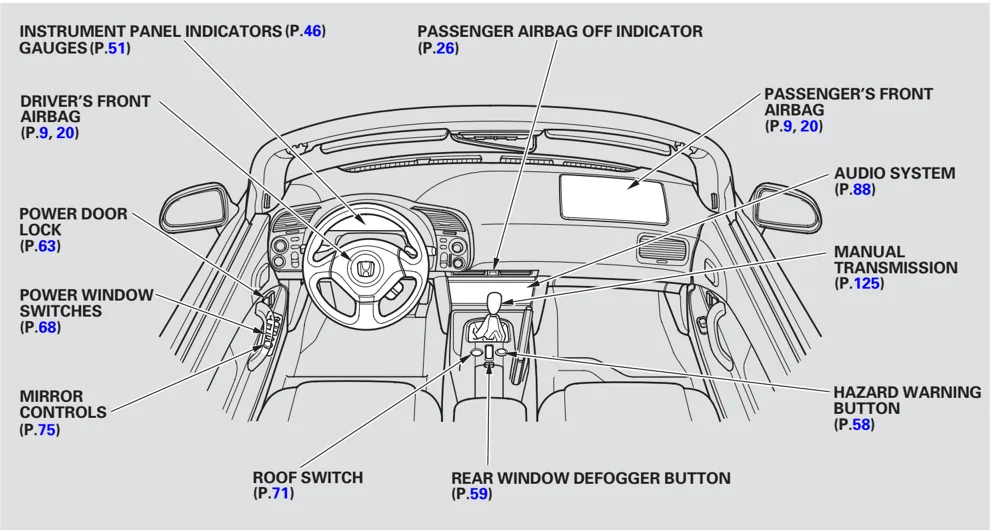
INSTRUMENT PANEL INDICATORS (P.46) GAUGES (P.51)
DRIVER’S FRONT AIRBAG (P.9, 20)
POWER DOOR LOCK (P.63)
POWER WINDOW SWITCHES (P.68)
MIRROR CONTROLS (P.75)
ROOF SWITCH (P.71)
PASSENGER AIRBAG OFF INDICATOR (P.26)
REAR WINDOW DEFOGGER BUTTON (P.59)
PASSENGER’S FRONT AIRBAG (P.9, 20)
AUDIO SYSTEM (P.88)
MANUAL TRANSMISSION (P.125)
HAZARD WARNING BUTTON (P.58)
Your Vehicle at a Glance
3
Main Menu
Your Vehicle at a Glance
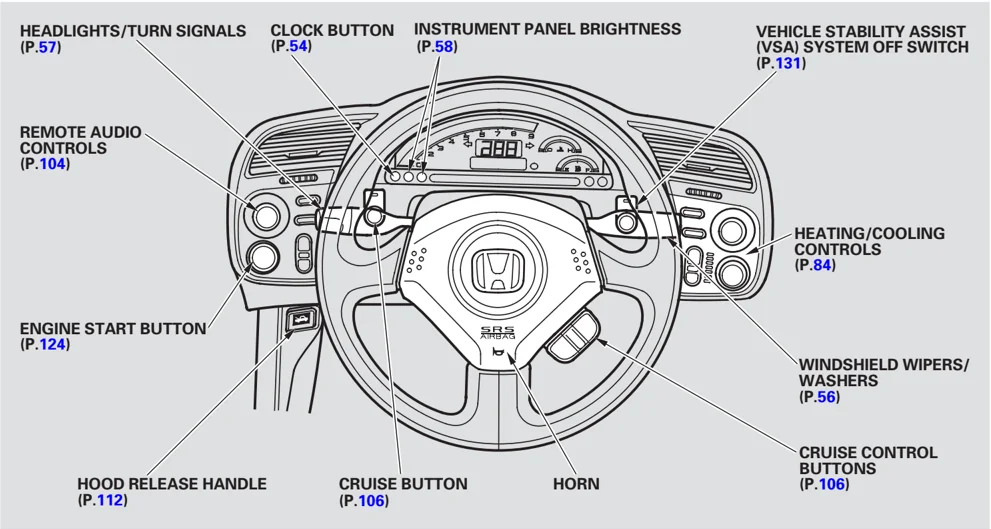
HEADLIGHTS/TURN SIGNALS (P.57)
CLOCK BUTTON (P.54)
INSTRUMENT PANEL BRIGHTNESS (P.58)
VEHICLE STABILITY ASSIST (VSA) SYSTEM OFF SWITCH (P.131)
REMOTE AUDIO CONTROLS (P.104)
HEATING/COOLING CONTROLS (P.84)
ENGINE START BUTTON (P.124)
WINDSHIELD WIPERS/ WASHERS (P.56)
HOOD RELEASE HANDLE (P.112)
CRUISE BUTTON (P.106)
HORN
CRUISE CONTROL BUTTONS (P.106)
4
Main Menu
Driver and Passenger Safety
This section gives you important information about how to protect yourself and your passenger. It shows you how to use seat belts. It explains how your airbags work. And it tells you how to properly restrain children in your vehicle.
- Important Safety Precautions ........ 6
- Your Vehicle's Safety Features ........ 7
- Seat Belts ........ 8
- Airbags ........ 9
- Protecting Adults and Teens ........ 10
- Close and Lock the Doors ........ 10
- Adjust the Seats ........ 10
- Adjust the Seat-Backs ........ 11
- Fasten and Position the
- Seat Belts ........ 12 5. Maintain a Proper Sitting
- Position ........ 13
- Advice for Pregnant Women ........ 14
- Additional Safety Precautions ........ 15 Additional Information About
- Your Seat Belts ........ 16 Seat Belt System Components... 16
- Lap/Shoulder Belt ........ 17 Automatic Seat Belt
- Tensioners ........ 18
- Seat Belt Maintenance ........ 18 Additional Information About Your
- Airbags ........ 20
- Airbag System Components ........ 20
- How Your Airbags Work ........ 22 How the SRS Indicator Works ... 25 How the Passenger Airbag Off
- Indicator Works ........ 26
- Airbag Service ........ 27
- Additional Safety Precautions ........ 28 Protecting Children — General
- Guidelines ........ 29 All Children Must Be
- Restrained ........ 29 Your Vehicle is Not Recommended for Child
- Passengers ........ 30 The Passenger's Airbag
- Can Pose Serious Risks ........ 30
- Additional Safety Precautions ........ 32
- Protecting Small Children ........ 33
- Selecting a Child Seat ........ 34
- Installing a Child Seat ........ 34
- Protecting Larger Children ........ 37
- Checking Seat Belt Fit ........ 37
- Using a Booster Seat ........ 38 When Can a Larger Child Ride
- in This Vehicle ........ 39
- Additional Safety Precautions ........ 40
- Carbon Monoxide Hazard ........ 41
- Safety Labels ........ 42
Driver and Passenger Safety
5
Important Safety Precautions
You’ll find many safety recommendations throughout this section, and throughout this manual. The recommendations on this page are the ones we consider to be the most important.
Always Wear Your Seat Belt A seat belt is your best protection in all types of collisions. Airbags are designed to supplement seat belts, not replace them. So even though your vehicle is equipped with airbags, make sure you and your passenger always wear your seat belts, and wear them properly (see page 12).
Your Vehicle is Not Recommended for Child Passengers Since all children are safest in the back seat of a vehicle, and your vehicle does not have a back seat, we recommend that you do not carry a child passenger.
Never carry an infant in a rear-facing child seat in this vehicle. If an older child must ride in this vehicle, follow all child safety instructions and warnings in this manual (see pages 29 — 40).
Be Aware of Airbag Hazards While airbags can save lives, they can cause serious or fatal injuries to occupants who sit too close to them, or are not properly restrained. Infants, young children, and short adults are at the greatest risk. Be sure to follow all instructions and warnings in this manual.
Don’t Drink and Drive Alcohol and driving don’t mix. Even one drink can reduce your ability to respond to changing conditions, and your reaction time gets worse with every additional drink. So don’t drink and drive, and don’t let your friends drink and drive, either.
Control Your Speed Excessive speed is a major factor in crash injuries and deaths. Generally, the higher the speed, the greater the risk, but serious injuries can also occur at lower speeds. Never drive faster than is safe for current conditions, regardless of the maximum speed posted.
Keep Your Vehicle in Safe Condition Having a tire blowout or a mechanical failure can be extremely hazardous. To reduce the possibility of such problems, check your tire pressures and condition frequently, and perform all regularly scheduled maintenance (see page 134).
6
Your Vehicle’s Safety Features
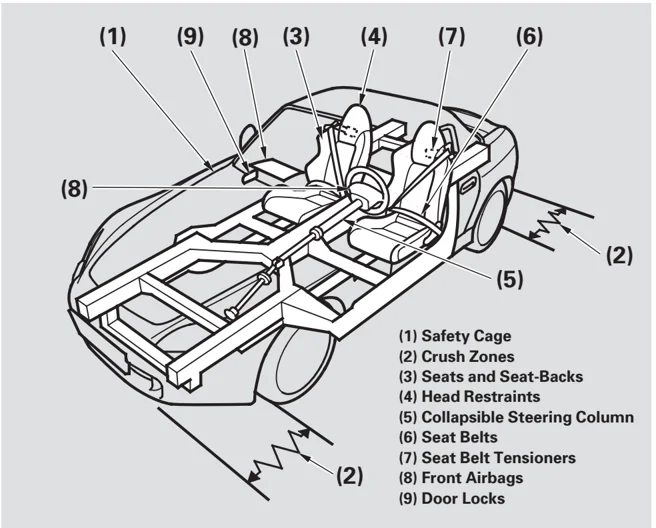
(1) (9) (8) (3) (4) (7) (6) (8) (2) (5) (2)
(1) Safety Cage (2) Crush Zones (3) Seats and Seat-Backs (4) Head Restraints (5) Collapsible Steering Column (6) Seat Belts (7) Seat Belt Tensioners (8) Front Airbags (9) Door Locks
Your vehicle is equipped with many features that work together to protect you and your passenger during a crash.
Some features do not require any action on your part. These include a strong steel framework that forms a safety cage around the passenger compartment; front and rear crush zones, a collapsible steering column; and tensioners that tighten the seat belts in a crash.
However, you and your passenger can’t take full advantage of these features unless you remain sitting in a proper position and always wear your seat belts. In fact, some safety features can contribute to injuries if they are not used properly.
The following pages explain how you can take an active role in protecting yourself and your passenger.
Driver and Passenger Safety
7
Your Vehicle’s Safety Features
Seat Belts Your vehicle is equipped with seat belts in both seating positions.
Your seat belt system also includes an indicator on the instrument panel and a beeper to remind you and your passengers to fasten your seat belts.
Why Wear Seat Belts Seat belts have proven to be the single most effective safety device for adults and larger children.
Not wearing a seat belt properly increases the chance of serious injury or death in a crash, even though your vehicle has airbags.
In addition, most states and all Canadian provinces require you to wear seat belts.
⚠ WARNING Not wearing a seat belt properly increases the chance of serious injury or death in a crash, even though your vehicle has airbags.
Be sure you and your passenger always wear seat belts and wear them properly.
When properly worn, seat belts:
• Keep you connected to the vehicle so you can take advantage of the vehicle’s built-in safety features.
• Help protect you in almost every type of crash, including frontal, side, and rear impacts and rollovers.
• Help keep you from being thrown against the inside of the vehicle and against a passenger.
• Keep you from being thrown out of the vehicle.
• Help keep you in a good position should the airbags ever deploy. A good position reduces the risk of injury from an inflating airbag and allows you to get the best advantage from the airbag.
Of course, seat belts cannot completely protect you in every crash. But in most cases, seat belts can reduce your risk of serious injury.
What you should do: Always wear your seat belt, and make sure you wear it properly.
8
Your Vehicle’s Safety Features
Airbags
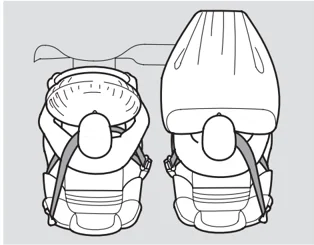
Your vehicle has a supplemental restraint system (SRS) with front airbags to help protect the heads and chests of the driver and a passenger during a moderate to severe frontal collision (see page 22 for more information on how your airbags work).
The most important things you need to know about your airbags are:
- Airbags do not replace seat belts. They are designed to supplement the seat belts.
- Airbags offer no protection in side impacts, rear impacts, rollovers, or minor frontal collisions.
- Airbags can pose serious hazards. To do their job, airbags must inflate with tremendous force. So while airbags help save lives, they can cause minor injuries or more serious or even fatal injuries if occupants are not properly restrained or sitting properly.
What you should do: Always wear your seat belt properly, and sit upright and as far back from the steering wheel as possible while allowing full control of the vehicle. A passenger should move the seat as far back from the dashboard as possible.
The rest of this section gives more detailed information about how you can maximize your safety.
Remember, however, that no safety system can prevent all injuries or deaths that can occur in a severe crash, even when seat belts are properly worn and the airbags deploy.
Driver and Passenger Safety
9
Protecting Adults and Teens
Introduction
The following pages provide instructions on how to properly protect the driver, an adult passenger or teenage child large enough and mature enough to drive or ride in your vehicle. See pages 29 – 40 for important guidelines on how to properly protect a child in a forward-facing child seat or a larger child passenger.
1.Close and Lock the Doors
After everyone has entered the vehicle, be sure the doors are closed and locked.
Your vehicle has door and trunk monitor indicators on the instrument panel to indicate when either door or the trunk is not tightly closed.
Locking the doors reduces the chance of someone being thrown out of the vehicle during a crash, and it helps prevent a passenger from accidentally opening a door and falling out.
Locking the doors also helps prevent an outsider from unexpectedly opening a door when you come to a stop.
See page 63 for how to lock the doors, and page 47 for how the door-open indicator works.
2.Adjust the Seats
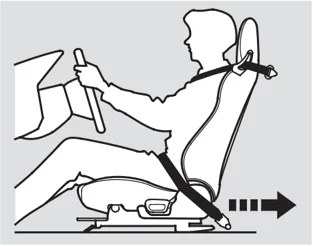
 Adjust the driver’s seat as far to the rear as possible while allowing you to maintain full control of the vehicle. Have a passenger adjust his or her seat as far to the rear as possible.
If you sit too close to the steering wheel or dashboard, you can be seriously injured by an inflating front airbag, or by striking the steering wheel or dashboard.
10
Main Menu Table of Contents
Protecting Adults and Teens
The National Highway Traffic Safety Administration and Transport Canada recommend that drivers allow at least 10 inches (25 cm) between the center of the steering wheel and the chest.
If you cannot get far enough away from the steering wheel and still reach the controls, we recommend that you investigate whether some type of adaptive equipment may help.
Once your seat is adjusted correctly, rock it back and forth to make sure the seat is locked in position.
See page 67 for how to adjust the seats.
⚠ WARNING
Sitting too close to a front airbag can result in serious injury or death if the front airbags inflate.
Always sit as far back from the front airbags as possible.
3. Adjust the Seat-Backs
Driver and Passenger Safety
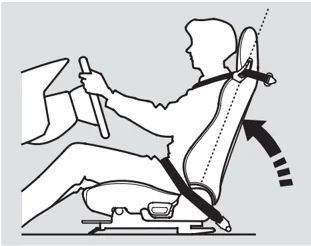
Adjust the driver’s seat-back to a comfortable, upright position, leaving ample space between your chest and the airbag cover in the center of the steering wheel.
A passenger should also adjust their seat-back to a comfortable, upright position.
CONTINUED
11
Protecting Adults and Teens
Reclining a seat-back so that the shoulder part of the belt no longer rests against the occupant’s chest reduces the protective capability of the belt. It also increases the chance of sliding under the belt in a crash and being seriously injured. The farther a seat-back is reclined, the greater the risk of injury.
See page 67 for how to adjust the seat-backs.
WARNING Reclining the seat-back too far can result in serious injury or death in a crash.
Adjust the seat-back to an upright position, and sit well back in the seat.
4. Fasten and Position the Seat Belts Insert the latch plate into the buckle, then tug on the belt to make sure the belt is securely latched. Check that the belt is not twisted, because a twisted belt can cause serious injuries in a crash.
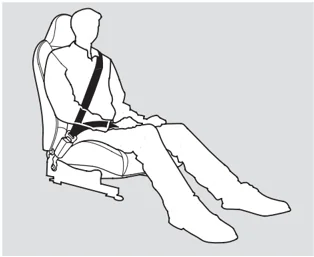
Position the lap part of the belt as low as possible across your hips, then pull up on the shoulder part of the belt so the lap part fits snugly. This lets your strong pelvic bones take the force of a crash and reduces the chance of internal injuries.
12
Protecting Adults and Teens
If necessary, pull up on the belt again to remove any slack, then check that the belt rests across the center of your chest and over your shoulder. This spreads the forces of a crash over the strongest bones in your upper body.
⚠ WARNING Improperly positioning the seat belts can cause serious injury or death in a crash.
Make sure all seat belts are properly positioned before driving.
Never place the shoulder portion of a lap/shoulder belt under your arm or behind your back. This could cause very serious injuries in a crash.
If a seat belt does not seem to work properly, it may not protect the occupant in a crash.
No one should sit in a seat with an inoperative seat belt. Using a seat belt that is not working properly can result in serious injury or death. Have your dealer check the belt as soon as possible.
See page 18 for additional information about your seat belts and how to take care of them.
5.Maintain a Proper Sitting Position
After occupants have adjusted their seats and put on seat belts, it is very important that they continue to sit upright, well back in their seats, with their feet on the floor, until the vehicle is parked and the engine is off.
Sitting improperly can increase the chance of injury during a crash. For example, if an occupant slouches, lies down, turns sideways, sits forward, leans forward or sideways, or puts one or both feet up, the chance of injury during a crash is greatly increased.
Driver and Passenger Safety
CONTINUED
13
Protecting Adults and Teens
In addition, an occupant who is out of position can be seriously or fatally injured in a crash by striking interior parts of the vehicle or being struck by an inflating front airbag.
WARNING
Sitting improperly or out of position can result in serious injury or death in a crash.
Always sit upright, well back in the seat, with your feet on the floor.
Advice for Pregnant Women
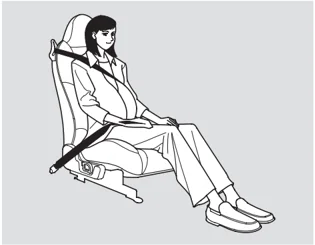
If you are pregnant, the best way to protect yourself and your unborn child when driving or riding in a vehicle is to always wear a seat belt, and keep the lap part of the belt as low as possible across the hips.
When driving, remember to sit upright and adjust the seat as far back as possible while allowing full control of the vehicle. When riding as a passenger, adjust the seat as far back as possible.
This will reduce the risk of injuries to both you and your unborn child that can be caused by a crash or an inflating front airbag.
Each time you have a checkup, ask your doctor if it’s okay for you to drive.
Protecting Adults and Teens
Additional Safety Precautions
- Two people should never use the same seat belt. If they do, they could be very seriously injured in a crash.
- Do not put any accessories on seat belts. Devices intended to improve occupant comfort or reposition the shoulder part of a seat belt can reduce the protective capability of the belt and increase the chance of serious injury in a crash.
- Do not place hard or sharp objects between yourself and a front airbag. Carrying hard or sharp objects on your lap, or driving with a pipe or other sharp object in your mouth, can result in injuries if your front airbag inflates.
- Do not attach or place objects on the airbag covers. Objects on the covers marked SRS AIRBAG could interfere with the proper operation of the airbags or be propelled inside the vehicle and hurt someone if the airbags inflate.
- Keep your hands and arms away from the airbag covers. If your hands or arms are close to an airbag cover, they could be injured if the airbag inflates.
Driver and Passenger Safety
15