Main Menu Table of Contents
Installing a Child Seat
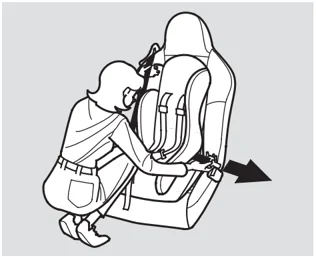
In this vehicle, a forward-facing child seat must be secured to the vehicle with the lap part of the lap/shoulder belt. In addition, the lockable retractor must be activated to secure a child seat.
- Move the vehicle seat to the rear-most position. Moving the seat as far back as possible reduces the chance of a child being injured or killed if the passenger’s airbag inflates.
-
With the child seat in position, route the belt through the child seat according to the seat maker’s instructions, then insert the latch plate into the buckle.
-
To activate the lockable retractor, slowly pull the shoulder part of the belt all the way out until it stops, then let the belt feed back into the retractor.
-
After the belt has retracted, tug on it. If the belt is locked, you will not be able to pull it out. If you can pull the belt out, it is not locked and you will need to repeat these steps.
Driver and Passenger Safety
35
Installing a Child Seat
 5. After confirming that the belt is locked, grab the shoulder part of the belt near the buckle, and pull up to remove any slack from the lap part of the belt. Remember, if the lap part of the belt is not tight, the child seat will not be secure.
To remove slack, it may help to put weight on the child seat, or push on the back of the seat while pulling up on the belt.
 6. Push and pull the child seat forward and from side-to-side to verify that it is secure enough to stay upright during normal driving maneuvers. If the child seat is not secure, unlatch the belt, allow it to retract fully, then repeat these steps.
To deactivate the lockable retractor and remove a child seat, unlatch the buckle, unroute the seat belt, and let the belt fully retract.
36
Protecting Larger Children
When a child reaches the recommended weight or height limit for a forward-facing child seat, the child should sit on a booster seat and wear a lap/shoulder belt.
Since this vehicle does not have a back seat, we recommend that you do not carry a larger child, age 12 or under, as a passenger.
However, the following pages provide guidelines to help you decide when a given child may ride in this vehicle, and how to properly protect the child.
⚠ WARNING Allowing a larger child age 12 or under to ride in the vehicle can result in injury or death if the passenger’s airbag inflates.
If a larger child must ride in the vehicle, adjust the vehicle seat as far back as possible, use a booster seat if needed, and have the child sit up properly and wear the seat belt properly.
Checking Seat Belt Fit
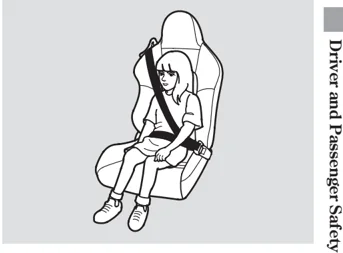
To determine if a lap/shoulder belt properly fits a child, have the child put on the seat belt, then ask yourself:
- Does the child sit all the way back against the seat?
- Do the child’s knees bend comfortably over the edge of the seat?
37
Protecting Larger Children
- Does the shoulder belt cross between the child’s neck and arm?
- Is the lap part of the belt as low as possible, touching the child’s thighs?
- Will the child be able to stay seated like this for the whole trip?
If you answer yes to all these questions, the child is ready to wear the lap/shoulder belt correctly. If you answer no to any question, the child needs to ride on a booster seat.
Using a Booster Seat
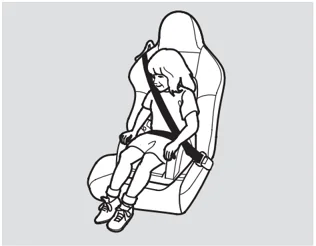
A child who has outgrown a forward-facing child seat should use a booster seat until the lap/shoulder belt fits them properly without the booster.
Some states and Canadian provinces also require children to use a booster seat until they reach a given age or weight (e.g., 6 years or 60 lbs). Be sure to check current laws in the states or provinces where you intend to drive.
Booster seats can be high-back or low-back. Whichever style you select, make sure the booster meets federal safety standards and that you follow the booster seat maker’s instructions.
If a child who uses a booster seat rides in this vehicle, move the vehicle seat as far to the rear as possible, and be sure the child is wearing the seat belt properly.
A child may continue using a booster seat until the tops of their ears are even with the top of the vehicle’s or booster’s seat-back. A child of this height should be tall enough to use the lap/shoulder belt without a booster seat.
38
Main Menu Table of Contents
Protecting Larger Children
When Can a Larger Child Ride in This Vehicle
The National Highway Traffic Safety Administration and Transport Canada recommend that all children age 12 and under be properly restrained in a back seat.
If the passenger’s airbag inflates in a moderate to severe frontal collision, the airbag can cause serious injuries to a child who is unrestrained, improperly restrained, sitting too close to the airbag, or out of position.
Of course, children vary widely. And while age may be one indicator of when a child can safely ride in this vehicle. There are other important factors you should consider.
Physical Size
Physically, a child must be large enough for the lap/shoulder belt to properly fit (see page 37). If the seat belt does not fit properly, with or without the child sitting on a booster, the child should not sit in this vehicle.
Maturity
To safely ride in this vehicle, a child must be able to follow the rules, including sitting properly, and wearing the seat belt properly throughout ride.
If you decide that a child can safely ride in this vehicle, be sure to:
- Carefully read the owner’s manual, and make sure you understand all seat belt instructions and all safety information.
- Move the vehicle seat to the rear-most position.
- Have the child sit up straight, back against the seat, and feet on or near the floor.
- Check that the child’s seat belt is properly and securely positioned.
- Supervise the child. Even mature children sometimes need to be reminded to fasten the seat belts or sit properly.
Driver and Passenger Safety
39
Protecting Larger Children
Additional Safety Precautions
- Do not let a child wear a seat belt across the neck. This could result in serious neck injuries during a crash.
- Do not let a child put the shoulder part of a seat belt behind the back or under the arm. This could cause very serious injuries during a crash. It also increases the chance that the child will slide under the belt in a crash and be injured.
- Two children should never use the same seat belt. If they do, they could be very seriously injured in a crash.
- Do not put any accessories on a seat belt. Devices intended to improve a child’s comfort or reposition the shoulder part of a seat belt can make the belt less effective and increase the chance of serious injury in a crash.
40
Main Menu Table of Contents
Carbon Monoxide Hazard
Your vehicle’s exhaust contains carbon monoxide gas. Carbon monoxide should not enter the vehicle in normal driving if you maintain your vehicle properly and follow the information on this page.
Have the exhaust system inspected for leaks whenever:
• The vehicle is raised for an oil change.
• You notice a change in the sound of the exhaust.
• The vehicle was in an accident that may have damaged the underside.
⚠WARNING
Carbon monoxide gas is toxic. Breathing it can cause unconsciousness and even kill you.
Avoid any enclosed areas or activities that expose you to carbon monoxide.
High levels of carbon monoxide can collect rapidly in enclosed areas, such as a garage. Do not run the engine with the garage door closed. Even with the door open, run the engine only long enough to move the vehicle out of the garage.
With the trunk open, airflow can pull exhaust gas into your vehicle’s interior and create a hazardous condition. If you must drive with the trunk open, open all the windows, and set the heating and cooling system as shown below.
If you must sit in your parked vehicle with the engine running, even in an unconfined area, adjust the heating and cooling system as follows:
- Select the fresh air mode.
- Select the [icon] mode.
- Set the fan speed to high.
- Set the temperature control to a comfortable setting.
Driver and Passenger Safety
41
Safety Labels
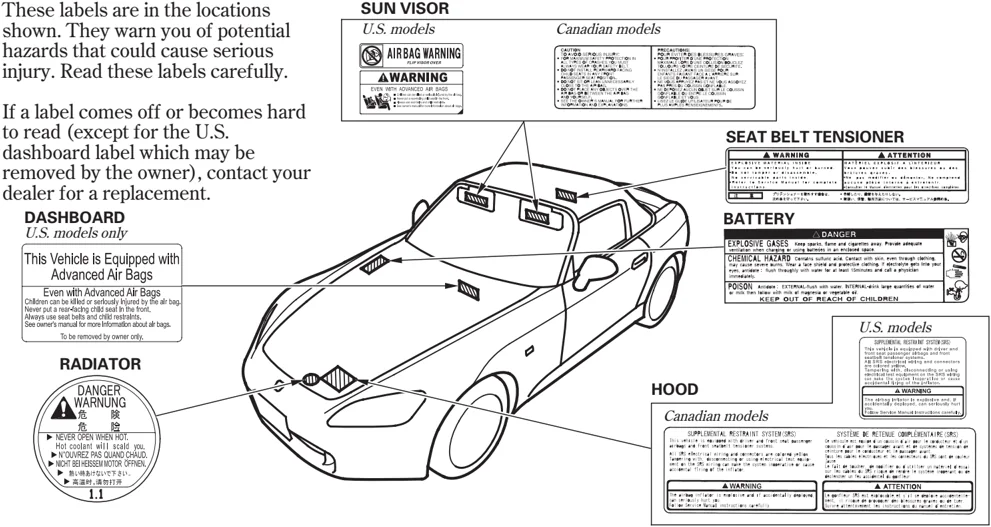
These labels are in the locations shown. They warn you of potential hazards that could cause serious injury. Read these labels carefully.
If a label comes off or becomes hard to read (except for the U.S. dashboard label which may be removed by the owner), contact your dealer for a replacement.
DASHBOARD U.S. models only
This Vehicle is Equipped with Advanced Air Bags
Even with Advanced Air Bags Children can be killed or seriously injured by the air bag. Never put a rear-facing child seat in the front. Always use seat belts and child restraints. See owner's manual for more information about air bags. To be removed by owner only.
RADIATOR
DANGER WARNUNG 危 険 危 险
► NEVER OPEN WHEN HOT. Hot coolant will scald you. ► N'OUVREZ PAS QUAND CHAUD. ► NICHT BEI HEISSEM MOTOR OFFNEN. ► 熱い時あけないで下さい。高温時,请勿打开
1.1
SUN VISOR U.S. models Canadian models
AIRBAG WARNING AUPORTERSON ATTENTION
▲WARNING EVEN WITH ADVANCED AIR BAGS
CAUTION PRECAUTIONS:
SEAT BELT TENSIONER
▲ 安全気注意 ▲ ATTENTION
BATTERY
▲ DANGER
EXPLOSIVE GASES Keep sparks, flame and cigarette away. Provide adequate ventilation when charging as using batteries in an enclosed space.
CHEMICAL HAZARD Contains sulfuric acid. Contact skin, even through clothing, may cause severe burns. Wear a face shield and protective clothing. If electrolyte gets into your eyes, antiseize : flush thoroughly with water for at least 15minutes and call a physician immediately.
POISON Accidental : EXTERNAL-fush with water. INTERNAL-drink large quantities of water or milk than follow with milk of magnesia or vegetable oil.
KEEP OUT OF REACH OF CHILDREN
HOOD
U.S. models
SUPPLEMENTAL RESTRAINT SYSTEM(SRS) This vehicle is equipped with driver and front passenger airbags and front passenger seatbelt tensioner systems. All SRS electrical wiring and connectors are colored yellow. Tampering with, disassembling or using electrical test equipment on the SRS wiring can make the system inoperative or cause accidental firing of the inflator.
▲ WARNING This airbag inflator is explosive and, if accidentally discharged, can seriously hurt you. Follow Service Manual instructions carefully.
Canadian models
SUPPLEMENTAL RESTRAINT SYSTEM (SRS) This vehicle is equipped with its driver and front seat passenger airbags and front passenger seat-belt system. All SRS electrical wiring and connectors are colored yellow. Tampering with, disassembling or using electrical test equipment on the SRS wiring can make this system inoperative or cause accidental firing of the inflator.
SYSTÈME DE RETENUE COMPLÉMENTAIRE (SRS) Ce véhicule est équipé d'un coussin d'air pour le conducteur et d'un coussin d'air pour le passavant ainsi que de systèmes de tension de ceinture pour le conducteur et le passavant avant. Tout fil électrique du système SRS sont de couleur jaune. Le fait de toucher, de modifier ou de faire l'essai d'un matériel à essai sur les câbles du SRS risque de rendre le système inopérant ou de déclencher un des accidentel du gonfleur.
▲ WARNING This airbag inflator is explosive and, if accidentally discharged, can seriously hurt you. Follow Service Manual instructions carefully.
▲ ATTENTION Le gonfleur SRS est explosif et, s'il se déclenche accidentellement, il risque de provoquer des blessures graves ou la mort. Suivre attentivement les instructions du manuel d'entretien.
42
Main Menu
Instruments and Controls
This section gives information about the controls and displays that contribute to the daily operation of your vehicle. All the essential controls are within easy reach.
- Control Locations ........ 44
- Instrument Panel ........ 45
- Instrument Panel Indicators ........ 46
- Gauges ........ 51
- Odometer ........ 51
- Trip meter ........ 51
- Select Button ........ 51
- Fuel Gauge ........ 52
- Check Fuel Cap Message ........ 52
- Temperature Gauge ........ 53 Outside Temperature
- Indicator ........ 53
- Maintenance Minder ........ 54
- Clock ........ 54 Controls Near the Steering
- Wheel ........ 55 Windshield Wipers and
- Washers ........ 56
- Turn Signal and Headlights ........ 57
- Instrument Panel Brightness ........ 58
- Hazard Warning Button ........ 58
- Rear Window Defogger ........ 59
- Keys and Locks ........ 60
- Immobilizer System ........ 61
- Ignition Switch ........ 62
- Power Door Locks ........ 63
- Trunk ........ 63
- Emergency Trunk Opener ........ 64
- Remote Transmitter ........ 65
- Seats ........ 67
- Power Windows ........ 68
- Convertible Top ........ 70
- Mirrors ........ 75
- Parking Brake ........ 76
- Interior Convenience Items ........ 77
- Beverage Holder ........ 78
- Accessory Power Socket ........ 78
- Console Compartments ........ 79
- Audio Panel ........ 79
- Dashboard Lower Pocket ........ 80
- Interior Light ........ 80
43
Control Locations
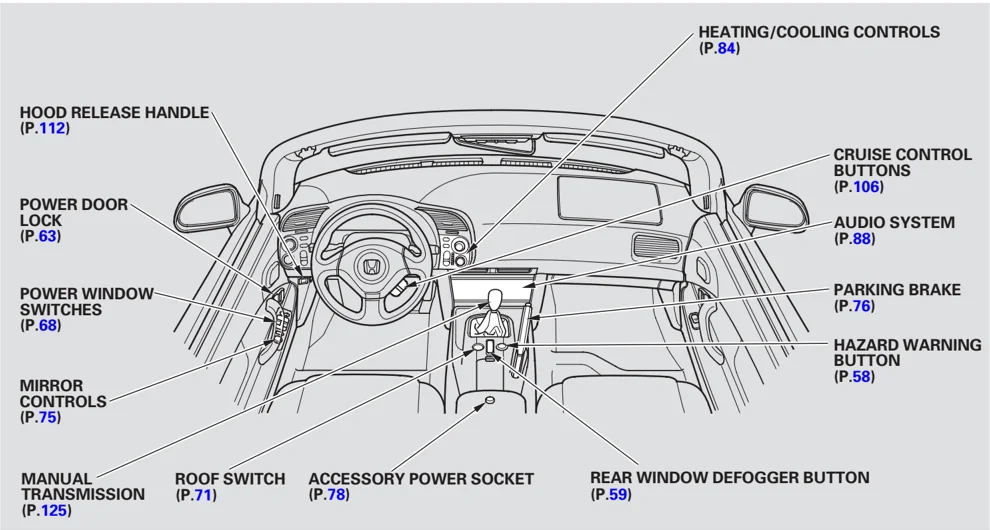
HOOD RELEASE HANDLE (P.112)
HEATING/COOLING CONTROLS (P.84)
POWER DOOR LOCK (P.63)
CRUISE CONTROL BUTTONS (P.106)
AUDIO SYSTEM (P.88)
POWER WINDOW SWITCHES (P.68)
PARKING BRAKE (P.76)
HAZARD WARNING BUTTON (P.58)
MIRROR CONTROLS (P.75)
MANUAL TRANSMISSION (P.125)
ROOF SWITCH (P.71)
ACCESSORY POWER SOCKET (P.78)
REAR WINDOW DEFOGGER BUTTON (P.59)
44
Instrument Panel
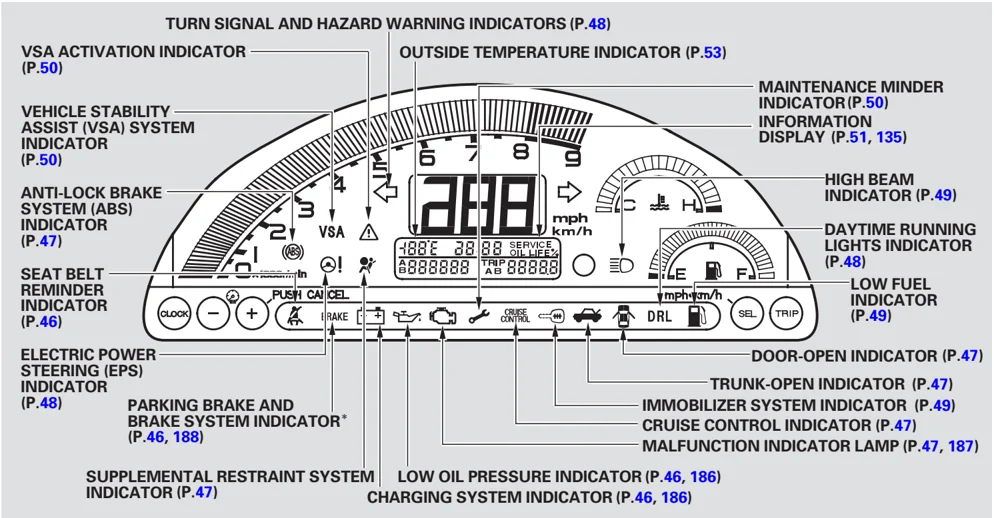
- The U.S. instrument panel is shown. Differences for Canadian models are noted in the text.
45
Instrument Panel Indicators
The instrument panel has many indicators to give you important information about your vehicle.
Seat Belt Reminder Indicator
This indicator comes on when you turn the ignition switch to the ON (II) position. It reminds you and your passenger to fasten your seat belts. A beeper also sounds if you and your passenger have not fastened your seat belts.
If you turn the ignition switch to the ON (II) position before fastening your seat belts, the beeper sounds, and the indicator flashes. If you do not fasten your seat belts before the beeper stops, the indicator stops flashing but remains on.
If your passenger does not fasten their seat belt, the indicator comes on about 6 seconds after the ignition switch is turned to the ON (II) position.
If either of you do not fasten your seat belt while driving, the beeper will sound and the indicator will flash again at regular intervals. For more information, see page 16.
Low Oil Pressure Indicator
 The engine can be severely damaged if this indicator flashes or stays on when the engine is running. For more information, see page 186.
Charging System Indicator
 If this indicator comes on when the engine is running, the battery is not being charged. For more information, see page 186.
U.S. Canada
Parking Brake and Brake System Indicator
 This indicator has two functions:
-
It comes on when you turn the ignition switch to the ON (II) position. It is a reminder to check the parking brake. A beeper sounds if you drive with the parking brake not fully released. Driving with the parking brake not fully released can damage the brakes and tires.
-
If it stays on after you have fully released the parking brake while the engine is running, or if it comes on while driving, there could be a problem with the brake system. For more information, see page 188.
46
Instrument Panel Indicators
Supplemental Restraint System Indicator This indicator comes on briefly when you turn the ignition switch to the ON (II) position. If it comes on at any other time, it indicates a potential problem with your airbags. This indicator will also alert you to a potential problem with your automatic seat belt tensioners, driver’s seat position sensor, or the passenger’s seat weight sensors. For more information, see page 25.
Anti-lock Brake System (ABS) Indicator This indicator normally comes on for a few seconds when you turn the ignition switch to the ON (II) position, and when you push the START button. If it comes on at any other time, there is a problem with the ABS. If this happens, have your vehicle checked at a dealer. With this indicator on, your vehicle still has normal braking ability but no anti-lock function. For more information, see page 128.
Malfunction Indicator Lamp See page 187.
Trunk-open Indicator This indicator comes on if the trunk lid is not closed tightly.
Door-open Indicator This indicator comes on if either door is not closed tightly.
Cruise Control Indicator This indicator comes on when you set the cruise control. See page 106 for information on operating the cruise control.
47
Instruments and Controls
Instrument Panel Indicators
Electric Power Steering (EPS) Indicator This indicator normally comes on when you turn the ignition to the ON (II) position and goes off after the engine starts. If it comes on at any other time, there is a problem in the electric power steering system. If this happens, stop the vehicle in a safe place and turn off the engine. Reset the system by restarting the engine. The indicator will not turn off immediately. If it does not go off after driving a short distance, or comes on again while driving, take the vehicle to your dealer to have it checked. With the indicator on, the EPS may be turned off, making the vehicle harder to steer.
If the power steering system overheats while driving, the assist is reduced and steering may feel slightly harder.
Driving with the power steering system continuously overheating can cause system damage.
Turn Signal and Hazard Warning Indicators The left or right turn signal indicator blinks when you signal a lane change or turn. If the indicator does not blink or blinks rapidly, it usually means one of the turn signal bulbs is burned out (see page 157). Replace the bulb as soon as possible, since other drivers cannot see that you are signaling.
When you press the hazard warning button, both turn signal indicators blink. All turn signals on the outside of the vehicle should flash.
“Daytime Running Lights” Indicator If this indicator comes on when the ignition switch is turned to the ON (II) position and the parking brake is released, it means there is a problem in the high beam headlight’s circuit. Have your vehicle checked by your dealer.
48
Instrument Panel Indicators
High Beam Indicator This indicator comes on with the high beam headlights. For more information, see page 57.
When the daytime running lights (DRL) are on, this indicator comes on with reduced brightness.
Immobilizer System Indicator This indicator comes on for a few seconds when you turn the ignition switch to the ON (II) position. It will then go off if you have inserted a properly-coded ignition key. If it is not a properly-coded key, the indicator will blink, and the engine will not start (see page 61).
This indicator also blinks several times when you turn the ignition switch from the ON (II) position to the ACCESSORY (I) or LOCK (0) position.
Low Fuel Indicator This indicator comes on as a reminder that you must refuel soon.
When the indicator comes on, there is about 2.22 US gal (8.4 l) of fuel remaining in the tank before the reading reaches E. There is a small reserve of fuel remaining in the tank when the reading does reach E.
Instruments and Controls
49
Instrument Panel Indicators
VSA Vehicle Stability Assist (VSA) System Indicator This indicator normally comes on for a few seconds when you turn the ignition switch to the ON (II) position.
If it comes on and stays on at any other time, or if it does not come on when you turn the ignition switch to the ON (II) position, there is a problem with the VSA system. Take your vehicle to a dealer to have it checked. Without VSA, your vehicle still has normal driving ability, but will not have VSA traction and stability enhancement. See page 128 for more information on the VSA system.
VSA Activation Indicator This indicator has three functions:
- It comes on as a reminder that you have turned off the vehicle stability assist (VSA) system.
- It flashes when VSA is active (see page 130).
- It comes on along with the VSA system indicator if there is a problem with the VSA system.
This indicator normally comes on for a few seconds when you turn the ignition switch to the ON (II) position. For more information, see page 130.
Maintenance Minder Indicator This indicator reminds you that it is time to take your vehicle in for scheduled maintenance. The maintenance main items and sub items will be displayed in the information display. See page 135 for more information on the maintenance minder.
This indicator goes off when your dealer resets it after completing the required maintenance service.
50