Additional Information About Your Seat Belts
Seat Belt System Components Your seat belt system includes lap/shoulder belts in both seating positions. The seat belts are also equipped with automatic seat belt tensioners.
This system uses the same sensors as the front airbags to monitor whether the seat belts are latched or unlatched, and how much weight is on the passenger’s seat (see page 24 ).
The seat belt system includes an indicator on the instrument panel and a beeper to remind you and your passenger to fasten your seat belts.
This system monitors the seat belts. If you turn the ignition switch to the ON (II) position before your seat belt is fastened, the beeper will sound and the indicator will flash. If your seat belt is not fastened before the beeper stops, the indicator will stop flashing but remain on.
If a passenger does not fasten their seat belt, the indicator will come on about 6 seconds after the ignition switch is turned to the ON (II) position.
If either the driver or passenger does not fasten their seat belt, the beeper will sound and the indicator will flash again at regular intervals.
When no one is sitting in the passenger’s seat, or a child or small adult is riding there, the indicator should not come on and the beeper should not sound.
If the indicator comes on or the beeper sounds when the driver’s seat belt is latched and there is no passenger and no items on the passenger’s seat, something may be interfering with the monitoring system. Look for and remove:
• Any items under the passenger’s seat. • Any objects hanging on the seat. • Any object touching the rear of the seat-back.
If no obstructions are found, have your vehicle checked by a dealer.
16
Additional Information About Your Seat Belts
Lap/Shoulder Belt The lap and shoulder belt goes over your shoulder, across your chest, and across your hips.
To fasten the belt, insert the latch plate into the buckle, then tug on the belt to make sure the buckle is latched (see page 12 for how to properly position the belt).
To unlock the belt, press the red PRESS button on the buckle. Guide the belt across your body so that it retracts completely. After exiting the vehicle, be sure the belt is out of the way and will not get closed in the door.
Both seat belts have an emergency retractor. In normal driving, the retractor lets you move freely in your seat while it keeps some tension on the belt. During a collision or sudden stop, the retractor automatically locks the belt to help restrain your body.
The passenger’s seat belt has a lockable retractor that must be activated to secure a forward-facing child seat (see page 34 ).
If the shoulder part of the belt is pulled all the way out, the lockable retractor will activate. The belt will retract, but it will not allow the passenger to move freely.
To deactivate the lockable retractor, unlatch the buckle and let the seat belt fully retract. To refasten the seat belt, pull it out only as far as needed.
Driver and Passenger Safety
17
Additional Information About Your Seat Belts
Automatic Seat Belt Tensioners
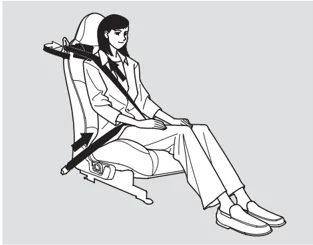
For added protection, the seat belts are equipped with automatic seat belt tensioners. When activated, the tensioners immediately tighten the belts to help hold the driver and a passenger in place.
The tensioners are designed to activate primarily in frontal collisions, and they should activate in any collision severe enough to cause airbag inflation.
However, the tensioners can be activated during a collision in which the airbags do not deploy. In this case, the airbags would not be needed, but the additional restraint could be helpful.
When the tensioners are activated, the seat belts will remain tight until they are unbuckled.
Seat Belt Maintenance
For safety, you should check the condition of your seat belts regularly.
Pull each belt out fully and look for frays, cuts, burns, and wear. Check that the latches work smoothly and the belts retract easily. If a belt does not retract easily, cleaning it may correct the problem (see page 160). Any belt that is not in good condition or not working properly will not provide good protection and should be replaced as soon as possible.
Honda provides a limited warranty on seat belts. See your Honda Warranty Information booklet for details.
If a seat belt is worn during a crash, it must be replaced by your dealer. A belt that has been worn during a crash may not provide the same level of protection in a subsequent crash.
18
Main Menu Table of Contents
Additional Information About Your Seat Belts
The dealer should also inspect the anchors for damage and replace them if needed. If the automatic seat belt tensioners activate during a crash, they must be replaced.
WARNING
Not checking or maintaining seat belts can result in serious injury or death if the seat belts do not work properly when needed.
Check your seat belts regularly and have any problem corrected as soon as possible.
Driver and Passenger Safety
19
Additional Information About Your Airbags
Airbag System Components
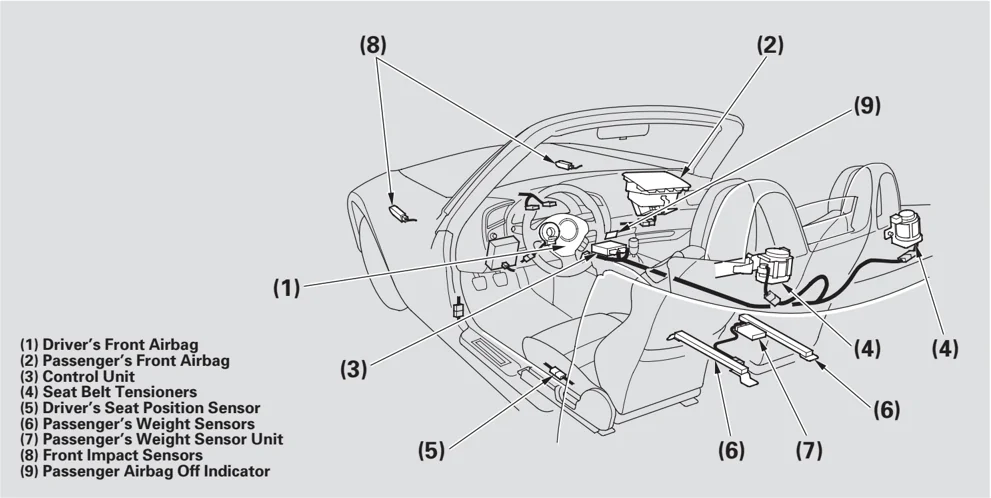
(1) Driver's Front Airbag (2) Passenger's Front Airbag (3) Control Unit (4) Seat Belt Tensioners (5) Driver's Seat Position Sensor (6) Passenger's Weight Sensors (7) Passenger's Weight Sensor Unit (8) Front Impact Sensors (9) Passenger Airbag Off Indicator
20
Additional Information About Your Airbags
Your airbag system includes:
- Two SRS (supplemental restraint system) airbags. The driver’s airbag is stored in the center of the steering wheel; the passenger’s airbag is stored in the dashboard. Both are marked “SRS AIRBAG.”
- Automatic seat belt tensioners (see page 18).
- Sensors that can detect a moderate to severe front impact.
- Sensors that can detect whether the driver’s seat belt and the passenger’s seat belt are latched or unlatched (see page 16).
- A driver’s seat position sensor that monitors the distance of the seat from the airbag. If the seat is too far forward, the airbag will inflate with less force (see page 24).
- Weight sensors that monitor the weight on the passenger’s seat. If the weight is about 65 lbs (29 kg) or less (the weight of an infant or small child), the passenger’s airbag will be turned off (see page 24).
- A sophisticated electronic system that continually monitors and records information about the sensors, the control unit, the airbag activators, the seat belt tensioners, and driver and passenger seat belt use when the ignition switch is in the ON (II) position.
- An indicator on the instrument panel that alerts you to a possible problem with your airbags, sensors, or seat belt tensioners (see page 25).
- An indicator on the dashboard that alerts you that the passenger’s airbag has been turned off (see page 26).
- Emergency backup power in case your vehicle’s electrical system is disconnected in a crash.
Driver and Passenger Safety
21
Additional Information About Your Airbags
How Your Airbags Work
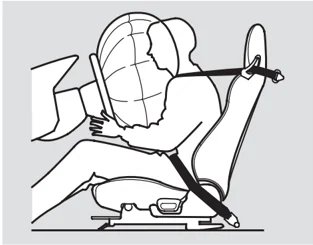
If you ever have a moderate to severe frontal collision, sensors will detect the vehicle’s rapid deceleration.
If the rate of deceleration is high enough, the control unit will instantly inflate the driver’s and passenger’s airbags, at the time and with the force needed.
During a frontal crash, your seat belt restrains your lower body and torso, and the front airbag helps protect your head and chest.
Although both airbags normally inflate within a split second of each other, it is possible for only one airbag to deploy.
This can happen if the severity of a collision is at the margin, or threshold, that determines whether or not the airbags will deploy. In such cases, the seat belt will provide sufficient protection, and the supplemental protection offered by the airbag would be minimal.
Only the driver’s airbag can deploy if there is no passenger in the passenger’s seat, or if the advanced airbag system has turned the passenger’s airbag off (see page 24).
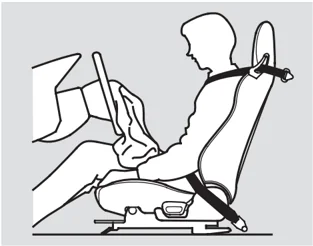
After inflating, the front airbags will immediately deflate, so they won’t interfere with the driver’s visibility, or the ability to steer or operate other controls.
The total time for inflation and deflation is one-tenth of a second, so fast that most occupants are not aware that the airbags deployed until they see them lying in their laps.
22
Additional Information About Your Airbags
After a crash, you may see what looks like smoke. This is actually powder from the airbag’s surface. Although the powder is not harmful, people with respiratory problems may experience some temporary discomfort. If this occurs, get out of the vehicle as soon as it is safe to do so.
Dual-Stage Airbags
Your front airbags are dual-stage airbags. This means they have two inflation stages that can be ignited sequentially or simultaneously, depending on crash severity.
In a more severe crash, both stages will ignite simultaneously to provide the quickest and greatest protection.
In a less severe crash, one stage will ignite first, then the second stage will ignite a split second later. This provides longer airbag inflation time with a little less force.
Dual-Threshold Airbags
Your front airbags are also dual-threshold airbags. Airbags with this feature have two deployment thresholds that depend on whether sensors detect the occupant is wearing a seat belt or not.
If the occupant’s belt is not latched, the airbag will deploy at a slightly lower threshold, because the occupant would need extra protection.
If the occupant’s belt is latched, the airbag will inflate at a slightly higher threshold, when the airbag would be needed to supplement the protection provided by the seat belt.
Driver and Passenger Safety
23
Additional Information About Your Airbags
Advanced Airbags Your airbags are also advanced airbags. The main purpose of this feature is to help prevent airbag-caused injuries to short drivers and children who ride in the passenger’s seat.
For both advanced airbags to work properly:
• Occupants must sit upright and wear their seat belts properly.
• Do not spill any liquids on or under the seats, cover the sensors, or put any objects or metal items under the seats.
Failure to follow these instructions could damage the sensors or prevent them from working properly.
 DRIVER’S SEAT POSITION SENSOR
The driver’s advanced front airbag system includes a seat position sensor under the seat. If the seat is too far forward, the airbag will inflate with less force, regardless of the severity of the impact.
If there is a problem with the sensor, the SRS indicator will come on, and the airbag will inflate in the normal manner regardless of the driver’s seating position.
 PASSENGER’S SEAT WEIGHT SENSOR
The passenger’s advanced airbag system has weight sensors under the seat. Although Honda does not encourage carrying a child in the passenger’s seat, if the sensors detect the weight of an infant or small child (up to about 65 lbs or 29 kg), the system will automatically turn the passenger’s airbag off.
Be aware that objects placed on the passenger’s seat can also cause the airbag to be turned off.
24
Additional Information About Your Airbags
When the airbag is turned off, a “passenger airbag off” indicator in the center of the dashboard comes on (see page 26).
If the weight sensors detect there is no passenger in the seat, the airbag will be off. However, the passenger airbag off indicator will not come on.
To ensure that the passenger’s advanced airbag system will work properly, do not do anything that would increase or decrease the weight on the passenger’s seat, such as hanging heavy objects on the seat.
How the SRS Indicator Works
The SRS indicator alerts you to a potential problem with your airbags or seat belt tensioners.
When you turn the ignition switch to the ON (II) position, this indicator comes on briefly then goes off. This tells you the system is working properly.
If the indicator comes on at any other time, or does not come on at all, you should have the system checked by your dealer. For example:
- If the SRS indicator does not come on after you turn the ignition switch to the ON (II) position.
- If the indicator stays on after the engine starts.
- If the indicator comes on or flashes on and off while you drive.
CONTINUED
25
Driver and Passenger Safety
Additional Information About Your Airbags
If you see any of these indications, the airbags and seat belt tensioners may not work properly when you need them.
WARNING
Ignoring the SRS indicator can result in serious injury or death if the airbag systems or tensioners do not work properly.
Have your vehicle checked by a dealer as soon as possible if the SRS indicator alerts you to a possible problem.
How the Passenger Airbag Off Indicator Works
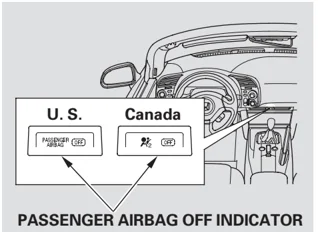
U. S. Canada PASSENGER AIRBAG OFF INDICATOR
This indicator alerts you that the passenger’s airbag has been shut off because weight sensors detect about 65 lbs (29 kg) or less (the weight of an infant or small child) on the passenger’s seat. It does not mean there is a problem with the airbag.
Be aware that objects placed on the passenger’s seat can cause the indicator to come on.
If no weight is detected on the passenger’s seat, the airbag will be automatically shut off. However, the indicator will not come on.
26
Additional Information About Your Airbags
The passenger airbag off indicator may come on and off repeatedly if the total weight on the seat is near the airbag cutoff threshold.
If this happens, adjust the seat as far to the rear as possible and have the passenger sit upright and wear the seat belt properly.
If the indicator comes on with no passenger and no objects on the passenger seat, or with an adult riding there, something may be interfering with the weight sensors. Look for and remove:
• Any items under the passenger’s seat.
• Any objects hanging on the seat.
• Any object touching the rear of the seat-back.
If no obstructions are found, have your vehicle checked by a dealer as soon as possible.
Airbag Service
Your airbag systems are virtually maintenance free, and there are no parts you can safely service. However, you must have your vehicle serviced if:
• An airbag ever inflates. Any airbag that has deployed must be replaced along with the control unit and other related parts. Any seat belt tensioner that activates must also be replaced.
Do not try to remove or replace any airbag by yourself. This must be done by an authorized dealer or a knowledgeable body shop.
27
Driver and Passenger Safety
Main Menu Table of Contents
Additional Information About Your Airbags
- The SRS indicator alerts you to a problem. Take your vehicle to an authorized dealer as soon as possible. If you ignore this indication, your airbags may not operate properly.
- If your vehicle has a moderate to severe impact. Even if your airbags do not inflate, your dealer should inspect the driver’s seat position sensor, the passenger’s weight sensors, the seat belt tensioners, and all seat belts worn during the crash to make sure they are operating properly.
Additional Safety Precautions
-
Do not attempt to deactivate your airbags. Together, airbags and seat belts provide the best protection.
-
Do not tamper with airbag components or wiring for any reason. Tampering could cause the airbags to deploy, possibly causing very serious injury.
-
Do not remove or modify a seat without consulting your dealer. This could make the driver’s seat position sensor or the passenger’s weight sensors ineffective. If it is necessary to remove or modify a seat to accommodate a person with disabilities, first contact Honda Automobile Customer Service at (800) 999-1009.
28
Protecting Children – General Guidelines
Children depend on adults to protect them. However, despite their best intentions, many adults do not know how to properly protect child passengers.
If you ever need to drive with a child in your vehicle, be sure to read this section. It begins with important general guidelines, then presents special information for small children who must ride in a forward-facing child seat, and for larger children.
All Children Must Be Restrained Each year, many children are injured or killed in vehicle crashes because they are either unrestrained or not properly restrained. In fact, vehicle accidents are the number one cause of the death of children ages 12 and under.
To reduce the number of child deaths and injuries, every state and Canadian province requires that children be properly restrained when they ride in a vehicle.
Any child who is too small to wear a seat belt must be restrained in an approved child seat that is properly secured to the vehicle (see pages 33 — 36).
Larger children must be restrained with a lap/shoulder belt and ride on a booster seat until the seat belt fits them properly (see pages 37 — 40).
⚠ WARNING
Children who are unrestrained or improperly restrained can be seriously injured or killed in a crash.
Any child too small for a seat belt should be properly restrained in a child seat. A larger child should be properly restrained with a seat belt and use a booster seat if necessary.
Driver and Passenger Safety
29
Protecting Children – General Guidelines
Your Vehicle is Not Recommended for Child Passengers The National Highway Traffic Safety Administration and Transport Canada recommend that all children age 12 and under be properly restrained in a back seat.
Since this vehicle does not have a back seat, we strongly recommend that you do not carry any child who is not large enough or mature enough to ride in front (see page 37).
The Passenger’s Airbag Can Pose Serious Risks Airbags have been designed to help protect adults in a moderate to severe frontal collision. To do this, the passenger’s airbag is quite large, and it can inflate with enough force to cause very serious injuries.
Even though your vehicle has an advanced airbag system that automatically turns the passenger’s airbag off (see page 24), please follow these guidelines:
Infants Never put a rear-facing child seat in this vehicle. If the airbag inflates, it can hit the back of the child seat with enough force to kill or very seriously injure an infant.
Small Children Placing a forward-facing child seat in the passenger’s seat can be hazardous. If the vehicle seat is too far forward, or the child’s head is thrown forward during a collision, an inflating airbag can strike the child with enough force to kill or very seriously injure a small child.
Larger Children Children who have outgrown child seats are also at risk of being injured or killed by an inflating passenger’s airbag. If a larger child must ride in this vehicle, see page 37 for important guidelines on how to decide when a child is ready to ride in the passenger’s seat and how to properly protect the child.
30
Protecting Children – General Guidelines
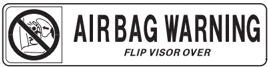
To remind you of the passenger’s airbag hazards, your vehicle has warning labels on the dashboard (U.S. models) and on the driver’s and passenger’s visors. Please read and follow the instructions on these labels.
U.S. Models Sun Visor
Dashboard
This Vehicle is Equipped with Advanced Air Bags
Even with Advanced Air Bags Children can be killed or seriously injured by the air bag. Never put a rear-facing child seat in the front. Always use seat belts and child restraints. See owner's manual for more information about air bags.
To be removed by owner only.
Driver and Passenger Safety
Canadian Models Sun Visor
CAUTION TO AVOID SERIOUS INJURY:
- FOR MAXIMUM SAFETY PROTECTION IN ALL TYPES OF CRASHES, YOU MUST ALWAYS WEAR YOUR SAFETY BELT.
- DO NOT INSTALL REARWARD-FACING CHILD SEATS IN ANY FRONT PASSENGER SEAT POSITION.
- DO NOT SIT OR LEAN UNNECESSARILY CLOSE TO THE AIR BAG.
- DO NOT PLACE ANY OBJECTS OVER THE AIR BAG OR BETWEEN THE AIR BAG AND YOURSELF.
- SEE THE OWNER'S MANUAL FOR FURTHER INFORMATION AND EXPLANATIONS.
PRECAUTIONS: POUR EVITER DES BLESSURES GRAVES:
- POUR PROFITER D'UNE PROTECTION MAXIMALE LORS D'UNE COLLISION BOUCLEZ TOUJOURS VOTRE CEINTURE DE SECURITE.
- N'INSTALLEZ JAMAIS UN SIEGE POUR ENFANTS FAISANT FACE A L'ARRIERE SUR LE SIEGE DU PASSAGER AVANT.
- NE VOUS APPEUYEZ PAS ET NE VOUS ASSOYEZ PAS PRES DU COUSSIN GONFLABLE.
- NE DEPOSEZ AUCUN OBJET SUR LE COUSSIN GONFLABLE OU ENTRE LE COUSSIN GONFLABLE ET VOUS.
- LISEZ LE GUIDE UTILISATEUR POUR DE PLUS AMPLES RENSEIGNEMENTS.
31
Protecting Children – General Guidelines
Additional Safety Precautions
- Never hold a small child on your lap. If you are not wearing a seat belt in a crash, you could be thrown forward and crush the child against the dashboard. If you are wearing a seat belt, the child can be torn from your arms and be seriously hurt or killed.
- Never put a seat belt over yourself and a child. During a crash, the belt could press deep into the child and cause serious or fatal injuries.
- Never let two children use the same seat belt. If they do, they could be very seriously injured in a crash.
- Do not leave children alone in a vehicle. Leaving children without adult supervision is illegal in most states and Canadian provinces, and can be very hazardous.
For example, a small child left in a vehicle on a hot day can die from heatstroke. A child left alone with the key in the ignition switch can accidentally set the vehicle in motion, possibly injuring themselves or others.
- Lock both doors and the trunk when your vehicle is not in use. Children who play in vehicles can accidentally get trapped inside. Teach your children not to play in or around vehicles. Know how to operate the emergency trunk opener and decide if your children should be shown how to use this feature (see page 64).
- **Keep vehicle keys and remote transmitters out of the reach of children
Protecting Small Children
Because an inflating airbag can seriously injure or kill small children, we recommend that you do not carry a small child as a passenger in this vehicle.
If you decide to transport a small child in this vehicle, be sure to move the passenger seat as far to the rear as possible, and follow the instructions and guidelines in the following pages.
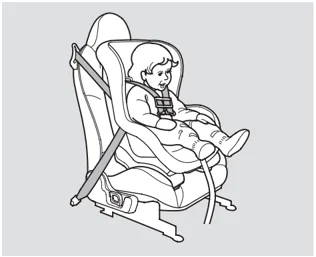
A child who is at least one year old, and who fits within the child seat maker’s weight and height limits, should be restrained in a forward-facing, upright child seat.
Of the different seats available, we recommend those that have a five-point harness system as shown.
We also recommend that a small child use the child seat until the child reaches the weight or height limit for the seat.
⚠ WARNING
Placing a forward-facing child seat in the passenger’s seat can result in serious injury or death if the airbag inflates.
If you must place a forward-facing child seat in the passenger’s seat, move the vehicle seat as far back as possible and properly restrain the child.
Driver and Passenger Safety
33
Selecting a Child Seat, Installing a Child Seat
Selecting a Child Seat
To provide proper protection, a child seat should meet three requirements:
-
The child seat should meet U.S. or Canadian Motor Vehicle Safety Standard 213. Look for FMVSS 213 or CMVSS 213 on the box.
-
The child seat should be of the proper type and size to fit the child.
-
The child seat should fit the passenger's seat.
Before purchasing a child seat, or using a previously purchased one, we recommend that you test the seat to make sure it fits properly in the passenger's seat.
Installing a Child Seat
After selecting a proper child seat, there are three main steps in installing a child seat:
-
Properly secure the child seat to the vehicle. All child seats must be secured to the vehicle with the lap part of a lap/shoulder belt. A child whose seat is not properly secured to the vehicle can be endangered in a crash.
-
Make sure the child seat is firmly secured. After installing a child seat, push and pull the seat forward and from side-to-side to verify that it is secure.
A child seat secured with a seat belt should be installed as firmly as possible. However, it does not need to be "rock solid." Some side-to-side movement can be expected and should not reduce the child seat's effectiveness.
If the child seat is not secure, use a different style of child seat that can be firmly secured.
- Secure the child in the child seat. Make sure the child is properly strapped in the child seat according to the child seat maker's instructions. A child who is not properly secured in a child seat can be seriously injured in a crash.
The following pages provide guidelines on how to properly install a forward-facing child seat.
34