Foreword
Welcome to the growing group of value-conscious people who drive Toyotas. We are proud of the advanced engineering and quality construction of each vehicle we build.
This Owner’s Manual explains the operation of your new Toyota. Please read it thoroughly and have all the occupants follow the instructions carefully. Doing so will help you enjoy many years of safe and trouble-free motoring. For important information about this manual and your Toyota, read the following pages carefully.
When it comes to service, remember that your Toyota dealer knows your vehicle very well and is interested in your complete satisfaction. Your Toyota dealer will provide quality maintenance and any other assistance you may require.
If there is not a Toyota dealer near you, or you need emergency assistance for any reason, please call the following number:
- U.S. OWNERS: Toyota Customer Assistance Center Toll-free: 1-800-331-4331
- CANADIAN OWNERS: Toyota Canada Customer Interaction Centre Toll-free: 1-888-TOYOTA-8 (1-888-869-6828)
Please leave this Owner’s Manual in this vehicle at the time of resale. The next owner will need this information also.
All information and specifications in this manual are current at the time of printing. However, because of Toyota’s policy of continual product improvement, we reserve the right to make changes at any time without notice.
Please note that this manual applies to all models and explains all equipment, including options. Therefore, you may find some explanations for equipment not installed on your vehicle.
TOYOTA MOTOR CORPORATION
© 2004 TOYOTA MOTOR CORPORATION
All rights reserved. This material may not be reproduced or copied, in whole or in part, without the written permission of Toyota Motor Corporation.
i
2005 RAV4 from Sep. ’04 Prod. (OM42570U)
Important information about this manual
Safety and vehicle damage warnings
Throughout this manual, you will see safety and vehicle damage warnings. You must follow these warnings carefully to avoid possible injury or damage.
The types of warnings, what they look like, and how they are used in this manual are explained as follows:
CAUTION
This is a warning against anything which may cause injury to people if the warning is ignored. You are informed about what you must or must not do in order to reduce the risk of injury to yourself and others.
NOTICE
This is a warning against anything which may cause damage to the vehicle or its equipment if the warning is ignored. You are informed about what you must or must not do in order to avoid or reduce the risk of damage to your vehicle and its equipment.
Safety symbol
When you see the safety symbol shown above, it means: "Do not..."; "Do not do this"; or "Do not let this happen".
ii
Important information about your Toyota
Occupant restraint systems
Toyota encourages you and your family to take the time to read Section 1-3 of this Owner’s Manual carefully. In terms of helping you understand how you can receive the maximum benefit of the occupant restraint systems this vehicle provides, Section 1-3 of this Owner’s Manual is the most important Section for you and your family to read.
Section 1-3 describes the function and operation concerning seats, seat belts, SRS airbags and child restraint systems of this vehicle and some potential hazards you should be aware of. These systems work together along with the overall structure of this vehicle in order to provide occupant restraint in the event of a crash. The effect of each system is enhanced when it is used properly and together with other systems. No single occupant restraint system can, by itself, provide you or your family with the equal level of restraint which these systems can provide when used together. That is why it is important for you and your family to understand the purpose and proper use of each of these systems and how they relate to each other.
The purpose of all occupant restraint systems is to help reduce the possibility of death or serious injury in the event of a collision. None of these systems, either individually or together, can ensure that there is no injury in the event of collision. However, the more you know about these systems and how to use them properly, the greater your chances become of surviving an accident without death or serious injury.
Seat belts provide the primary restraint to all occupants of the vehicle, and every occupant of the vehicle should wear seat belts properly at all times. Children should always be secured in child restraint systems that are appropriate for their age and size. SRS (Supplemental Restraint System) airbags are, as their names imply, designed to work with, and be supplemental to, seat belts and are not substitutes for them. SRS airbags can be very effective in reducing the risk of head and chest injuries by preventing contact of the head and chest with interior portions of the vehicle.
iii
In order to be effective, the SRS airbags must deploy with tremendous speed. The rapid deployment of the SRS airbags makes the SRS airbags themselves potential sources of serious injury if an occupant is too close to an airbag, or if an object or some part of his or her body has been placed between the occupant and the airbag at the time of deployment. This is just one example of how the instructions in Section 1-3 of this Owner's Manual will help ensure proper use of the occupant restraint systems, and increase the safety they can provide to you and your family in the event of an accident.
Toyota recommends you to read the provisions in Section 1-3 carefully and refer to them as needed during your time of ownership of this vehicle.
Event data recorder
Your vehicle has computers that monitor and control certain aspects of your vehicle. These computers assist in driving and maintaining optimal vehicle performance. Besides storing data useful for troubleshooting, there is a system to record data in a crash or a near car crash event. This is called an Event Data Recorder (EDR).
The SRS airbag sensor assembly contains the EDR. In a crash or a near car crash event, this device records some or all of the following information:
● Engine speed
● Whether the brake pedal was applied or not
● Vehicle speed
● To what extent the accelerator pedal was depressed
● Position of the transmission selector lever
● Whether the driver and front passenger wore the seat belts or not
● Driver's seat position
● Front passenger's occupant classification
● SRS airbag deployment data
iv
- SRS airbag system diagnostic data The information above is intended to be used for the purpose of improving vehicle safety performance. Unlike general data recorders, the EDR does not record sound data such as conversation between passengers. Toyota will not disclose the data recorded in an EDR to a third party except when:
- An agreement from the vehicle's owner (or the leasing company for a leased vehicle) is obtained
- Officially requested by the police or other authorities
- Used as a defense for Toyota in a law suit
- Ordered by the court However, if necessary Toyota will:
- Use the data for research on Toyota vehicle safety performance
- Disclose the data to a third party for research purposes without disclosing details of the vehicle owner, and only when it is deemed necessary
- Disclose summarized data cleared of vehicle identification information to a non-Toyota organization for research purposes
New vehicle warranty
Your new vehicle is covered by the following Toyota limited warranties:
- New vehicle warranty
- Emission control systems warranty
- Others For further information, please refer to the "Owner's Warranty Information Booklet" or "Owner's Manual Supplement".
Your responsibility for maintenance
It is the owner's responsibility to make sure that the specified maintenance is performed. Section 6 gives details of these maintenance requirements. Also included in Section 6 is general maintenance. For scheduled maintenance information, please refer to the "Scheduled Maintenance Guide" or "Owner's Manual Supplement".
v
Important health and safety information about your Toyota
CAUTION
- WARNING: Engine exhaust, some of its constituents, and a wide variety of automobile components contain or emit chemicals known to the State of California to cause cancer and birth defects and other reproductive harm. In addition, oils, fuels and fluids contained in vehicles as well as waste produced by component wear contain or emit chemicals known to the State of California to cause cancer and birth defects or other reproductive harm.
- Battery posts, terminals and related accessories contain lead and lead compounds. Wash your hands after handling. Used engine oil contains chemicals that have caused cancer in laboratory animals. Always protect your skin by washing thoroughly with soap and water.
Accessories, spare parts and modification of your Toyota
A wide variety of non-genuine spare parts and accessories for Toyota vehicles are currently available in the market. You should know that Toyota does not warrant these products and is not responsible for their performance, repair, or replacement, or for any damage they may cause to, or adverse effect they may have on, your Toyota vehicle.
This vehicle should not be modified with non-genuine Toyota products. Modification with non-genuine Toyota products could affect its performance, safety or durability, and may even violate governmental regulations. In addition, damage or performance problems resulting from the modification may not be covered under warranty.
vi
Spark ignition system of your Toyota
The spark ignition system in your Toyota meets all requirements of the Canadian Interference-Causing Equipment Standard.
Tires and loading on your Toyota
Underinflated or overinflated tire pressure and the excess load may result in the deterioration of steering ability and braking ability, leading to an accident. Check the tire inflation pressure periodically and be sure to keep the load limits given in this Owner’s Manual. For details about tire inflation pressure and load limits, see pages 291 and 221.
Installation of a mobile two-way radio system
As the installation of a mobile two-way radio system in your vehicle could affect electronic systems such as multiport fuel injection system/sequential multiport fuel injection system, electronic throttle control system, cruise control system, anti-lock brake system, traction control system, vehicle stability control system, SRS airbag system and seat belt pretensioner system, be sure to check with your Toyota dealer for precautionary measures or special instructions regarding installation.
vii
Scrapping of your Toyota
The SRS airbag and seat belt pretensioner devices in your Toyota contain explosive chemicals. If the vehicle is scrapped with the airbags and pretensioners left as they are, this may cause an accident such as fire. Be sure to have the systems of the SRS airbag and seat belt pretensioner removed and disposed of by the qualified service shop or by your Toyota dealer before you dispose of your vehicle.
On- pavement and off- road driving tips
This vehicle belongs to the utility vehicle class. Utility vehicles have a significantly higher rollover rate than other types of vehicles. This vehicle will handle and maneuver differently from an ordinary passenger car because it is designed for off-road use also. In addition, this vehicle has a higher ground clearance and center of gravity than that of an ordinary passenger car. This vehicle design feature causes this type of vehicle to be more likely to rollover. Failure to operate this vehicle correctly may result in loss of control, accidents or vehicle rollover causing death or serious injury. Be sure to read “Off-road vehicle precautions” on page 198 in Section 2 and “Off-road driving precautions” on page 230 in Section 3.
viii
SECTION 1 - 1
OPERATION OF INSTRUMENTS AND CONTROLS
Overview of instruments and controls
- Instrument panel overview . . . . . . . . . . . . . . . . . . . . . . . . . . . . . . . . . . . . . . . . . . . . . . . . . . . . . . . . . . . . . . . . . . . . . . . . . . . . . . . . . . . . . . . . . . . . . . . . . . . . . . . . . . . . . . . . . . . . . . . . . . . . . . . . . . . . . . . . . . . . . . . . . . . . . . . . . . . . . . . . . . . . . . . . . . . . . . . . . . . . ........ 2
- Instrument cluster overview . . . . . . . . . . . . . . . . . . . . . . . . . . . . . . . . . . . . . . . . . . . . . . . . . . . . . . . . . . . . . . . . . . . . . . . . . . . . . . . . . . . . . . . . . . . . . . . . . . . . . . . . . . . . . . ........ 5
- Indicator symbols on the instrument panel . . . . . . . . . . . . . . . . . . . . . . . . . . . . . . . . . . . . . . . . . . . . . . . . . . . . . . . . . . . . . . . . . . . . . . . . . . . . . . . . . . . . . . . . . . . . . . . . . . . . . . . . . . ........

Instrument panel overview
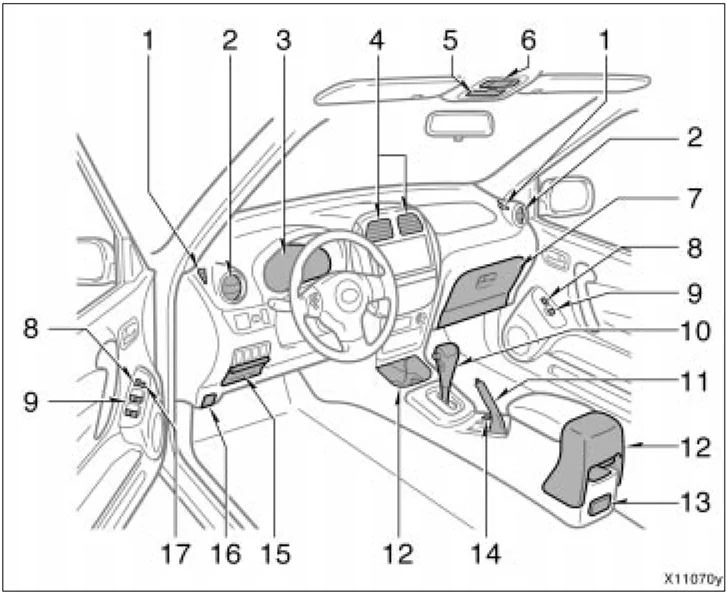
- Side defroster outlets
- Side vents
- Instrument cluster
- Center vents
- Garage door opener, garage door opener box or auxiliary box
- Electric moon roof switch and personal light
- Glove box
- Power door lock switches
- Power window switches
- Automatic transmission selector lever or manual transmission gear shift lever
- Parking brake lever
- Cup holders
- Ashtray
- Power outlet
- Auxiliary box
- Hood lock release lever
- Window lock switch
2
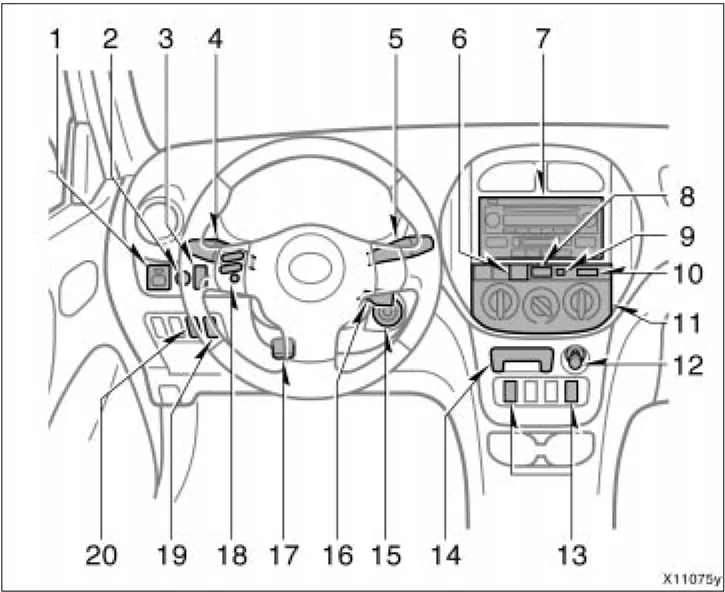
- Power rear view mirror control switches
- Instrument panel light control knob
- Engine immobilizer system indicator light
- Headlight, turn signal and front fog light switches
- Wiper and washer switches
- Rear window and outside rear view mirror defogger switch
- Audio system
- Emergency flasher switch
- Front passenger's seat belt reminder light
- Clock display
- Air conditioning controls
- Cigarette lighter
- Seat heater switches
- Ashtray
- Ignition switch
- Cruise control switch
- Tilt steering lock release lever
- Audio remote control switches
3
- “TRAC OFF” (traction control off) switch
- Tire pressure warning system reset switch
4
Instrument cluster overview
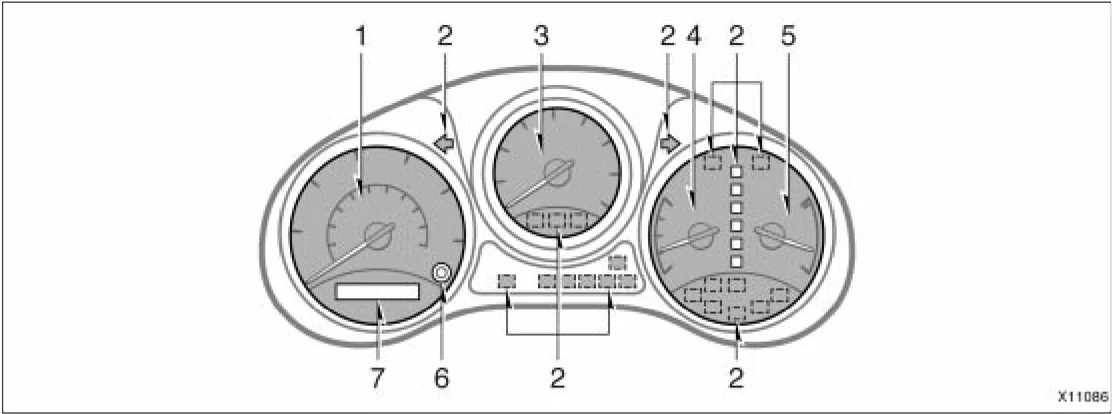
- Speedometer
- Service reminder indicators and indicator lights
- Tachometer
- Fuel gauge
- Engine coolant temperature gauge
- Trip meter reset knob
- Odometer and two trip meters
X11086
5
Indicator symbols on the instrument panel
| BRAKE or (!) | Brake system warning light*1 |
|---|---|
| Driver's seat belt reminder light*1 | |
| PASSENGER | Front passenger's seat belt reminder light*1 |
| Discharge warning light*1 | |
| Low engine oil pressure warning light*1 | |
| CHECK or | Malfunction indicator lamp*1 |
| Low fuel level warning light*1 | |
|---|---|
| ABS or (ABS) | Anti-lock brake system warning light*1 |
| Open door warning light*1 | |
| SRS warning light*1 | |
| A/T OIL TEMP | Automatic transmission fluid temperature warning light*1 |
| VSC TRAC | Vehicle stability control system/traction control system warning light*1 |
| (!) | Low tire pressure warning light*1 |
| Low windshield washer fluid level warning light*1 |
6
| MAINTREQD | Engine oil replacement reminder light*¹ |
| Headlight high beam indicator light | |
| Turn signal indicator lights | |
| P R ND 2 L | Automatic transmission indicator lights |
| O/DOFF | Overdrive- off indicator light |
| Slip indicator light | |
| TRACOFF | Traction control system off indicator light(two- wheel drive models) |
| CRUISE | Cruise control indicator light*² |
*1: For details, see “Service reminder indicators and warning buzzers” on page 109 in Section 1-6. *2: If this light flashes, see “Cruise control” on page 135 in Section 1-7.
7
8