SECTION 5
CORROSION PREVENTION AND APPEARANCE CARE
Corrosion prevention and appearance care
- Protecting your Toyota from corrosion . . . . . . . . . . . . . . . . . . . . . . . . . . . . . . . . . . . . . . . . . . . . . . . . . . . . . . . . . . . . . . . . . . . . . . . . . . . . . . . . . . . . . . . . . . . . . . . . . . . . . . . . . . . . . . . . . . . . . . . . . . . . . . . . . . . . . . . . . . . . . . . . . . . . . . . . . . . . . . . . . . . . . . . . . . . . . . ........ 266
- Washing and waxing your Toyota . . . . . . . . . . . . . . . . . . . . . . . . . . . . . . . . . . . . . . . . . . . . . . . . . . . . . . . . . . . . . . . . . . . . . . . . . . . . . . . . . . . . . . . . . . . . . . . . . . . . . . . . . . . . ........ 267
- Cleaning the interior . . . . . . . . . . . . . . . . . . . . . . . . . . . . . . . . . . . . . . . . . . . . . . . . . . . . . . . . . . . . . . . . . . . . . . . . . . . . . . . . . . . . . . . . . . . . . . . . . . . . . . . . . . . . . . . . ........
'05 Rav4_U (L/O 0409)
Protecting your Toyota from corrosion
Toyota, through the diligent research, design and use of the most advanced technology available, helps prevent corrosion and provides you with the finest quality vehicle construction. Now, it is up to you. Proper care of your Toyota can help ensure long-term corrosion prevention.
The most common causes of corrosion to your vehicle are:
- The accumulation of road salt, dirt and moisture in hard-to-reach areas under the vehicle.
- Chipping of paint, or undercoating caused by minor accidents or by stones and gravel.
Care is especially important if you live in particular areas or operate your vehicle under certain environmental conditions:
- Road salt or dust control chemicals will accelerate corrosion, as will the presence of salt in the air near the sea-coast or in areas of industrial pollution.
- High humidity accelerates corrosion especially when temperatures range just above the freezing point.
- Wetness or dampness to certain parts of your vehicle for an extended period of time, may cause corrosion even though other parts of the vehicle may be dry.
- High ambient temperatures can cause corrosion to those components of the vehicle which do not dry quickly due to lack of proper ventilation.
The above signifies the necessity to keep your vehicle, particularly the underside, as clean as possible and to repair any damage to paint or protective coatings as soon as possible.
To help prevent corrosion on your Toyota, follow these guidelines:
Wash your vehicle frequently. It is, of course, necessary to keep your vehicle clean by regular washing, but to prevent corrosion, the following points should be observed:
- If you drive on salted roads in the winter or if you live near the ocean, you should hose off the undercarriage at least once a month to minimize corrosion.
- High pressure water or steam is effective for cleaning the vehicle's underside and wheel housings. Pay particular attention to these areas as it is difficult to see all the mud and dirt. It will do more harm than good to simply wet the mud and debris without removing. The lower edge of doors, rocker panels and frame members have drain holes which should not be allowed to clog with dirt as trapped water in these areas can cause corrosion.
- Wash the underside of the vehicle thoroughly when winter is over.
See "Washing and waxing your Toyota" on page 267 for more tips.
Check the condition of your vehicle's paint and trim. If you find any chips or scratches in the paint, touch them up immediately to prevent corrosion from starting. If the chips or scratches have gone through the bare metal, have a qualified body shop make the repair.
266
Check the interior of your vehicle. Water and dirt can accumulate under the floor mats and could cause corrosion. Occasionally check under the mats to make sure the area is dry. Be particularly careful when transporting chemicals, cleansers, fertilizers, salt, etc; these should be transported in proper containers. If a spill or leak should occur, immediately clean and dry the area.
Use mud shields on your wheels. If you drive on salted or gravel roads, mud shields help protect your vehicle. Full-size shields, which come as near to the ground as possible, are the best. We recommend that the fittings and the area where the shields are installed be treated to resist corrosion. Your Toyota dealer will be happy to assist in supplying and installing the shields if they are recommended for your area.
Keep your vehicle in a well ventilated garage or a roofed place. Do not park your vehicle in a damp, poorly ventilated garage. If you wash your vehicle in the garage, or if you drive it covered with water or snow, your garage may be so damp as to cause corrosion. Even if your garage is heated, a wet vehicle can corrode if the ventilation is poor.
Washing and waxing your Toyota
Washing your Toyota Keep your vehicle clean by regular washing.
The following cases may cause weakness to the paint or corrosion to the body and parts. Wash your vehicle as soon as possible.
- When driving in a coastal area
- When driving on a road sprinkled with antifreeze
- When exposed to coal tar, tree sap, bird droppings and carcass of an insect
- When driving in areas where there is a lot of smoke, soot, dust, iron dust or chemical substances
- When the vehicle becomes remarkably dirty with dust and mud
Hand-washing your Toyota Work in the shade and wait until the vehicle body is not hot to the touch.
CAUTION When cleaning under floor or chassis, be careful not to injure your hands.
- Rinse off loose dirt with a hose. Remove any mud or road salt from the underside of the vehicle or in the wheel wells.
- Wash with a mild car-wash soap, mixed according to the manufacturer's instructions. Use a soft cotton mitt and keep it wet by dipping it frequently into the wash water. Do not rub hard—let the soap and water remove the dirt.
Plastic wheel ornaments: The plastic wheel ornaments are damaged easily by organic substances. If any organic substances splashes an ornament, be sure to wash it off with water and check if the ornament is damaged.
CAUTION Do not attach the heavily damaged plastic wheel ornament. It may fly off the wheel and cause accidents while the vehicle is moving.
267
Aluminum wheels: Use only a mild soap or neutral detergent. Plastic bumpers: Wash carefully. Do not scrub with abrasive cleaners. The bumper faces are soft. Road tar: Remove with turpentine or cleaners that are marked safe for painted surfaces.
NOTICE Do not use organic substances (gasoline, kerosene, benzine or strong solvents), which may be toxic or cause damage.
- Rinse thoroughly—dried soap can cause streaking. In hot weather you may need to rinse each section right after you wash it.
- To prevent water spots, dry the vehicle using a clean soft cotton towel. Do not rub or press hard—you might scratch the paint.
Automatic car wash Your vehicle may be washed in an automatic car wash, but remember that the paint can be scratched by some types of brushes, unfiltered washing water, or the washing process itself. Scratching reduces paint durability and gloss, especially on darker colors. The manager of the car wash should be able to advise you whether the process is safe for the paint on your vehicle.
NOTICE To prevent damage to the antenna, make sure it is removed before driving your Toyota through an automatic car wash.
Waxing your Toyota Polishing and waxing is recommended to maintain the original beauty of your Toyota's finish. Apply wax once a month or if the vehicle surface does not repel water well.
- Always wash and dry the vehicle before you begin waxing, even if you are using a combined cleaner and wax.
- Use a good quality polish and wax. If the finish has become extremely weathered, use a car-cleaning polish, followed by a separate wax. Carefully follow the manufacturer's instructions and precautions. Be sure to polish and wax the chrome trim as well as the paint.
- Wax the vehicle again when water does not bead but remains on the surface in large patches.
NOTICE Always remove the plastic bumpers if your vehicle is re-painted and placed in a high heat paint waxing booth. High temperatures could damage the bumpers.
268
Cleaning the interior
CAUTION
- Vehicles with side airbags and curtain shield airbags: Be careful not to splash water or spill liquid on the floor. This may prevent the side airbag and curtain shield airbag from activating correctly, resulting in serious injury.
- Do not wash the vehicle floor with water, or allow water to get onto the floor when cleaning the vehicle interior or exterior. Water may get into audio components or other electrical components above or under the floor carpet (or mat) and cause a malfunction; and it may cause body corrosion.
Vinyl interior The vinyl upholstery may be easily cleaned with a mild soap or detergent and water.
First vacuum over the upholstery to remove loose dirt. Then, using a sponge or soft cloth, apply the soap solution to the vinyl. After allowing it to soak in for a few minutes to loosen the dirt, remove the dirt and wipe off the soap with a clean damp cloth. If all the dirt do not come off, repeat the procedure. Commercial foaming-type vinyl cleaners are also available which work well. Follow the manufacturer's instructions.
NOTICE Do not use solvent, thinner, gasoline or window cleaner on the interior.
Carpets Use a good foam-type shampoo to clean the carpets.
Begin by vacuuming thoroughly to remove as much dirt as possible. Several types of foam cleaners are available; some are in aerosol cans and others are powders or liquids which you mix with water to produce a foam. To shampoo the carpets, use a sponge or brush to apply the foam. Rub in overlapping circles.
Do not apply water—the best results are obtained by keeping the carpet as dry as possible. Read the shampoo instructions and follow them closely.
Seat belts The seat belts may be cleaned with mild soap and water or with lukewarm water.
Use a cloth or sponge. As you are cleaning, check the belts for excessive wear, fraying, or cuts.
NOTICE ◆Do not use dye or bleach on the belts—it may weaken them. ◆Do not use the belts until they become dry.
Windows The windows may be cleaned with any household window cleaner.
NOTICE When cleaning the inside of the rear window, be careful not to scratch or damage the heater wires or connectors.
269
Air conditioning control panel, audio panel, instrument panel, console panel, and switches
Use a soft damp cloth for cleaning. Soak a clean soft cloth in water or lukewarm water then lightly wipe off dirt.
NOTICE
◆Do not use organic substances (solvents, kerosene, alcohol, gasoline, etc.) or alkaline or acidic solutions. These chemicals can cause discoloring, staining or peeling of the surface.
◆If you use cleaners or polishing agents, make sure their ingredients do not include the substances mentioned above.
◆If you use a liquid car freshener, do not apply the liquid onto the vehicle's interior surfaces. It may contain the ingredients mentioned above. Immediately clean any spill using the method mentioned above.
Leather Interior
The leather upholstery may be cleaned with neutral detergent for wool.
Remove dirt using a soft cloth dampened with 5% solution of neutral detergent for wool. Then thoroughly wipe off all traces of detergent with a clean damp cloth.
After cleaning or whenever any part of the leather gets wet, dry with a soft clean cloth. Allow the leather to dry in a ventilated shaded area.
NOTICE
◆If a stain should fail to come out with a neutral detergent, apply a cleaner that does not contain an organic solvent.
◆Never use organic substances such as benzine, alcohol or gasoline, or alkaline or acid solutions for cleaning the leather as these could cause discoloring.
◆Use of a nylon brush or synthetic fiber cloth, etc. may scratch the fine grained surface of the leather.
◆Mildew may develop on soiled leather upholstery. Be especially careful to avoid oil spots. Try to keep your upholstery always clean.
◆Long exposure to direct sunlight may cause the leather surface to harden and shrink. Keep your vehicle in a shaded area, especially in the summer.
◆The interior of your vehicle is apt to heat up on hot summer days, so avoid placing on the upholstery items made of vinyl or plastic or containing wax as these tend to stick to leather when warm.
◆Improper cleaning of the leather upholstery could result in discoloration or staining.
If you have any questions about the cleaning of your Toyota, your local Toyota dealer will be pleased to answer them.
270
SECTION 6
VEHICLE MAINTENANCE AND CARE
Vehicle maintenance and care
- Maintenance requirements . . . . . . . . . . . . . . . . . . . . . . . . . . . . . . . . . . . . . . . . . . . . . . . . . . . . . . . . . . . . . . . . . . . . . . . . . . . . . . . . . . . . . . . . . . . . . . . . . . . . . . . . . . . . . . . . . . . . . . . . . . . . . . . . . . . . . . . . . . . . . . . . . . . . . . . . . . . . . . . . . . . . . . . . . . . . . . . . . . . . . . . . . . . . . . . . . ........ 272
- General maintenance . . . . . . . . . . . . . . . . . . . . . . . . . . . . . . . . . . . . . . . . . . . . . . . . . . . . . . . . . . . . . . . . . . . . . . . . . . . . . . . . . . . . . . . . . . . . . . . . . . . . . . . . . . . . . . . . . ........ 273
- Does your vehicle need repairing? . . . . . . . . . . . . . . . . . . . . . . . . . . . . . . . . . . . . . . . . . . . . . . . . . . . . . . . . . . . . . . . . . . . . . . . . . . . . . . . . . . . . . . . . . . . . . . . . . . . . . . . . . . . . ........

Maintenance requirements
Your Toyota vehicle has been designed for fewer maintenance requirements with longer service intervals to save both your time and money. However, each regular maintenance, as well as day-to-day care, is more important than ever before to ensure smooth, trouble-free, safe, and economical drivings.
It is the owner's responsibility to make sure the specified maintenance, including general maintenance service, is performed. Note that both the new vehicle and emission control system warranties specify that proper maintenance and care must be performed. See "Owner's Warranty Information Booklet" or "Owner's Manual Supplement" for complete warranty information.
General maintenance
General maintenance items are those day-to-day care practices that are important to your vehicle for proper operation. It is the owner's responsibility to ensure that the general maintenance items are performed regularly.
These checks or inspections can be done either by yourself or a qualified technician, or if you prefer, your Toyota dealer will be pleased to do them at a nominal cost.
272
Scheduled maintenance
The scheduled maintenance items listed in the "Scheduled Maintenance Guide" or "Owner's Manual Supplement" are those required to be serviced at regular intervals.
For details of your maintenance schedule, read the "Scheduled Maintenance Guide" or "Owner's Manual Supplement".
It is recommended that any replacement parts used for maintenance or for the repair of the emission control system be Toyota supplied.
The owner may elect to use non-Toyota supplied parts for replacement purposes without invalidating the emission control system warranty. However, use of replacement parts which are not of equivalent quality may impair the effectiveness of the emission control systems.
You may also elect to have maintenance, replacement, or repair of the emission control devices and system performed by any automotive repair establishment or individual without invalidating this warranty. See "Owner's Warranty Information Booklet" or "Owner's Manual Supplement" for complete warranty information.
Where to go for service?
Toyota technicians are well-trained specialists and are kept up to date with the latest service information through technical bulletins, service tips, and in-dealership training programs. They learn to work on Toyotas before they work on your vehicle, rather than while they are working on it.
You can be confident that your Toyota dealer's service department performs the best job to meet the maintenance requirements on your vehicle—reliably and economically.
Your copy of the repair order is proof that all required maintenance has been performed for warranty coverage. If any problems should arise with your vehicle while under warranty, your Toyota dealer will promptly take care of it. Again, be sure to keep a copy of the repair order for any service performed on your Toyota.
What about do-it-yourself maintenance?
Many of the maintenance items are easy to do yourself if you have a little mechanical ability and a few basic automotive tools. Simple instructions for how to perform them are presented on page 277 in Section 7.
If you are a skilled do-it-yourself mechanic, the Toyota service manuals are recommended. Please be aware that do-it-yourself maintenance can affect your warranty coverage. See “Owner’s Warranty Information Booklet” or “Owner’s Manual Supplement” for the details.
General maintenance
Listed below are the general maintenance items that should be performed as frequently as specified. In addition to checking the items listed, if you notice any unusual noise, smell or vibration, you should investigate the cause or take your vehicle to your Toyota dealer or a qualified service shop immediately. It is recommended that any problem you notice be brought to the attention of your dealer or the qualified service shop for their advice.
CAUTION Make these checks only with adequate ventilation if you run the engine.
IN THE ENGINE COMPARTMENT Items listed below should be checked from time to time, e.g. each time when refueling.
Washer fluid Make sure there is sufficient fluid in the tank. See page 303 in Section 7-3 for additional information.
Engine coolant level Make sure the coolant level is between the “FULL” and “LOW” lines on the see-through reservoir when the engine is cold. See page 288 in Section 7-2 for additional information.
Radiator, condenser and hoses Check that the front of the radiator and condenser are clean and not blocked with leaves, dirt, or insects. See page 289 in Section 7-2 for additional information.
Battery electrolyte level Your Toyota has a maintenance free battery. You do not have to add distilled water. For longer life of the battery, however, see page 300 for additional information.
Brake fluid level Make sure the brake fluid level is correct. See page 290 in Section 7-2 for additional information.
Engine oil level Check the level on the dipstick with the engine turned off and the vehicle parked on a level spot. See page 286 in Section 7-2 for additional information.
273
Power steering fluid level Check the level through the reservoir. The level should be in the "HOT" or "COLD" range depending on the fluid temperature. See page 290 in Section 7-2 for additional information.
Exhaust system If you notice any change in the sound of the exhaust or smell exhaust fumes, have the cause located and corrected immediately. (See "Engine exhaust cautions" on page 203 in Section 2.)
INSIDE THE VEHICLE Items listed below should be checked regularly, e.g. while performing periodic services, cleaning the vehicle, etc.
Lights Make sure the headlights, stop lights, tail lights, turn signal lights, and other lights are all working.
Service reminder indicators and warning buzzers Check that all service reminder indicators and warning buzzers function properly.
Steering wheel Check that it has the specified free play. Be alert for changes in steering condition, such as hard steering or strange noise.
Seats Check that all seat controls such as seat adjusters, seatback recliner, etc. operate smoothly and that all latches lock securely in any position. For folding-up rear seatbacks, check that the latches lock securely.
Seat belts Check that the seat belt system such as buckles, retractors and anchors operate properly and smoothly. Make sure the belt webbing is not cut, frayed, worn or damaged.
Accelerator pedal Check the pedal for smooth operation and uneven pedal effort or catching.
Clutch pedal Check the pedal for smooth operation.
Brake pedal Check the pedal for smooth operation and that the pedal has the proper clearance. Check the brake booster function.
Brakes In a safe place, check that the brakes do not pull to one side when applied.
Parking brake Check that the lever has the proper travel and that, on a safe incline, your vehicle is held securely with only the parking brake applied.
Automatic transmission "Park" mechanism Check the lock release button of the selector lever for proper and smooth operation. On a safe incline, check that your vehicle is held securely with the selector lever in "P" position and all brakes released.
OUTSIDE THE VEHICLE Items listed below should be performed from time to time, unless otherwise specified.
Fluid leaks Check underneath for leaking fuel, oil, water or other fluid after the vehicle has been parked for a while. If you smell fuel fumes or notice any leak, have the cause found and corrected immediately.
Doors and engine hood Check that all doors and back door operate smoothly and all latches lock securely. Make sure the engine hood secondary latch secures the hood from opening when the primary latch is released.
274
Tire inflation pressure Check the pressure with a gauge every two weeks, or at least once a month. See page 291 in Section 7-2 for additional information.
Tire surface and wheel nuts Check the tires carefully for cuts, damage or excessive wear. See page 293 in Section 7-2 for additional information. When checking the tires, make sure no nuts are missing, and check the nuts for looseness. Tighten them if necessary.
Tire rotation Rotate the tires according to the maintenance schedule. (For scheduled maintenance information, please refer to the “Scheduled Maintenance Guide” or “Owner’s Manual Supplement”. ) See page 295 in Section 7-2 for additional information.
Does your vehicle need repairing? Be on the alert for changes in performance, sounds, and visual tip-offs that indicate service is needed. Some important clues are as follows:
- Engine missing, stumbling, or pinging
- Appreciable loss of power
- Strange engine noises
- A leak under the vehicle (However, water dripping from the air conditioning after use is normal.)
- Change in exhaust sound (This may indicate a dangerous carbon monoxide leak. Drive with the windows open and have the exhaust system checked immediately.)
- Flat-looking tire; excessive tire squeal when cornering; uneven tire wear
- Vehicle pulls to one side when driving straight on a level road
- Strange noises related to suspension movement
- Loss of brake effectiveness; spongy feeling brake or clutch pedal; pedal almost touches floor; vehicle pulls to one side when braking
- Engine coolant temperature continually higher than normal
If you notice any of these clues, take your vehicle to your Toyota dealer as soon as possible. It probably needs adjustment or repair.
CAUTION Do not continue driving with the vehicle unchecked. It could result in serious vehicle damage and possibly personal injury.
275
Emissions Inspection and Maintenance (I/M) programs
Some states have vehicle emission inspection programs which include OBD (On-Board Diagnostics) checks.
The OBD system monitors the operation of the emission control system. When the OBD system determines that a problem exists somewhere in the emission control system, the malfunction indicator lamp comes on. In this case, your vehicle may not pass the I/M test and need to be repaired. Contact your Toyota dealer to service the vehicle.
Even if the malfunction indicator lamp does not come on, your vehicle may not pass the I/M test as readiness codes have not been set in the OBD system.
Readiness codes are automatically set during ordinary driving. However, when the battery is disconnected or run down, the codes are erased. Also, depending on your driving habits, the codes may not be completely set.
Also, if the malfunction indicator lamp had come on recently due to temporary malfunction such as a loose fuel tank cap, your vehicle may not pass the I/M test.
The malfunction indicator lamp will go off after taking several driving trips, but the error code in the OBD system will not be cleared unless about 40 trips or more are taken.
If your vehicle does not pass the I/M test even the malfunction indicator lamp does not come on, contact your Toyota dealer to prepare the vehicle for re-testing.
276
SECTION 7- 1
DO- IT- YOURSELF MAINTENANCE
Introduction
- Engine compartment overview ........ 278
- Fuse locations ........ 279
- Do- it- yourself service precautions ........ 279
- Parts and tools ........ 281
- Positioning the jack ........ 282
277

Engine compartment overview
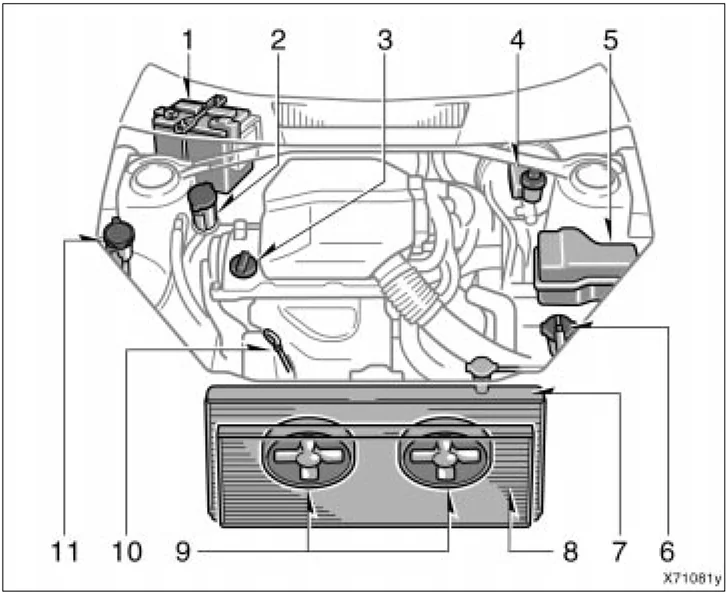
- Battery
- Power steering fluid reservoir
- Engine oil filler cap
- Brake fluid reservoir
- Fuse block
- Engine coolant reservoir
- Radiator
- Condenser
- Electric cooling fans
- Engine oil level dipstick
- Windshield and rear window washer fluid tank
278
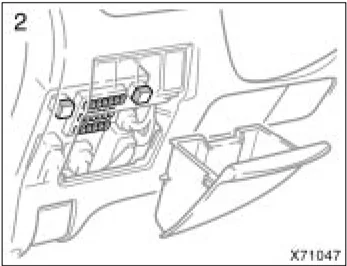
Fuse locations
 1
Spare fuses
X71034
 2
X71047
Do-it-yourself service precautions
If you perform maintenance by yourself, be sure to follow the correct procedure given in this Section.
You should be aware that improper or incomplete servicing may result in operating problems.
Performing do-it-yourself maintenance during the warranty period may affect your warranty coverage. Read the separate Toyota Warranty statement for details and suggestions.
This Section gives instructions only for those items that are relatively easy for an owner to perform. As explained in Section 6, there are still a number of items that must be done by a qualified technician with special tools.
For information on tools and parts for do-it-yourself maintenance, see "Parts and tools" on page 281 in this Section.
Utmost care should be taken when working on your vehicle to prevent accidental injury. Here are a few precautions that you should be especially careful to observe:
279
CAUTION
-
When the engine is running, keep hands, clothing, and tools away from the moving fan and engine drive belts. (Removing rings, watches, and ties is advisable.)
-
Right after driving, the engine compartment—the engine, radiator, exhaust manifold, power steering fluid reservoir and spark plug boots, etc.—will be hot. So be careful not to touch them. Oil, fluids and spark plugs may also be hot.
-
If the engine is hot, do not remove the radiator cap or loosen the drain plugs to prevent burning yourself.
-
Do not leave anything that may burn easily, such as paper or rags, in the engine compartment.
-
Do not smoke, cause sparks or allow open flames around fuel or the battery. Their fumes are flammable.
-
Do not get under your vehicle with just the body jack supporting it. Always use automotive jack stands or other solid supports.
-
Be sure that the ignition is off if you work near the electric cooling fans or radiator grille. With the ignition on, the electric cooling fans will automatically start to run if the engine coolant temperature is high and/or the air conditioning is on.
-
Use eye protection whenever you work on or under your vehicle where you may be exposed to flying or falling material, fluid spray, etc.
-
Used engine oil contains potentially harmful contaminants which may cause skin disorders such as inflammation or skin cancer, so care should be taken to avoid prolonged and repeated contact with it. To remove used engine oil from your skin, wash thoroughly with soap and water.
-
Do not leave used oil within the reach of children.
-
Dispose of used oil and filter only in a safe and acceptable manner. Do not dispose of used oil and filter in household trash, in sewers or onto the ground. Call your dealer or a service station for information concerning recycling or disposal.
-
Be extremely cautious when working on the battery. It contains poisonous and corrosive sulfuric acid.
NOTICE
◆ Remember that battery and ignition cable carry high currents or voltages. Be careful of accidentally causing a short circuit.
◆ Add only “Toyota Super Long Life Coolant” or similar high quality ethylene glycol based non-silicate, non-amine, non-nitrite, and non-borate coolant with long-life hybrid organic acid technology to fill the radiator. “Toyota Super Long Life Coolant” is a mixture of 50% coolant and 50% deionized water (for the U.S.A.) or 55% coolant and 45% deionized water (for Canada).
◆ If you spill some of the coolant, be sure to wash it off with water to prevent it from damaging the parts or paint.
280
'05 Rav4_U (L/O 0409)
- Do not allow dirt or anything else to fall through the spark plug holes.
- Use only spark plugs of the specified type. Using other types will cause engine damage, loss of performance or radio noise.
- Do not reuse iridium-tipped spark plugs by cleaning or regapping.
- Do not overfill automatic transmission fluid, or the transmission could be damaged.
- Do not drive with the air cleaner filter removed, or excessive engine wear could result. Also backfiring could cause a fire in the engine compartment.
- Be careful not to scratch the glass surface with the wiper frame.
- When closing the engine hood, check to see that you have not forgotten any tools, rags, etc.
Parts and tools
Here is a list of parts and tools you will need to perform do-it-yourself maintenance. Remember all Toyota parts are designed in metric sizes, so your tools must be metric.
CHECKING THE ENGINE OIL LEVEL
Parts (if level is low):
- "Toyota Genuine Motor Oil" or equivalent
See page 286 in Section 7-2 for details about engine oil selection.
Tools:
- Rag or paper towel
- Funnel (only for adding oil)
CHECKING THE ENGINE COOLANT LEVEL
Parts (if level is low):
- "Toyota Super Long Life Coolant" or similar high quality ethylene glycol based non-silicate, non-amine, non-nitrite, and non-borate coolant with long-life hybrid organic acid technology.
"Toyota Super Long Life Coolant" is a mixture of 50% coolant and 50% deionized water (for the U.S.A.) or 55% coolant and 45% deionized water (for Canada).
Tools:
- Funnel (only for adding coolant)
CHECKING BRAKE FLUID
Parts (if level is low):
- SAE J1703 or FMVSS No.116 DOT 3 brake fluid
Tools:
- Rag or paper towel
- Funnel (only for adding fluid)
CHECKING POWER STEERING FLUID
Parts (if level is low):
- Automatic transmission fluid DEXRON®II or III
Tools:
- Rag or paper towel
- Funnel (only for adding fluid)
CHECKING BATTERY CONDITION
Tools:
- Warm water
- Baking soda
- Grease
- Conventional wrench (for terminal clamp bolts)
281
CHECKING AND REPLACING FUSES Parts (if replacement is necessary): ● Fuse with same amperage rating as original
ADDING WASHER FLUID Parts: ● Water ● Washer fluid containing antifreeze (for winter use)
Tools: ● Funnel
REPLACING LIGHT BULBS Parts: ● Bulb with same number and wattage rating as original (See charts in “Replacing light bulbs” on page 304 in Section 7-3.)
Tools: ● Screwdriver
Positioning the jack
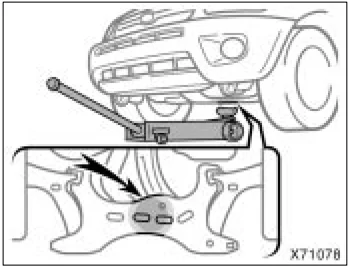
Front
Rear (four-wheel drive models)
Rear (two-wheel drive models)
282
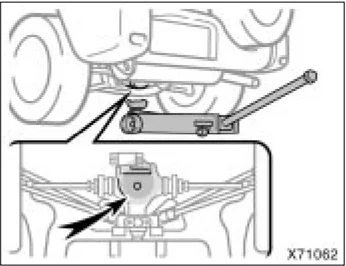
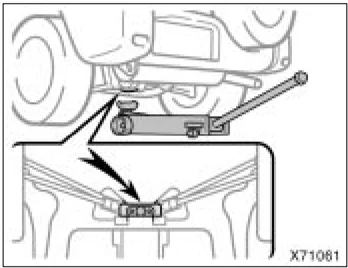
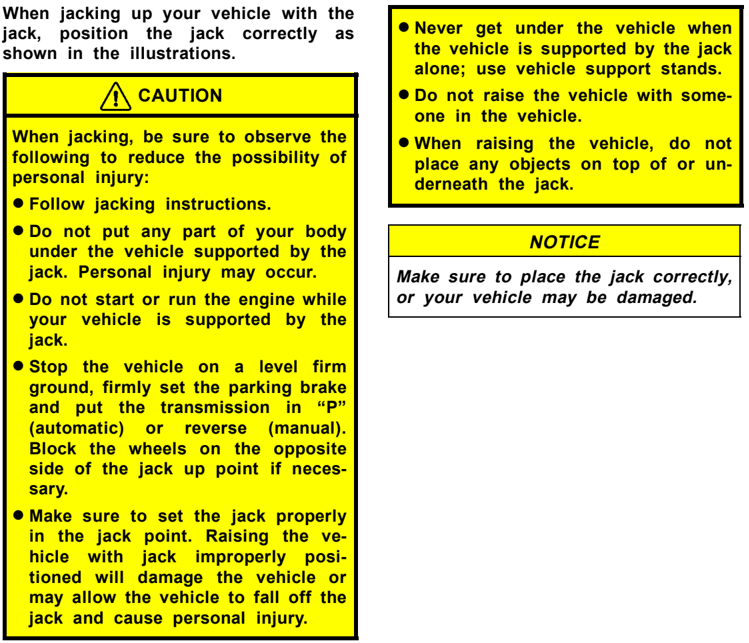
When jacking up your vehicle with the jack, position the jack correctly as shown in the illustrations.
CAUTION
When jacking, be sure to observe the following to reduce the possibility of personal injury:
-
Follow jacking instructions.
-
Do not put any part of your body under the vehicle supported by the jack. Personal injury may occur.
-
Do not start or run the engine while your vehicle is supported by the jack.
-
Stop the vehicle on a level firm ground, firmly set the parking brake and put the transmission in "P" (automatic) or reverse (manual). Block the wheels on the opposite side of the jack up point if necessary.
-
Make sure to set the jack properly in the jack point. Raising the vehicle with jack improperly positioned will damage the vehicle or may allow the vehicle to fall off the jack and cause personal injury.
-
Never get under the vehicle when the vehicle is supported by the jack alone; use vehicle support stands.
-
Do not raise the vehicle with someone in the vehicle.
-
When raising the vehicle, do not place any objects on top of or underneath the jack.
NOTICE
Make sure to place the jack correctly, or your vehicle may be damaged.
283
284