Operation
Driving instructions
▼ Driving instructions
Drive sensibly – save fuel
Fuel consumption, to a great extent, depends on driving habits and operating conditions.
To save fuel you should:
- Keep tires at the recommended tire inflation pressures.
- Remove unnecessary loads.
- Remove roof rack when not in use.
- Allow engine to warm up under low load use.
- Avoid frequent acceleration and deceleration.
- Have all maintenance work performed at the intervals specified in the Maintenance Booklet and as required by the maintenance service display. Contact an authorized Mercedes-Benz Center.
Fuel consumption is also increased by driving in cold weather, in stop-and-go traffic, on short trips and in hilly area.
Drinking and driving
Warning!
Drinking and driving and/or taking drugs and driving are very dangerous combinations. Even a small amount of alcohol or drugs can affect your reflexes, perceptions and judgment.
The possibility of a serious or even fatal accident are greatly increased when you drink or take drugs and drive.
Do not drink or take drugs and drive or allow anyone to drive who has been drinking or taking drugs.
Pedals
Warning!
Keep driver's foot area clear at all times. Objects stored in this area may impair pedal movement.
Power assistance
Warning!
With the engine not running, there is no power assistance for the brake and steering systems. In this case, it is important to keep in mind that a considerably higher degree of effort is necessary to brake and steer the vehicle.
283
Operation
Driving instructions
Brakes
Warning!
After driving in heavy rain for some time without applying the brakes or through water deep enough to wet brake components, the first braking action may be somewhat reduced and increased pedal pressure may be necessary to obtain expected braking effect. Maintain a safe distance from vehicles in front.
Resting your foot on the brake pedal will cause excessive and premature wear of the brake pads.
It can also result in the brakes overheating, thereby significantly reducing their effectiveness. It may not be possible to stop the vehicle in sufficient time to avoid an accident.
To help prevent brake disk corrosion after driving on wet road surfaces (particularly salted roads), it is advisable to brake the vehicle with considerable force prior to parking. The heat generated serves to dry the brakes.
If your brake system is normally only subject to moderate loads, you should occasionally test the effectiveness of the brakes by applying above-normal braking pressure at higher speeds. This will also enhance the grip of the brake pads.
Warning!
Make sure not to endanger any other road users when carrying out these braking maneuvers.
Refer to the description of the Brake Assist System (BAS) (▷ page 88).
If the parking brake is released and the brake warning lamp in the instrument cluster stays on, the brake fluid level in the reservoir is too low.
Brake pad wear or a leak in the system may be the reason for low brake fluid in the reservoir.
Have the brake system inspected immediately. Contact an authorized Mercedes-Benz Center.
All checks and service work on the brake system should be carried out by qualified technicians only. Contact an authorized Mercedes-Benz Center.
Only install brake pads and brake fluid recommended by Mercedes-Benz.
284
Operation
Driving instructions
Warning!
If other than recommended brake pads are installed, or other than recommended brake fluid is used, the braking properties of the vehicle can be degraded to an extent that safe braking is substantially impaired. This could result in an accident.
! When driving down long and steep grades, relieve the load on the brakes by shifting into a lower gear to use the engine's braking power. This helps prevent overheating of the brakes and reduces brake pad wear.
After hard braking, it is advisable to drive on for some time, rather than immediately park, so that the air stream will cool down the brakes faster.
Driving off
Apply the brakes to test them briefly after driving off. Perform this procedure only when the road is clear of other traffic.
Warm up the engine smoothly. Do not place full load on the engine until the operating temperature has been reached.
When starting off on a slippery surface, do not allow a drive wheel to spin for an extended period with the ESP® switched off. Doing so may cause serious damage to the drivetrain which is not covered by the Mercedes-Benz Limited Warranty.
! Simultaneously depressing the accelerator pedal and applying the brake reduces engine performance and causes premature brake and drivetrain wear.
Parking
! Set the parking brake whenever parking or leaving the vehicle. In addition, move gear selector lever to position P (manual transmission: first or reverse gear).
When parking on hills, always turn front wheels towards the road curb.
Warning!
Do not park this vehicle in areas where combustible materials such as grass, hay or leaves can come into contact with the hot exhaust system, as these materials could be ignited and cause a vehicle fire.
To reduce the risk of personal injury as a result of vehicle movement, before turning off the engine and leaving the vehicle always:
- Keep right foot on brake pedal.
285
Operation
Driving instructions
- Manual transmission: Move gearshift lever to neutral position (no gear selected).
- Firmly depress parking brake pedal.
- Automatic transmission*: Move the gear selector lever to position P.
- Slowly release brake pedal.
- When parked on an incline, turn front wheels towards the road curb.
- Turn the SmartKey in the starter switch to position 0 and remove the SmartKey from the starter switch.
- Take the SmartKey and lock vehicle when leaving.
Tires
Warning!
If you feel a sudden significant vibration or ride disturbance, or you suspect that possible damage to your vehicle has occurred, you should turn on the hazard warning flashers, carefully slow down, and drive with caution to an area which is a safe distance from the road.
Inspect the tires and the vehicle underbody for possible damage. If the vehicle or tires appear unsafe, have the vehicle towed to the nearest Mercedes-Benz Center or tire dealer for repairs.
Treadwear indicators (TWI) are required by law. These indicators are located in six places on the tread circumference and become visible at a tread depth of approximately 1/16 in (1.6 mm), at which point the tire is considered worn and should be replaced.
The treadwear indicator appears as a solid band across the tread.
Warning!
Although the applicable federal motor vehicle safety laws consider a tire to be worn when the treadwear indicators (TWI) become visible at approximately 1/16 in (1.6 mm), we recommend that you do not allow your tires to wear down to that level. As tread depth approaches 1/8 in (3 mm), the adhesion properties on a wet road are sharply reduced.
Depending upon the weather and/or road surface (conditions), the tire traction varies widely.
Specified tire inflation pressures must be maintained. This applies particularly if the tires are subjected to high loads (e.g. high speeds, heavy loads, high ambient temperatures).
286
Operation
Driving instructions
Warning! Do not drive with a flat tire. A flat tire affects the ability to steer or brake the vehicle. You may lose control of the vehicle. Continued driving with a flat tire or driving at high speed with a flat tire will cause excessive heat build-up and possibly a fire.
Hydroplaning
Depending on the depth of the water layer on the road, hydroplaning may occur, even at low speeds and with new tires. Reduce vehicle speed, avoid track grooves in the road and apply brakes cautiously in the rain.
Tire traction
The safe speed on a wet, snow covered or icy road is always lower than on a dry road. You should pay particular attention to the condition of the road whenever the outside temperatures are close to the freezing point.
Warning! If ice has formed on the road, tire traction will be substantially reduced. Under such weather conditions, drive, steer and brake with extreme caution.
Mercedes-Benz recommends winter tires (▷ page 336) with a minimum tread depth of approximately 1/6 in (4 mm) on all four wheels for the winter season to ensure normal balanced handling characteristics. On packed snow, they can reduce your stopping distance compared to summer tires. Stopping distance, however, is still considerably greater than when the road is not covered with snow or ice. Exercise appropriate caution.
❗ Avoid spinning of a drive wheel. This may cause serious damage to the drivetrain which is not covered by the Mercedes-Benz Limited Warranty.
287
Operation
Driving instructions
Tire speed rating
Regardless of the tire speed rating, local speed limits should be obeyed. Use prudent driving speeds appropriate to prevailing conditions.
Warning!
Even when permitted by law, never operate a vehicle at speeds greater than the maximum speed rating of the tires.
Exceeding the maximum speed for which tires are rated can lead to sudden tire failure, causing loss of vehicle control and possibly resulting in an accident and/or personal injury and possible death, for you and for others.
C 230¹, C 280, C 280 4MATIC, C 350, C 350 4MATIC
Your vehicle is factory equipped with “H”-rated tires, which have a speed rating of 130 mph (210 km/h).
An electronic speed limiter prevents your vehicle from exceeding a speed of 130 mph (210 km/h).
C 230 Sport, C 350 Sport
Your vehicle is factory equipped with “W”-rated tires, which have a speed rating of 168 mph (270 km/h).
An electronic speed limiter prevents your vehicle from exceeding a speed of 130 mph (210 km/h).
For information on speed rating for winter tires, see “Winter tires” (> page 336).
For additional general information on tire speed markings on tire sidewall, see “Tire speed rating” (> page 323).
¹ Canada only
288
Operation
Driving instructions
Winter driving instructions
The most important rule for slippery or icy roads is to drive sensibly and to avoid abrupt acceleration, braking and steering maneuvers. Do not use the cruise control system under such conditions.
When the vehicle is in danger of skidding, move gear selector lever to position N or in case of manual transmission declutch. Try to keep the vehicle under control by corrective steering action.
For information on driving with snow chains, see “Snow chains” (▷ page 337).
Warning! On slippery road surfaces, never downshift in order to obtain braking action. This could result in drive wheel slip and reduced vehicle control. Your vehicle’s ABS will not prevent this type of control loss.
Road salts and chemicals can adversely affect braking efficiency. Increased pedal force may become necessary to produce the normal braking effect.
Depressing the brake pedal periodically when traveling at length on salt-strewn roads can bring road-salt-impaired braking efficiency back to normal.
If the vehicle is parked after being driven on salt-treated roads, the braking efficiency should be tested as soon as possible after driving is resumed.
Warning! Make sure not to endanger any other road users when carrying out these braking maneuvers.
Warning! If the vehicle becomes stuck in snow, make sure snow is kept clear of the exhaust pipe and from around the vehicle with the engine running. Otherwise, deadly carbon monoxide (CO) gases may enter vehicle interior resulting in unconsciousness and death.
To assure sufficient fresh air ventilation, open a window slightly on the side of the vehicle not facing the wind.
Warning! The outside temperature indicator is not designed to serve as an ice-warning device and is therefore unsuitable for that purpose. Indicated temperatures just above the freezing point do not guarantee that the road surface is free of ice.
For more information, see “Winter driving” (▷ page 336).
289
Operation
Driving instructions
Standing water
! Do not drive through flooded areas or water of unknown depth. Before driving through water, determine its depth. Never accelerate before driving into water. The bow wave could force water into the engine and auxiliary equipment, thus damaging them.
If you must drive through standing water, drive slowly to prevent water from entering the passenger compartment or the engine compartment. Water in these areas could cause damage to electrical components or wiring of the engine or transmission, or could result in water being ingested by the engine through the air intake causing severe internal engine damage. Any such damage is not covered by the Mercedes-Benz Limited Warranty.
Passenger compartment
Warning!
Always fasten items being carried as securely as possible.
In an accident, during hard braking or sudden maneuvers, loose items will be thrown around inside the vehicle, and cause injury to vehicle occupants unless the items are securely fastened in the vehicle.
The trunk is the preferred place to carry objects.
Driving abroad
Abroad, there is an extensive Mercedes-Benz service network at your disposal. If you plan to drive into areas which are not listed in the index of your Mercedes-Benz Center directory, you should request pertinent information from an authorized Mercedes-Benz Center.
290
Operation
Driving instructions
Control and operation of radio transmitters
COMAND*, radio and telephone*
Warning!
Please do not forget that your primary responsibility is to drive the vehicle safely. Only operate the COMAND (Cockpit Management and Data System), radio or telephone¹ if road, weather and traffic conditions permit.
Bear in mind that at a speed of just 30 mph (approximately 50 km/h), your vehicle is covering a distance of 44 feet (approximately 14 m) every second.
¹ Observe all legal requirements.
Telephones* and two-way radios
Warning!
Never operate radio transmitters equipped with a built-in or attached antenna (i.e. without being connected to an external antenna) from inside the vehicle while the engine is running. Doing so could lead to a malfunction of the vehicle's electronic system, possibly resulting in an accident and personal injury.
Radio transmitters, such as a portable telephone or a citizens band unit should only be used inside the vehicle if they are connected to an antenna that is installed on the outside of the vehicle.
Refer to the radio transmitter operation instructions regarding use of an external antenna.
Catalytic converter
Your Mercedes-Benz is equipped with monolithic-type catalytic converters, an important element in conjunction with the oxygen sensors to achieve substantial control of the pollutants in the exhaust emissions. Keep your vehicle in proper operating condition by following our recommended maintenance instructions as outlined in your Maintenance Booklet.
! To prevent damage to the catalytic converters, only use premium unleaded gasoline in this vehicle.
Any noticeable irregularities in engine operation should be repaired promptly. Otherwise, excessive unburned fuel may reach the catalytic converter, causing it to overheat and potentially start a fire.
291
Operation
Driving instructions
Warning!
As with any vehicle, do not idle, park or operate this vehicle in areas where combustible materials such as grass, hay or leaves can come into contact with the hot exhaust system, as these materials could be ignited and cause a vehicle fire.
Emission control
Certain systems of the engine serve to keep the toxic components of the exhaust gases within permissible limits required by law.
These systems, of course, will function properly only when maintained strictly according to factory specifications. Any adjustments on the engine should, therefore, be carried out only by qualified Mercedes-Benz Center authorized technicians. Engine adjustments should not be altered in any way. Moreover, the specified service jobs must be carried out regularly according to Mercedes-Benz servicing requirements. For details refer to the Maintenance Booklet.
Warning!
Inhalation of exhaust gas is hazardous to your health. All exhaust gas contains carbon monoxide, and inhaling it can cause unconsciousness and possible death.
Do not run the engine in confined areas (such as a garage) which are not properly ventilated. If you think that exhaust gas fumes are entering the vehicle while driving, have the cause determined and corrected immediately. If you must drive under these conditions, drive only with at least one window fully open at all times.
292
Operation
Driving instructions
Coolant temperature
During severe operating conditions and stop-and-go city traffic, the coolant temperature may rise close to approximately 248°F (120°C).
The engine should not be operated with the coolant temperature over 248°F (120°C). Doing so may cause serious engine damage which is not covered by the Mercedes-Benz Limited Warranty.
Warning!
- Driving when your engine is badly overheated can cause some fluids, which may have leaked into the engine compartment, to catch fire. You could be seriously burned.
- Steam from an overheated engine can cause serious burns and can occur just by opening the hood. Stay away from the engine if you see or hear steam coming from it.
Turn off the engine, get out of the vehicle and do not stand near the vehicle until the engine has cooled down.
293
Operation
At the gas station
Refueling
Warning! Gasoline is highly flammable and poisonous. It burns violently and can cause serious injury. Whenever you are around gasoline, avoid inhaling fumes and skin contact, extinguish all smoking materials. Never allow sparks, flame or smoking materials near gasoline!
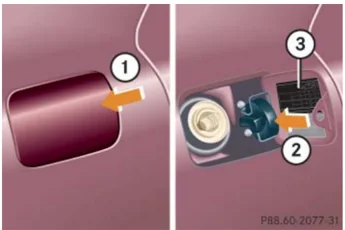
The fuel filler flap is located on the right-hand side of the vehicle towards the rear. Locking/unlocking the vehicle with the SmartKey automatically locks/unlocks the fuel filler flap.

① To open the fuel filler flap ② To insert the fuel filler cap ③ Supplemental tire inflation pressure information
► Turn the engine off by turning the SmartKey to position 0. ► Remove the SmartKey from the starter switch. ► Open the fuel filler flap by pushing at the point indicated by arrow ①. The fuel filler flap springs open. ► Turn fuel cap counterclockwise and hold on to it until possible pressure is released. ► Take off cap and set it in direction of arrow ② in the recess on the fuel filler flap.
To prevent fuel vapors from escaping into open air, fully insert filler nozzle unit.
► Only fill your tank until the filler nozzle unit cuts out – do not top up or overfill.
Warning! Overfilling of the fuel tank may create pressure in the system which could cause a gas discharge. This could cause the gas to spray back out when removing the fuel pump nozzle, which could cause personal injury.
294
Operation At the gas station
▶ Replace fuel cap by turning it clockwise until it audibly engages.
▶ Close fuel filler flap.
ℹ Leaving the engine running and the fuel cap open can cause the yellow fuel tank reserve warning lamp to flash and the [check engine icon] malfunction indicator lamp (USA only) or the [malfunction icon] malfunction indicator lamp (Canada only) to illuminate.
For more information, see “Practical hints” (▷ page 352) and (▷ page 353).
Check regularly and before a long trip

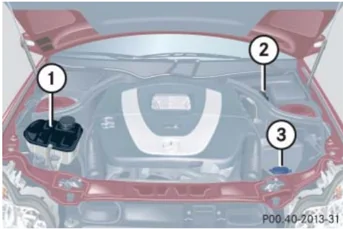
① Coolant ② Brake fluid (fuse box cover removed) ③ Windshield washer and headlamp cleaning system*
ℹ Opening the hood, see (▷ page 297).
Coolant
For normal replenishing, use water (potable water quality). For more information, see “Coolant level” (▷ page 301) and see “Fuels, coolants, lubricants, etc.” (▷ page 440).
Brake fluid
❗ If you find that the brake fluid in the brake fluid reservoir has fallen to the minimum mark or below, have the brake system checked for brake pad thickness and leaks immediately. Notify an authorized Mercedes-Benz Center immediately. Do not add brake fluid as this will not solve the problem. For more information, see “Practical hints” (▷ page 351).
Removing fuse box cover (▷ page 422).
295
Operation
At the gas station
Windshield washer and headlamp cleaning system* For more information on filling up the washer reservoir, see “Windshield washer system and headlamp cleaning system*” (▷ page 303).
Engine oil level For more information on engine oil level, see “Engine oil” (▷ page 298).
Vehicle lighting Check function and cleanliness. For more information on replacing light bulbs, see “Replacing bulbs” (▷ page 397). Exterior lamp switch (▷ page 118).
Tire inflation pressure More information on tire inflation pressure (▷ page 316).
296
▼ Engine compartment
Hood
Warning! Do not pull the release lever while the vehicle is in motion. Otherwise the hood could be forced open by passing air flow.
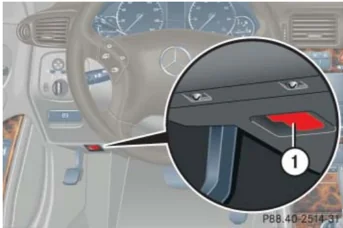
Opening The hood lock release lever is located to the left of the steering wheel under the dashboard.

① Hood lock release lever
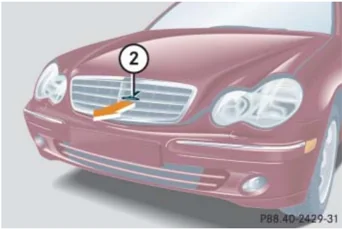
▶ Pull lever ① downwards. The hood is unlocked and handle ② will extend out of the radiator grille.
! To avoid damage to the windshield wipers or hood, never open the hood if the wiper arms are folded forward away from the windshield.
② Handle for opening the hood
Operation Engine compartment
▶ Pull handle ② to its stop out of radiator grille. ▶ Pull up on the hood (do not pull up on the handle) and then release it. The hood will be automatically held open at shoulder height by gas-filled struts.
Warning! To help prevent personal injury, stay clear of moving parts when the hood is open and the engine is running. Make sure the hood is properly closed before driving. When closing the hood, use extreme caution not to catch hands or fingers.
The radiator fan may continue to run for approximately 30 seconds or even restart after the engine has been turned off. Stay clear of fan blades.
297