Operation
Maintenance
We strongly recommend that you have your vehicle serviced by an authorized Mercedes-Benz Center, in accordance with the Maintenance Booklet at the times called for by the maintenance service indicator display.
Failure to have the vehicle maintained in accordance with the Maintenance Booklet and maintenance service indicator at the designated times/mileage will result in vehicle damage not covered by the Mercedes-Benz Limited Warranty.
Maintenance service indicator message
The maintenance service indicator will notify you when your next maintenance service is due.
Starting approximately 1 month before your next maintenance service is due, one of the following messages will appear in the multifunction display while you are driving or when you switch on the ignition (example service A):
Service A in XXXXX Miles (Km) Service A in XXX Days Service A due now
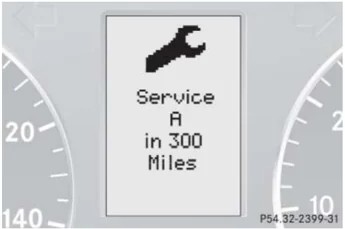
The type of maintenance service due is indicated in the multifunction display:
Basic service (A) Extended service (B)
Vehicles equipped with FSS (Flexible Service System) only (Canada vehicles): The interval between maintenance services depends on your driving habits. A gentle driving style, moderate engine speeds and the avoidance of short-distance trips will lengthen the interval between services.
338
Operation
Maintenance
Clearing the maintenance service indicator message
The maintenance service indicator is automatically cleared
- after approximately 10 seconds when you switch on the ignition or when reaching the maintenance service threshold while driving
- after approximately 30 seconds, once the suggested maintenance service term has passed
You can also clear it yourself.
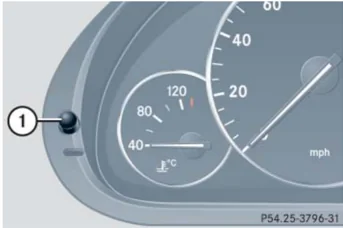
① Reset button
▶ Press reset button ① on the instrument cluster.
The maintenance service indicator message is cleared and the standard display appears in the multifunction display (▷ page 135).
Maintenance service term exceeded
If you have exceeded the suggested maintenance service term, you will see the following message in the multifunction display:
Service A exceeded by XXXX Miles (Km) Service A exceeded by XXX Days
In addition, a signal sounds when the message appears.
Any authorized Mercedes-Benz Center will reset the maintenance service indicator following a completed maintenance service.
Calling up the maintenance service indicator display
▶ Switch on the ignition (▷ page 33).
▶ Press button [icon] or [icon] on the multifunction steering wheel repeatedly until the standard display appears in the multifunction display (▷ page 130).
▶ Press button [icon] or [icon] until the maintenance service indicator display with the service symbol [icon] or [icon] and the service deadline appears in the multifunction display.
339
Operation
Maintenance
If the battery is disconnected, the days of disconnection will not be included in the count shown by the maintenance service indicator. To arrive at the true maintenance service deadline, you will need to subtract these days from the days shown in the maintenance service indicator message or maintenance service indicator display.
Do not confuse the maintenance service indicator with the engine oil level indicator .
Resetting the maintenance service indicator
In the event that the maintenance service on your vehicle is not carried out by an authorized Mercedes-Benz Center, you can have the maintenance service indicator reset. The automotive maintenance facility carrying out the maintenance service will find the information for resetting the maintenance service indicator in the maintenance-relevant information for your vehicle. Such information is available from either your authorized Mercedes-Benz Center or directly from Mercedes-Benz.
If the maintenance service indicator was inadvertently reset, have an authorized Mercedes-Benz Center correct it.
Only reset if the proper maintenance service has been performed. Resetting the system without performing the proper service as called for by the maintenance service indicator will result in engine damage and/or other vehicle damage not covered by the Mercedes-Benz Limited Warranty.
340
Operation
Vehicle care
▼ Vehicle care
Cleaning and care of the vehicle
Warning!
Many cleaning products can be hazardous. Some are poisonous, others are flammable. Always follow the instructions on the particular container. Always open your vehicle's doors or windows when cleaning the inside.
Never use fluids or solvents that are not designed for cleaning your vehicle.
Always lock away cleaning products and keep them out of reach of children.
While in operation, even while parked, your vehicle is subjected to varying external influences which, if gone unchecked, can attack the paintwork as well as the underbody and cause lasting damage.
Such damage is caused not only by extreme and varying climatic conditions, but also by:
- Air pollution
- Road salt
- Tar
- Gravel and stone chipping
To avoid paint damage, you should immediately remove:
- Grease and oil
- Fuel
- Coolant
- Brake fluid
- Bird droppings
- Insects
- Tree resins, etc.
Frequent washing reduces and/or eliminates the aggressiveness and potency of the above adverse influences.
More frequent washings are necessary to deal with unfavorable conditions:
- near the ocean
- in industrial areas (smoke, exhaust emissions)
- during winter operation
You should check your vehicle from time to time for stone chipping or other damage. Any damage should be repaired as soon as possible to prevent corrosion.
In doing so, do not neglect the underbody of the vehicle. A prerequisite for a thorough check is a washing of the underbody followed by a thorough inspection. Damaged areas need to be re-undercoated.
Your vehicle has been treated at the factory with a wax-base rustproofing in the body cavities which will last for the lifetime of the vehicle. Post-production treatment is neither necessary nor recommended by Mercedes-Benz because of the possibility of incompatibility between materials used in the production process and others applied later.
341
Operation
Vehicle care
We have selected car-care products and compiled recommendations which are specially matched to our vehicles and which always reflect the latest technology. You can obtain Mercedes-Benz approved car-care products at an authorized Mercedes-Benz Center.
Scratches, corrosive deposits, corrosion or damage due to negligent or incorrect care cannot always be removed or repaired with the car-care products recommended here. In such cases it is best to seek aid at an authorized Mercedes-Benz Center.
The following topics deal with the cleaning and care of your vehicle and give important "how-to" information as well as references to Mercedes-Benz approved car-care products.
Power washer
! Follow the instructions provided by the power washer manufacturer on maintaining a distance between the vehicle and the nozzle of the power washer.
Never use a round nozzle to power-wash tires. The intense jet of water can result in damage to the tire.
Always replace a damaged tire.
Always keep the jet of water moving across the surface. Do not aim directly at electrical parts, electrical connectors, seals, or other rubber parts.
Tar stains
Quickly remove tar stains before they dry and become more difficult to remove. A tar remover is recommended.
Paintwork, painted body components
! Affixing stickers, adhesive tape or similar materials to painted body components may damage the paintwork.
Mercedes-Benz approved Paint Care should be applied when water drops on the paint surface do not "bead up". This should normally be done every 3 to 5 months, depending on the climate and washing detergent used.
Mercedes-Benz approved Paint Cleaner should be applied if the paint surface shows signs of embedded dirt (i.e. loss of gloss).
Do not apply any of these products or wax if your vehicle is parked in the sun or if the hood is still hot.
► Use the appropriate MB-Touch-Up Stick for quick and provisional repairs of minor paint damage (i.e. chips from stones, vehicle doors, etc.).
342
Operation
Vehicle care
Engine cleaning
Prior to cleaning the engine compartment, make sure to protect electrical components and connectors from the intrusion of water and cleaning agents.
Corrosion protection, such as MB Anticorrosion Wax, should be applied to the engine compartment after every engine cleaning. Before applying, all control linkage bushings and joints should be lubricated. The poly-V-belt and all pulleys should be protected from any wax.
Vehicle washing
In the winter, thoroughly remove all traces of road salt as soon as possible.
When washing the vehicle underbody, do not forget to clean the inner sides of the wheels.
Hand-wash
Do not use hot water or wash your vehicle in direct sunlight.
- Only use a mild car wash detergent, such as Mercedes-Benz approved Car Shampoo.
- Thoroughly spray the vehicle with a diffused jet of water.
Direct only a very weak spray towards the ventilation intake.
- Use plenty of water and rinse the sponge and chamois frequently.
- Rinse with clean water and thoroughly dry with a chamois.
Do not allow cleaning agents to dry on the finish.
Automatic car wash
You can have your car washed in an automatic car wash from the start. Automatic car washes without brushes are preferable.
If the vehicle is very dirty, prewash it before running it through the automatic car wash.
! Due to the width of the vehicle, fold in exterior rear view mirrors prior to running the vehicle through an automatic car wash to prevent damage to the mirrors.
Make sure that the windshield wiper switch is set to 0 (> page 53). Otherwise, the rain sensor could activate and cause the wipers to move unintentionally. This may lead to vehicle damage.
343
Operation
Vehicle care
i After running the vehicle through an automatic car wash, wipe any wax off of the windshield (> page 345). This will prevent smears and reduce wiping noise which can be caused by residual wax on the windshield.
When leaving the car wash, make sure that the mirrors are folded out. Otherwise they may vibrate.
Ornamental moldings
For regular cleaning and care of ornamental moldings, use a damp cloth.
! Do not use chrome cleaner on ornamental moldings. Although ornamental moldings may have chrome appearance, they could be made of anodized aluminum that will be damaged when cleaned with chrome cleaner. Instead, use a damp cloth to clean those ornamental moldings.
For very dirty ornamental moldings of which you are sure are chrome-plated, use a chrome cleaner. If in doubt whether an ornamental molding is chrome-plated, contact an authorized Mercedes-Benz Center.
Headlamps, tail lamps, side markers, turn signal lenses
► Use a mild car wash detergent, such as Mercedes-Benz approved Car Shampoo, with plenty of water.
! Only use window cleaning solutions that are suitable for plastic lamp lenses. Window cleaning solutions which are not suitable may damage the plastic lamp lenses of the headlamps. Therefore, do not use abrasives, solvents or cleaners that contain solvents.
Never apply strong force and only use a soft, non-scratching cloth when cleaning the lenses. Do not attempt to wipe dirty lenses with a dry cloth or sponge. Otherwise you may scratch or damage the lens surface.
344
Operation
Vehicle care
Cleaning the windows and the wiper blades
**! ** The windshield wipers must be in a vertical position before folding them away from the windshield. They could otherwise damage the hood.
Never open the hood when the wiper arms are folded forward.
- Switch on the ignition (▷ page 33).
- Turn combination switch to wiper setting II (▷ page 53).
- With wiper arms in vertical position, switch off the ignition (▷ page 33).
Warning! For safety reasons, switch off wipers and remove SmartKey from starter switch before cleaning the windshield and/or the wiper blades. Otherwise, the wiper motor could suddenly turn on and cause injury.
- Fold the wiper arms forward until they snap into place.
- Clean the wiper blade inserts with a clean cloth and detergent solution.
- Use a soft, clean cloth and a mild window cleaning solution on all outside and inside glass surfaces.
An automotive glass cleaner is recommended.
**! ** Fold the windshield wiper arms back onto the windshield before turning the SmartKey in the starter switch.
Hold on to the wiper when folding the wiper arm back. If released, the force of the impact from the tensioning spring could crack the windshield.
**! ** To clean the window interior, do not use a dry cloth, abrasives, solvents or cleaners containing solvents. Do not touch the inside of the front, rear or side windows with hard objects such as an ice scraper or ring. Doing so may damage the windows.
345
Operation
Vehicle care
Light alloy wheels
If possible, clean wheels once a week.
► Use Mercedes-Benz approved Wheel Care, a soft bristle brush and a strong spray of water for cleaning the light alloy wheels.
! Only use acid-free cleaning materials. Acid may cause corrosion or damage the clear coat.
! The vehicle should not be parked for an extended period of time immediately after it has been cleaned, especially not after the wheel rims have been cleaned with wheel rim cleaner. Wheel rim cleaners can lead to increased corrosion of the brake disks and brake pads. Therefore, the vehicle's brake system should always be warmed-up before it is parked after cleaning. To do so, please drive your vehicle for several minutes to allow the brakes to dry.
When applying Mercedes-Benz approved Tire Care and Mercedes-Benz approved Wheel Care products, take care not to spray them on the brake disks.
Plastic and rubber parts
► Use a gentle dishwashing detergent or mild detergent for delicate fabrics as a washing solution.
! Do not use oil or wax on these parts.
Instrument cluster and cup holders
► Use a gentle dishwashing detergent or mild detergent for delicate fabrics as a washing solution.
► Wipe with a cloth moistened in a lukewarm solution.
! To prevent scratches, do not use scouring agents.
346
Operation
Vehicle care
Hard plastic trim items ► Use Mercedes-Benz approved Interior Care, a soft, lint-free cloth and apply with light pressure.
! To prevent scratches, do not use scouring agents.
Steering wheel and gear selector lever ► Wipe with a damp cloth and dry thoroughly or clean with Mercedes-Benz approved Leather Care.
Carpets ► Use Mercedes-Benz approved Carpet and Fabric Care for cleaning the carpets.
Headliner and shelf below rear window ► Use a soft bristle brush or a dry-shampoo cleaner in case of excessive dirt.
Seat belts ► Only use clear, lukewarm water and soap.
! The webbing must not be treated with chemical cleaning agents. Do not dry the webbing at temperatures above 176°F (80°C) or in direct sunlight.
Warning! Do not bleach or dye seat belts as this may severely weaken them. In a crash they may not be able to provide adequate protection.
347
Operation
V ehicle care
Upholstery
Using aftermarket seat covers or wearing clothing that have the tendency to give off coloring (e.g. when wet, etc.) may cause the upholstery to become permanently discolored. By lining the seats with a proper intermediate cover, contact-discoloration will be prevented.
Leather upholstery
- Wipe leather upholstery with a damp cloth and dry thoroughly or clean with Mercedes-Benz approved Leather Care.
Exercise particular care when cleaning perforated leather as its underside should not become wet.
MB Tex upholstery
- Use Mercedes-Benz approved Interior Care onto a soft, lint-free cloth and apply with light pressure for cleaning the upholstery.
Wood trims
- Dampen cloth using water and use damp cloth to clean wood trims in your vehicle.
! Do not use solvents like tar remover or wheel cleaner nor polishes or waxes as these may be abrasive.
348
Practical hints
What to do if ... Where will I find ...? Unlocking/locking in an emergency Opening/closing in an emergency Resetting activated head restraints Replacing SmartKey batteries Replacing bulbs Replacing wiper blades Flat tire Battery Jump starting Towing the vehicle Fuses
349

Practical hints
What to do if ...
Lamps in instrument cluster
General information:
If any of the following lamps in the instrument cluster fails to come on during the bulb self-check when switching on the ignition, have the respective bulb checked and replaced if necessary.
| Problem | Possible cause/consequence | Suggested solution |
|---|---|---|
| The yellow ABS indicator lamp comes on while driving. | The ABS has detected a malfunction and has switched off. The BAS and the ESP® are also switched off (see messages in display).The brake system is still functioning normally but without the ABS available.If the ABS control unit is malfunctioning, other systems such as the navigation system* or the automatic transmission* may also be malfunctioning. | ► Continue driving with added caution. Wheels may lock during hard braking, reducing steering capability.► Read and observe messages in the display (▷ page 358).► Have the system checked at an authorized Mercedes-Benz Center as soon as possible.Failure to follow these instructions increases the risk of an accident. |
| The charging voltage has fallen below ten volts. The ABS has switched off.The battery might not be charged sufficiently. | ► Switch off electrical consumers that are currently not needed, e.g. seat heating*.► If necessary, have the generator (alternator) and battery checked.When the voltage is above this value again, the ABS is operational again. |
350
Practical hints
What to do if ...
| Problem | Possible cause/consequence | Suggested solution |
|---|---|---|
| BRAKE(USA only)(!)(Canada only)The red brake warning lamp comes on while driving and you hear a warning sound. | You are driving with the parking brake set. | ► Release the parking brake (▷ page 50). |
| BRAKE(USA only)(!)(Canada only)The red brake warning lamp comes on while driving. | There is insufficient brake fluid in the reservoir. | ► Risk of accident! Carefully stop the vehicle and notify an authorized Mercedes-Benz Center. Do not add brake fluid! This will not solve the problem. |
Warning!
Driving with the brake warning lamp illuminated can result in an accident. Have your brake system checked immediately if the brake warning lamp stays on. Don’t add brake fluid before checking the brake system. Overfilling the brake fluid reservoir can result in spilling brake fluid on hot engine parts and the brake fluid catching fire. You can be seriously burned.
!
If you find that the brake fluid in the brake fluid reservoir has fallen to the minimum mark or below, have the brake system checked for brake pad thickness and leaks.
351
Practical hints
What to do if ...
352
Practical hints
What to do if ...
| Problem | Possible cause/consequence | Suggested solution |
|---|---|---|
| check engine (USA only)engine (Canada only)The yellow engine malfunction indicator lamp comes on while driving. | Your fuel tank is empty. | ► After refuelling start, turn off and restart the engine three or four times in succession.The limp-home mode is canceled. You do not need to have your vehicle checked. |
353
Practical hints
What to do if ...
Practical hints
What to do if ...
| Problem | Possible cause/consequence | Suggested solution |
|---|---|---|
| The red seat belt telltale comes on after starting the engine with all doors closed. | The seat belt telltale reminds you and your passengers to fasten your seat belts before driving off. | ► Fasten your seat belts. |
| The red seat belt telltale flashes and you additionally hear an intermittent warning signal with increasing intensity for a maximum of 60 seconds when the vehicle’s speed exceeds 15 mph (25 km/h). | You and/or your front passenger have forgotten to fasten your seat belts. | ► Fasten your seat belts. |
| There are items placed on the front passenger seat and therefore the system senses the front passenger seat as being occupied. | ► Remove the items from the front passenger seat and put them in a safe place. | |
| The red SRS indicator lamp comes on while driving. | There is a malfunction in the restraint systems. The air bags or emergency tensioning devices (ETDs) could deploy unexpectedly or fail to deploy in an accident. | ► Drive with added caution to the nearest authorized Mercedes-Benz Center. |
Warning!
In the event a malfunction of the SRS is indicated as outlined above, the SRS may not be operational.
For your safety, we strongly recommend that you visit an authorized Mercedes-Benz Center immediately to have the system checked; otherwise the SRS may not be deployed when needed in an accident, which could result in serious or fatal injury, or it might deploy unexpectedly and unnecessarily which could also result in an accident and/or injury to you or to others.
355
Practical hints
What to do if ...
Lamp in center console
Warning!
If the indicator lamp illuminates and remains illuminated with the weight of a typical adult or someone larger than a small individual on the front passenger seat, do not have any passenger use the front passenger seat until the system has been repaired.
356
Practical hints
What to do if ...
| Problem | Possible cause/consequence | Suggested solution |
|---|---|---|
| The front passenger front air bag off indicator lamp does not illuminate and/or does not remain illuminated with the weight of a typical 12-month-old child in a standard child restraint or less on the front passenger seat. | The system is malfunctioning. | - Make sure there is nothing between seat cushion and child seat and check installation of the child seat.- Make sure that no objects applying supplemental weight onto the seat are present.- If the front passenger front air bag off indicator lamp remains out, have the system checked as soon as possible by an authorized Mercedes-Benz dealer. Do not transport a child on the front passenger seat until the system has been repaired.- Also note any messages in the multifunction display and follow corrective steps (▷ page 364). |
Warning!
If the indicator lamp does not illuminate or remains out with the weight of a typical 12-month-old child in a standard child restraint or less on the front passenger seat, do not transport a child on the front passenger seat until the system has been repaired.
357
Practical hints
What to do if ...
Vehicle status messages in the multifunction display
Warning and malfunction messages appear in the multifunction display located in the instrument cluster.
Certain warning and malfunction messages are accompanied by an audible signal.
Address these messages accordingly and follow the additional instructions given in this Operator’s Manual.
Selecting the vehicle status message memory menu in the control system (▷ page 138) displays both cleared and uncleared messages.
High-priority messages appear in the multifunction display in red color.
Certain messages of high priority cannot be cleared from the multifunction display using the reset button (▷ page 127) or button , , , or on the steering wheel.
Other messages of high priority and messages of less immediate priority can be cleared from the multifunction display using the reset button (▷ page 127) or button , , , or on the steering wheel. They are then stored in the vehicle status message memory (▷ page 138). Remember that clearing a message will only make the message disappear. Clearing a message will not correct the condition that caused the message to appear.
Warning! All categories of messages contain important information which should be taken note of and, where a malfunction is indicated, addressed as soon as possible at an authorized Mercedes-Benz Center.
Failure to repair condition noted may cause damage not covered by the Mercedes-Benz Limited Warranty, or result in property damage or personal injury.
Warning! No messages will be displayed if either the instrument cluster or the multifunction display is inoperative.
Contact your nearest authorized Mercedes-Benz Center.
358
Practical hints
What to do if ...
Switching on the ignition causes all instrument cluster lamps (except low beam headlamp indicator lamp, high beam headlamp indicator lamp, and turn signal indicator lamps unless activated) as well as the multifunction display to come on. Make sure the lamps and multifunction display are in working order before starting your journey.
On the pages that follow, you will find a compilation of the most important warning and malfunction messages that may appear in the multifunction display.
For your convenience the messages are divided into two sections:
- Text messages (▷ page 360)
- Symbol messages (▷ page 369)
359
Practical hints
What to do if ...
Text messages
| Display message | Possible cause/consequence | Possible solution |
|---|---|---|
| ABS malfunctionVisit workshop | The ABS has detected a malfunction and has switched off. The ESP®, BAS and the Run Flat Indicator* are also deactivated.The brake system is still functioning normally but without the systems specified above. | ► Continue driving with added caution. Wheels may lock during hard braking, reducing steering capability.► Have the system checked at an authorized Mercedes-Benz Center as soon as possible.Failure to follow these instructions increases the risk of an accident. |
| Display malfunctionVisit workshop | The ABS or the ABS display is malfunctioning. | ► Continue driving with added caution. Wheels may lock during hard braking, reducing steering capability.► Have the system checked at an authorized Mercedes-Benz Center as soon as possible.Failure to follow these instructions increases the risk of an accident. |
360
Practical hints
What to do if ...
| Display message | Possible cause/consequence | Possible solution |
|---|---|---|
| ESP unavailableSee Operator’s Manual | The ESP® was deactivated because of a malfunction or interrupted power supply. The BAS and the Run Flat Indicator* are also deactivated.The ABS might not be operational.The brake system is still functioning normally but without the systems specified above. | ► Continue driving with added caution.► Visit an authorized Mercedes-Benz Center as soon as possible.Failure to follow these instructions increases the risk of an accident. |
| If the yellow ESP® warning lamp ⚠ flashes while driving and this message appears, the electronic traction system has switched off to prevent overheating of the drive wheel brakes. | As soon as the brakes have cooled off, the electronic traction system switches on again. | |
| The self-diagnosis has not been completed yet.The ESP®, BAS and the Run Flat Indicator* are temporarily deactivated.The brake system is still functioning normally but without the systems specified above. | The display will clear after driving a short distance at more than 12 mph (20 km/h). |
361
Practical hints
What to do if ...
| Display message | Possible cause/consequence | Possible solution |
|---|---|---|
| ESP unavailableSee Operator’s Manual | The charging voltage has fallen below 10 volts. The battery might not be charged sufficiently.The ESP®, BAS and the Run Flat Indicator* are deactivated.The brake system is still functioning normally but without the systems specified above. | ► Continue driving with added caution.► If necessary, have the generator and battery checked.When the voltage is above this value again, the ESP® is operational again. |
| ESP malfunctionVisit workshop | The ESP® is deactivated because of a malfunction.The ESP®, BAS and the Run Flat Indicator* are deactivated.The brake system is still functioning normally but without the systems specified above. | ► Continue driving with added caution.► Visit an authorized Mercedes-Benz Center as soon as as possible.Failure to follow these instructions increases the risk of an accident. |
| Display malfunctionVisit workshop | The ESP® or the ESP® display is malfunctioning. | ► Continue driving with added caution.► Visit an authorized Mercedes-Benz Center as soon as as possible.Failure to follow these instructions increases the risk of an accident. |
362