Operation
Tires and wheels
General: Depending on the design standards used, the tire size molded into the sidewall may have no letter or a letter preceding the tire size designation.
No letter preceding the size designation (as illustrated above): Passenger car tire based on European design standards.
Letter “P” preceding the size designation: Passenger car tire based on U.S. design standards.
Letter “LT” preceding the size designation: Light Truck tire based on U.S. design standards.
Letter “T” preceding the size designation: Temporary spare tires which are high pressure compact spares designed for temporary emergency use only.
Tire width The tire width ① (▷ page 321) indicates the nominal tire width in mm.
Aspect ratio The aspect ratio ② (▷ page 321) is the dimensional relationship between tire section height and section width and is expressed in percentage. The aspect ratio is arrived at by dividing section height by section width.
Tire code The tire code ③ (▷ page 321) indicates the tire construction type. The “R” stands for radial tire type. Letter “D” means diagonal or bias ply construction; letter “B” means belted-bias ply construction.
At the tire manufacturer’s option, any tire with a speed capability above 149 mph (240 km/h) can include a “ZR” in the size designation (for example: 245/40 ZR 18). For additional information, see “Tire speed rating” (▷ page 323).
Rim diameter The rim diameter ④ (▷ page 321) is the diameter of the bead seat, not the diameter of the rim edge. Rim diameter is indicated in inches (in).
Tire load rating The tire load rating ⑤ (▷ page 321) is a numerical code associated with the maximum load a tire can support.
For example, a load rating of 91 corresponds to a maximum load of 1 356 lbs (615 kg) the tire is designed to support. See also “Maximum tire load” (▷ page 327) where the maximum load associated with the load index is indicated in kilograms and lbs.
322
Operation
Tires and wheels
Warning The tire load rating must always be at least half of the GAWR (▷ page 331) of your vehicle. Otherwise, tire failure may be the result which may cause an accident and/or serious personal injury to you or others. Always replace rims and tires with the same designation, manufacturer and type as shown on the original part.
Warning! Do not overload the tires by exceeding the specified load limit or vehicle capacity weight as indicated on the placard located on the driver's door B-pillar. Overloading the tires can overheat them, possibly causing a blowout. Overloading the tires can also result in handling or steering problems, or brake failure.
For additional information on tire load rating, see "Load identification" (▷ page 325).
Tire load rating ⑤ (▷ page 321) and Tire speed rating ⑥ (▷ page 321) are also referred to as "service description".
Tire speed rating
The tire speed rating ⑥ (▷ page 321) indicates the approved maximum speed for the tire.
Warning! Even when permitted by law, never operate a vehicle at speeds greater than the maximum speed rating of the tires. Exceeding the maximum speed for which tires are rated can lead to sudden tire failure, causing loss of vehicle control and possibly resulting in an accident and/or personal injury and possible death, for you and for others.
Tire load rating ⑤ (▷ page 321) and Tire speed rating ⑥ (▷ page 321) are also referred to as "service description".
323
Operation
Tires and wheels
Summer tires
- At the tire manufacturer’s option, any tire with a speed capability above 149 mph (240 km/h) can include a “ZR” in the size designation (for example: 245/40 ZR18). To determine the maximum speed capability of the tire, the service description for the tire must be referred to. The service description is comprised of the tire load rating ⑤ (> page 321) and the tire speed rating ⑥ (> page 321).
If your tire includes “ZR” in the size designation and no service description ⑤ and (> page 321) is given, the tire manufacturer must be consulted for the maximum speed capability.
If a service description ⑤ and ⑥ (> page 321) is given, the speed capability is limited by the speed symbol in the service description.
Example: 245/40 ZR18 97Y.
In this example, “97Y” is the service description. The letter “Y” designates the speed rating and the speed capability of the tire is limited to 186 mph (300 km/h).
- Any tire with a speed capability above 186 mph (300 km/h) must include a “ZR” in the size designation AND the service description must be placed in parenthesis. Example: 275/40 ZR 18 (99Y). The “(Y)” speed rating in parenthesis designates the maximum speed capability of the tire as being above 186 mph (300 km/h). Consult the tire manufacturer for the actual maximum permissible speed of the tire.
Operation
Tires and wheels
All-season and winter tires
| Index | Speed rating |
|---|---|
| Q M+S¹ | up to 100 mph (160 km/h) |
| T M+S¹ | up to 118 mph (190 km/h) |
| H M+S¹ | up to 130 mph (210 km/h) |
| V M+S¹ | up to 149 mph (240 km/h) |
¹ or M+S △ for winter tires
i Not all M+S rated tires provide special winter performance. Make sure the tires you use show M+S and the mountain/snowflake △ marking on the tire sidewall. These tires meet specific snow traction performance requirements of the Rubber Manufacturers Association (RMA) and the Rubber Association of Canada (RAC) and have been designed specifically for use in snow conditions.
Load identification
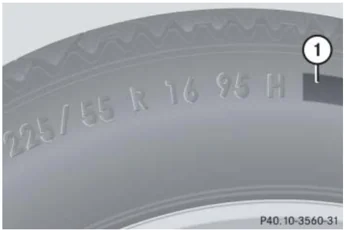
① Load identification
i For illustration purposes only. Actual data on tires is specific to each vehicle and may vary from data shown in above illustration.
In addition to tire load rating, special load information may be molded into the tire sidewall following the letter designating the tire speed rating ① (▷ page 325).
No specification given: absence of any text (like in above example) indicates a standard load (SL) tire.
XL or Extra Load: designates an extra load (or reinforced) tire.
Light Load: designates a light load tire.
C, D, E: designates load range associated with the maximum load a tire can carry at a specified pressure.
325
Operation
Tires and wheels
DOT, Tire Identification Number (TIN)
U.S. tire regulations require each new tire manufacturer or tire retreader to mold a TIN into or onto a sidewall of each tire produced.
The TIN is a unique identifier which facilitates efforts by tire manufactures to notify purchasers in recall situations or other safety matters concerning tires and gives purchasers the means to easily identify such tires.
The TIN is comprised of “Manufacturer’s identification mark”, “Tire size”, “Tire type code”, and “Date of manufacture”.
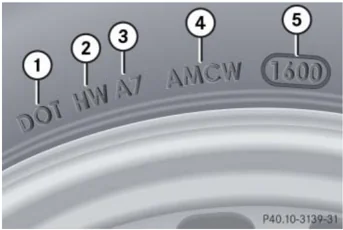
① DOT ② Manufacturer’s identification mark ③ Tire size ④ Tire type code (at the option of the tire manufacturer) ⑤ Date of manufacture
For illustration purposes only. Actual data on tires is specific to each vehicle and may vary from data shown in above illustration.
DOT (Department of Transportation) A tire branding symbol ① (▷ page 326) which denotes the tire meets requirements of the U.S. Department of Transportation.
Manufacturer’s identification mark The manufacturer’s identification mark ② (▷ page 326) denotes the tire manufacturer.
New tires have a mark with two symbols.
Retreaded tires have a mark with four symbols. For more information on retreaded tires, see (▷ page 304).
Tire size The code ③ (▷ page 326) indicates the tire size.
326
Operation
Tires and wheels
Tire type code
The code ④ (▷ page 326) may, at the option of the manufacturer, be used as a descriptive code for identifying significant characteristics of the tire.
Date of manufacture
The date of manufacture ⑤ (▷ page 326) identifies the week and year of manufacture.
The first two figures identify the week, starting with “01” to represent the first full week of the calendar year. The second two figures represent the year.
For example, “3202” represents the 32nd week of 2002.
Maximum tire load
 ① Maximum tire load rating
Warning! Do not overload the tires by exceeding the specified load limit or vehicle capacity weight as indicated on the placard located on the driver’s door B-pillar. Overloading the tires can overheat them, possibly causing a blowout. Overloading the tires can also result in handling or steering problems, or brake failure.
i For illustration purposes only. Actual data on tires is specific to each vehicle and may vary from data shown in above illustration.
The maximum tire load is the maximum weight the tires are designed to support.
For more information on tire load rating (▷ page 322).
For information on calculating total and cargo load capacities (▷ page 310).
327
Operation
Tires and wheels
Maximum tire inflation pressure
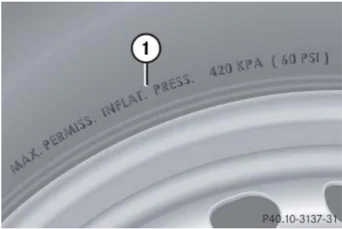
① Maximum permissible tire inflation pressure
i For illustration purposes only. Actual data on tires is specific to each vehicle and may vary from data shown in above illustration.
This is the maximum permissible tire inflation pressure for the tire.
Always follow the recommended tire inflation pressure (▷ page 314) for proper tire inflation.
Warning!
Never exceed the max. tire inflation pressure. Follow recommended tire inflation pressures.
Do not underinflate tires. Underinflated tires wear excessively and / or unevenly, adversely affect handling and fuel economy, and are more likely to fail from being overheated.
Do not overinflate tires. Overinflated tires can adversely affect handling and ride comfort, wear unevenly, increase stopping distance, and result in sudden deflation (blowout) because they are more likely to become punctured or damaged by road debris, potholes etc.
Uniform Tire Quality Grading Standards (U.S. vehicles)
Tire manufacturers are required to grade tires based on three performance factors: treadwear, traction, and temperature resistance.
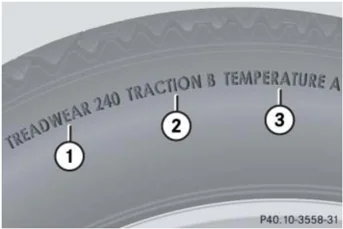
① Treadwear ② Traction ③ Temperature resistance
i For illustration purposes only. Actual data on tires is specific to each vehicle and may vary from data shown in above illustration.
328
Operation
Tires and wheels
Quality grades can be found, where applicable, on the tire sidewall between tread shoulder and maximum section width. For example:
| Treadwear | Traction | Temperature |
|---|---|---|
| 200 | AA | A |
All passenger car tires must conform to federal safety requirements in addition to these grades.
Treadwear
The treadwear grade is a comparative rating based on the wear rate of the tire when tested under controlled conditions on a specified government test course. For example, a tire graded 150 would wear one and one-half (□-□/□) times as well on the government course as a tire graded 100. The relative performance of tires depends upon the actual conditions of their use, however, and may depart significantly from the norm due to variations in driving habits, service practices and differences in road characteristics and climate.
Traction
The traction grades, from highest to lowest, are AA, A, B, and C. Those grades represent the tire’s ability to stop on wet pavement as measured under controlled conditions on specified government test surfaces of asphalt and concrete. A tire marked C may have poor traction performance.
Warning!
The traction grade assigned to this tire is based on straight-ahead braking traction tests, and does not include acceleration, cornering, hydroplaning, or peak traction characteristics.
329
Operation
Tires and wheels
Temperature
The temperature grades are A (the highest), B, and C, representing the tire’s resistance to the generation of heat and its ability to dissipate heat when tested under controlled conditions on a specified indoor laboratory test wheel. Sustained high temperature can cause the material of the tire to degenerate and reduce tire life, and excessive temperature can lead to sudden tire failure. The grade C corresponds to a level of performance which all passenger car tires must meet under the Federal Motor Vehicle Safety Standard No. 109. Grades B and A represent higher levels of performance on the laboratory test wheel than the minimum required by law.
Warning! The temperature grade for this tire is established for a tire that is properly inflated and not overloaded. Excessive speed, underinflation, or excessive loading, either separately or in combination, can cause excessive heat build-up and possible tire failure.
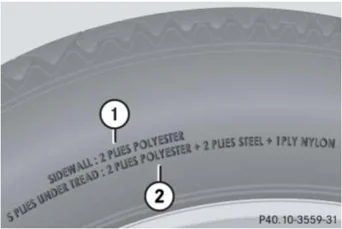
Tire ply material

① Plies in sidewall ② Plies under tread
For illustration purposes only. Actual data on tires is specific to each vehicle and may vary from data shown in above illustration.
This marking tells you about the type of cord and number of plies in the sidewall and under the tread.
330
Operation
Tires and wheels
Tire and loading terminology
Accessory weight The combined weight (in excess of those standard items which may be replaced) of automatic transmission, power steering, power brakes, power windows, power seats, radio, and heater, to the extent that these items are available as factory-installed equipment (whether installed or not).
Air pressure The amount of air inside the tire pressing outward on each square inch of the tire. Air pressure is expressed in pounds per square inch (psi), or kilopascal (kPa) or bars.
Aspect ratio Dimensional relationship between tire section height and section width expressed in percentage.
Bar Another metric unit for air pressure. There are 14.5038 pounds per square inch (psi) to 1 bar; there are 100 kilopascals (kPa) to 1 bar.
Bead The tire bead contains steel wires wrapped by steel cords that hold the tire onto the rim.
Cold tire inflation pressure Tire inflation pressure when your vehicle has been sitting for at least three hours or driven no more than one mile (1.6 km).
Curb weight The weight of a motor vehicle with standard equipment including the maximum capacity of fuel, oil, and coolant, and, if so equipped, air conditioning and additional optional equipment, but without passengers and cargo.
DOT (Department of Transportation) A tire branding symbol which denotes the tire meets requirements of the U.S. Department of Transportation.
GAWR (Gross Axle Weight Rating) The GAWR is the maximum permissible axle weight. The gross vehicle weight on each axle must never exceed the GAWR for the front and rear axle indicated on the certification label located on the driver’s door B-pillar.
331
Operation
Tires and wheels
GVW (Gross Vehicle Weight) The GVW comprises the weight of the vehicle including fuel, tools, spare wheel, installed accessories, passengers and cargo and, if applicable, trailer tongue load. The GWV must never exceed the GVWR indicated on the certification label located on the driver’s door B-pillar.
GVWR (Gross Vehicle Weight Rating) This is the maximum permissible vehicle weight of the fully loaded vehicle (weight of the vehicle including all options, passengers, fuel, and cargo and, if applicable, trailer tongue load). It is indicated on certification label located on the driver’s door B-pillar.
Kilopascal (kPa) The metric unit for air pressure. There are 6.9 kPa to 1 psi; another metric unit for air pressure is bars. There are 100 kilopascals (kPa) to 1 bar.
Maximum load rating The maximum load in kilograms and pounds that can be carried by the tire.
Maximum loaded vehicle weight The sum of curb weight, accessory weight, vehicle capacity weight and production options weight.
Maximum tire inflation pressure This number is the greatest amount of air pressure that should ever be put in the tire under normal driving conditions.
Normal occupant weight The number of occupants the vehicle is designed to seat, multiplied by 68 kilograms (150 lbs).
Occupant distribution The distribution of occupants in a vehicle at their designated seating positions.
332
Operation
Tires and wheels
Production options weight The combined weight of those installed regular production options weighing over 5 lbs (2.3 kilograms) in excess of those standard items which they replace, not previously considered in curb weight or accessory weight, including heavy duty brakes, ride levelers, roof rack, heavy duty battery, and special trim.
PSI (Pounds per square inch) A standard unit of measure for air pressure -> bar, kilopascal (kPa).
Recommended tire inflation pressure Recommended tire inflation pressure listed on placard located on driver's door B-pillar for normal driving conditions. Provides best handling, tread life and riding comfort.
Rim A metal support for a tire or a tire and tube assembly upon which the tire beads are seated.
Sidewall The portion of a tire between the tread and the bead.
TIN (Tire Identification Number) Unique identifier which facilitates efforts by tire manufacturers to notify purchasers in recall situations or other safety matters concerning tires and gives purchases the means to easily identify such tires. The TIN is comprised of "Manufacturer's identification mark", "Tire size", "Tire type code" and "Date of manufacture".
Tire load rating Numerical code associated with the maximum load a tire can support.
Tire ply composition and material used This indicates the number of plies or the number of layers of rubber-coated fabric in the tire tread and sidewall. Tire manufacturers also must indicate the ply materials in the tire and sidewall, which include steel, nylon, polyester, and others.
Tire speed rating Part of tire designation; indicates the speed range for which a tire is approved.
333
Operation
Tires and wheels
Traction Force exerted by the vehicle on the road via the tires. The amount of grip provided.
Tread The portion of a tire that comes into contact with the road.
Treadwear indicators Narrow bands, sometimes called “wear bars” that show across the tread of a tire when only 1/16 in (1.6 mm) of tread remains.
Uniform Tire Quality Grading Standards A tire information system that provides consumers with ratings for a tire’s traction, temperature and treadwear. Ratings are determined by tire manufacturers using government testing procedures. The ratings are molded into the sidewall of the tire.
Vehicle capacity weight Rated cargo and luggage load plus 68 kilograms (150 lbs) times the vehicle’s designated seating capacity.
Vehicle maximum load on the tire Load on an individual tire that is determined by distributing to each axle its share of the maximum loaded vehicle weight and dividing it by two.
334
Operation
Tires and wheels
Rotating tires
Warning! Rotate front and rear wheels only if the tires are of the same dimension.
If your vehicle is equipped with mixed-size tires (different tire dimensions front vs. rear), tire rotation is not possible.
Tire rotation can be performed on vehicles with tires of the same dimension all around. If your vehicle is equipped with tires of the same dimension all around, tires can be rotated, observing a a front-to-rear rotation pattern that will maintain the intended rotation (spinning) direction of the tire (▷ page 307).
In some cases, such as when your vehicle is equipped with mixed-size tires (different tire dimension front vs. rear), tire rotation is not possible.
If applicable to your vehicle's tire configuration, tires can be rotated according to the tire manufacturer's recommended intervals in the tire manufacturer's warranty pamphlet located in your vehicle literature portfolio. If none is available, tires should be rotated every 3000 to 6000 miles (5000 to 10000 km), or sooner if necessary, according to the degree of tire wear. The same rotation (spinning) direction must be maintained (▷ page 307).
Rotate tires before the characteristic tire wear pattern becomes visible (shoulder wear on front tires and tread center wear on rear tires).
Thoroughly clean the mounting face of wheels and brake disks, i.e. the inner side of the wheels/tires, during each rotation. Check for and ensure proper tire inflation pressure.
Warning! Have the tightening torque checked after changing a wheel. Wheels could become loose if not tightened with a torque of 80 lb-ft (110 Nm).
Only use genuine Mercedes-Benz wheel bolts specified for your vehicle's rims.
For information on wheel change, see the "Practical hints" section (▷ page 383) and (▷ page 406).
335
Operation
Winter driving
Before the onset of winter, have your vehicle winterized at an authorized Mercedes-Benz Center. This service includes:
- Check of anticorrosion and antifreeze concentration.
- Addition of cleaning concentrate to the water of the windshield and headlamp cleaning system. Add MB Concentrate "S" to a premixed windshield washer solvent/antifreeze which is formulated for below freezing temperatures (▷ page 448).
- Battery test. Battery capacity drops with decreasing ambient temperature. A well charged battery helps to make sure that the engine can be started, even at low ambient temperatures.
- Tire change.
Winter tires
Always use winter tires at temperatures below 45°F (7°C) and whenever wintry road conditions prevail. Not all M+S rated tires provide special winter performance. Make sure the tires you use show M+S and the mountain/snowflake marking on the tire sidewall. These tires meet specific snow traction performance requirements of the Rubber Manufacturers Association (RMA) and the Rubber Association of Canada (RAC) and have been designed specifically for use in snow conditions. Use of winter tires is the only way to achieve the maximum effectiveness of the ABS, ESP®, and 4MATIC in winter operation.
For safe handling, make sure that all mounted winter tires are of the same make and have the same tread design.
Warning!
Winter tires with a tread depth of less than 1/6 in (4 mm) must be replaced. They are no longer suitable for winter operation.
Always observe the speed rating of the winter tires installed on your vehicle. If the maximum speed for which your tires are rated is below the speed rating of your vehicle, you must place a notice to this effect where it will be seen by the driver. Such notices are available from your tire dealer or from any authorized Mercedes-Benz Center.
336
Operation
Winter driving
Warning!
If you use your spare tire when winter tires are fitted on the other wheels, be aware that the difference in tire characteristics may very well impair turning stability and that overall driving stability may be reduced. Adapt your driving style accordingly.
Have the spare tire replaced with a winter tire at the nearest authorized Mercedes-Benz Center.
Block heater (Canada only)
The engine is equipped with a block heater.
The electrical cable may be installed at an authorized Mercedes-Benz Center.
Snow chains
Snow chains should only be driven on snow-covered roads at speeds not to exceed 30 mph (50 km/h). Remove chains as soon as possible when driving on roads without snow.
When driving with snow chains, you may wish to deactivate the ESP® (> page 89) before setting the vehicle in motion. This will improve the vehicle's traction.
Please observe the following guidelines when using snow chains:
-
Use of snow chains is not permissible with all wheel/tire combinations.
-
Snow chains should only be used on the rear wheels. Follow the manufacturer's mounting instructions.
-
Only use snow chains that are approved by Mercedes-Benz. Your authorized Mercedes-Benz Center will be glad to advise you on this subject.
-
Use of snow chains may be prohibited depending on location. Always check local and state laws before installing snow chains.
Some tire sizes do not leave adequate clearance for snow chains. To help avoid serious damage to your vehicle or tires, use of snow chains is not permissible with the following tire sizes:
- 245/40 R17 91W
- 245/40 R17 91W MOExtended
- T 125/90 R16 98M
- T 125/80 R17 99M
337