Seating and Safety Restraints
SEATING
Notes:
Reclining the seatback can cause an occupant to slide under the seat’s safety belt, resulting in severe personal injuries in the event of a collision.
Do not pile cargo higher than the seatbacks to reduce the risk of injury in a collision or sudden stop.
Adjustable head restraints
Head restraints help to limit head motion in the event of a rear collision. Adjust your head restraint so that it is located directly or as close as possible behind your head.
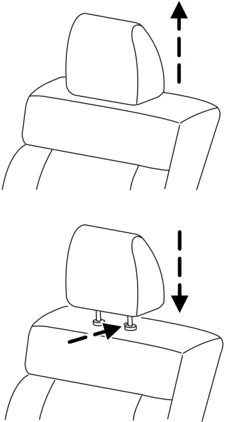
The head restraints can be moved up and down.

Push control to lower head restraint.
99
Seating and Safety Restraints
Front seat
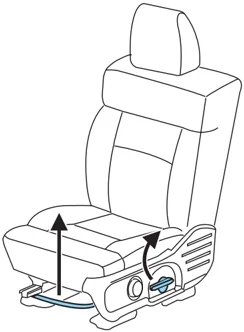
- Lift the track release bar to move the seat forward or rearward. Make sure that the seat is relatched into place.
- Pull the release lever handle located on the side of the seat up to move the seat back forward or backward.
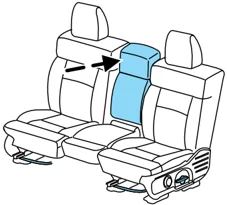
Using the armrest (if equipped)
Push the release control to move the armrest up or down.
100
Seating and Safety Restraints
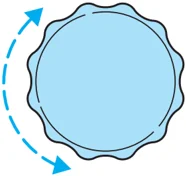
Using the manual lumbar support
For more lumbar support, turn the lumbar support control toward the front of vehicle.
For less lumbar support, turn the lumbar support control toward the rear of vehicle.
Adjusting the front power seat (if equipped)
Never adjust the driver’s seat or seatback when the vehicle is moving.
Do not pile cargo higher than the seatbacks to avoid injuring people in a collision or sudden stop.
Always drive and ride with your seatback upright and the lap belt snug and low across the hips.
Reclining the seatback can cause an occupant to slide under the seat’s safety belt, resulting in severe personal injuries in the event of a collision.
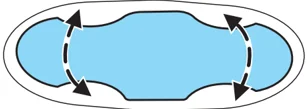
The control is located on the outboard side of the seat cushion. Press the front or rear portion to tilt the seat.
101
Seating and Safety Restraints
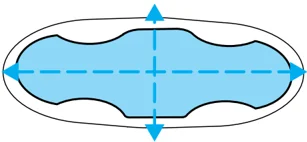
Press the control to move the seat forward, backward, up or down.
Memory seats/adjustable pedals (if equipped)
This system allows automatic positioning of the driver seat and adjustable pedals to two programmable positions.
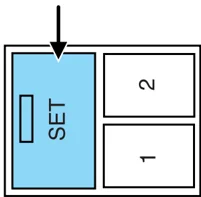
The memory seat control is located on the driver's seat.
- To program position one, move the driver seat, and adjustable pedals to the desired position. Press the SET control. The SET control indicator light will briefly illuminate. While the light is illuminated, press control 1.
- To program position two, repeat the previous procedure using control 2.
A position can only be recalled when the transmission gearshift is in Park. A memory position may be programmed at any time.
Heated seats (if equipped)
To operate the heated seats, do the following:
- Push control located on the instrument panel to set at high heat.

- Push control again to set at low heat.
- Push again to deactivate.
The indicator light on the control will illuminate when activated.
The system automatically shuts off after 10 minutes.
102
Seating and Safety Restraints
REAR SEATS
Head restraints
The purpose of these head restraints is to help limit head motion in the event of a rear collision. To properly adjust your head restraints, lift the head restraint so that it is located directly behind your head or as close to that position as possible.
The head restraints can be moved up and down. Lift the head restraint so that it is located directly or as close as possible behind your head.
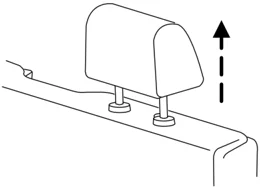
Push control to lower head restraint.
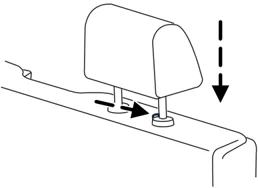
Folding up the rear seats (if equipped )
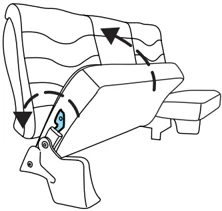
The rear seat has a split 60/40 cushion. Each seat cushion can be flipped up into the seatback position.
103
Seating and Safety Restraints
- Pull control to release seat cushion.
- Rotate seat cushion up until it locks into vertical storage position.

Returning the seat to seating position
Always be sure that the seat is in a latched position, whether the seat is occupied or empty. If not latched, the seat may cause injury during a sudden stop.
- Pull control on the side of the seat to release seat cushion from storage position.
- Push seat cushion down until it locks into horizontal position.
SAFETY RESTRAINTS
Personal Safety System
The Personal Safety System provides an improved overall level of frontal crash protection to front seat occupants and is designed to help further reduce the risk of air bag-related injuries. The system is able to analyze different occupant classifications and conditions and crash severity before activating the appropriate safety devices to help better protect a range of occupants in a variety of frontal crash situations.
Your vehicle's Personal Safety System consists of:
- Driver and passenger dual-stage air bag supplemental restraints.
- Front safety belts with pretensioners, energy management retractors, and safety belt usage sensors.
- Driver's seat position sensor.
- Front crash severity sensor.
- Front passenger sensing system
- Passenger Air Bag Off indicator light.
- Passenger air bag ON/OFF switch (if equipped)
104
Seating and Safety Restraints
• Restraints Control Module (RCM) with impact and safing sensors.
• Restraint system warning light and back-up tone.
• The electrical wiring for the air bags, crash sensor(s), safety belt pretensioners, front safety belt usage sensors, driver seat position sensor, and indicator lights.
How does the personal safety system work?
The Personal Safety System can adapt the deployment strategy of your vehicle's safety devices according to crash severity and occupant classification and conditions. A collection of crash and occupant sensors provides information to the Restraints Control Module (RCM). During a crash, the RCM activates the safety belt pretensioners and/or either none, one, or both stages of the dual-stage air bag supplemental restraints based on crash severity and occupant classification and conditions.
The fact that the pretensioners or air bags did not activate for both front seat occupants in a collision does not mean that something is wrong with the system. Rather, it means the Personal Safety System determined the accident conditions (crash severity, belt usage, etc.) were not appropriate to activate these safety devices. Front air bags and pretensioners are designed to activate only in frontal and near-frontal collisions, not rollovers, side-impacts, or rear-impacts unless the collision causes sufficient longitudinal deceleration.
Driver and passenger dual-stage air bag supplemental restraints
The dual-stage air bags offer the capability to tailor the level of air bag inflation energy. A lower, less forceful energy level is provided for more common, moderate-severity impacts. A higher energy level is used for the most severe impacts. Refer to Air bag Supplemental Restraints section in this chapter.
Front crash severity sensor
The front crash severity sensor enhances the ability to detect the severity of an impact. Positioned up front, it provides valuable information early in the crash event on the severity of the impact. This allows your Personal Safety System to distinguish between different levels of crash severity and modify the deployment strategy of the dual-stage air bags and safety belt pretensioners.
105
Seating and Safety Restraints
Driver's seat position sensor
The driver’s seat position sensor allows your Personal Safety System to tailor the deployment level of the driver dual-stage air bag based on seat position. The system is designed to help protect smaller drivers sitting close to the driver air bag by providing a lower air bag output level.
Front passenger sensing system
For air bags to do their job they must inflate with great force, and this force can pose a potentially deadly risk to occupants that are very close to the air bag when it begins to inflate. For some occupants, like infants in rear-facing child seats, this occurs because they are initially sitting very close to the air bag. For other occupants, this occurs when the occupant is not properly restrained by seat belts or child safety seats and they move forward during pre-crash braking. The most effective way to reduce the risk of unnecessary injuries is to make sure all occupants are properly restrained. Accident statistics suggest that children are much safer when properly restrained in the rear seating positions than in the front.
Air bags can kill or injure a child in a child seat. NEVER place a rear-facing child seat in front of an active air bag. If you must use a forward-facing child seat in the front seat, move the seat all the way back.
Always transport children 12 years old and under in the back seat and always properly use appropriate child restraints.
The front passenger sensing system can automatically turn off the passenger front air bag when a rear facing child seat, a forward-facing child restraint, or a booster seat is detected. Even with this technology, parents are STRONGLY encouraged to always properly restrain children in the rear seat. The system may not automatically turn the airbag OFF if a child seat is attached to the LATCH anchors on the front passenger seat of the Regular Cab, therefore turn the airbag OFF with the manual Airbag On/Off switch. The sensor also turns off the air bag when the passenger seat is empty to prevent unnecessary replacement of the air bag(s) after a collision.
When the front passenger seat is occupied and the sensing system has turned off the passenger’s frontal air bag, the “pass air bag off” indicator will light and stay lit to remind you that the front passenger frontal air bag is off. See Front passenger sensing system in the airbags section of this chapter.
106
Seating and Safety Restraints
Front safety belt usage sensors
The front safety belt usage sensors detect whether or not the driver and front outboard passenger safety belts are fastened. This information allows your Personal Safety System to tailor the air bag deployment and safety belt pretensioner activation depending upon safety belt usage. Refer to Safety Belt section in this chapter.
Front safety belt pretensioners
The safety belt pretensioners are designed to tighten the safety belts firmly against the occupant’s body during a collision. This maximizes the effectiveness of the safety belts and helps properly position the occupant relative to the air bag to improve protection. The safety belt pretensioners can be either activated alone or, if the collision is of sufficient severity, together with the air bags.
Front safety belt energy management retractors
The front safety belt energy management retractors allow webbing to be pulled out of the retractor in a gradual and controlled manner in response to the occupant’s forward momentum. This helps reduce the risk of force-related injuries to the occupant’s chest by limiting the load on the occupant. Refer to Safety Belt section in this chapter.
Passenger Airbag on/off switch (if equipped)
The passenger airbag on/off switch (if equipped) allows deactivation of the passenger side airbag by inserting a key into the switch. See Passenger air bag ON/OFF switch (if equipped) in this chapter.
Determining if the Personal Safety System is operational
The Personal Safety System uses a warning light in the instrument cluster or a back-up tone to indicate the condition of the system. Refer to the Warning Light section in the Instrument Cluster chapter. Routine maintenance of the Personal Safety System is not required.
The Restraints Control Module (RCM) monitors its own internal circuits and the circuits for the air bag supplemental restraints, crash sensor(s), safety belt pretensioners, front safety belt buckle sensors, and the driver seat position sensor. In addition, the RCM also monitors the restraints warning light in the instrument cluster. A difficulty with the system is indicated by one or more of the following.
- The warning light will either flash or stay lit.
- The warning light will not illuminate immediately after ignition is turned on.
107
Seating and Safety Restraints
• A series of five beeps will be heard. The tone pattern will repeat periodically until the problem and warning light are repaired. If any of these things happen, even intermittently, have the Personal Safety System serviced at your dealership or by a qualified technician immediately. Unless serviced, the system may not function properly in the event of a collision.
Safety restraints precautions
! Always drive and ride with your seatback upright and the lap belt snug and low across the hips.
! To reduce the risk of injury, make sure children sit in the back seat where they can be properly restrained.
! Never let a passenger hold a child on his or her lap while the vehicle is moving. The passenger cannot protect the child from injury in a collision.
! All occupants of the vehicle, including the driver, should always properly wear their safety belts, even when an air bag supplemental restraint system (SRS) is provided.
! It is extremely dangerous to ride in a cargo area, inside or outside of a vehicle. In a collision, people riding in these areas are more likely to be seriously injured or killed. Do not allow people to ride in any area of your vehicle that is not equipped with seats and safety belts. Be sure everyone in your vehicle is in a seat and using a safety belt properly.
! In a rollover crash, an unbelted person is significantly more likely to die than a person wearing a safety belt.
! Each seating position in your vehicle has a specific safety belt assembly which is made up of one buckle and one tongue that are designed to be used as a pair. 1) Use the shoulder belt on the outside shoulder only. Never wear the shoulder belt under the arm. 2) Never swing the safety belt around your neck over the inside shoulder. 3) Never use a single belt for more than one person.
108
Seating and Safety Restraints
Always transport children 12 years old and under in the back seat and always properly use appropriate child restraints.
 Safety belts and seats can become hot in a vehicle that has been closed up in sunny weather; they could burn a small child. Check seat covers and buckles before you place a child anywhere near them.
Combination lap and shoulder belts
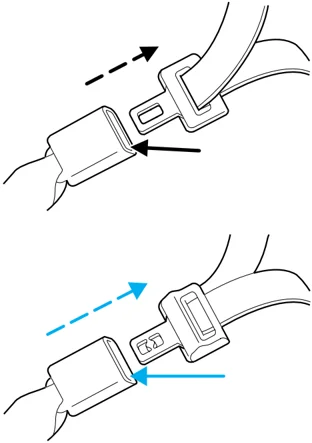
- Insert the belt tongue into the proper buckle (the buckle closest to the direction the tongue is coming from) until you hear a snap and feel it latch. Make sure the tongue is securely fastened in the buckle.
• Front seats
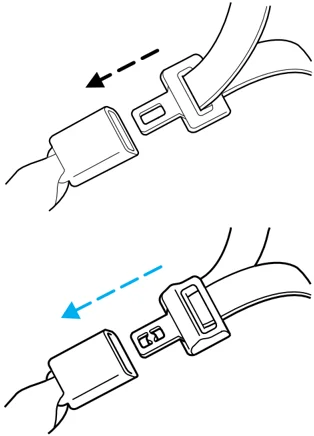
• Rear seats (if equipped)
- To unfasten, push the release button and remove the tongue from the buckle.
109
Seating and Safety Restraints
• Front seats
• Rear seats (if equipped)
Energy management retractors Your vehicle has a seat belt system equipped with energy management retractors at the driver and front outboard passenger seating positions.
An energy management retractor is a device which pays out webbing in a controlled manner. This feature is designed to help further reduce the risk of force-related injuries to the occupant.
Seat belt systems equipped with an energy management retractor must be replaced if they were in use during a frontal collision which resulted in deployment of the frontal air bags. Refer to the Safety belt maintenance section in this chapter.
Vehicle sensitive mode The vehicle sensitive mode is the normal retractor mode, allowing free shoulder belt length adjustment to your movements and locking in response to vehicle movement. For example, if the driver brakes suddenly or turns a corner sharply, or the vehicle receives an impact of approximately 5 mph (8 km/h) or more, the combination safety belts will lock to help reduce forward movement of the driver and passengers.
110
Seating and Safety Restraints
The front seat belt system can also be made to lock manually by quickly pulling on the shoulder belt. Rear seat belts (if equipped) cannot be made to lock up by pulling quickly on the belt.
Automatic locking mode
In this mode, the shoulder belt is automatically pre-locked. The belt will still retract to remove any slack in the shoulder belt.
The automatic locking mode is not available on the driver safety belt.
When to use the automatic locking mode
- Anytime a child safety seat is installed in a passenger front or outboard rear seating position with Regular Cab or SuperCab. SuperCrew and SuperCab models include the center seating position of the second row. Children 12 years old and under should be properly restrained in the rear seat whenever possible. Refer to Safety Restraints for Children or Safety Seats for Children later in this chapter.
How to use the automatic locking mode
- Buckle the combination lap and shoulder belt.
- Front passenger seat
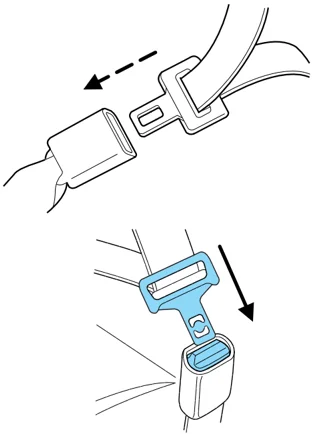
- Rear seats (if equipped)
111
Seating and Safety Restraints
- Grasp the shoulder portion and pull downward until the entire belt is extracted.
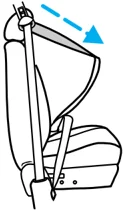
- Allow the belt to retract. As the belt retracts, you will hear a clicking sound. This indicates the safety belt is now in the automatic locking mode.
How to disengage the automatic locking mode
Disconnect the combination lap/shoulder belt and allow it to retract completely to disengage the automatic locking mode and activate the vehicle sensitive (emergency) locking mode.
After any vehicle collision, the safety belt systems at all outboard seating positions (except the driver position, which does not have this feature) must be checked by a qualified technician to verify that the automatic locking retractor feature for child seats is still functioning properly. In addition, all seat belts should be checked for proper function.
BELT AND RETRACTOR ASSEMBLY MUST BE REPLACED if the seat belt assembly "automatic locking retractor" feature or any other seat belt function is not operating properly when checked according to the procedures in Workshop Manual. Failure to replace the Belt and Retractor assembly could increase the risk of injury in collisions.
Safety belt pretensioner
Your vehicle is equipped with safety belt buckle pretensioners at the driver and front outboard passenger seating positions.
Do NOT place objects between the seats, this could interfere with the functioning of the pretensioner.
112
Seating and Safety Restraints
The driver and front outboard passenger safety belt pretensioners are designed to activate only during certain frontal or near-frontal collisions with sufficient longitudinal deceleration. A safety belt buckle pretensioner is a device which tightens the webbing of the lap and shoulder belts during some collisions in such a way that they fit more snugly against the body.
The driver and front outboard passenger safety belt system (including retractors, buckles and height adjusters) must be replaced if the vehicle is involved in a collision that results in the activation of the safety belt pretensioners. Refer to the Safety belt maintenance section in this chapter.
Failure to replace the safety belt assembly under the above conditions could result in severe personal injuries in the event of a collision.
Safety belt usage sensors
The driver and front outboard passenger safety belt buckles are equipped with sensors that detect if the safety belts are fastened. The sensors provide information to the Personal Safety System which can then adapt the air bag deployment or safety belt pretensioner activation based upon safety belt usage.
The Personal Safety System provides the most benefit to belted occupants. The system monitors and tailors the air bag deployment based upon safety belt usage. Failure to properly wear your safety belt will increase your risk of injury.
113
Seating and Safety Restraints
Front safety belt height adjustment (if equipped)
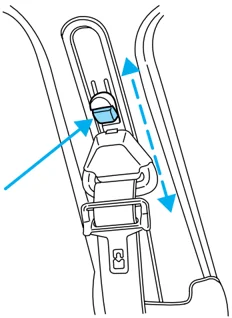
Your vehicle has safety belt height adjustments for the driver and right front passenger. Adjust the height of the shoulder belt so the belt rests across the middle of your shoulder.
To lower the shoulder belt height, push the button and slide the height adjuster down. To raise the height of the shoulder belt, push the button and slide the height adjuster up. Pull down on the height adjuster to make sure it is locked in place.

Position the safety belt height adjusters so that the belt rests across the middle of your shoulder. Failure to adjust the safety belt properly could reduce the effectiveness of the seat belt and increase the risk of injury in a collision.
Lap belts
Adjusting the lap belt
The lap belt should fit snugly and as low as possible around the hips, not across the waist.
The front center lap belt tongue is designed to fit only in the correct buckle. The tongue will not securely latch if you attempt to use it in any of the outboard seating position buckles. To ensure that you have used the correct buckle you should hear a snap and feel it latch.
114
Seating and Safety Restraints
• 1st row center seating position The lap belt does not adjust automatically.
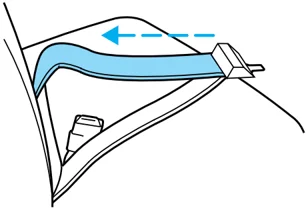
Insert the tongue into the correct buckle (the buckle closest to the direction the tongue is coming from). To lengthen the belt, turn the tongue at a right angle to the belt and pull across your lap until it reaches the buckle. To tighten the belt, pull the loose end of the belt through the tongue until it fits snugly across the hips.
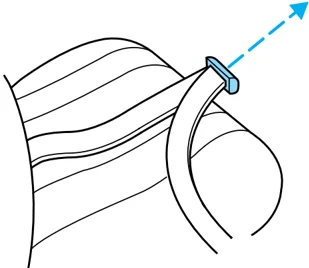
Shorten and fasten the belt when not in use.
115
Seating and Safety Restraints
Safety belt warning light and indicator chime
The safety belt warning light illuminates in the instrument cluster and a chime sounds to remind the occupants to fasten their safety belts.
Conditions of operation
BeltMinder
The BeltMinder feature is a supplemental warning to the safety belt warning function. This feature provides additional reminders by intermittently sounding a chime and illuminating the safety belt warning lamp in the instrument cluster when the driver's and front passenger's safety belt is unbuckled.
The BeltMinder feature uses information from the front passenger sensing system to determine if a front seat passenger is present and therefore potentially in need of a warning. To avoid activating the BeltMinder feature for objects placed in the front passenger seat, warnings will only be given to large front seat occupants as determined by the front passenger sensing system.
Both the driver's and passenger's safety belt usages are monitored and either may activate the BeltMinder feature. The warnings are the same for the driver and the front passenger. If the BeltMinder warnings have expired (warnings for approximately 5 minutes) for one occupant (driver or front passenger), the other occupant can still activate the BeltMinder feature.
116
Seating and Safety Restraints
| If... | Then... |
|---|---|
| The driver’s and front passenger’s safety belts are buckled before the ignition switch is turned to the ON position or less than 1-2 minutes have elapsed since the ignition switch has been turned ON... | The BeltMinder feature will not activate. |
| The driver’s or front passenger’s safety belt is not buckled when the vehicle has reached at least 5 km/h (3 mph) and 1-2 minutes have elapsed since the ignition switch has been turned to ON... | The BeltMinder feature is activated - the safety belt warning light illuminates and the warning chime sounds for 6 seconds every 30 seconds, repeating for approximately 5 minutes or until the safety belts are buckled. |
| The driver’s or front passenger’s safety belt becomes unbuckled for approximately 1 minute while the vehicle is traveling at least 5 km/h (3 mph) and more than 1-2 minutes have elapsed since the ignition switch has been turned to ON... | The BeltMinder feature is activated - the safety belt warning light illuminates and the warning chime sounds for 6 seconds every 30 seconds, repeating for approximately 5 minutes or until the safety belts are buckled. |
The following are reasons most often given for not wearing safety belts:
(All statistics based on U.S. data)
117
Seating and Safety Restraints
| Reasons given... | Consider... |
|---|---|
| “Crashes are rare events” | 36700 crashes occur every day. The more we drive, the more we are exposed to “rare” events, even for good drivers. 1 in 4 of us will be seriously injured in a crash during our lifetime. |
| “I’m not going far” | 3 of 4 fatal crashes occur within 25 miles of home. |
| “Belts are uncomfortable” | We design our safety belts to enhance comfort. If you are uncomfortable - try different positions for the safety belt upper anchorage and seatback which should be as upright as possible; this can improve comfort. |
| “I was in a hurry” | Prime time for an accident. BeltMinder reminds us to take a few seconds to buckle up. |
| “Safety belts don’t work” | Safety belts, when used properly, reduce risk of death to front seat occupants by 45% in cars, and by 60% in light trucks. |
| “Traffic is light” | Nearly 1 of 2 deaths occur in single-vehicle crashes, many when no other vehicles are around. |
| “Belts wrinkle my clothes” | Possibly, but a serious crash can do much more than wrinkle your clothes, particularly if you are unbelted. |
| “The people I’m with don’t wear belts” | Set the example, teen deaths occur 4 times more often in vehicles with TWO or MORE people. Children and younger brothers/sisters imitate behavior they see. |
118
Seating and Safety Restraints
| Reasons given... | Consider... |
|---|---|
| “I have an air bag” | Air bags offer greater protection when used with safety belts. Frontal airbags are not designed to inflate in rear and side crashes or rollovers. |
| “I’d rather be thrown clear” | Not a good idea. People who are ejected are 40 times more likely to DIE. Safety belts help prevent ejection, WE CAN’T “PICK OUR CRASH”. |
⚠️ Do not sit on top of a buckled safety belt to avoid the Belt Minder chime. Sitting on the safety belt will increase the risk of injury in an accident. To disable (one-time) or deactivate the Belt Minder feature please follow the directions stated below.
One time disable
If at any time the driver/front passenger quickly buckles then unbuckles the BeltMinder feature for that seating position, the BeltMinder is disabled for the current ignition cycle. The BeltMinder feature will re-enable during the same ignition cycle if the occupant buckles and remains buckled for approximately 30 seconds. Confirmation is not given for the one time disable.
Deactivating/activating the BeltMinder feature
The driver and front passenger BeltMinder are deactivated/activated independently. When deactivating/activating one seating position, do not buckle the other position as this will terminate the process.
Read steps 1 - 4 thoroughly before proceeding with the deactivation/activation programming procedure.
The driver and front passenger BeltMinder features can be deactivated/activated by performing the following procedure:
Before following the procedure, make sure that:
- The parking brake is set
- The gearshift is in P (Park) (automatic transmission)
- The ignition switch is in the OFF position
- The driver and front passenger safety belts are unbuckled
119
Seating and Safety Restraints
To reduce the risk of injury, do not deactivate/activate the Belt Minder feature while driving the vehicle.
- Turn the ignition switch to the RUN (or ON) position. (DO NOT START THE ENGINE)
- Wait until the safety belt warning light turns off. (Approximately 1 minute)
- Step 3 must be completed within 50 seconds after the safety belt warning light turns off.
- For the seating position being disabled, buckle then unbuckle the safety belt 9 times, ending in the unbuckled state. (Step 3 must be completed within 50 seconds after the safety belt warning light turns off.)
- After step 3, the restraint system warning light (airbag light) will be turned on for three seconds.
- Within 10 seconds of the light turning on, buckle then unbuckle the safety belt.
- This will disable the BeltMinder feature for that seating position if it is currently enabled. As confirmation, the restraint system warning light will flash 4 times per second for 3 seconds.
- This will enable the BeltMinder feature for that seating position if it is currently disabled. As confirmation, the restraint system warning light will flash 4 times per second for 3 seconds, followed by 3 seconds with the light off, then followed by the restraint system warning light flashing 4 times per second for 3 seconds again.
Safety belt extension assembly
If the safety belt is too short when fully extended, there is a 8 inch (20 cm) safety belt extension assembly that can be added (part number 611C22). This assembly can be obtained from your dealer at no cost. Use only extensions manufactured by the same supplier as the safety belt. Manufacturer identification is located at the end of the webbing on the label. Also, use the safety belt extension only if the safety belt is too short for you when fully extended.
Do not use extensions to change the fit of the shoulder belt across the torso.
Safety belt maintenance
Inspect the safety belt systems periodically to make sure they work properly and are not damaged. Inspect the safety belts to make sure
120
Seating and Safety Restraints
there are no nicks, tears or cuts. Replace if necessary. All safety belt assemblies, including retractors, buckles, front seat belt buckle assemblies, buckle support assemblies (slide bar-if equipped), shoulder belt height adjusters (if equipped), shoulder belt guide on seatback (if equipped), child safety seat LATCH and tether anchors, and attaching hardware, should be inspected after a collision. Ford Motor Company recommends that all safety belt assemblies in use in vehicles involved in a collision be replaced. However, if the collision was minor and a qualified technician finds that the belts do not show damage and continue to operate properly, they do not need to be replaced. Safety belt assemblies not in use during a collision should also be inspected and replaced if either damage or improper operation is noted.
Failure to inspect and if necessary replace the safety belt assembly under the above conditions could result in severe personal injuries in the event of a collision.
Refer to Interior in the Cleaning chapter.
AIR BAG SUPPLEMENTAL RESTRAINT SYSTEM (SRS)

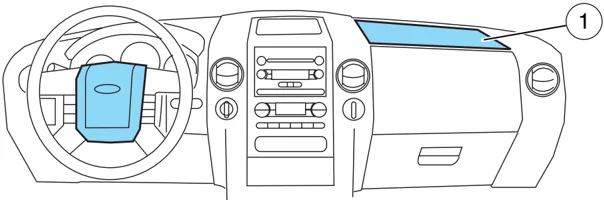
- Air bag cover
The air bag supplemental restraint system is designed to work in conjunction with the safety belts to help protect the driver and front outboard passenger from certain upper body injuries. The term "supplemental restraint" means the air bags are intended as a supplement to the safety belts. Air bags alone cannot protect as well as air bags plus safety belts in impacts for which the air bags are designed to deploy, and air bags do not offer any protection in crashes for which they do not deploy.
The air bag supplemental restraint system consists of:
- driver and passenger dual stage air bag modules (which include the inflators and air bags).
121
Seating and Safety Restraints
- one or more impact and safing sensors.
- the same indicator light, RCM (restraints control module) and diagnostic unit used for the Personal safety system.
- Front passenger sensing system
- Passenger airbag on/off switch (if equipped)
- Passenger air bag off indicator light.
The air bag supplemental restraints are an integral part of the Personal Safety System. They are designed to be deployed in cases where the Personal Safety System has determined the occupant conditions and crash severity are appropriate to activate these devices. Refer to the Personal Safety System section in this chapter.
I mportant SRS precautions
! All occupants of the vehicle, including the driver, should always properly wear their safety belts, even when an air bag (SRS) is provided.

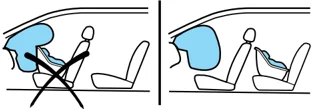
! Always transport children 12 years old and under in the back seat if your vehicle has a back seat. Rear facing infant seats should NEVER be placed in the front seats, unless the passenger air bag is turned off (if equipped with an air bag On/Off switch). See Passenger air bag ON/OFF switch. This is because the back of the infant seat is too close to the inflating air bag and the risk of a fatal injury to the infant when the air bag inflates is substantial.
122
Seating and Safety Restraints
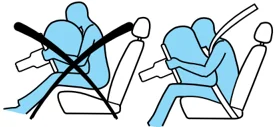
! The National Highway Traffic Safety Administration (NHTSA) recommends a minimum distance of at least 10 inches (25 cm) between an occupant's chest and the driver air bag cover.
Never place your arms or feet over the air bag module as a deploying air bag can result in serious fractures or other injuries.
To properly position yourself away from the air bag:
- Move your seat to the rear as far as you can while still reaching the pedals comfortably.
- Recline the seat slightly one or two degrees from the upright position.
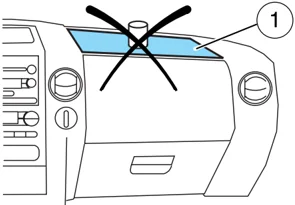
Do not put anything on or over the air bag cover (1). Placing objects on or over the air bag cover may cause those objects to be thrown by the air bag into your face and torso or may result in a failure of the air bag to inflate properly, both of which could result in serious injury.

Do not attempt to service, repair, or modify the air bag supplemental restraint systems or its fuses. See your Ford or Lincoln Mercury dealer.
The front passenger air bag is not designed to offer protection to an occupant in the center front seating position.
Modifying or adding equipment to the front end of the vehicle (including frame, bumper, front end body structure and tow hooks) may affect the performance of the air bag system, increasing the risk of injury. Do not modify the front end of the vehicle.
123